Calculating Real Landed Fabric Costs from Booked Loom Hours
Calculating real landed fabric cost requires dividing hourly loom shed rates by efficiency-adjusted yield and adding verified yarn loss, finishing shrinkage, and freight.

Capacity
Calculating the linear output of a loom shed starts with mechanical speed. A weaving machine operates at a set rotational frequency measured in picks per minute ~ the number of filling yarns crossing the warp bed every sixty seconds. When a buyer books mill time, they buy machine hours, but financial consumption is tracked in finished linear metres.
Bridging that gap means turning shaft rotation into fabric length while adjusting for structural density and downtime.
The basic formula for theoretical output depends on filling density, measured in picks per centimetre or picks per inch. A fabric specified at 24 picks per centimetre takes 2,400 picks to make one linear metre of greige cloth. If the loom runs continuously at 500 picks per minute, it puts down 30,000 picks an hour.
Dividing hourly picks by the specified pick density gives a theoretical speed of 12.5 linear metres per loom hour.
Theoretical output never matches actual production on the shed floor. Industrial looms stop for warp end breaks, filling yarn failures, beam changes, selvedge trimming, and routine maintenance. Shed efficiency measures actual operating minutes against total booked minutes as a percentage.
In linen production ~ where flax fibers have uneven tensile strength and frequent slubs ~ efficiency usually hovers between 75 percent and 85 percent on rapier machines, and between 70 percent and 80 percent on air-jet looms. Applying an 80 percent efficiency rating to the calculation above drops real output from 12.5 metres to 10.0 linear metres per booked hour.
On shed allocation sheets across European weaving mills, machine setup fees are routinely invoiced apart from running hours. Booking a loom shed carries fixed costs regardless of run length. Warping the creel, drawing yarns through harness frames, denting the reed, and weaving sample swatches take up hours that produce no saleable fabric.
On a short 1,000-metre run, setup can eat up 12 to 20 loom hours. Spreading 18 non-productive hours over a small order dilutes the hourly yield, adding nearly two dollars per metre to the base cost before yarn is even factored in.
A loom running at 600 picks per minute on a 100 percent flax warp loses 14 percent efficiency the moment relative humidity drops below 65 percent in the shed.
Hourly loom rates vary widely by width and insertion technology. Narrow looms at 190 centimetres wide carry lower depreciation than 340-centimetre frames built for double-bed sheeting. Air-jet looms insert filling yarn faster than rapier looms, but consume far more power to generate compressed air.
A full cost model weighs the hourly machine rate against actual linear yield for a given weave structure.
Machine Mechanics and Speed Thresholds
Loom speed is capped by yarn quality and weave geometry. Plain weaves create maximum yarn-to-yarn friction because every warp thread alternates over and under every filling thread. High-density plain weaves force the reed to pack each filling yarn hard against the fell of the cloth.
Pushing a loom too fast on a dense plain weave frays the warp ends, causing severe shedding issues and frequent stops.
The table below outlines typical operating parameters for common linen fabric constructions running on modern 220 centimetre rapier looms at 20 degrees Celsius and 65 percent relative humidity.
| Fabric Construction Name | Yarn Count (Nm) Warp/Weft | Sett (Ends x Picks / cm) | Loom Speed (PPM) | Standard Shed Efficiency (%) | Realized Yield (Metres / Loom Hour) |
|---|---|---|---|---|---|
| Fine Shirting Plain Weave | Nm 36 / Nm 36 | 28 x 24 | 520 | 82% | 10.66 |
| Medium Dress Weight Twill 2/1 | Nm 26 / Nm 26 | 22 x 20 | 480 | 84% | 12.09 |
| Heavy Upholstery Plain Weave | Nm 14 / Nm 14 | 16 x 14 | 420 | 76% | 13.68 |
| Jacquard Table Damask | Nm 36 / Nm 36 | 32 x 28 | 440 | 74% | 6.97 |
Hourly machine cost calculations need to include both direct labor and shed overhead. A single operator manages six to twelve rapier looms depending on yarn quality. If yarn quality drops and warp breaks rise above three stops per loom hour, the shed must assign fewer looms per operator or slow the machines down.
Dropping speed by 10 percent reduces dynamic stress on fragile linen warps, pushing shed efficiency up from 72 percent to 83 percent. That reduction in downtime yields a higher net linear output despite the lower mechanical speed.
Booking Parameters and Capacity Calculations
Capacity contracts require clear definitions of booked time. Sheds sell machine time as either gross or net production hours. Gross booking includes every hour a loom is assigned to an order ~ beam mounting, reed drawing, warp tying, and mechanical adjustments included.
Net booking charges strictly for active running hours logged by the monitoring system. Buying on a gross-hour basis puts the risk of warp prep delays and knotting issues entirely on the buyer.
Evaluating loom capacity proposals means checking all underlying shed assumptions. The checklist covers critical factors to review before confirming loom time.
- Target operating speed must reflect realistic limits for the chosen yarn count rather than maximum machine speeds published by loom builders.
- Shed efficiency guarantees require baseline thresholds, setting penalties or bonuses if actual efficiency strays more than 5 percent from calculated norms.
- Warp beam capacity limits set the maximum continuous run length possible before incurring a forced beam-change downtime charge.
- Waste percentage allowances establish acceptable yarn losses during creeling, knotting, and setup.
A lower hourly loom rate rarely offsets the losses incurred when running a fine flax warp across a wide machine bed at degraded efficiency.

Yield
Converting yarn mass into finished woven yardage means accounting for geometric changes during weaving and finishing. Flax yarn enters the mill on cylindrical packages measured by length and weight. It exits the finishing plant as a fabric matrix with physical dimensions quite different from the original yarn.
Crimp, take-up, selvedge draw-in, and finishing shrinkage reduce the linear yield achieved from every kilogram of spun fiber.
Warp crimp is the extra yarn length used as warp threads undulate over and under filling picks. Expressed as a percentage, it measures the difference between unraveled straight yarn length and the woven fabric length it occupies. In a standard plain weave linen, warp crimp ranges between 6 percent and 12 percent depending on filling density and yarn tension.
A 1,000-metre warp on the beam yields roughly 910 metres of greige fabric at 9 percent crimp.
Weft crimp works on the crosswise axis. As filling yarn travels across the warp sheet, it bends around warp ends, causing fabric width to contract once reed pressure releases. A reed width of 170 centimetres yields an off-loom greige width of 160 centimetres after filling crimp and temple contraction take effect.
Mass calculations rely on yarn count systems. For wet-spun linen, yarn count is given in Metric Count (Nm) ~ the number of 1,000-metre hanks per kilogram ~ or in Lea, the number of 300-yard hanks per pound. Converting yarn count and weave construction into mass per square metre requires calculating yarn weight for both warp and weft.
ISO 7211-3 crimp calculations require tension removal under a standard atmosphere of 20 degrees Celsius and 65 percent relative humidity before measuring crimp differential between yarn and woven bed.
Calculating raw warp mass per linear metre means multiplying total warp ends across the reed width by target length, adjusting for crimp, and dividing by the yarn count. Total warp ends equal reed width multiplied by ends per centimetre. For a fabric with 1,600 total warp ends using Nm 26 yarn with 8 percent warp crimp, one linear metre of greige cloth takes 1,600 ends times 1.08 metres of yarn ~ 1,728 metres of single yarn in total.
Dividing 1,728 metres by Nm 26 gives 66.46 grams of warp yarn per linear metre.
Filling mass follows the same logic. Filling yarn consumed per linear metre equals picks per centimetre times 100 centimetres, times reed width in metres, adjusted for waste and crimp, then divided by weft yarn count. A construction with 20 picks per centimetre on a 1.70 metre reed width takes 3,400 metres of filling yarn per linear metre of fabric.
With Nm 26 weft yarn, that works out to 130.77 grams per linear metre. Combined raw yarn weight comes to 197.23 grams per greige linear metre.
Finishing Loss and Shrinkage Coefficients
Greige fabric undergoes heavy wet processing to turn stiff off-loom cloth into finished apparel or home textiles. Scouring removes natural flax waxes, pectins, and warp sizing agents applied during prep. Desizing and bleaching erode fiber mass, causing a weight drop known as boil-off loss.
For 100 percent linen, finishing weight loss ranges from 5 percent to 10 percent depending on whether the target shade is natural, half-bleached, or optic white.
Dimensions contract further during wet finishing. Relaxation shrinkage happens when weaving tension releases in the wash, while thermal shrinkage occurs during drying and tentering. A greige fabric measuring 100 linear metres off the loom shrinks to 92 metres after standard scouring, bleaching, and tumbling.
Width contracts too, pulling a 160 centimetre greige bed down to a 145 centimetre finished width.
The table below shows crimp, take-up, and finishing yield factors across four primary linen weaves, tracking dimensions from beam to finished bolt.
| Weave Structure Type | Warp Crimp (%) | Weft Crimp (%) | Finishing Weight Loss (%) | Linear Shrinkage (%) | Net Fiber Yield (Finished M / Greige M) |
|---|---|---|---|---|---|
| Plain Weave (1×1 Tabby) | 9.5% | 6.2% | 7.5% | 8.0% | 0.920 |
| Twill 2/2 | 7.0% | 4.8% | 6.8% | 6.5% | 0.935 |
| Satin 5-Harness | 5.2% | 3.5% | 6.0% | 5.0% | 0.950 |
| Huckaback Toweling Weave | 12.0% | 8.5% | 8.0% | 11.0% | 0.890 |
Accounting for yarn waste during prep is essential for accurate landed cost models. Warping waste happens when transferring yarn from bobbins to the warping reed. Sizing waste occurs when bath residues coat yarn ends unevenly, forcing trimmings.
Loom waste includes tail ends left on the beam pan and selvedge cut-offs from shuttleless insertion systems. Total cumulative waste runs between 4 percent and 7 percent of raw yarn purchase weight.
Yarn Mass Reconciliation
Finding the total raw yarn mass required for a target yardage means working backward from final specifications. Finished fabric weight per square metre (GSM) must reconcile with the raw yarn counts committed to the warp and weft beams.
Take an order for 5,000 finished linear metres of plain weave linen at 145 centimetres finished width, with a target finished weight of 165 grams per square metre. Total finished mass required is 5,000 metres times 1.45 metres times 0.165 kilograms per square metre, or 1,196.25 kilograms of finished fabric.
Applying 8.0 percent finishing linear shrinkage means the shed must weave 5,434.78 greige metres. Factoring in a 7.5 percent finishing weight loss requires a total greige mass of 1,293.24 kilograms. With 5.5 percent overall yarn waste across warping, sizing, and setup, ordering requires 1,368.51 kilograms of raw yarn spun to specification.
That puts the net conversion factor at 1.144 kilograms of raw yarn per kilogram of finished linen cloth.
Flax fiber absorbs environmental moisture rapidly ~ changing measured mass by up to 12 percent depending on humidity without altering structural fiber volume.

Weft
Filling insertion systems dictate loom productivity and drive direct hourly operating costs. In linen weaving, choosing between rapier and air-jet mechanisms changes both shed capacity and weft preparation costs. Linen filling yarns pose clear physical challenges at high speeds due to low elasticity, stiff bending behavior, and natural slubs.
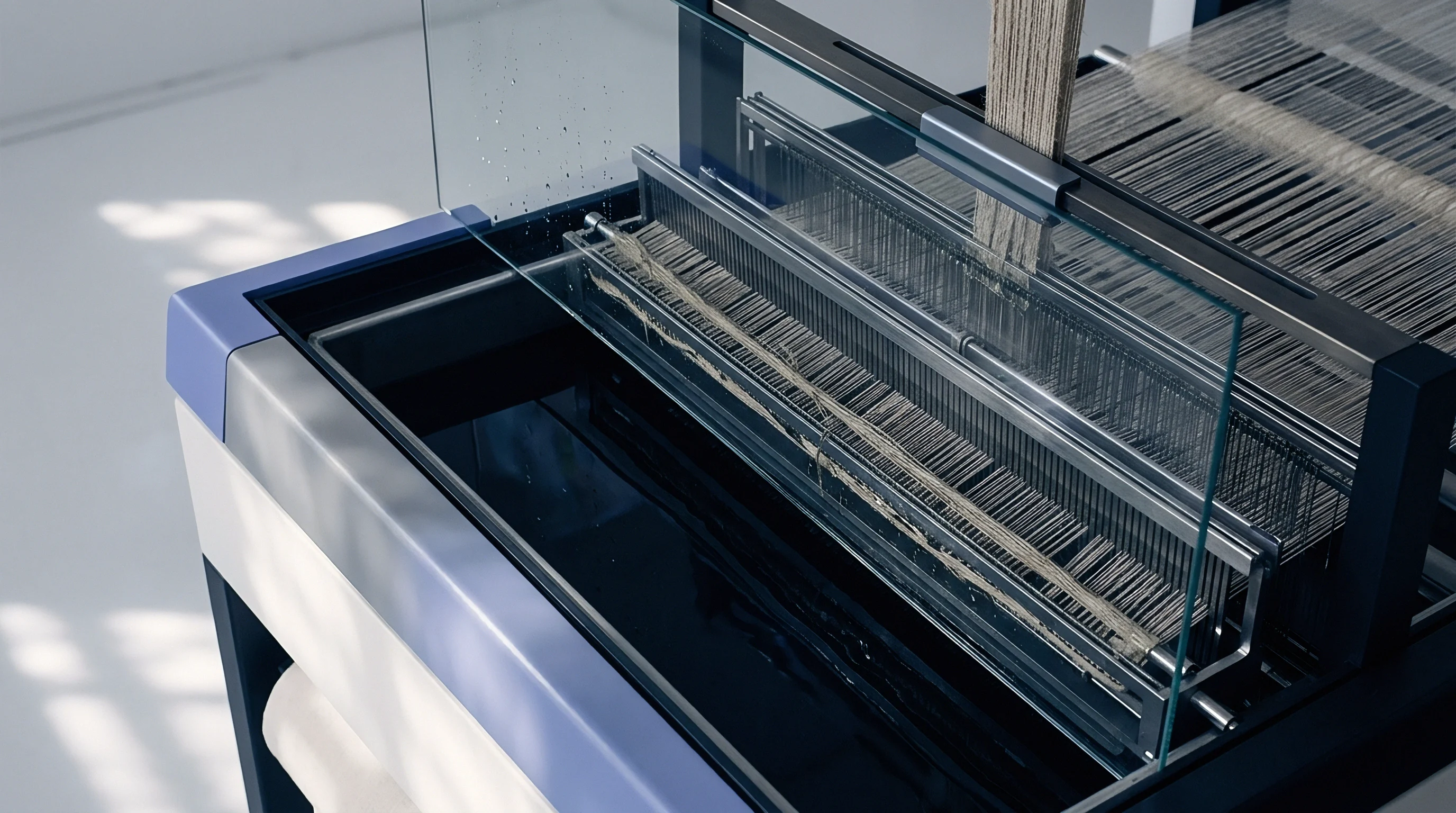
Rapier systems use mechanical grippers on flexible ribbons or rigid rods to carry filling yarn across the warp shed. Positive rapiers transfer yarn from the left insertion head to the right receiving head at the center of the warp sheet. Mechanical gripping holds weak or uneven yarns securely, preventing snaps.
Rapier speeds for linen usually cap at 500 to 550 picks per minute on a 220 centimetre reed bed.
Air-jet looms swap mechanical grippers for high-pressure air nozzles. A main jet launches filling yarn into a profile reed channel, while relay nozzles across the width fire sequential air blasts to maintain velocity. Air-jet machines hit 700 to 800 picks per minute on continuous filament synthetics, but run much slower on linen.
Stiff flax fibers create drag, and thick slubs catch on warp threads, causing frequent mispicks. Weaving linen on air-jets requires specialized high-grade, low-slub yarn spun specifically for air insertion.
How Does Weft Insertion Rate Dictate True Loom Speed?
The filling insertion rate measures total weft yarn installed per minute, calculated by multiplying picks per minute by the width of yarn inserted through the reed. A rapier running at 500 picks per minute on a 2.2 metre reed width achieves an insertion rate of 1,100 metres per minute. An air-jet operating at 650 picks per minute on the same width hits 1,430 metres per minute.
Higher insertion rates increase power consumption sharply. Air compressors feeding main and relay nozzles draw substantial power. Producing dry, oil-free compressed air at 0.6 MPa pressure adds noticeable utility overhead to every machine hour.
While an air-jet loom cuts total hours needed for a 10,000-metre order, its electricity use per hour is nearly double that of a mechanical rapier.
Running a 220 centimetre rapier frame with warp break rates climbing past 8.2 stoppages per loom hour led to 420 metres of rejected greige linen. Every filling break forces the monitoring system to stop the loom instantly to avoid missing picks. The automatic pick finder reverses motion, unweaves the bad pick, and waits for the operator to re-thread.
A single stop eats two to five minutes of loom time.
Calibrating actual picks per minute across insertion technologies requires a systematic audit. The steps below outline the sequence for determining maximum stable speeds on fine linen filling yarn.
- Mount sample warp beams prepared from certified single-origin flax lots to eliminate strength variance.
- Set initial mechanical speed at 60 percent of the manufacturer’s maximum rated capacity for the target reed width.
- Adjust shed relative humidity to precisely 68 percent and ambient temperature to 22 degrees Celsius.
- Increase operating speed in increments of 20 picks per minute every four running hours.
- Record filling stoppage frequency, nozzle pressure fluctuations, and warp end abrasion continuously across each four-hour speed bracket.
- Identify the maximum stable speed threshold where machine stoppages remain under 1.5 events per loom hour over a continuous 24-hour cycle.
Selvedge waste varies sharply between systems. Rapier looms pull a continuous yarn package, leaving short tails of 2 to 3 centimetres on each edge that are trimmed away by selvedge shears. Air-jets require auxiliary tuck-in units or leno mechanisms to secure the edge, producing longer waste tails up to 5 centimetres per pick.
Over a 50,000-metre run, air-jet selvedge waste uses an additional 120 to 180 kilograms of filling yarn compared to rapier weaving.
When an oversized flax slub passes through an air-jet nozzle tip, friction strips outer fibers into a brush-like blockage that disrupts downstream air velocity. Mechanical rapiers avoid this completely because metallic gripper jaws enclose the fiber lump during transit across the shed.
Choosing air-jet insertion to cut booked loom hours means buying higher-grade combed linen yarn with an evenness coefficient (CV%) under 14 percent, raising yarn costs by 15 percent to 22 percent per kilogram. That raw material premium often swallows the entire saving from running the shed at higher picks per minute.
Deploying excessive air pressure on fragile single linen yarns blows out filling strands mid-flight, leaving operations to absorb forty-eight hundred dollars in unrecoverable downtime and scrap across 300 booked hours.
Defects
Fabric grading turns physical defects into financial yield reductions. Greige cloth leaving the loom room carries structural anomalies from yarn variations, mechanical glitches, or operator error. The standard benchmark for evaluating woven fabric quality is the ASTM D5430 Four-Point System, which assigns penalty points to visual defects based on length and severity.
Under the Four-Point System, defects are penalized across a 100-square-yard evaluation block. Defects up to 3 inches long receive 1 point. Defects between 3 and 6 inches get 2 points.
Those between 6 and 9 inches receive 3 points. Flaws over 9 inches earn 4 points. No single linear yard can accumulate more than 4 penalty points regardless of how many individual flaws it contains.
Fabric scoring under 28 penalty points per 100 square yards earns Grade A status and commands full contract value. Yardage accumulating between 28 and 40 points per 100 square yards drops to Grade B, incurring price discounts from 15 percent to 30 percent. Fabric exceeding 40 penalty points is rejected or sold to liquidators at scrap value.
Coarse single flax yarns running as weft break modern air-jet nozzles faster than continuous filament synthetic carriers.
Loom hours spent weaving Grade B or rejected fabric represent lost capacity. If a buyer books 1,000 loom hours expecting 10,000 metres of Grade A cloth, producing 1,500 metres of Grade B fabric alters the landed cost per Grade A metre. Fixed loom charges stay the same, but must now be spread across a smaller volume of prime fabric.

Fault Classification and Shed Root Causes
Identifying fault origins helps technical buyers determine whether defect penalties should be billed back to the shed or absorbed as yarn variance. Structural linen defects divide into warp-wise flaws, filling-wise flaws, and spot anomalies.
The list below categorizes standard visual defects seen during linen inspection, outlining their physical appearance and mechanical cause.
- Starting marks appear as thick or thin bands across the fabric width, caused by improper loom brake adjustment during restarts after a stop.
- Broken picks occur when filling yarn snaps mid-shed and the loom fails to stop instantly, leaving a missing horizontal thread across the cloth.
- Reed lines show as continuous vertical streaks along the warp direction, caused by bent or damaged reed wires.
- Slub catchers create tight spots and local distortion when thick yarn nodes catch in harness eyes or drop wires.
- Double ends happen when two broken warp yarns twist together inside a single dent wire, creating double-density vertical stripes.
When a warp yarn breaks under tension, the loose end can entangle adjacent warp threads, creating cluster defects known as floats or stitches. Modern looms use electronic warp stop motions with drop wires. Each warp end passes through a thin metal drop wire held up by yarn tension.
If the yarn snaps, the drop wire falls onto an electrical contact bar, tripping the main motor brake within 15 milliseconds.
Grade A fabric commands full price, but zero-defect linen on high-speed shuttleless looms remains impossible given the natural irregularities of flax fiber. Contract yield allowances must account for a baseline defect rate.
Inspection frames run fabric at controlled speeds of 15 to 20 metres per minute under 1,500 lux overhead illumination. Inspectors record flaw positions in digital mapping software, marking selvedges with metallic stickers or ink. Digital maps allow cutting software to position garment pattern pieces around defects automatically, maximizing marker efficiency.
While starting marks and reed lines are typically caused by mechanical settings or hardware wear, fiber strength variations within certified flax lots can generate similar flaws when raw yarn variations exceed machine tolerances.

Freight
Transport logistics turn ex-mill fabric costs into final landed values. Once linen leaves the finishing plant, freight, customs duties, port handling, and insurance add substantial layers to the base loom-hour calculation. Landed cost models must account for spatial density, packaging, and trade classifications.
Freight charges look at both gross weight and volumetric weight. Ocean shipping calculates volume in Cubic Metres (CBM), while air freight uses the IATA standard where 1 Cubic Metre equals 167 kilograms. Because woven linen is dense, a fully packed export crate of rolled cloth typically reaches mass limits well before exhausting container volume.
Maximizing roll density through tight core packing keeps volumetric penalties down during container shipping.
Customs duties apply on landed value. International trade uses the Harmonized Commodity Description and Coding System (HS Code) to set ad valorem tariff rates. Woven flax fabrics fall mainly under HS Heading 5309.
Unbleached or bleached linens classify under 5309.11, while dyed or printed linens sit under 5309.19. Tariffs range from 0 percent to 12 percent depending on free trade agreements, preferential trade rules, and origin documentation.
Customs clearing agents calculate ad valorem duty on the combined FOB fabric price and international transit charges rather than yarn cost alone.
Freight rates shift by season, spiking during peak manufacturing quarters when vessel space tightens on major lanes. Landed cost calculations need to include container drayage, terminal handling at both origin and destination, bill of lading fees, and customs broker retainers.

Documentary Verification and Cargo Protection
On containerized shipments from Asian mills, moisture barriers require inspection at origin to prevent mildew during transit. Linen fibers absorb up to 12 percent ambient moisture without feeling damp. Shipping rolls across maritime climate zones creates condensation inside containers ~ known as container rain.
Sealed polyethylene wrapping and active desiccant packs inside export crates protect fabric bolts from mildew and water stains.
Auditing landed costs requires verifying every shipping document with the consignment. The breakdown below details the documents needed to validate freight invoices and customs tariffs.
- Commercial Invoice must detail split values for raw yarn, loom-hour conversion costs, and finishing charges to establish baseline customs valuation.
- Certificate of Origin provides legal proof of processing location, enabling preferential tariffs under applicable trade agreements.
- Packing List details roll-by-roll gross weight, net weight, linear meterage, finished width, and crate dimensions.
- Bill of Lading documents carrier receipt, transit routing, payment terms, and transfer of cargo title.
- Mill Inspection Dossier records ASTM D5430 Four-Point visual defect maps and physical test verification reports for every lot in the container.
The table below shows a complete landed cost breakdown per finished linear metre, tracking expenses from initial loom booking through to destination warehouse receipt.
| Cost Component Description | Calculation Substrate / Basis | Unit Cost (USD / M) | Share of Landed Cost (%) |
|---|---|---|---|
| Raw Flax Yarn Purchase | 1.144 kg Yarn per Finished Metre | $5.15 | 42.6% |
| Warp Preparation & Sizing | Creel, Warping, Slashing Overhead | $0.65 | 5.4% |
| Booked Loom Hour Cost | 0.093 Loom Hours per Metre @ $22/hr | $2.05 | 16.9% |
| Wet Finishing & Bleaching | Scouring, Dyeing, Tumble Drying | $1.40 | 11.6% |
| Quality Inspection & Grading | Four-Point Mapping & Trimming | $0.30 | 2.5% |
| Export Packaging & Crating | Core Tubes, Moisture Bags, Wooden Crates | $0.25 | 2.1% |
| Ocean Freight & Container Drayage | 40ft High Cube Container Allocation | $0.45 | 3.7% |
| Marine Cargo Insurance | 0.35% of CIF Value | $0.04 | 0.3% |
| Customs Clearance & Broker Fees | Fixed Port Documentation Allocation | $0.12 | 1.0% |
| Import Customs Duty | 8.5% Ad Valorem Duty on CIF Value | $0.88 | 7.3% |
| Destination Drayage & Unloading | Local Warehouse Transit Allocation | $0.85 | 7.0% |
| Total Landed Cost per Metre | Sum of all direct and indirect landed components | $12.09 | 100.0% |
Every commercial invoice must explicitly include the Standard Incoterms 2020 Clause: “DDP Destination Warehouse (Incoterms 2020), clearing customs under HS Code 5309.11 at specified buyer facility, with seller retaining all financial liability for transit demurrage, tariff adjustments, and moisture damage prior to offloading sign-off.”
Reconciliation
Financial reconciliation rolls physical yield loss, machine efficiency, yarn scrap, and freight into a single calculation model. Buyers who track loom hours without factoring in structural shrinkage and landed freight consistently underestimate their true exposure by 15 percent to 25 percent.
Building a master landed cost formula requires a clear sequence. Step one determines greige meterage needed per finished metre. Step two calculates raw yarn mass adjusted for waste.
Step three converts machine speed and efficiency into booked loom hours. Step four applies mill hourly rates and finishing fees. Step five overlays international logistics, tariffs, and port charges.
Consider a reconciliation model for an order of 20,000 finished linear metres of 100 percent linen apparel fabric at 145 centimetres finished width and 180 grams per square metre.
The target weave is a 2/1 twill using Nm 30 yarn for both warp and weft. Pick density is set at 22 picks per centimetre finished (20 picks per centimetre off-loom). Warp density stands at 24 ends per centimetre finished, requiring 22 ends per centimetre in the reed.
Warp crimp is 8.0 percent, and weft crimp is 5.5 percent. Machine parameters call for a reed width of 168 centimetres, running on a 220 centimetre rapier loom at 480 picks per minute at 83 percent shed efficiency.
At 480 picks per minute and 20 picks per centimetre off-loom, theoretical production is 14.4 metres per hour. Applying 83 percent shed efficiency reduces actual yield to 11.95 linear metres per running hour. Delivering 20,000 finished metres with 7.0 percent finishing shrinkage requires a greige output of 21,505.38 metres.
Dividing total greige metres by 11.95 metres per hour yields a requirement of 1,799.61 running loom hours.
Pre-production setup, warp tying, and harness drawing add 24 non-productive hours, bringing total booked loom time to 1,823.61 machine hours. At a contracted shed rate of $24.00 per machine hour, total weaving charges come to $43,766.64, or $2.19 per finished linear metre.
Yarn consumption calculations run parallel. Total warp ends equal 168 centimetres reed width times 22 ends per centimetre ~ 3,696 warp ends in total. Including 8.0 percent warp crimp, each linear metre of greige cloth consumes 3,991.68 metres of single warp yarn.
Across 21,505.38 greige metres, total warp yarn length reaches 85,842,593 metres. Dividing by Nm 30 count yields 2,861.42 kilograms of raw warp yarn.
Filling calculations require multiplying 20 picks per centimetre by 100 centimetres times 1.68 metres reed width, giving 3,360 metres of weft yarn per greige metre. Accounting for 5.5 percent weft crimp and selvedge tails pushes this to 3,544.8 metres per metre. Across the greige order, total weft yarn length equals 76,234,221 metres.
Dividing by Nm 30 count yields 2,541.14 kilograms of weft yarn. Total raw yarn mass comes to 5,402.56 kilograms. Adding 5.0 percent for warping and weaving scrap brings total raw yarn purchasing requirements to 5,672.69 kilograms.
At $4.80 per kilogram, raw material cost totals $27,228.91, or $1.36 per finished metre.
Finishing costs add further line items. Scouring, bleaching, and softening run $1.25 per finished linear metre ($25,000.00 total). Quality inspection mapping adds $0.25 per metre ($5,000.00), and packaging/crating adds $0.20 per metre ($4,000.00).
The total FOB mill price comes to $104,995.55, giving a base FOB cost of $5.25 per finished linear metre.
International logistics and duties complete the landed calculation. Ocean shipping in two 40-foot containers costs $7,200.00. Marine insurance at 0.35 percent adds $367.48.
Destination port fees and customs brokerage add $1,850.00. Ad valorem customs duty at 8.0 percent on the CIF value ($112,563.03) generates a tariff charge of $9,005.04. Local warehouse drayage costs $1,400.00.
Total landed freight and duty costs come to $19,822.52.
Combining FOB mill expenses ($104,995.55) and international transit costs ($19,822.52) gives a net landed expenditure of $124,818.07. Dividing this total by the 20,000 finished linear metres delivered gives a true landed cost of $6.24 per finished linear metre.
Discrepancies uncovered during audits of final mill invoices against booked capacity contracts almost always trace back to unadjusted efficiency variances. Sourcing teams that lock machine rates, yarn mass conversion ratios, defect allowances, and logistics multipliers into a single landed cost framework protect operational margins against shed downtime and freight inflation.