Calculating Greige Warp Shrinkage Parameters for Standard Plain Weave Constructions
Greige warp shrinkage in plain weaves calculates by combining geometrical yarn crimp, machine tension stretch, and fiber swelling take-up.


Crimp
In plain weave constructions, the undulation of interlacing threads governs how raw yarn length converts into cloth dimensions. As warp and weft alternate one-over and one-under, neither set remains straight. Following this wavy path, the warp yarn travels a longer distance through the cloth than the physical cut of the fabric itself.
This extra length defines warp crimp, which forms the baseline for calculating greige shrinkage and total yarn consumption.

Geometry of Plain Weave Interlacing
In classical Pierce geometry for plain weave, thread spacing, yarn diameter, and weave amplitude set the theoretical minimum warp path. When weft yarn sits under tension, it acts as a rigid cylinder around which the warp bends. A high count of warp ends per centimetre forces tight radii of curvature, increasing the warp length required to yield one metre of greige cloth, with yarn diameter governing packing density.
If yarn linear density rises while end and pick counts stay fixed, each thread occupies more cross-sectional space, pushing the warp path further out of true. For that reason, fine counts like Ne 60/1 show lower mechanical crimp than coarse yarns like Ne 10/1 under identical sett conditions. Structural tightness decides whether warp crimp dominates weft crimp or whether the two systems divide the curvature evenly.
Coarse yarn diameters combined with dense pick counts force higher warp undulation than fine counts at loose setts.
Thread Path Bending and Take-Up Dynamics
Accurate warp preparation depends on separating crimp percentage from warp take-up percentage. Crimp measures the excess length of yarn relative to woven fabric length, whereas take-up measures the length lost from the original un-woven warp during weaving. Conflating the two introduces systematic errors into beam calculations.
At beat-up, the reed drives the filling yarn into the cloth fell, pressing it against the warp and establishing the characteristic zigzag path. High mechanical tension on the warp sheet during shedding keeps the warp flatter, forcing the softer weft to take most of the bend. When warp tension eases, the ends yield to weft resistance, driving warp crimp up and reducing off-loom greige length.
Balanced plain weaves undergo crimp interchange as soon as tension drops off-loom. Releasing stored elastic stress allows internal yarn torque and flexural rigidity to pull the warp threads into a deeper wave profile. Highly twisted ring-spun warps resist axial bending, showing less off-loom crimp growth than low-twist open-end yarns of the same linear density.
A loose structure with low pick density allows the weft to stay essentially straight, leaving the warp to carry the full crimp load.

Dent
Reed design sets the initial width and warp distribution in the loom shed. The width across the drawn-in dents forms the baseline for every calculation of width contraction and length take-up, tracking how the physical boundary of the reed translates into free-standing greige dimensions.

Reed Width Calculations and Lateral Contraction
Total reed width always exceeds target off-loom greige width because of weft tension, warp crimp, and edge pull-in. Whether inserted by shuttle, rapier, or air-jet, the filling yarn draws the selvedge ends inward, narrowing the sheet directly behind the fell. Denser pick counts apply greater cumulative lateral pull per centimetre of fabric length.
Because heavy filling yarns pull harder against the warp sheet than fine counts, they require a wider reed setting to hit the same off-loom width. The reed count in dents per centimetre and the denting plan together govern warp packing density. Drawing three ends per dent generates higher local friction and clearer reed marks than drawing two ends per dent at the same total end count.
| Yarn Count (Ne) | Ends x Picks per cm | Reed Width (cm) | Off-Loom Width (cm) | Warp Crimp (%) | Width Shrinkage (%) |
|---|---|---|---|---|---|
| Ne 20/1 x Ne 20/1 | 24 x 20 | 168.0 | 160.0 | 7.2 | 4.76 |
| Ne 30/1 x Ne 30/1 | 28 x 24 | 166.5 | 160.0 | 8.1 | 3.90 |
| Ne 40/1 x Ne 40/1 | 32 x 28 | 165.0 | 160.0 | 8.8 | 3.03 |
| Ne 60/1 x Ne 60/1 | 40 x 36 | 164.0 | 160.0 | 9.5 | 2.44 |
Every plain weave balances longitudinal warp crimp against lateral weft pull-in. If weft density rises relative to warp density, weft crimp drops and warp crimp rises, increasing off-loom length shrinkage while checking width contraction. Managing these two forces requires balancing reed width against warp beam stretch allowances during production planning.
- Yarn Flexural Rigidity Higher twist multiples increase bending resistance, shallowing crimp depth and cutting off-loom length shrinkage.
- Weft Insertion Tension Excessive filling tension draws selvedges inward, aggravating width contraction and requiring wider reed draws.
- Shed Opening Timing Early shed closure locks the pick before full beat-up, raising weft crimp while limiting warp crimp accumulation.
- Temple Ring Geometry Aggressive temple pin angles maintain width and control draw-in, but add tension to edge warp threads.
An incorrect reed width leaves the loom tuner trying to compensate through warp tension adjustments beyond safe limits, inviting end breaks, irregular pick density, and permanent off-spec fabric widths.

Arithmetic
Mathematical modeling turns thread counts and linear densities into workable warp length allowances. Estimating greige shrinkage involves calculating theoretical crimp from geometrical models and adjusting for practical take-up under shed tension, working from basic yarn geometry up to total beam requirements.

Mathematical Formulations for Warp Take-Up Factor
Warp crimp percentage, C, measures the un-woven warp thread length, L_w, against the woven greige fabric length, L_f, expressed as C = ((L_w – L_f) / L_f) 100. The warp take-up factor, T, defines the length loss relative to original warp length through T = ((L_w – L_f) / L_w) 100. Converting from crimp to take-up follows the expression T = C / (100 + C).
In Pierce’s inter-thread space model for 1/1 plain weave, d_1 represents warp yarn diameter in millimetres, d_2 weft yarn diameter in millimetres, p_1 warp thread spacing, and p_2 weft thread spacing (calculated as 10 divided by picks per centimetre). The combined diameter d equals d_1 + d_2. For spun cotton, yarn diameter in millimetres is estimated by d = 0.905 / sqrt(Ne), where Ne is the English Cotton Count.
Fractional warp crimp c_1 is calculated from the simplified relation c_1 = (4/3) (h_1^2 / p_2^2), where h_1 represents warp weave amplitude. When crimp interchange leaves the weft completely straight, h_1 equals the combined diameter sum d. Substituting d into the relationship gives c_1 = (4/3) ((d_1 + d_2)^2 / p_2^2).
Standard ISO 7211-3 mandates removing crimp under a specified standardized tension force of 0.5 centinewtons per tex to measure original yarn length accurately.
Consider a standard plain weave construction specified as: Warp Ne 30/1, Weft Ne 30/1, Ends per cm 28, Picks per cm 24. Calculate the required warp length to produce 1,000 metres of off-loom greige fabric.
Step 1: Calculate yarn diameters for warp and weft.
d_1 = 0.905 / sqrt(30) = 0.905 / 5.477 = 0.1652 mm.
d_2 = 0.905 / sqrt(30) = 0.1652 mm.
d = d_1 + d_2 = 0.3304 mm.
Step 2: Calculate weft thread spacing p_2.
p_2 = 10 / 24 = 0.4167 mm.
Step 3: Calculate theoretical fractional warp crimp c_1 assuming 85 percent crimp allocation to the warp system due to standard loom warp tension settings.
c_1 (100% warp crimp) = (4/3) (0.3304^2 / 0.4167^2) = (1.3333) (0.10916 / 0.17364) = 1.3333 0.6287 = 0.8382.
Adjusting for real yarn flattening (flattening factor 0.80 for ring-spun yarns) and actual crimp distribution (85% to warp):
c_1 (actual) = 0.8382 0.80 0.85 = 0.5700 fractional crimp, equivalent to 5.70 percent warp crimp.
Step 4: Convert warp crimp percentage C to warp take-up percentage T.
T = 5.70 / (100 + 5.70) = 5.70 / 105.70 = 0.05392, or 5.392 percent take-up.
Step 5: Account for machine stretch during sizing and warping (typically 1.5 percent permanent sizing elongation) alongside off-loom structural relaxation (2.0 percent longitudinal relaxation).
Net warp allowance factor = 1 + Crimp Take-Up – Size Stretch + Off-Loom Relaxation.
Net factor = 1 + 0.05392 – 0.0150 + 0.0200 = 1.05892.
Step 6: Calculate total warp beam length required for 1,000 metres of off-loom greige cloth.
Warp Length = 1,000 metres 1.05892 = 1,058.92 metres of warp sheet on the beam.
Under standard commercial contracts governed by mill allowances, a discrepancy exceeding 1.0 percent between calculated and delivered greige bolt length justifies buyer rejection or automatic line-item invoice deductions.

Shed
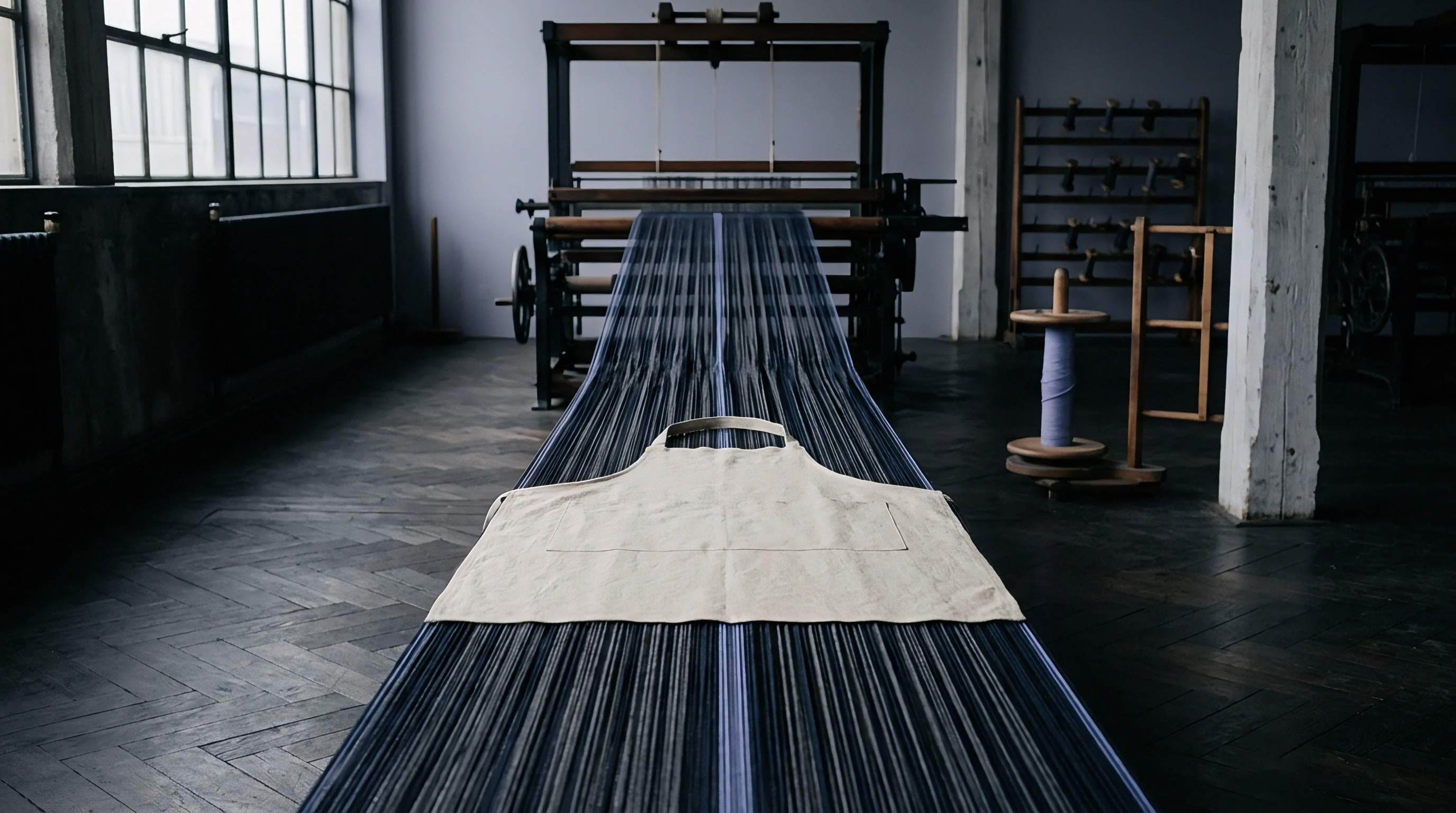
Dynamic tensile loads in the weaving shed alter yarn properties constantly. As harness frames cycle, backrest rollers oscillate, and the reed beats up, the warp sheet undergoes both elastic elongation and permanent deformation. Accurately determining greige warp shrinkage means separating this machine-induced elastic strain from true geometric crimp.

Loom Mechanical Tension and Warp Relaxation
Backrest positioning controls how much the warp path lengthens during shed opening. As the shed parts for weft insertion, the line from drop wires to fell extends. Without sufficient spring damping on the backrest roller, peak tension spikes, stretching the yarn mechanically and disguising the true crimp state while the sheet remains on the loom.
High tension prevents threads from shifting into natural equilibrium, leaving the fabric artificially elongated right after doffing. Over twenty-four to forty-eight hours on the warehouse floor, viscoelastic recovery contracts the roll lengthwise. This dry relaxation shrinkage requires neither moisture nor heat; it is driven entirely by the release of mechanical strain stored in the fibers.
- Cut a two-metre sample from the greige roll immediately behind the cloth fell while still under loom tension.
- Lay the sample flat without tension on a smooth surface and record the baseline length after sixty seconds.
- Condition the sample at 20 degrees Celsius and 65 percent relative humidity for twenty-four hours.
- Remeasure between bench marks to determine the percentage of off-loom elastic recovery.
- Run a gentle wash relaxation cycle per ISO 5077 to isolate elastic recovery from water-induced relaxation shrinkage.
Shed geometry controls warp extension directly. Keeping the sheet under heavy tension flattens crimp during weaving, only to cause steep contraction once the cloth is cut from the loom. Easing backrest tension lets warp threads adopt their natural wave profile right in the shed, stabilizing off-loom length and preventing sudden yield losses in batching.
Greige length shortfalls are frequently attributed to night-shift humidity drops inside the weaving shed, when the actual cause is high backrest tension applied to mask poor yarn quality.

Swell
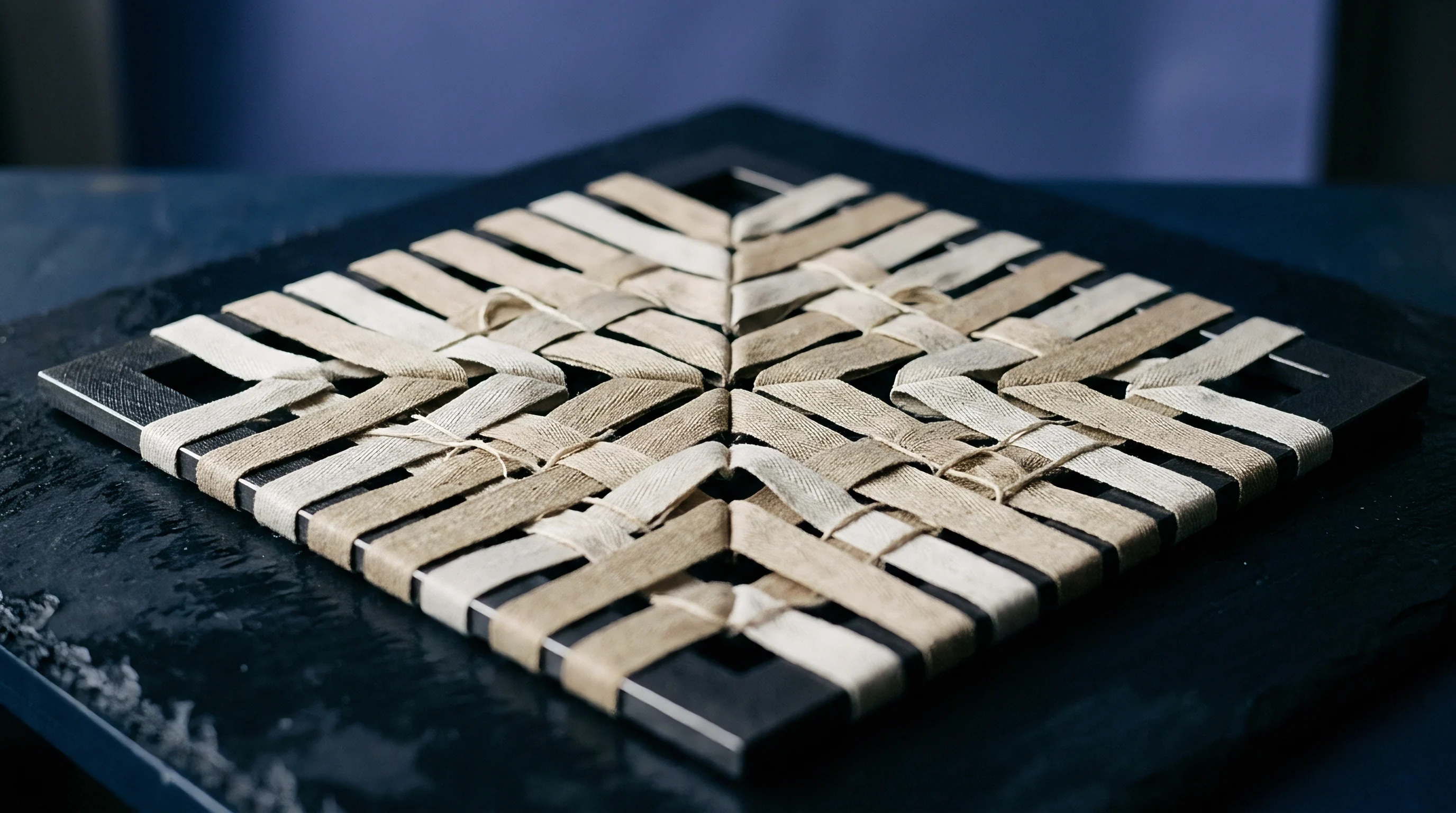
When greige fabric enters wet desizing, scouring, or bleaching, fiber dimensions shift rapidly. Cellulosics like cotton and linen absorb water, swelling noticeably in diameter with almost no change in length. This anisotropic expansion changes the geometry at crossover points, forcing warp ends to travel around swollen weft threads and driving substantial fabric shrinkage.

Aqueous Wet Processing and Fiber Diameter Expansion
Full wet immersion swells cotton fiber diameter by fourteen to twenty percent. As the filling yarns thicken, warp ends must trace a longer route over each pick. Unrestrained warp threads draw in longitudinally around the enlarged weft circumference, producing immediate relaxation shrinkage.
The magnitude of wet contraction reflects initial greige crimp and yarn packing density. In dense plain weaves with high cover factors, void space between threads fills quickly as fibers swell; once internal clearance disappears, structural pressure forces the fabric inward in both directions. Open constructions give swollen fibers room to expand internally, resulting in far smaller dimensional changes during wet finishing.
| Fiber Blend | Yarn Count (Ne) | Fiber Diameter Swelling (%) | Greige Warp Crimp (%) | Wet Relaxation Shrinkage (%) | Total Warp Take-Up (%) |
|---|---|---|---|---|---|
| 100% Combed Cotton | Ne 40/1 | 14.2 | 8.2 | 4.5 | 12.33 |
| 100% Linen (Flax) | Lea 30/1 | 22.0 | 6.5 | 7.8 | 13.80 |
| 100% Viscose Rayon | Ne 30/1 | 35.0 | 7.8 | 9.2 | 16.28 |
| 65/35 Poly/Cotton | Ne 40/1 | 5.5 | 8.5 | 1.8 | 10.15 |

When Should Woven Fabric Construction Calculations Account for Yarn Swelling?
Calculations must account for fiber swelling whenever finished specifications call for wet processing before cutting. Sizing and weaving models that factor in only mechanical loom take-up underestimate total yarn consumption by four to ten percent on washed or finished goods. Ignoring the hydro-mechanical response of cellulosics inevitably leads to yield shortfalls.
- Fiber Water Absorption Capacity Hydrophilic fibers require significantly larger wet shrinkage allowances during warp prep than hydrophobic synthetics.
- Finished Construction Cover Factor Fabrics with total cover factors above eighty percent experience pronounced crimp amplification during wet desizing.
- Yarn Twist Vector Balance Plied yarns resist radial expansion better than singles ring-spun equivalents, limiting movement during wetting.
- Finishing Line Mechanical Restraint Stenter clip tension counteracts relaxation shrinkage mechanically, trading off physical length loss against residual fabric tension.
Finishing technicians continue to debate where purely mechanical crimp relaxation ends and irreversible cross-link shifting begins under hot processing liquors.

Tariff
Warp shrinkage calculations directly dictate operating margins and finished fabric pricing. Warp yarn is committed capital, tied up on the beam before the first pick enters the shed. Overestimating shrinkage inflates yarn consumption estimates and carrying costs; underestimating it leaves orders short on yardage, triggering delivery penalties and wasting machine capacity.

Warp Length Allocation and Beam Economics
Mill margins hinge on the loom hour. A machine running at three hundred picks per minute weaves a predictable length of warp per shift. If a calculation underestimates take-up by two percent, a ten-thousand-metre warp beam runs out two hundred metres early.
The mill loses scheduled capacity, absorbs unscheduled downtime, and shoulders changeover overhead with no finished metres to show for it.
Because yarn count dictates package volume and axial clearance, coarse plain weave warps require larger beam flanges or more frequent beam changes, magnifying the penalty of short runs. Warping setup costs are fixed; amortizing them over an underestimated warp length distorts the true landed cost per metre and erodes margin on tight commodity orders.
Financial Metrics on Loom-Hour Yield
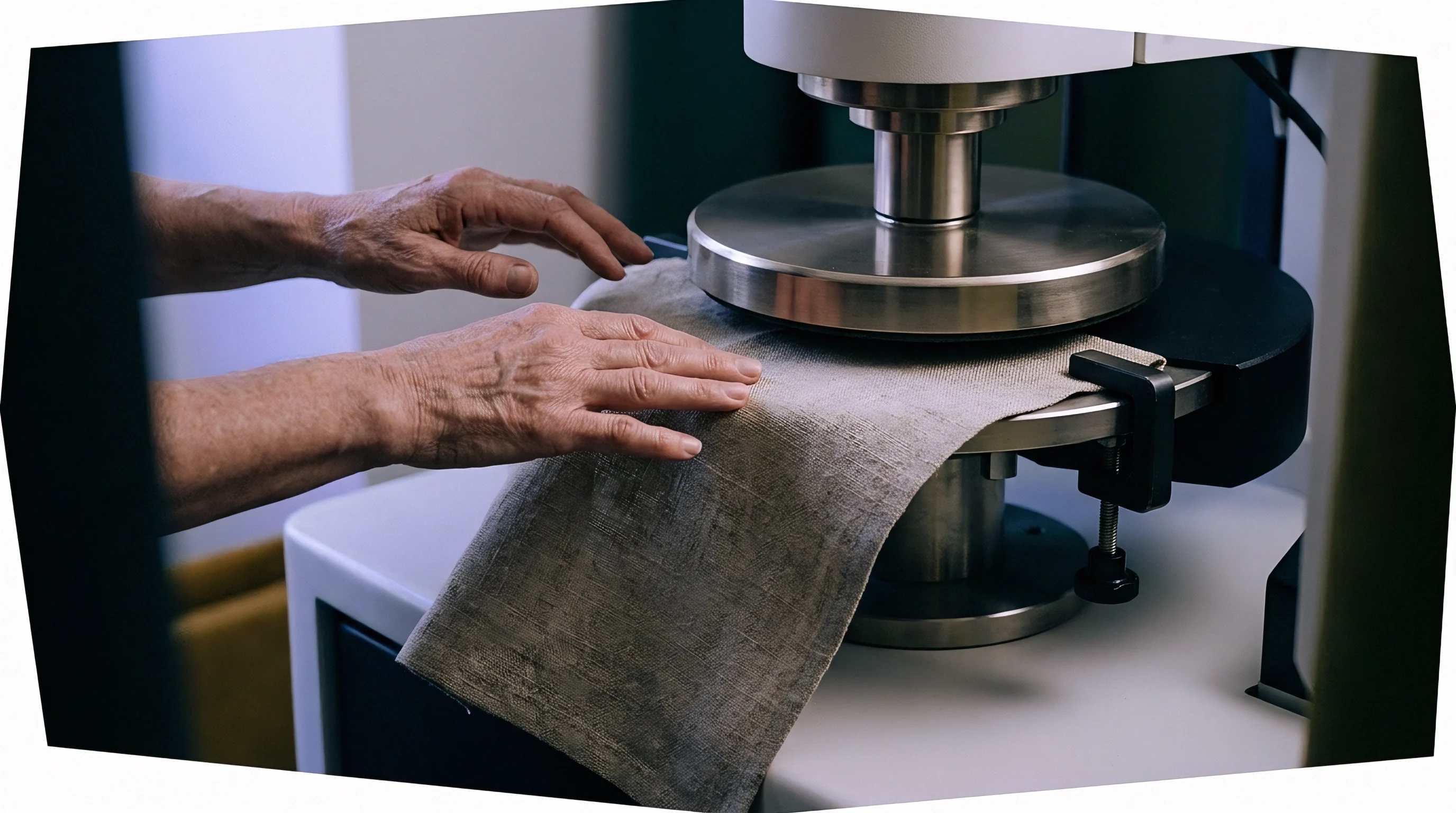
Cost models convert yarn pricing per kilogram into landed cost per linear metre through yield equations. Greige warp cost per metre equals yarn price per kilogram multiplied by total ends, divided by the yarn count metric conversion factor, multiplied by one plus the warp take-up factor. Small errors in that take-up value carry straight through to the bottom-line quote.
Consider twenty looms assigned to weave 50,000 metres of greige plain weave from 30 Ne combed cotton warp with 3,600 total ends at 85 percent efficiency. A 2.5 percent miscalculation in the warp take-up factor skews raw yarn procurement by more than 600 kilograms. Beyond purchasing, resolving that deficit demands forty-eight unbudgeted loom hours to tie back in and weave out the shortfall.
Commercial supply contracts need clear tolerances connecting weight per square metre, off-loom width, and crimp percentages. If a contract sets rigid finished mass targets without adjusting warp length allowances for wet take-up, the mill ends up absorbing the cost of extra ends inserted simply to satisfy minimum weight requirements.
Sound calculations align loom mechanics with commercial delivery, ensuring that every metre wound onto the beam yields its expected share of billable cloth.