Scutcher Mechanical Losses and Intrinsic Tenacity Retention in Flax Processing
Calibrating scutching turbine speed and moisture regain maximizes long flax yield and preserves intrinsic bundle tenacity for traceable origin auditing.


Beat
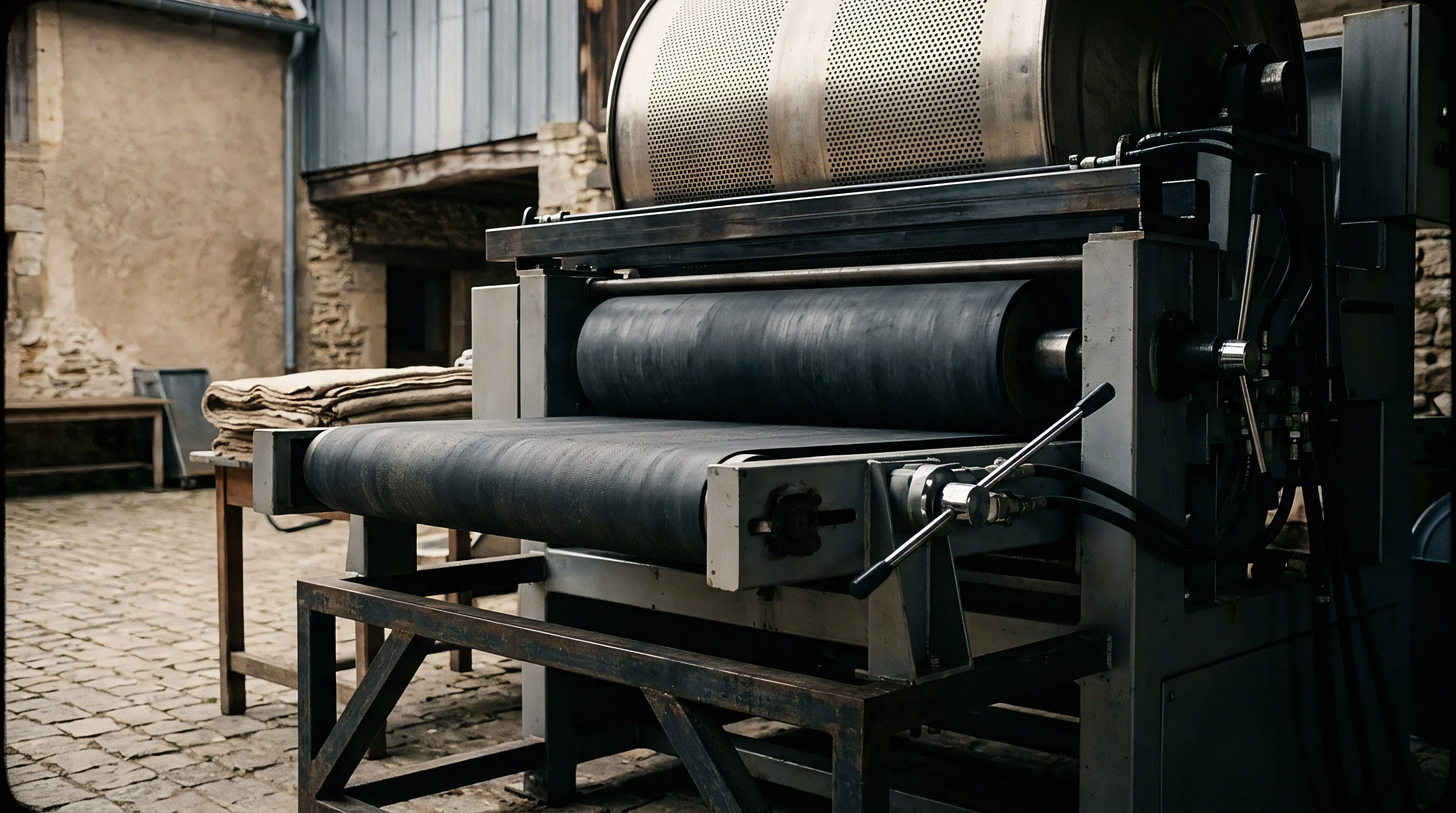
Mechanical decortication breaks retted flax straw into spinnable fiber bundles by striking it with rotating steel or wooden blades. In the primary extraction stage, parallel flax stalks pass through fluted breaker rollers before reaching a scutching turbine wheel. These fluted rolls crush the brittle woody core, or shive, into short fragments while keeping the surrounding cortical bast fiber bundles intact.
The clearance between opposing rollers determines the initial mechanical fracturing: too much pressure crushes the cellulosic cell walls of the bast fiber, whereas too little leaves large shive particles attached to the bundle.
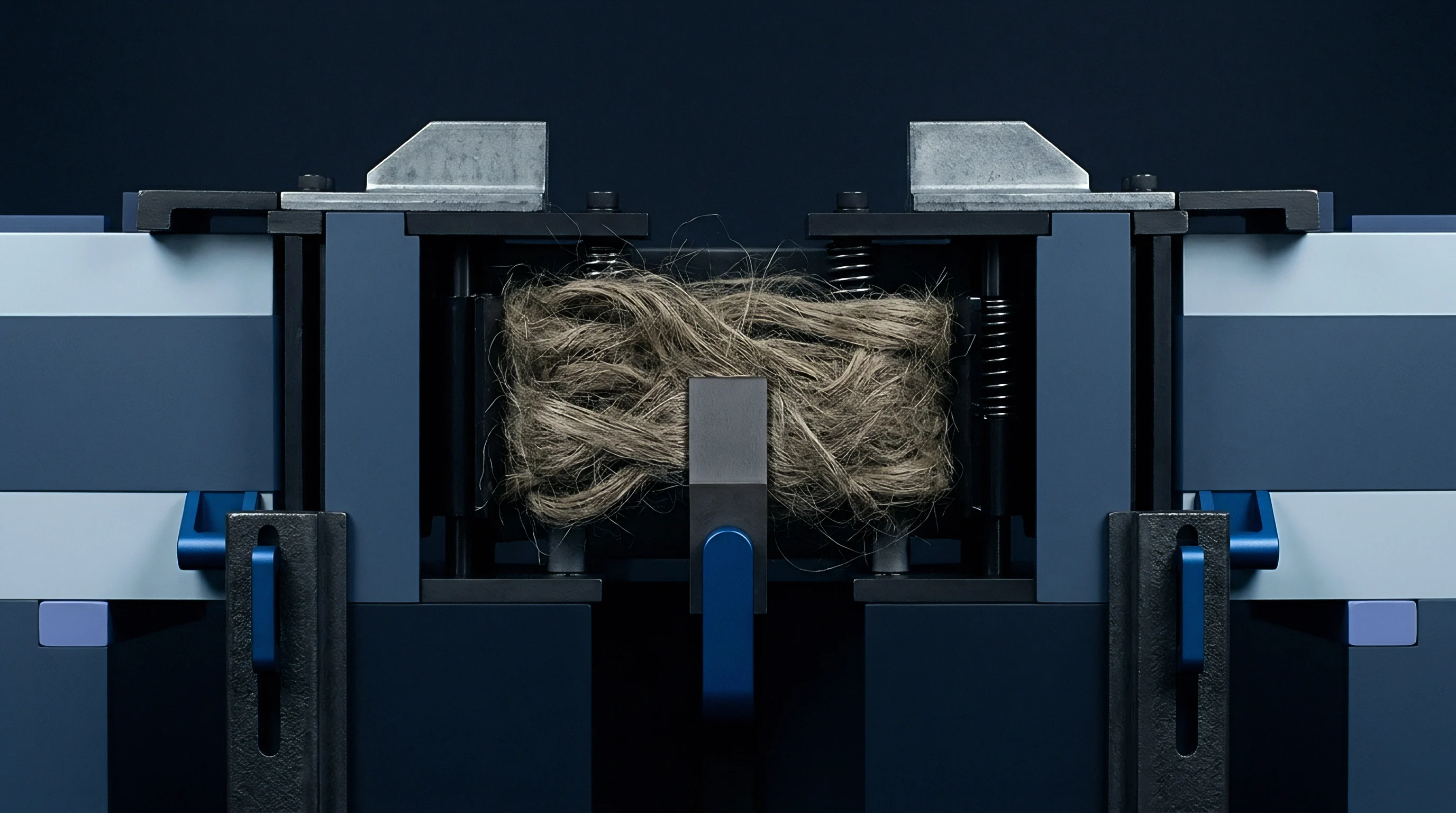
Turbine Rotor Kinetics
Rotational velocity dictates how much kinetic energy transfers when blades strike the held flax straw. Industrial scutching turbines typically use rotors fitted with flexible wipers or rigid steel blades running between 200 and 280 revolutions per minute. As a blade hits the hanging flax, it applies both bending and shear stresses that strip broken shive from the pectin matrix bonding fiber to the stem sheath.
Higher circumferential tip speeds raise throughput, but they also increase breakage within the long line fiber fraction.
Clearance between the rotating blade tip and stationary grid bar sets the impact intensity. Tight gaps improve shive extraction but cause severe fiber abrasion; dropping the blade clearance below two millimeters sharply accelerates transverse fiber shear. Under-retted straw retains strong middle-lamella pectin bonds, requiring higher impact energy to dislodge shive and consequently raising the rate of bundle snapping.
Operating a scutching turbine at rotor speeds exceeding 250 revolutions per minute reduces long line fiber yield by 3.2 percent for every 10 percent increase in tip velocity.

Breaker Roller Impact Mechanics
Pairs of fluted cylinders crush the central woody core before straw reaches the scutching wheel. Modern decortication lines use four to six pairs of fluted rollers with progressively finer pitch profiles. Deep flutes create the primary fractures, while shallower flutes flex the technical fiber bundles to loosen the bast tissue from the inner xylem cylinder.
Flute depth, profile radius, and pneumatic roll pressure together determine the energy density delivered to the un-retted or dew-retted stem.
| Turbine Speed (RPM) | Tip Velocity (m/s) | Rotor Clearance (mm) | Long Line Fiber Retention (%) | Tow Fraction Ratio (%) |
|---|---|---|---|---|
| 190 | 14.9 | 3.5 | 16.2 | 7.1 |
| 220 | 17.3 | 2.5 | 14.8 | 8.6 |
| 250 | 19.6 | 2.0 | 13.1 | 10.4 |
| 280 | 22.0 | 1.5 | 11.2 | 12.8 |
Excessive roller and turbine speeds sever long fiber bundles, though pre-existing stalk brittleness from uneven field retting also contributes to short fiber generation.
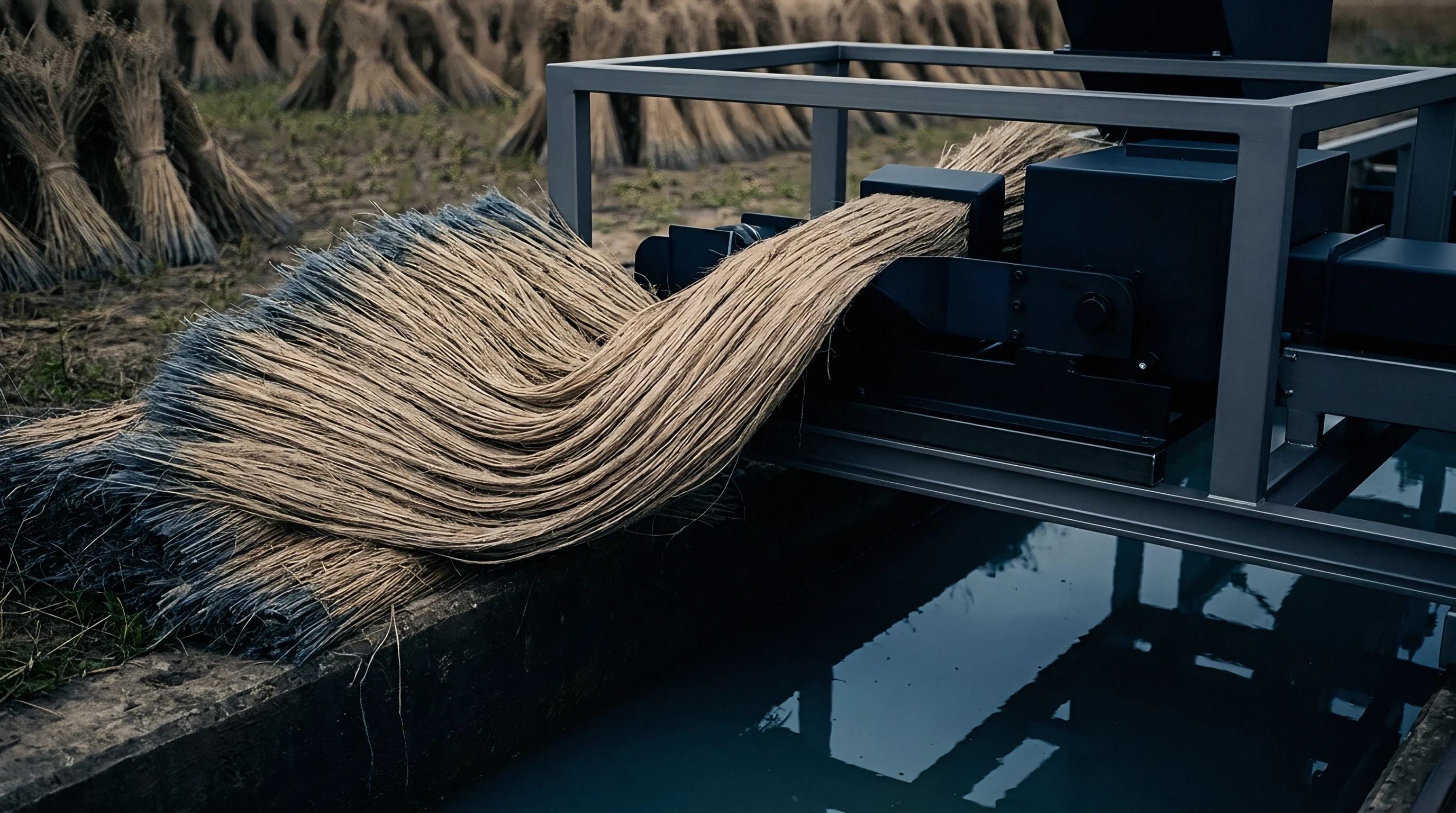
Tow
Fractionation divides decorticated fiber into continuous long line strands and shorter co-product fragments. The short fibers produced during scutching form scutching tow ~ an unaligned mixture of elementary fibers, broken technical bundles, and coarse shive. While long line fiber brings higher prices for fine wet-spun yarns, tow goes into lower-value uses like coarse dry-spun yarn, non-woven mats, and technical composites.
The ratio of long line fiber to short tow remains the primary measure of scutching efficiency and financial return.

Shive Separation Efficiency
Extracting the woody core requires balancing grid bar gaps against centrifugal force. As turbine blades beat flax stalks against the scutching grid, liberated shive drops through grid openings into pneumatic extraction ducts. If the gaps are too narrow, broken core fragments stay trapped in the fiber mass, forcing aggressive downstream hackling that degrades fiber length.
If the gaps are too wide, intact long line fibers fall into the tow bin, routing valuable material into lower-grade streams.
Moisture levels during decortication directly affect how the shive breaks. Processing straw below eleven percent moisture regain makes the stem core so brittle that it shatters into fine woody dust instead of clean, distinct shive fragments. This fine dust clings electrostatically to technical fiber bundles, complicating removal and raising waste figures during hackling and carding.
Conditioning dew-retted flax straw to a uniform moisture regain prevents premature bundle snapping during decortication.
Fractionation Mechanics and Waste Fractions
Fiber length distribution directly reflects the balance between applied shearing stress and inherent stem cohesion. Four principal mechanical failure modes account for short fiber generation during primary decortication:
- Over-Beating Fracture ~ High rotational speeds cause repeated mechanical shear, snapping elementary fiber bundles into short tow.
- Insufficient Moisture Regain ~ Processing dew-retted straw below twelve percent moisture embrittles cell walls, leading to excessive fragmentation.
- Improper Grid Gap Calibration ~ Overly wide anvil spacing lets intact long fibers drop into the shive collection chute.
- Non-Uniform Stem Feed ~ Irregular flax ribbon orientation across breaker rollers exposes misaligned fibers to transverse shearing.
Setting turbine geometry involves balancing throughput against long line yield. Flax scutched above optimal moisture levels produces heavy tow filled with unseparated shive, while overly dry straw yields clean waste alongside snapped long line fibers.

Fiber
Cellular integrity dictates yarn tensile strength and processing limits in wet spinning. Elementary flax fibers consist of multilayered cell walls made of crystalline cellulose microfibrils embedded in hemicellulose and lignin. Individual elementary fibers, twenty to fifty millimeters long, are bound by middle-lamella pectins into technical fibers extending the full length of the stem.
Tenacity retention measures the proportion of single-bundle tensile strength preserved through decortication.
Cell Wall Micro-Cracking and Slip Planes
Excessive shear creates localized structural dislocations within elementary cellulose microfibrils. Known as knee knots or slip planes, these disruptions form when impact flexes the cell wall past its elastic limit, acting as stress concentrators along the fiber.
When technical bundles with high slip plane densities are loaded during spinning, micro-fractures originate at these damaged nodal points. Automated bundle testing shows a direct link between scutching impact energy and reduced force at break. Intact bast fibers reach intrinsic tenacity values above 60 cN/tex, but severe mechanical over-processing pulls technical bundle tenacity below 40 cN/tex.
| Moisture Regain (%) | Beater Rotor Clearance (mm) | Tenacity Retention (cN/tex) | Dislocation Density (Knee Knots/mm) | Cell Wall Fracture Rate (%) |
|---|---|---|---|---|
| 10.0 | 1.5 | 38.5 | 14.2 | 8.8 |
| 12.5 | 2.0 | 47.2 | 9.6 | 4.3 |
| 14.0 | 2.5 | 56.8 | 5.1 | 1.9 |
| 16.0 | 3.0 | 52.1 | 4.8 | 2.1 |

Turbine Velocity and Ultimate Fiber Strength
Impacts above twenty-five meters per second degrade technical bundle tenacity before hackling begins. High-speed video shows that rapid impact sends violent transverse waves down the free length of the held flax ribbon. This wave motion generates heavy shear stress between adjacent elementary fibers, rupturing middle-lamella pectin bonds and splitting technical fibers lengthwise.
While longitudinal splitting thins the bundle, transverse cell wall cracking permanently reduces tensile strength.
Preserving intrinsic tenacity requires adjusting mechanical energy to match the retting status of each batch. Over-retted straw, with its degraded intercellular pectin, releases shive under lighter mechanical action and suffers severe tenacity loss on aggressive turbine setups. Conversely, under-retted straw benefits from precise moisture conditioning rather than stronger impacts to clear shive without disrupting microfibrillar alignment.
It remains unclear whether low-temperature mechanical softening before scutching can suppress microfibrillar dislocations without affecting pectin removal during downstream wet spinning.

Trace
Documentary continuity from harvest to spun yarn underpins provenance claims across international supply chains. European Flax certification sets chain-of-custody protocols requiring physical segregation and mass-balance accounting for Western European flax. As raw straw moves from farm storage to decortication facilities, batch identifiers accompany the material through every step, linking field lot numbers to output bale tags for downstream spinners and weavers.
European Flax Scope Verification
Chain of custody certification depends on physical segregation and transactional balance audits. Scutching facilities in certified schemes undergo annual third-party audits under ISO 17065 guidelines to verify accounting accuracy. Auditors reconcile incoming raw straw tonnage against certified sales declarations for long line fiber and tow to prevent substitution of uncertified straw.
When certified European flax straw ships to external processing hubs, such as commission scutching facilities in Asian textile mills, transaction certificates must accompany every shipment stage. Scope certificates verify that a plant is eligible to process certified fiber, while transaction certificates confirm the weight, lot code, and origin claim of specific consignments. Any break in documentary continuity voids certified status, regardless of where the straw was grown.
Certification Scope Clause 3.1 mandates physical segregation and dedicated run scheduling for all certified fiber batches entering processing turbines.

Chain of Custody Document Structures
Bale tags and weighbridge logs establish verifiable link points between retting field harvests and scutching outputs. Complete traceability dossier assembly demands strict records across four primary operational documentation tiers:
- Field Retting Certificate ~ Official declaration specifying farm coordinates, straw variety, dew-retting duration, and harvest lot identification numbers.
- Weighbridge Delivery Receipts ~ Stamped entry documents recording raw un-scutched straw mass, vehicle identification, and delivery timestamp at the processing facility.
- Scutching Machine Operating Logs ~ Shift records capturing processing line speeds, rotor settings, daily yield outputs, and batch changeover cleaning protocols.
- Transaction Certificate Scope Declarations ~ Authorized documents linking specific scutched fiber weight to downstream spinning mill purchasing orders.
Discrepancies lead to immediate audit failure. European Flax Chain of Custody Requirement Clause 4.2 mandates physical segregation during turbine runs, placing the responsibility on the facility to prove lot integrity using time-stamped batch logs.

Audit
Mass balance reconciliation compares physical input weight against total output recovery to expose yield inflation or material substitution. Commission scutching mills operate against yield benchmarks based on incoming moisture and stem quality. Standard dew-retted European flax yields roughly fourteen to fifteen percent long line fiber, eight to ten percent short tow, fifty to fifty-five percent shive, and fifteen to twenty percent moisture loss and fine dust.
Deviations from these baseline ratios signal machine miscalibration or unauthorized lot blending.
Straw to Fiber Mass Reconciliation
Yield verification requires dry-weight accounting across raw stalks, long line fiber, short co-products, and waste. Discrepancies between incoming straw weight and recovered output indicate poor process control or unrecorded transfers. To eliminate moisture variation, auditors run dry-mass calculations based on ISO 6741 oven-dry testing standards.
For example, a 10,000-kilogram lot of dew-retted flax straw delivered at 13.5 percent moisture content yields a baseline of 1,450 kilograms of long line fiber (14.5%), 1,000 kilograms of scutching tow (10.0%), 5,800 kilograms of shive (58.0%), and 1,750 kilograms of evaporated moisture and dust (17.5%). Raising turbine speed from 210 rpm to 260 rpm shifts this distribution, dropping long line yield to 1,180 kilograms (11.8%) and raising short tow output to 1,320 kilograms (13.2%).
| Stage / Stream | Input Mass (kg) | Standard Output (kg) | Deviated High-Speed Output (kg) | Variance Value Impact ($) |
|---|---|---|---|---|
| Raw Straw Entry | 10,000 | ~ | ~ | ~ |
| Long Line Fiber ($4.20/kg) | ~ | 1,450 | 1,180 | -1,134.00 |
| Scutching Tow ($1.15/kg) | ~ | 1,000 | 1,320 | +368.00 |
| Shive Co-Product ($0.15/kg) | ~ | 5,800 | 5,750 | -7.50 |
| Moisture & Dust Loss | ~ | 1,750 | 1,750 | 0.00 |
| Net Value Yield | ~ | $7,810.00 | $7,036.50 | -$773.50 |
Yield Deviation Thresholds
Acceptable material loss variances range between two and four percent, depending on atmospheric humidity fluctuations. Performing rigorous physical yield verification requires a standardized four-stage facility review procedure:
- Record the gross weight and moisture regain of the incoming dew-retted straw batch before feeding it into the breaker rollers.
- Weigh and sum the output of long line fiber, short tow, ejected shive, and extracted dust at batch completion.
- Calculate the dry-weight mass balance to confirm total output matches total input within a three percent evaporation allowance.
- Compare the long line to short tow ratio against historical baseline yield curves to identify over-processing or diverted streams.
Unreconciled yield losses compromise downstream origin declarations, invalidating preferential tariff claims and exposing importers to retroactive customs reassessments.

Breach
Contractual disputes over degraded fiber quality usually trace back to unmonitored mechanical damage during primary processing. Supply agreements for raw flax ought to include explicit performance specifications setting minimum tenacity thresholds alongside yield targets. When scutching mills run equipment at excessive speeds to maximize throughput, the resulting microstructural cell wall damage is invisible under visual grading but causes catastrophic failure in wet spinning.
Commercial Tenacity Warranties
Purchase contracts for high-count yarn set minimum single-bundle tensile parameters based on standardized tests. Typically referencing ISO 3060 bundle breaker testing, these contracts require long line fiber to show a tenacity of at least 45 cN/tex. Specifying tenacity limits in scutching agreements forces processing mills to keep turbine speeds within calibrated operating limits.
Customs authorities enforce origin labeling through unbroken chain-of-custody documentation. Under European Union Regulation 1007/2011 and the United States Textile Fiber Products Identification Act, selling unverified or mislabeled flax exposes traders to civil penalties and product seizure. Shipments that fail origin audits incur financial penalties and forfeit preferential tariffs under Harmonized System heading 5301.

Contractual Remedy Mechanics
Financial settlement provisions apply when technical bundles fail tensile benchmarks. Sourcing contracts typically include penalty formulas that link price reductions directly to measured tenacity loss ~ for example, cutting the purchase price by two percent for every cN/tex drop below baseline, capped at ten percent before full lot rejection rights take effect.
Writing tenacity benchmarks directly into scutching subcontracts protects spinning mills against structural yarn failure while establishing clear financial accountability across decortication facilities.