Impact of Elevated Microfibril Angles on Bast Fibre Tenacity
Elevated microfibril angles reduce bast fibre tenacity by shifting load distribution from cellulose backbones to matrix shear, depressing hackling yields.

Helix
The internal architecture of bast fibers governs how well they withstand tensile stress during processing and mechanical loading. In plants like flax, hemp, jute, and ramie, long-chain crystalline cellulose molecules assemble into microfibrils within the cell wall. These microfibrils are embedded in an amorphous matrix of hemicellulose and pectins.
The primary factor dictating an elementary fiber’s ultimate strength is its microfibril angle ~ the angular deviation between the helical cellulose microfibrils in the dominant secondary cell wall layer and the longitudinal axis of the stem.
In premium long-staple flax, microfibrils in the thick secondary wall align closely with the fiber length, typically at angles of 6 to 10 degrees relative to the main axis. This parallel alignment directs tensile loads straight along the covalent backbone of the crystalline cellulose glucan chains. When genetic variations, weather stress during growth, or poor harvest timing widen this angle, the fiber’s mechanical behavior changes completely.
A wider angle shifts force distribution from direct axial tension along the cellulose backbone to off-axis transverse loading and inter-microfibrillar shear in the matrix polymer network.

Cellulose Alignment in Bast Cell Walls
In elementary flax and hemp fibers, the thickest internal layer houses parallel chains of highly crystalline cellulose that make up to eighty percent of the wall cross-section. This geometric arrangement forms the load-bearing skeleton of the fiber. At low angles near 6 degrees, axial extension creates uniform tensile strain across the crystalline lattices.
Tensile strength ~ expressed as tenacity in centinewtons per tex or ultimate tensile stress in megapascals ~ peaks here, as the high Young’s modulus of crystalline cellulose (approximately 130 to 180 gigapascals) dominates the response to deformation.
Widening the microfibril angle to 15 or 20 degrees introduces a structural effect where axial tensile loads translate into rotational torque and shear displacement along the helical path. Matrix polymers, with an intrinsic elastic modulus under 5 gigapascals, must transfer these shear stresses between adjacent cellulose microfibrils. Because hemicellulose and pectin have far lower shear strength than crystalline cellulose, the cell wall yields under much lower force.
Mechanical failure occurs not through direct covalent glucan chain scission, but through inter-microfibrillar sliding, interfacial debonding, and premature wall cracking.
The orientation of cellulose microfibrils within the secondary cell wall establishes the upper theoretical limit for axial tensile performance before yarn spinning occurs.
Crystallite Orientation and Axial Load Transfer
When external tension stretches a technical filament, force propagates along the spiraling cellulose framework inside each elementary unit. The mathematical relationship between measured tenacity and internal helical deviation follows a cosine transformation modified by matrix transverse compliance. At zero degrees orientation, the effective axial modulus equals the intrinsic modulus of the crystalline cellulose core.
As the angle widens to 18 degrees, the effective elastic modulus drops by more than forty percent, with a corresponding drop in ultimate tensile strength.
Strain at break increases as the microfibril orientation angle becomes more oblique, allowing the helical structure to uncoil slightly under longitudinal strain and deform plastically before rupture. While higher strain capacity might seem useful for energy absorption, in textile processing this elongation causes irreversible draft slipping, permanent necking, and unstable yarn formation. Flax fibers with elevated orientation angles show low work-to-break efficiency despite higher extension values, because absolute breaking force drops far faster than elongation increases.
| Fiber Source and Condition | Mean Microfibril Angle (degrees) | Single Fiber Tenacity (cN/tex) | Axial Young’s Modulus (GPa) | Elongation at Break (%) |
|---|---|---|---|---|
| Prime Water-Retted Flax (Middle Stem) | 6.2 to 8.5 | 58.0 to 68.5 | 48.5 to 62.0 | 1.8 to 2.2 |
| Standard Dew-Retted Flax (Line Grade) | 8.8 to 11.2 | 44.0 to 54.0 | 35.0 to 44.0 | 2.1 to 2.6 |
| Secondary Over-Retted Flax (Coarse Tow) | 14.5 to 18.0 | 28.0 to 36.5 | 21.0 to 28.5 | 2.9 to 3.8 |
| Industrial Hemp (Technical Line) | 10.5 to 13.5 | 38.0 to 48.0 | 28.0 to 36.0 | 2.0 to 2.5 |
| Commercial Ramie (Degummed Ribbon) | 7.0 to 9.0 | 52.0 to 62.0 | 42.0 to 50.0 | 2.3 to 2.7 |
The transition from pure tension to shear-dominated stress distribution also alters how moisture affects fiber strength. Water absorbed into non-crystalline regions forces matrix chains apart, reducing matrix shear yield strength. In fibers with narrow orientation angles, wet conditions actually increase tenacity because hydrogen bonding within crystalline cellulose rearranges efficiently under axial tension.
Conversely, fibers with elevated microfibril angles show smaller wet tenacity gains or even strength losses, as water plasticizes the matrix layer already struggling to transfer off-axis shear loads.
Evaluating incoming long-staple bales by measuring both crystallite dispersion and bundle breaking force isolates raw material deficits from mechanical processing damage. Analysis shows that a 5-degree shift in average crystallite deviation correlates with a drop of 15 centinewtons per tex in technical fiber tenacity. Spinners processing high-angle lots face severe restrictions on draft ratios, fine count limits, and winding speeds.
Whether agricultural breeding strategies can stabilize microfibril geometry during extreme weather in stem elongation remains an open question.
Strand
Individual elementary fibers combine within the bast region of the plant stem to form complex composite bundles held together by a pectin-lignin middle lamella. The ultimate strength of a commercial flax or hemp strand depends on two distinct structural tiers: the internal molecular geometry of individual elementary cells and the adhesive integrity of the matrix binding dozens of cells into a coherent technical fiber. An elevated microfibril angle weakens both tiers at once.
Controlled biological retting removes non-cellulosic pectins and hemicelluloses from the outer bundle surfaces, allowing technical fibers to separate cleanly during scutching and hackling. However, over-retting or uneven field retting exposes elementary cell walls to enzymatic attack. This degradation targets the amorphous matrix between cellulose microfibrils, weakening the lateral support needed to transfer shear stress along spiraling microfibril paths.
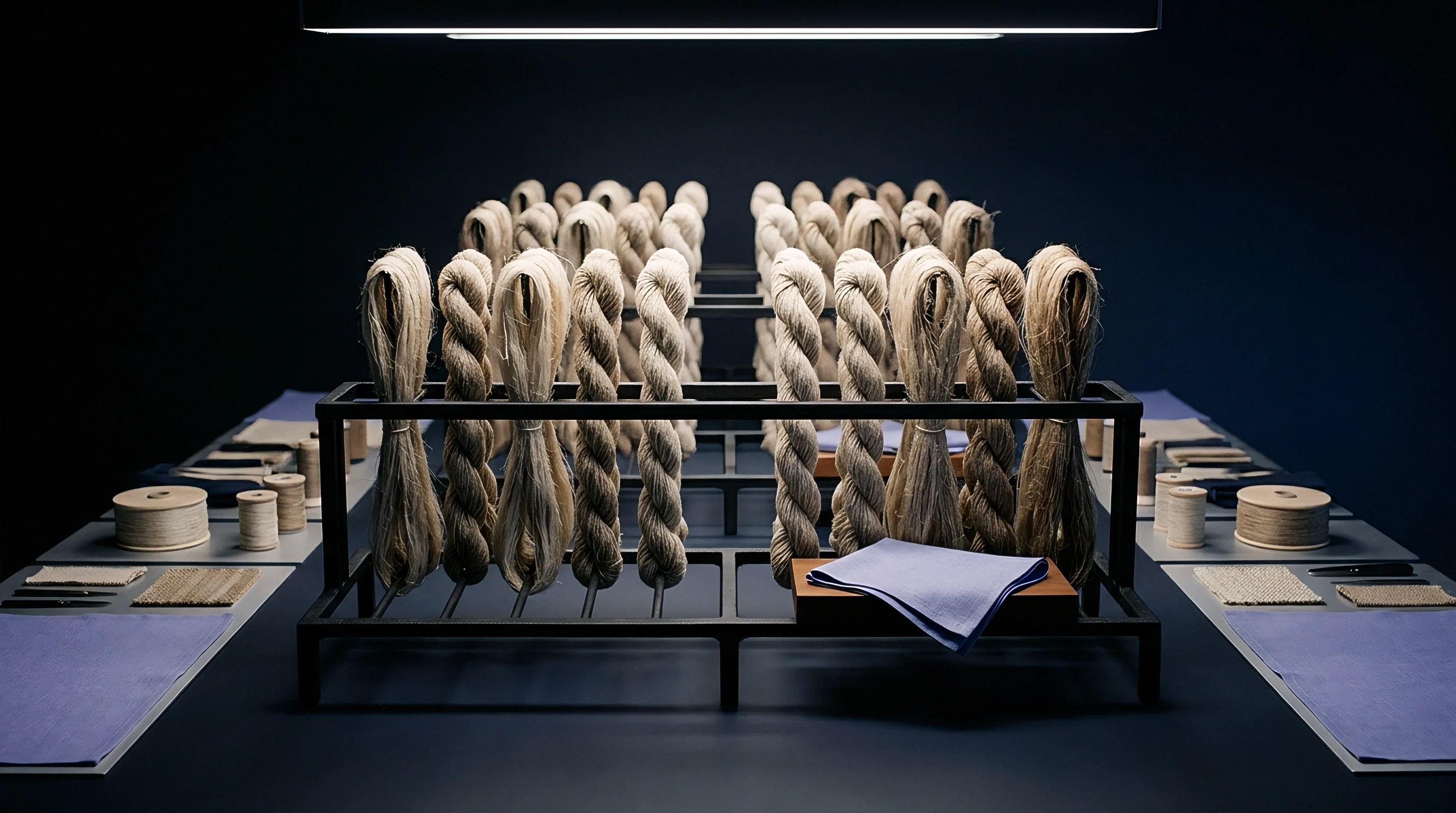
Elementary Fibres versus Technical Bundles
Measuring an individual elementary cell reveals intrinsic mechanical performance, whereas a technical bundle reflects composite structural interactions. When an elementary fiber has an elevated microfibril angle, its reduced axial stiffness causes it to stretch further under load before taking its share of force. In a bundle of hundreds of elementary cells, microfibril angles vary across the cross-section, with outer stem fibers often featuring narrower angles than those from the core.
Under tension, elementary fibers with narrower angles pick up load first because their higher Young’s modulus makes them stiffer. These aligned cells reach their breaking strain and snap sequentially while neighboring high-angle cells are still uncoiling and stretching without contributing peak resistance. This asynchronous failure mechanism imposes a heavy strength penalty on technical strands: the measured tenacity of a bundle with mixed microfibril angles falls well below the weighted arithmetic average of its constituent cells.
Coarser bottom stem segments display wider microfibril offsets than fine middle stem sections harvested from the same stalk.
Retting Kinetics and Cell Wall Angular Deviation
The pace and extent of field dew-retting heavily influence the mechanical stability of high-angle bast fibers. Biological retting relies on fungal colonization ~ predominantly species like Cladosporium herbarum ~ to secrete pectinolytic enzymes that cleave the middle lamella. If rain is uneven or swaths remain unturned, local enzyme concentrations spike and penetrate past the middle lamella into the outer secondary wall layers of individual elementary cells.
Without intact pectin-hemicellulose bridges to lock its helical pitch, the microfibril framework loses its structural pinning.
Loss of matrix pinning allows elevated microfibrils to slip laterally under tension, accelerating premature fiber pull-out within technical bundles. While friction between adjacent cells partially masks this deficit in dry testing, passing the fiber through the warm water bath of a wet-spinning frame swells and softens the remaining degraded pectins. The technical bundle then slips apart under drafting forces well below its dry breaking threshold.
- Inter-Microfibrillar Matrix Shear Yielding occurs when external tension forces spiraling cellulose microfibrils to slip laterally through degraded hemicellulose regions, causing internal cell wall delamination.
- Sequential Element Rupture Sequence develops in bundles with non-uniform microfibril orientation, leading stiff low-angle cells to break first under low elongation while high-angle cells fail to engage peak load.
- Enzymatic Wall Micro-Void Formation results from excessive retting duration, where fungal enzymes digest amorphous polysaccharides within secondary cell walls and remove the lateral support needed for helical load transfer.
- Middle Lamella Interfacial Cleavage manifests during mechanical drafting when pectin degradation combined with off-axis shear forces from elevated microfibrils causes technical bundles to divide prematurely into weak short segments.
Morphological position along the plant stem introduces further variation in microfibril orientation. Middle-stem flax strands maintain the narrowest angles and highest crystalline order, yielding the strongest line fiber. Root-end fibers display microfibril angles routinely 4 to 8 degrees wider than middle-stem sections, paired with thicker cell walls and higher lignin content.
Fiber bundles from stem bases yield lower tenacity, higher flexural rigidity, and unpredictable drafting behavior. Consequently, raw fiber lots containing high proportions of stem-base material require lower draft speeds and higher twist multipliers to prevent roving slippage during spinning.

Clamp
Measuring microfibril angles and single-fiber tenacity in the laboratory demands precise metrological controls to avoid testing artifacts. Primary physical methods for determining microfibril geometry include Wide-Angle X-ray Diffraction, Polarized Light Microscopy, and Second Harmonic Generation Microscopy. Tensile strength evaluation relies on automated single-fiber instruments, such as Favimat equipment, or bundle testers like Pressley and Stelometer units operating under the standardized atmospheric conditions outlined in ISO 139.
Single fiber tensile testing under ISO 11566 involves clamping isolated elementary fibers across defined test spans, typically 10 millimeters or 3.2 millimeters. When testing fibers with elevated microfibril angles, reducing gauge length produces a dramatic apparent increase in breaking force. This occurs because shorter spans reduce the statistical probability of capturing an internal structural defect or localized micro-crack along the spiraling cellulose pathway.

Single Fibre Favimat and Diffraction Benchmarking
Automated single-fiber testing systems combine linear density measurement via vibroscope with pneumatic clamping jaws to calculate true tenacity per filament. The instrument measures resonance frequency under known tension to derive fiber fineness in dtex before executing the tensile pull. For fibers with high microfibril angles, vibroscope testing requires careful tension calibration; reduced axial stiffness alters vibrational damping characteristics, which can overestimate linear density if uncorrected.
Diffraction measurements provide the ultimate baseline for microfibril angle verification. Wide-Angle X-ray Diffraction directs a monochromatic X-ray beam through a parallel bundle of elementary fibers. The 200 crystalline cellulose reflection plane produces diffraction arcs whose azimuthal intensity profiles reflect crystallite angular dispersion.
Analyzing the full width at half maximum of these azimuthal intensity peaks yields the quantitative mean microfibril angle. X-ray diffraction measures purely crystalline alignment, whereas optical techniques reflect both crystalline cellulose and amorphous matrix orientation.
What Differential Explains Gauge Length Tenacity Shifts?
How much tenacity varies across changing gauge lengths depends directly on the microfibril angle distribution within the sample. At a 10-millimeter gauge length, an elementary flax fiber with an 8-degree microfibril angle retains roughly eighty-two percent of its short-span 3.2-millimeter strength. An elementary fiber with a 16-degree angle drops to less than fifty-five percent of its short-span value over that same 10-millimeter gauge.
The wider angle increases sensitivity to structural flaws, as internal shear stresses concentrate around cell wall irregularities and pit apertures.
| Test Method Standard | Primary Parameter Quantified | Sample Size Requirement | Measurement Accuracy Range | Primary Metrological Limitation |
|---|---|---|---|---|
| WAXD Azimuthal Profile | Crystalline Microfibril Angle | 10 mg parallel fiber bundle | +/- 0.5 degrees | Measures crystalline regions only, ignoring amorphous matrix effects. |
| ISO 11566 Favimat Single Fiber | Single Filament Tenacity and Modulus | 50 individual elementary fibers | +/- 0.8 cN/tex | High labor requirement and sensitivity to jaw-face slipping. |
| ISO 2370 Bundle Stelometer | Flat Bundle Tenacity and Elongation | 3.0 mg combed flat fiber ribbon | +/- 1.2 cN/tex | Averages single-fiber variability and depends on operator combing skill. |
| Polarized Light Microscopy | Mean Cell Wall Birefringence | 30 isolated single cells | +/- 1.2 degrees | Requires manual tilt-stage operation and refractive index matching oils. |
| All tensile test methods require conditioning at 20 +/- 2 degrees Celsius and 65 +/- 4 percent relative humidity per ISO 139 standards. | ||||
Precise verification of single-fiber tensile metrics requires a strict execution workflow. Skipping key calibration or mounting steps compromises report validity and undermines commercial claims.
- Condition the raw fiber lot for twenty-four hours in a controlled atmosphere maintaining twenty degrees Celsius and sixty-five percent relative humidity.
- Isolate individual elementary fibers manually under a stereomicroscope using fine dissecting needles to avoid inducing mechanical twist or surface micro-cracks.
- Mount each isolated fiber across a specialized paper tab frame featuring a precise ten-millimeter aperture using cold-curing epoxy resin adhesives.
- Measure the linear density of mounted fibers on an automated resonant vibroscope instrument operating under an applied bias tension of 0.05 centinewtons per dtex.
- Load the paper tab into the pneumatic clamps of the single-fiber tensile frame and severe the side support bridges of the paper frame using a heated wire element.
- Execute the tensile test at a constant rate of extension equal to ten percent gauge length per minute until complete filament fracture occurs.
Widening the mean microfibril angle from 8 to 16 degrees cuts single-fiber tenacity by 22 percent. Misinterpreting test reports that omit gauge length specifications leads to severe commercial errors. Buying a high-angle fiber lot evaluated at a flattering 3.2-millimeter gauge length creates disastrous line failures when processed on commercial drafting frames set to long spans.
The operational cost lands directly in the spinning mill: broken end counts skyrocket, machine efficiency plummets below seventy percent, and high-speed wet spinning frames suffer expensive downtime.
Roving
Converting hackled flax line fiber into high-quality yarn requires precise control over draft forces during roving and spinning. In wet spinning, twisted roving passes through a hot water bath ~ typically maintained between 60 and 70 degrees Celsius ~ to soften pectins in the inter-cellular matrix. This thermal treatment allows elementary fibers to slide past one another under drafting tension, drawing the strand down to its target count before final twist insertion.
When processing fibers with elevated microfibril angles, hot water immersion causes unexpected structural changes in the drafting zone. Because high-angle microfibrils exhibit lower axial stiffness, individual filaments stretch elastically inside the wet bath under draft tension rather than sliding cleanly past adjacent cells. As the drafted strand exits the rollers, this stored elastic strain relaxes instantly, destroying cohesion and creating severe yarn count irregularity (high mass CV%).
Draft Cohesion and Wet Spinning Trough Dynamics
Temperature and retention time in the wet-spinning trough must align with the microfibril angle profile of the fiber lot. High-angle bast fibers contain matrix pectins that are less densely packed due to looser crystalline alignment, causing rapid softening in hot water. If water temperature exceeds 65 degrees Celsius when processing a 15-degree microfibril angle lot, the inter-cellular pectin dissolves completely, triggering false draft and complete strand severance inside the trough.
Spinning fine yarn counts such as Nm 39 or Nm 50 requires high initial tenacity and narrow microfibril angles in the raw fiber. Attempting to wet-spin fine counts from high-angle raw material forces the spinner to increase the twist multiplier on the roving frame to keep the strand intact. This elevated twist prevents clean draft attenuation at the main spinning frame, resulting in thick-and-thin slub defects and frequent yarn breakage under ring traveler tension.
Purchasing agreements specifying a minimum individual tenacity of 45 centinewtons per tex reject lots exceeding an average secondary wall microfibril angle of twelve degrees.
Maximum Spinnable Count Limits
The finest spinnable yarn count attainable from a flax lot scales directly with fiber tenacity and microfibril geometry. High microfibril angles restrict the draft ratio because the fiber’s lower elastic modulus permits excessive strand necking. Drafting high-angle line fiber beyond its structural limit drops yarn tenacity below the 15 centinewtons per tex minimum required for high-speed weaving or knitting.
- Low Microfibril Angle Lots (6 to 9 degrees) allow high draft ratios up to 22, enabling stable wet spinning of fine yarns from Nm 39 up to Nm 80 with low end-breakage rates.
- Moderate Microfibril Angle Lots (10 to 13 degrees) restrict maximum draft ratios to approximately 14, capping commercial wet spinning at medium yarn counts between Nm 18 and Nm 30.
- High Microfibril Angle Lots (14 to 18 degrees) force dry spinning or coarse wet spinning routes, capping yarn counts below Nm 14 and requiring high twist insertion levels.
- Degraded Outer-Stem Lots (above 18 degrees) exclude line spinning entirely, forcing conversion into short-staple carded tow blends suitable only for heavy coarse yarns or non-woven industrial mats.
Low tenacity and high draft breakage in a delivered lot are often attributed to incorrect wet-spinning bath temperatures that degrade pectin balance, but elevated microfibril angles inside the delivered bales reduce the intrinsic load capacity of the cellulose framework before the fiber ever enters the water. Spinners adjusting frame settings for high-angle material must reduce draft speeds by up to twenty percent and accept a coarser output to maintain runnable line stability.
Calculus
Evaluating raw bast fiber purely on a price-per-kilogram basis introduces severe commercial distortion into sourcing operations. The real cost of flax fiber shows in the landed cost per finished linear metre of fabric meeting physical specifications. Elevated microfibril angles erode margin by depressing hackling yield, raising comber waste percentages, lowering yarn conversion efficiency, and forcing spinners into coarser, lower-value product categories.
During hackling, scutched long flax passes through rotating pinned combs of increasing needle density to align technical fibers, eliminate short fibers, and clean remaining shive. High-tenacity fiber with narrow microfibril angles withstands the mechanical impact of hackling pins without excessive transverse fracture. In contrast, high-angle fiber with reduced matrix shear strength splits transversely under pin impact, converting valuable long line fiber into low-value hackling tow.
Hackling Yield Loss and Waste Allowances
A standard hackling setup converts prime scutched flax with an 8-degree microfibril angle into approximately sixty-two percent dressed long line fiber, thirty-two percent hackling tow, and six percent comber waste and dust. Processing a 15-degree microfibril angle lot through identical pin sequences drops the dressed long line yield to forty-four percent while pushing hackling tow to fifty percent. Because dressed line fiber commands three to four times the price of hackling tow, this yield collapse sharply increases raw material input costs per kilogram of spinnable fiber.
In downstream wet spinning, reduced fiber tenacity compounds the losses incurred during hackling. Lower tensile strength forces slower frame speeds to prevent ring-traveler breakage, directly reducing hourly output per spindle. Higher end-breakage rates demand extra manual piecing labor, generate more soft waste, and increase yarn splices per cone, triggering quality downgrade penalties during fabric inspection.
Flax line fiber exhibiting a ten-degree microfibril angle delivers sixty-two percent hackling yield compared to forty-four percent yield for fourteen-degree material under identical pin density protocols.
Landed Yarn Economics and Metre Yield
Constructing a complete landed cost model requires tracing raw fiber yield through hackling, roving, wet spinning, winding, and weaving. The financial impact of microfibril angle variation shows clearly in the final fabric yield metrics.
| Process and Yield Parameter | Variant A (Narrow MFA: 8.2 deg) | Variant B (Elevated MFA: 15.4 deg) | Commercial Cost Variance Effect |
|---|---|---|---|
| Scutched Fiber Purchase Price | $4.80 / kg | $3.90 / kg | Variant B features a 18.7% initial raw material price discount. |
| Hackling Line Yield (%) | 63.5 % | 45.0 % | Variant B loses 18.5 percentage points of long-line yield to tow. |
| Effective Line Fiber Cost | $7.56 / kg | $8.67 / kg | Variant B becomes 14.7% more expensive per kg of usable line fiber. |
| Max Runnable Yarn Count | Nm 39 (25.6 tex) | Nm 18 (55.5 tex) | Variant B cannot reach fine yarn count specifications. |
| Spinning End Breakage Rate | 18 breaks / 1000 sp hr | 52 breaks / 1000 sp hr | Variant B triples piecing labor costs and increases splices. |
| Finished Fabric Mass Target | 150 g / sq m | 220 g / sq m | Variant B forces a heavier weight fabric construction. |
| Landed Metre Cost (1.5m Width) | $3.42 / linear metre | $4.88 / linear metre | Variant B results in a 42.7% higher landed cost per finished metre. |
The economic comparison in Table 3 highlights the commercial trap of low-priced raw flax. The high-angle material carries an initial nineteen percent discount on the offer sheet. However, because hackling yield collapses and spinning performance suffers, the usable long-line cost per kilogram ends up fifteen percent higher.
Furthermore, because high-angle fiber cannot achieve fine counts like Nm 39, the mill must weave heavier fabrics, consuming more fiber mass per linear metre produced. Selecting the high-angle lot ultimately increases landed cost per linear metre of fabric by over forty-two percent.
Standard purchasing contracts incorporate strict yield adjustment clauses to compensate for tenacity deficits driven by microfibril orientation anomalies. Contracts under standard linen trade rules stipulate that if delivered line fiber lots exhibit an average single-fiber tenacity below 40 centinewtons per tex, the buyer retains the contractual right to apply a penalty equal to twice the percentage deficit in hackling yield, or reject the shipment entirely at the seller’s expense.
Settlement
Securing consistent quality in bast fiber sourcing requires formalizing technical parameters within contract specifications and establishing rigorous incoming inspection procedures. Traditional hand-grading ~ relying on visual lustre, tactile softness, and manual bundle snapping ~ fails to detect subtle shifts in microfibril orientation. An over-retted or stress-grown fiber lot may present an attractive bright color and soft hand feel while harboring severe secondary wall defects that destroy spinning productivity.
Sourcing practices must enforce objective laboratory testing protocols before accepting international shipment documentation or authorizing letter-of-credit drawdowns. Integrating wide-angle X-ray diffraction screening or automated single-fiber tensile verification into standard quality dossiers keeps substandard raw material out of the hackling room.
Quality Dossier Requirements and Acceptance Sampling
A complete commercial fiber qualification dossier must accompany every landed container shipment. This dossier must move beyond basic moisture regain and shive content figures to present statistically valid mechanical and microstructural data. Sampling plans under ISO 2859-1 require representative core sampling across at least ten percent of incoming bales per lot.
- Certified Tensile Test Certificate detailing single fiber or Stelometer flat bundle tenacity metrics, including full load-strain distribution curves and stated test gauge lengths.
- Microstructural Orientation Profile reporting mean microfibril angle determined via X-ray diffraction or optical retardation microscopy across representative stem segments.
- Linear Density and Fineness Distribution verified by vibroscopic analysis or air-flow measurement per ISO 2370 to establish fineness uniformity metrics.
- Hackling Yield Pre-Trial Report generated from a standardized five-kilogram comb trial confirming long line yield, tow generation, and shive removal percentages.
When laboratory testing surfaces a tenacity deficit or elevated microfibril angle in landed stock, formal dispute resolution procedures take effect. Contract terms dictate arbitration through international linen trade bodies, where independent referee laboratories re-test archived reference samples taken during bale loading at the scutching mill using standardized ISO methods.
Commercial Dispute Resolution for Tenacity Deficits
Proving that a delivered lot fails mechanical specifications requires showing that the measured deficiency exceeds the combined tolerance limits of the test method and sampling variation. If referee testing confirms that the mean microfibril angle exceeds contract limits by more than two degrees, or that single-fiber tenacity falls more than five percent below the baseline, the buyer can initiate a formal claim. Remedies range from negotiated price discounts covering documented hackling yield losses to full lot rejection with mandatory replacement.
A comprehensive quality assurance framework ties technical microstructural parameters directly to financial settlement terms. Sourcing practices that incorporate microfibril angle metrics into raw material qualification sheets eliminate commercial ambiguity, protect mill productivity, and maintain strict control over landed fabric costs in competitive global markets.