Multi Isotope Soil Isoscape Mapping for Western European Linen Provenance
Multi-isotope mapping of strontium and oxygen provides an empirical origin gate that exposes commingled or substituted linen independent of paperwork claims.


Matrix
Thermal ionization mass spectrometry of unbleached flax sliver yields an 87Sr/86Sr strontium ratio between 0.7078 and 0.7102 across the marine sedimentary belt stretching from Caen through West Flanders to Dordrecht. A declaration claiming European Flax status on imported Chinese yarn fails when testing reveals an 87Sr/86Sr value exceeding 0.7125, alongside a carbon delta13C shift past negative twenty-six per mil. A buyer paying a twenty-two percent certified fibre surcharge on sixty count wet-spun linen discovers the substitution once the laboratory compares delivered samples against documented regional soil coordinates.
Origin is recorded directly during cellular lignification, creating a physical baseline independent of merchant declarations.
Light stable isotopes of hydrogen and oxygen reflect meteoric water taken up during vegetative growth from May through July. Rainfall across the coastal plains of northern France, Belgium, and the southern Netherlands carries a delta18O signature between negative six and negative 7.5 per mil relative to Vienna Standard Mean Ocean Water. Eastern European continental fields drop toward negative nine per mil, whereas irrigated crops in Egypt exceed positive 1.2 per mil from strong evaporative enrichment in the Nile basin.
Blending lower-cost non-European roving into declared Western European stock shifts these bulk delta18O and delta2H values right away.
A bulk delta18O shift exceeding 1.8 per mil away from the seasonal precipitation mean indicates foreign roving commingled during gill-box drafting.
Lead isotope ratios, specifically 206Pb/204Pb paired with 207Pb/204Pb, track legacy industrial emissions and atmospheric dust deposited on the stalk prior to harvest. Topsoils along the English Channel retain lead signatures that differ clearly from the coal-derived aerosol footprints of central China or the metalliferous soils of the Ural foothills. Measuring lead together with strontium gives geological markers that do not change with seasonal rainfall.
Combined, these four isotope systems distinguish genuine Atlantic maritime flax from continental substitutes.
Customs agencies and arbitration panels rely on isotope ratio mass spectrometry for physical verification when paperwork chains show breaks. An invoice linked to an expired scope certificate fails laboratory concordance testing when strontium and oxygen profiles point to entirely different latitudes. For commercial buyers, the key is whether multi-element baselines can consistently isolate sub-regional growing areas even when unusual seasonal rainfall alters hydrological ratios across neighboring European watersheds.
Silt
Quaternary loess covers the Franco-Belgian maritime basin, forming a continuous geological stratum marked by consistent mineral weathering and carbonate dissolution. Windblown deposits from Weichselian glacial grinding provide an exchangeable strontium supply dominated by Cretaceous chalk and Paleogene marine carbonates. Bioavailable strontium in the top thirty centimeters of soil enters the plant through passive calcium pathways without detectable mass fractionation.
During rapid growth, the flax stem incorporates this ambient 87Sr/86Sr ratio straight into its structural cellulose and calcium pectate lamellae.
Precipitation gradients drive changes in delta eighteen oxygen. Atlantic weather systems move inland across the coastal plain, dropping moisture that follows predictable isotopic dilution along Rayleigh distillation curves. Western European flax fields receive rains depleted in heavy isotopes proportional to their distance from the coast and summer storm tracks.
Regional soil moisture balances this precipitation against evaporation, yielding an isotopic baseline that remains stable over decades within specific geographic regions.
The underlying loess deposits anchor this geographic boundary.
| Geographic Region | Geological Substrate | 87Sr/86Sr Mean | delta18O Range (per mil) | delta13C Range (per mil) | 206Pb/204Pb Mean |
|---|---|---|---|---|---|
| Franco-Belgian Maritime Loess Belt | Weichselian aeolian silt over chalk | 0.7088 ± 0.0008 | -7.2 to -5.8 | -28.8 to -27.1 | 18.42 ± 0.06 |
| Nile River Delta System | Holocene fluvisols and basaltic alluvium | 0.7061 ± 0.0004 | +1.4 to +3.6 | -25.2 to -23.8 | 18.89 ± 0.09 |
| Heilongjiang Alluvial Plain | Mollisols over granitic/volcanic wash | 0.7118 ± 0.0012 | -11.8 to -9.4 | -26.4 to -24.9 | 18.15 ± 0.08 |
| Belarus and Baltic Glacial Drift | Pleistocene sandy moraines and till | 0.7135 ± 0.0016 | -9.6 to -8.1 | -29.4 to -27.8 | 18.31 ± 0.07 |
| Values represent dry scutched long fibre, corrected against V-PDB, V-SMOW, and NIST SRM 987 standards across five consecutive harvest seasons. | |||||
Matching soil map data with isotopic reference databases shows tight spatial clustering across Normandy, Picardy, and Zeeland. Nitrogen isotope ratios (delta15N) introduce agricultural input signals to this geological baseline. Synthetic nitrate fertilizers common in intensive farming pull delta15N down toward atmospheric zero, while traditional Western European crop rotations show organic soil nitrogen values between positive 3.5 and positive 6.2 per mil.
An imported shipment showing low delta15N combined with unusual lead ratios indicates industrial farming practices foreign to coastal European fields.
Field-to-field variation across the maritime loess corridor is far smaller than the difference separating Normandy from Eastern European glacial plains. Deep taproots pull water and cations from subsoil reservoirs that cushion the plant during short surface droughts. Strontium isotopes also survive heat processing without shifting.
When reviewing lab reports, buyers check that the isotopic profile aligns with the regional geology rather than the supplier address on the bill of lading.

Tow
Dew-retting leaves harvested stems on damp ground for four to six weeks while fungi break down the pectin bonds binding fibre bundles to the inner woody core. Exposure to rain and moisture during field retting does not alter non-exchangeable carbon and hydrogen bonds within the cellulose structure. Water-retting tanks, on the other hand, submerged fibre in water sources that can change surface minerals if the river or well water has a different isotopic makeup.
Because traditional European flax is dew-retted in the field under Atlantic rain, the plant’s original isotopic profile stays fixed in the fibre.
Scutching mills use turbine blades to strip outer shives and divide high-value long line fibre from shorter tow. Mechanical decortication requires no water or heat, so processing equipment leaves the fibre’s mineral profile unchanged. Alterations only happen downstream when spinning mills process raw sliver in chemical baths for boiling, scouring, bleaching, and degumming.
Has Chemical Finishing Masked Indigenous Isotopic Baselines?
Alkali scouring with sodium hydroxide strips away hemicellulose, surface waxes, and pectin binders, removing light elements bound in outer plant layers. Hydrogen and oxygen atoms in secondary hydroxyl groups readily swap with industrial process water during wet spinning and bleaching. If a mill in Zhejiang province boils European line sliver in local groundwater with a delta18O of negative 9.2 per mil, the exchangeable hydroxyl oxygen shifts toward that local water profile.
To remove these process artifacts, analysts isolate alpha-cellulose through chlorite delignification and nitration, exposing the underlying covalent matrix that retains the original photosynthetic signature.
Industrial wet processing introduces identifiable compositional variations across intermediate product stages:
- Heavy cation retention preserves original 87Sr/86Sr ratios through standard alkali boils, keeping the geological signature intact within non-exchangeable mineral complexes.
- Hydroxyl isotope exchange alters raw bulk delta18O and delta2H values during bleaching, requiring nitrocellulose extraction prior to mass spectrometry.
- Carbonate descaling rinses used in industrial processing dissolve mineral dust, which can shift trace lead concentrations without altering core 206Pb/204Pb ratios.
- Enzymatic bio-polishing treatments break down surface microfibrils without causing significant fractionation in the crystalline core of the strand.
Spinning additives and batch lubricants distort bulk isotope testing if samples are burned without prior extraction. Petroleum-based lubricants add synthetic carbon that pushes delta13C values toward negative thirty-one per mil. Soxhlet extraction using petroleum ether removes these synthetic oils, leaving clean cellulose for testing.
Soxhlet extraction with petroleum ether eliminates spinning oils before isotopic ratio determination.
Paper tags provide no physical proof. Testing whole yarn without removing sizing agents can lead to false rejections of genuine European goods caused by process water interference. Mills facing challenged shipments often claim that regional finishing baths or local scouring agents caused the shift picked up by inspectors.

Custody
Documentary chains create administrative links between farming cooperatives and textile processors. European Flax certification, managed by the Alliance for European Flax-Linen & Hemp, covers fibre grown in France, Belgium, and the Netherlands. Scutching mills must maintain physical separation, logging lot numbers and weighbridge slips.
As fibre moves into global spinning networks, chain-of-custody checks rely on annual third-party audits and transaction certificates for individual shipments.
Mass balance systems allow unsegregated blending in practice. While European Flax rules mandate physical separation in certified facilities, standard commercial contracts let mills hold both certified and uncertified inventory in the same plant. Mills often buy certified European scutched tow alongside uncertified Russian, Belarusian, or Heilongjiang fibre.
The certified paperwork covers a matching allocation of finished yarn, while lower-cost uncertified material is fed into carding and drawing lines to trim costs.
Auditing procedures verify traceability across physical and administrative milestones:
- The buyer collects scutching mill consignment notes showing gross mass, net dry fibre weight, and field registration coordinates.
- Inspectors reconcile spinning mill delivery receipts with customs import entries, matching volume totals against invoices.
- Auditors inspect bale storage areas on site to verify that European Flax barcodes match active production runs.
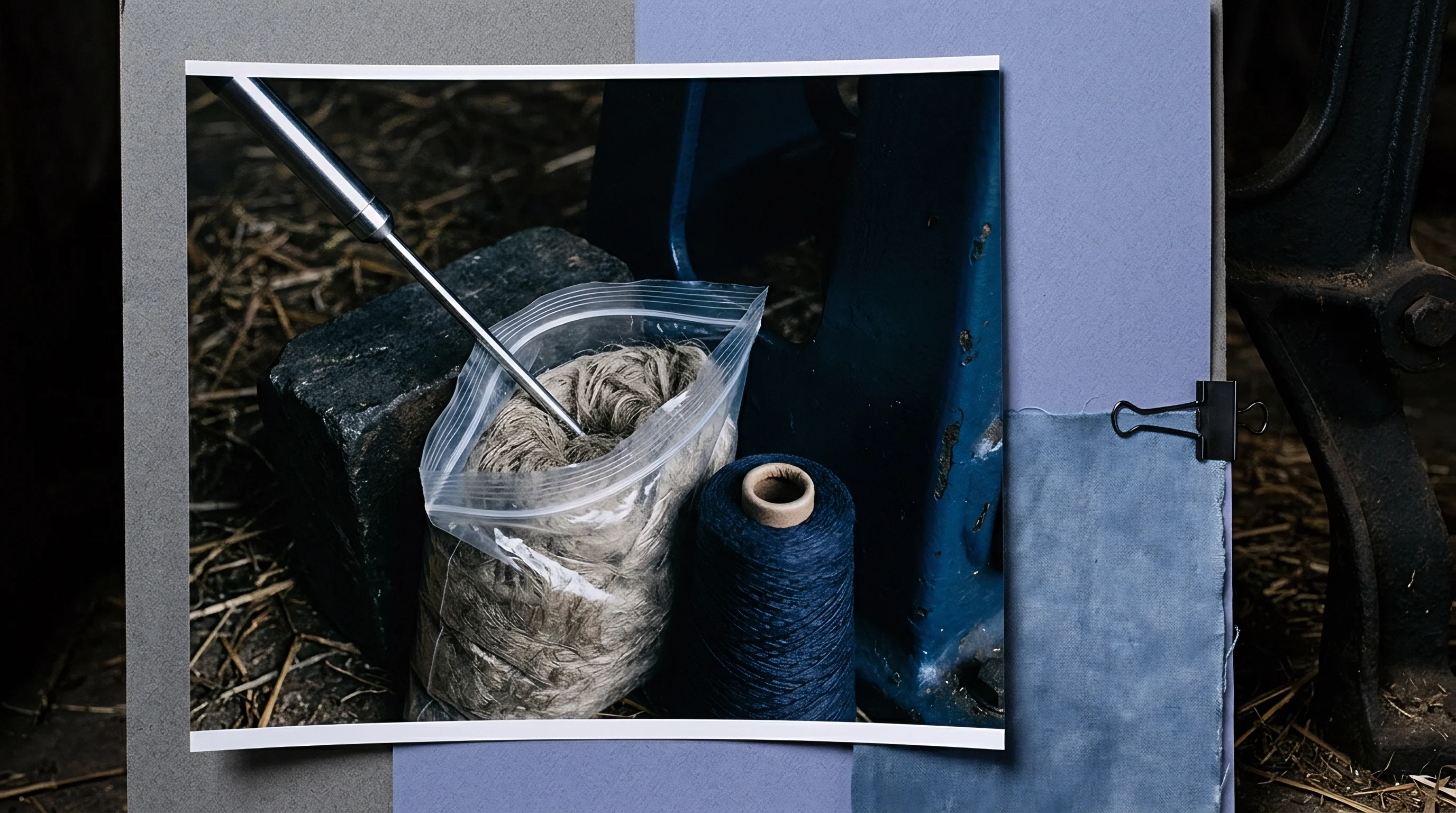
- Technicians sample sliver from draw frames before wet spinning to store for isotopic testing.
- Sourcing managers reconcile finished yarn shipments against raw scutched fibre inputs using standard conversion yield tables.
Yield losses during processing create gaps that paper audits rarely catch. Long line wet spinning produces around thirty-five percent tow and sorting waste, while dry tow spinning discards roughly forty-five percent. Accounting entries can adjust these loss figures to conceal blended uncertified fibre.
A paper audit alone will not uncover a fifteen percent substitution rate buried inside inflated waste estimates.
Alliance for European Flax-Linen & Hemp scheme rules require certified entities to retain batch transaction certificates for a minimum of five calendar years.
Transaction certificates expire after twelve months, creating risk for weavers if a yarn spinner fails a routine audit. If a mill’s license lapses, inventory produced during the valid window remains certified only when backed by individual dispatch records tied to specific lot numbers. Contracts using clause 14 of the international linen trade rules place full liability for uncertified mixing on the yarn supplier, including financial indemnity if inventory is seized downstream.


Tariff
Customs systems classify raw and processed flax under Harmonized System heading 5301, and woven fabrics under heading 5309. Non-preferential origin rules apply the substantial transformation standard, set out in EU Customs Code Article 60 and US 19 CFR Part 102. In many jurisdictions, spinning raw fibre into yarn constitutes a tariff shift that grants local origin, turning imported European fibre into Chinese or Indian yarn for duty purposes.
However, claiming European origin on finished fabric requires both European raw material and regional processing to meet preferential trade rules or protected regional labels.

Is Laboratory Verification Sufficient for Customs Clearance Defense?
Customs agencies frequently use isotopic profiling to catch shipments evading trade sanctions or duty rates. United States Customs and Border Protection detains imports that fail origin tracing standards until importers prove no raw material originated in restricted regions. A Certificate of Origin from a chamber of commerce offers little protection against a detention order when isotope testing flags forbidden coordinates.
Chamber documents hold no weight when multi-element analysis shows half the yarn mass came from undeclared regions.
False origin claims lead straight to cargo seizures. When customs authorities suspect misdeclaration, testing fees, port demurrage, and legal costs quickly stack up against the importer of record. Importers submitting isotopic test reports must show that the reference database uses statistically sound sample sizes across consecutive harvests.
If testing cannot rule out overlap between neighboring river basins, the tribunal rejects the defense, assessing retroactive anti-dumping duties and civil penalties.
Commercial contracts allocate provenance risk through specific documentation thresholds:
- Scope certificate verification confirms the manufacturer held active certification when the material was produced.
- Transaction certificate concordance ensures the volume on the invoice matches the quantitative allocation approved by the certifying body.
- Batch-level isotopic testing warranties require the supplier to cover testing costs if testing reveals non-compliant geographic signatures.
- Customs indemnity obligations require the supplier to reimburse all duties, fines, and legal fees caused by false origin declarations.
Laboratory data alone is rarely enough before a customs magistrate without complete paper records. A clean isotope test matching Franco-Belgian soil does not replace missing transaction certificates required under trade agreements. Dual inventory operations must maintain strict physical separation.
Sourcing arrangements that fail to match physical test results with complete documentary proof risk cargo forfeiture and loss of margin at the destination port.

Clearance
Evaluating a linen purchase requires measuring the true landed cost difference between verified Western European fibre and unverified alternatives. Certified European Flax line fibre carries a premium of 0.80 to 1.40 euros per kilogram over uncertified Russian or Asian stock at the spinning mill gate. Converting raw material costs to finished yardage shows why substitution happens in large-scale operations.
A plain weave linen fabric of 200 grams per square meter requires roughly 240 grams of yarn per linear meter after accounting for preparation and loom contraction.
Consider an order for 50,000 meters of finished linen fabric woven from 26 Nm wet-spun yarn, requiring 12,000 kilograms of yarn. With an average raw fibre surcharge of 1.10 euros per kilogram, full European certification adds 13,200 euros to yarn production costs before overhead and weaving margins. A mill that secretly substitutes thirty percent non-European tow gains roughly 3,960 euros in added margin per container while charging normal market prices on the invoice.
Third-party multi-isotope testing costs between 450 and 750 euros per composite sample, covering strontium extraction, thermal ionization mass spectrometry, and cellulose oxygen equilibration. Testing one sample per five-tonne dye lot adds under 0.03 euros per meter to production costs on commercial runs. Sourcing managers routine fit this testing into standard quality assurance budgets to prevent costly inventory seizures at customs.
Yarn spinners pay the certification fee.
Protecting commercial orders requires building mandatory batch testing terms directly into purchase contracts. The agreement sets out that three independent skeins taken from random roll deliveries undergo isotopic testing against the Western European loess database. If results place the raw fibre outside the 87Sr/86Sr range of 0.7078 to 0.7102 or the delta18O range of negative 7.5 to negative 5.8 per mil, the buyer can reject the shipment without cure, apply a thirty percent breach penalty, and charge back all testing fees.
Setting clear analytical parameters turns supplier compliance into a enforceable operational requirement.