Determining Dry Mass Regain in Flax Roving Processing
Determining dry mass regain in flax roving requires 105°C thermal drying coupled with solvent extraction corrections to separate water loss from spinning oils.
Hydration
Flax bast fibers have a porous cellular structure dominated by long parallel cellulose microfibrils embedded in an amorphous matrix of hemicellulose and pectin. These structural polymers contain millions of exposed hydroxyl groups that draw water vapor from surrounding air through hydrogen bonding. Moisture equilibrium in flax roving is not a fixed physical constant; it shifts continuously with relative humidity, ambient temperature, processing history, and atmospheric hysteresis.
Because raw scutched and combed flax roving undergoes mechanical drafting, roving twisting, and optional boiling or wet-spinning preparation, the physical accessibility of these hydroxyl sites changes at each manufacturing stage.
Flax fibers absorb atmospheric water rapidly. In raw, untreated bast fibers, the non-crystalline regions of cellulose and the surrounding pectin-hemicellulose gel take up moisture far more readily than the highly ordered crystalline microfibrils. When flax roving sits in a humid mill environment, water molecules first build a monomolecular layer across accessible internal capillary surfaces before condensing into bulk water within intercellular spaces.
This sorption behavior underpins gravimetric mass determinations in linen manufacturing.
Cellulosic Matrix and Moisture Binding Mechanism
Water molecules enter bast fiber structures through hydrogen bonding at free hydroxyl groups located along non-crystalline cell walls. Flax cellulose is roughly 65 to 70 percent crystalline, so water sorption occurs predominantly within the remaining 30 to 35 percent amorphous region and the inter-microfibrillar pectins. Primary hydroxyl groups at the C-6 position and secondary hydroxyl groups at C-2 and C-3 on the anhydroglucose rings serve as primary sorption sites.
At low relative humidity levels below 20 percent, water binds tightly to these primary hydroxyl sites through direct hydrogen bonds, forming a monomolecular layer with high differential heat of sorption. As relative humidity rises between 20 and 70 percent, secondary water layers condense onto the primary layer through weaker dipole-dipole interactions. Above 70 percent relative humidity, capillary condensation takes over, filling macro-voids and lumen channels in the flax cells.
Water molecules bind to hydroxyl sites throughout this process. This multi-stage sorption causes flax roving to swell transversely by up to 15 percent in diameter while expanding less than 1 percent axially.
Distinguishing Moisture Regain from Moisture Content
Calculations in textile metrology rely on two distinct mathematical expressions to quantify water held within a fibrous mass. Moisture regain expresses the mass of absorbed water as a percentage of the dry oven-dried fiber mass, whereas moisture content expresses water mass as a percentage of the total moist fiber mass including water. Confusing these two values introduces substantial financial and technical errors into commercial yarn accounting.
In mathematical terms, taking Mw as the initial wet mass of the roving sample and Md as the oven-dry mass after desiccation, moisture regain (R) and moisture content (C) are defined as follows:
Moisture Regain (R):
R = ((M_w – M_d) / M_d) 100
Moisture Content (C):
C = ((M_w – M_d) / M_w) 100
Converting between the two requires a simple algebraic transformation:
R = (C / (100 – C)) 100
C = (R / (100 + R)) 100
A flax roving sample weighing 100.00 grams with an oven-dry mass of 88.50 grams contains 11.50 grams of water. Expressed as moisture content, this yields 11.50 percent. Expressed as moisture regain, the same sample yields 12.99 percent.
Commercial transactions, yarn spinning yield calculations, and official certification schemes universally utilize moisture regain rather than moisture content.
Standard Commercial Moisture Values for Flax
International trading codes set baseline moisture allowances for dry-spun, wet-spun, and boiled bast materials to harmonize global trade invoicing. Because bringing multi-ton commercial shipments to exact oven-dry mass is impractical, international bodies such as the International Confederation of Flax and Hemp (CELC), ISO, and BISFA establish standardized commercial regain values. Billed invoice weights reflect the calculated dry mass plus this agreed commercial allowance.
Under ISO 6741 standards, unbleached dry-spun flax roving carries an official commercial moisture regain allowance of 12.00 percent. Boiled flax roving, which has lost a portion of its hydrophobic natural waxes during hot alkaline treatments, carries a commercial regain allowance of 12.00 to 13.00 percent depending on contract specifications. Bleached roving carries an allowance of 12.00 percent.
When actual measured regain deviates from these standardized values, the invoiced weight of the roving consignment must be recalculated to prevent buyers from paying fiber prices for excess atmospheric moisture or sellers from losing money on overly dry shipments.
Standard commercial regain for unbleached flax roving under ISO 6741 is fixed at 12.00 percent calculated on bone-dry fiber mass.
Hysteresis complicates moisture measurements in industrial testing laboratories. When flax roving loses moisture to reach equilibrium from a wet state (desorption), it retains a higher moisture regain than when it absorbs moisture to reach equilibrium from a completely dry state (adsorption) at identical ambient temperature and relative humidity. At standard conditions of 20°C and 65 percent relative humidity, desorption equilibrium in flax roving typically sits near 12.5 percent regain, while adsorption equilibrium sits near 10.5 percent regain.
Standard testing methodologies mandate pre-conditioning specimens in low-humidity air before testing to ensure all measurements approach equilibrium from the adsorption path.
The precise kinetic point where crystalline cellulose region surface adsorption transitions to permanent pectin network swelling under high-humidity transit conditions remains an open empirical question for technical yarn converters.
Specimen
Representative sampling across a commercial shipment of flax roving determines whether lab-scale gravimetric analysis accurately reflects multi-ton lot conditions. Flax roving is supplied in wound bobbins, coiled cans, or pressed packages, where ambient moisture penetrates external layers rapidly while leaving inner cores untouched for weeks. Taking a surface sample from an open bobbin yields falsely elevated or depressed moisture readings depending on weather conditions on the day of testing.
Sampling procedures governed by ISO 1130 and ISO 6741-1 require systematic extraction of test material across multiple production positions and winding depths. A lab sample taken without strict core-to-surface stratification fails to capture the true average regain of the mill shipment.
Sampling Protocols across Winding Depths
Selecting roving material for gravimetric dry mass determination demands stripping away outer protective layers that interact directly with room air. Laboratory technicians must discard the outer 15 to 20 meters of roving from bobbin packages before gathering sample strands. For large creel packages, material must be collected simultaneously from outer, middle, and inner core positions across at least 10 percent of the total bobbin units in a delivery lot.
Field technicians collect minimum single specimen masses of 50 to 100 grams for precision laboratory ovens, or larger 500-gram bulk samples when utilizing full-basket industrial dry-mass testing apparatus. Handling roving strands with bare hands transfers skin lipids and moisture to the fibers, artificially distorting gravimetric readings. Technicians must wear non-hygroscopic nitrile gloves and utilize pre-cleaned stainless steel shears to cut sample lengths directly into sealed transport vessels.
Hermetic Containment and Environmental Isolation
Exposure of stripped roving specimens to ambient mill air for even two minutes causes measurable moisture drift. In high-humidity environments, dry fiber absorbs up to 0.5 percent moisture mass within three minutes of ambient contact. Laboratory transport protocols demand immediate isolation of cut roving strands inside vapor-tight containment vessels before weighing.
Aluminum foil laminate bags with vapor barrier seals, heavy-walled polyethylene canisters with rubber gaskets, or glass weighing bottles with ground-glass stoppers serve as approved containment options. The tare mass of each empty container must be pre-weighed on an analytical balance to 0.001-gram precision before entering the sampling area. When roving is placed inside, the vessel must be sealed tightly, wiped clean of external dust, and weighed immediately to establish gross initial wet mass.
| Container Type | Initial Specimen Mass (g) | Mass After 5 Min Exposure (g) | Mass After 15 Min Exposure (g) | Percentage Regain Shift (%) |
|---|---|---|---|---|
| Open Glass Beaker | 50.000 | 50.185 | 50.410 | +0.82 |
| Unsealed Polyethylene Bag | 50.000 | 50.065 | 50.140 | +0.28 |
| Gasketed Aluminum Canister | 50.000 | 50.001 | 50.002 | +0.00 |
| Ground Glass Weighing Bottle | 50.000 | 50.000 | 50.000 | +0.00 |
Tare Mass Stabilization Procedures
Accounting for container tare dynamics prevents structural mass distortion in final dry weight equations. Weighing vessels exposed to temperature variations during thermal oven drying experience dimensional and mass fluctuations caused by air buoyancy and adsorbed surface water film changes. Containers must undergo identical heating, cooling, and desiccating cycles as the roving specimens they hold.
Empty weighing bottles are pre-weighed after heating them to 105°C for 60 minutes and cooling them inside a desiccator containing active silica gel for 45 minutes. Standardized laboratory procedures require recording empty container mass Mt to four decimal places. When wet roving mass Mw is added, total combined mass Minitial equals Mw + Mt. Isomeric air pressure shifts inside closed weighing bottles during cooling must be equalized by briefly loosening ground-glass stoppers inside the desiccator before closing them for balance placement.
Specimen transport vessels must demonstrate a moisture vapor transmission rate below 0.01 grams per square meter per day under ISO 1130 sampling rules.
In commercial audits, moisture retention curves are evaluated across ambient humidity gradients to confirm sample integrity during transport from spinning mill to independent lab. Inadequate seal torque on transport cans remains a primary cause of audit variance between buyer and seller measurements.
Bobbin surface drying during creel transfer is often presented as an unavoidable environmental loss that buyers ought to absorb without financial adjustment.
Desiccation
Oven drying serves as the primary quantitative method for stripping absorbed moisture from bast fiber samples to isolate bone-dry mass. Forced-draft ventilated drying ovens governed by ISO 6741-2 and ASTM D2495 pass heated air across roving strands to drive off unbound and bound water molecules. The drying process must be tightly controlled: insufficient heating leaves residual moisture behind, while excessive temperature causes thermal degradation of organic non-cellulosic constituents in the flax fiber.
Standardized drying protocols set target air temperatures to 105°C ± 2°C. At this temperature, free water and hydrogen-bonded water escape into the circulating airstream within two to four hours depending on sample bulk density and air velocity across the drying chamber.
Thermal Kinetic Thresholds of Non-Cellulosic Degradation
Flax is a complex composite fiber composed of roughly 70 to 75 percent cellulose, 15 percent hemicellulose, 4 to 5 percent pectin, 2 to 3 percent lignin, and 1 to 2 percent waxes and fats. Each component exhibits distinct thermal decomposition thresholds. While crystalline cellulose remains thermally stable up to 180°C, non-cellulosic components begin volatilizing at temperatures far lower than those used for synthetic fiber testing.
Pectins and low-molecular-weight hemicelluloses undergo minor thermal cleavage and volatile mass loss when exposed to temperatures above 110°C for extended durations. Heating flax roving to 120°C to speed up drying causes non-water organic volatile loss, creating a false decrease in dry mass that artificially inflates calculated moisture regain figures. Setting oven temperatures precisely to 105°C protects against pectin degradation while ensuring complete moisture removal.

Ventilated Oven Dynamics and Constant Mass Equilibrium
Ventilated testing ovens must maintain positive air exchange rates to prevent water vapor saturation within the drying chamber. Fresh ambient air drawn into the oven passes over heating elements, rises through perforated specimen baskets, and exits through top exhaust dampers. If exhaust dampers are closed or fan impellers fail, relative humidity inside the oven chamber rises, creating a partial water vapor pressure that halts fiber drying short of bone-dry state.
Determination of dry mass relies on reaching constant mass. Standard testing rules define constant mass as the point where consecutive weighings of the specimen, taken at minimum 15-minute drying intervals, show a mass change of less than 0.05 percent. For a 100-gram roving sample, mass differences between consecutive readings must not exceed 0.05 grams.
Primary operational failure modes during thermal oven drying of flax roving specimens include:
- Temperature overshoot caused by poorly calibrated bi-metallic thermostats driving chamber temperatures above 110°C and causing thermal volatilization of natural flax pectins.
- Insufficient air velocity across dense roving packages resulting in localized vapor saturation pockets and incomplete core drying.
- Exhaust vent occlusion preventing humid air discharge and raising internal equilibrium vapor pressure inside the heating cabinet.
- Premature removal of specimens prior to achieving true constant mass equilibrium under ISO 6741 criteria.
- Inadequate desiccator saturation allowing cold silica gel to pass atmospheric moisture back into hot dried fiber samples during cooling.
- Thermal balance drift caused by weighing hot specimen baskets directly on internal balance pans without temperature equalization.
Desiccator Cooling Mechanics versus Built in Balance Systems
Weighing bone-dry flax specimens presents distinct thermodynamic challenges. Bone-dry cellulose is intensely hygroscopic and absorbs ambient moisture within seconds of exposure to room air. Laboratory technicians must choose between two approved weighing methodologies: cooling specimens inside sealed desiccators before external weighing, or utilizing specialized ventilated ovens with integrated electronic balances that weigh specimens inside the heated oven chamber.
External weighing requires transferring hot specimen bottles from the oven into desiccators loaded with fresh activated silica gel or phosphorus pentoxide. As the hot bottle cools, air inside contracts, creating a vacuum that draws moist room air past ground-glass lids unless vacuum relief valves or silicone grease seals function perfectly. Cooling requires 30 to 45 minutes.
Built-in oven balances eliminate cooling delays by weighing specimen baskets while air heating continues, though airflow fans must be paused briefly during balance stabilization to eliminate aerodynamic lift forces on the sample basket.
Ventilated drying ovens must complete a minimum of 20 full air chamber exchanges per minute at 105°C under ASTM D2495 standards.
Thermal overshoot during dry weight determination scorches amorphous non-cellulosic compounds, driving off non-aqueous organic mass and creating artificial weight deficits that inflate supplier billing margins across multi-ton yarn deliveries.
Extract
Commercial flax roving contains volatile chemical additives and natural waxes alongside pure cellulose and water. During wet spinning, sliver preparation, or roving bobbin preparation, processors apply spinning lubricants, batching oil emulsions, softeners, and anti-static finishes to facilitate mechanical drafting and reduce fiber friction. When roving samples undergo thermal oven drying at 105°C, volatile fractions of these applied lubricants evaporate along with absorbed water.
If mass lost during oven drying is attributed entirely to water loss, the calculated moisture regain value becomes artificially high. To establish accurate moisture regain and precise commercial fiber mass, non-water mass loss components must be identified, extracted, and mathematically deducted from gravimetric calculations.
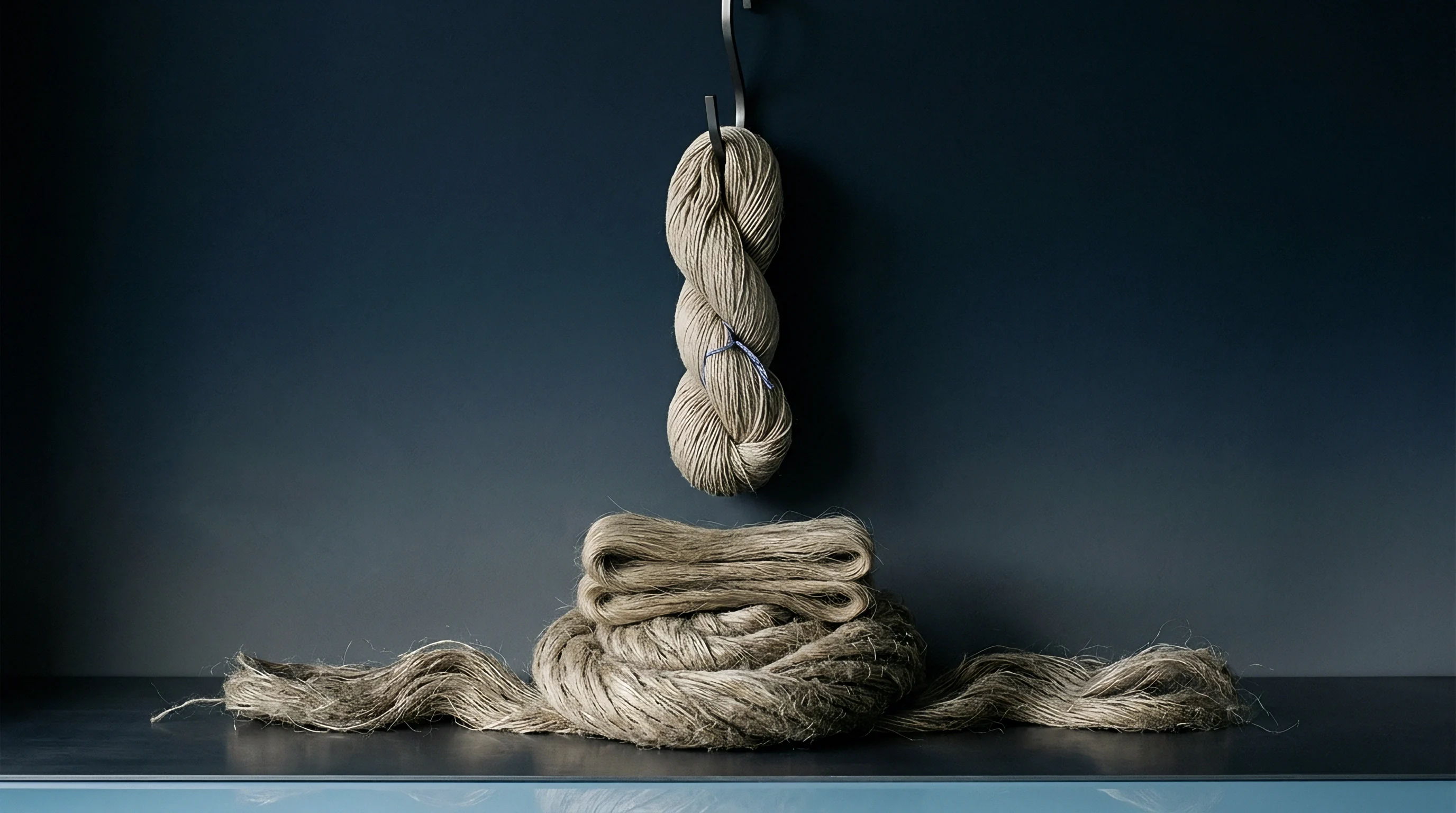
Solvent Extraction Protocols for Lipid and Lubricant Removal
Quantifying non-water volatile constituents requires Soxhlet solvent extraction per ISO 3074 or ISO 1833 guidelines. A representative roving specimen undergoes extraction using an organic solvent such as dichloromethane or petroleum ether. The solvent recycles continuously through the fiber mass for 16 to 20 cycles, dissolving natural flax waxes, applied batching oils, and synthetic spinning lubricants without attacking the cellulose backbone.
After solvent extraction, the liquid extract is distilled, and residual oils are dried in a small evaporating dish at 103°C to constant mass. Expressed as a percentage of initial sample mass, this yields the extractable organic fraction Ep. Raw scutched flax roving contains 1.2 to 1.8 percent natural waxes and fats, while lubricated wet-spinning roving contains up to 2.5 to 3.5 percent total extractable surface content.
| Component Identification | Mass Fraction Range (%) | Test Method Standard | Impact On Uncorrected Regain |
|---|---|---|---|
| Absorbed Fiber Moisture | 10.50 – 13.50 | ISO 6741-2 Oven Drying | Primary Regain Component |
| Applied Spinning Oils | 0.80 – 1.80 | ISO 3074 Soxhlet Dichloromethane | Falsely Elevates Regain if Uncorrected |
| Natural Flax Waxes / Fats | 1.10 – 1.60 | ISO 3074 Solvent Extraction | Partial Volatilization at 105°C |
| Volatile Softeners / Anti-Stats | 0.20 – 0.50 | Thermal Desorption GC-MS | Evaporates Fully in Oven |
| Bone-Dry Pure Fiber Residue | 82.60 – 87.40 | Calculated Residual Mass | True Fiber Basis |

Corrected Dry Mass Formulas
Isolating pure dry fiber mass requires adjusting standard oven-dry readings to remove extracted lipids, batching oils, and residual chemical processing agents. Let Mw represent initial wet sample mass, Md represent uncorrected oven-dry mass measured at 105°C, and Me represent total extracted non-water organic mass obtained via Soxhlet analysis.
Corrected Dry Fiber Mass (Md,corr):
M_d,corr = M_d – M_e
Corrected True Moisture Mass (Mwater):
M_water = M_w – M_d – M_v
Where Mv represents the volatile portion of applied spinning lubricants that evaporated during oven drying but was not captured in non-volatile Soxhlet residue. Corrected Moisture Regain (Rcorr) is expressed as:
R_corr = ((M_w – M_d,corr – M_e) / M_d,corr) 100
An uncorrected extractable lipid load of 1.4 percent alters billed lot weight by seven hundred kilograms across a fifty-ton shipment. Neglecting solvent extraction corrections forces buyers to pay high flax fiber prices for cheap synthetic processing oils and natural fats.
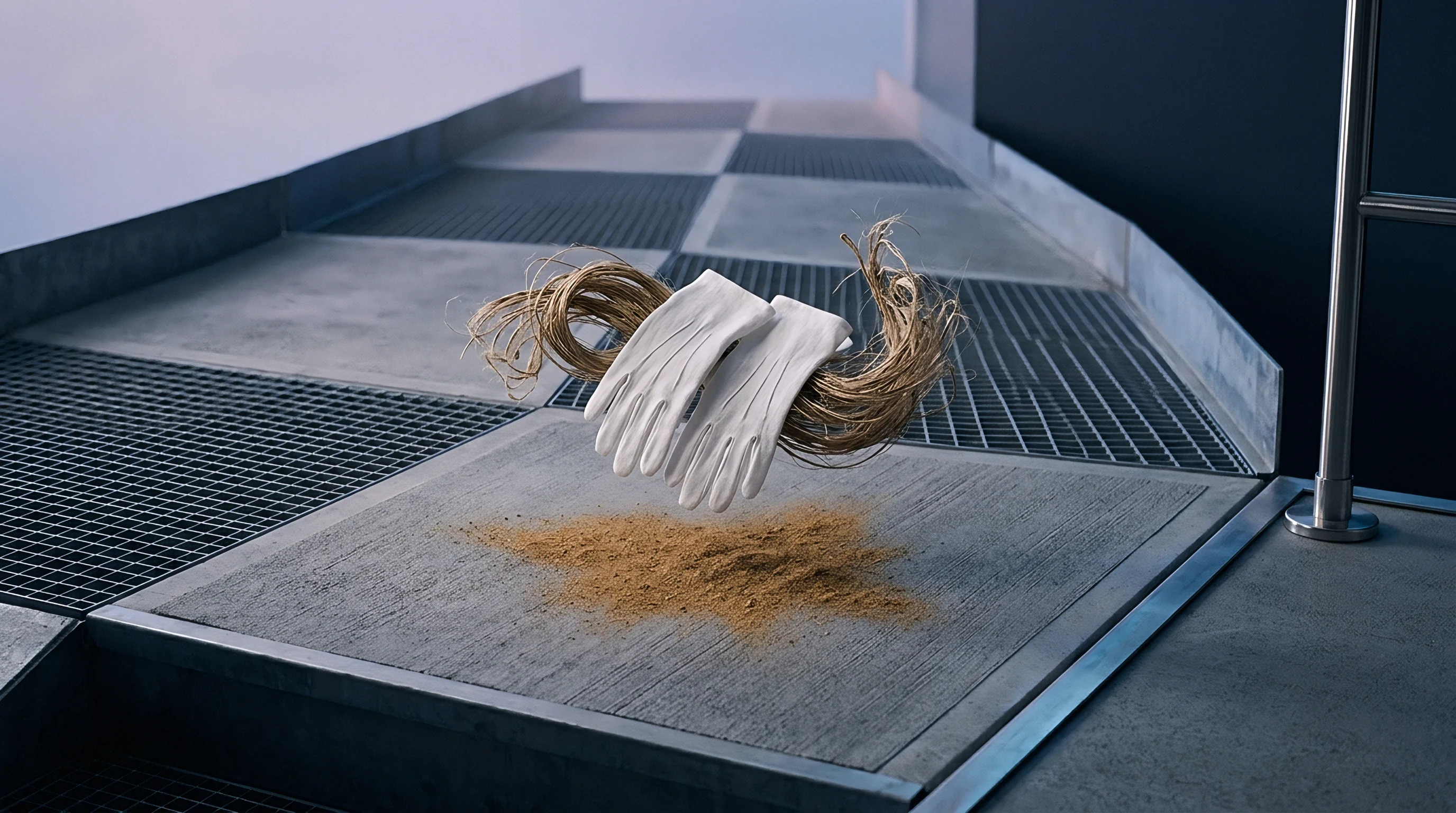
Residual Pectin Volatilization Dynamics
Beyond applied oils, boiling and bleaching treatments alter the non-cellulosic composition of flax roving. Alkali boiling removes water-soluble pectins and hemicelluloses, shifting the baseline dry mass of treated roving. Unboiled raw roving contains active pectins that release micro-quantities of bound carbon dioxide and volatile organic acids under prolonged exposure to dry 105°C air.
To differentiate chemical decomposition from water loss, advanced textile laboratories utilize thermogravimetric analysis coupled with mass spectrometry (TGA-MS). Testing confirms that water release peaks between 80°C and 102°C, whereas pectin breakdown products emerge slowly above 104°C. Standard lab ovens cannot separate these fractions without accompanying solvent extraction steps.
Solvent extraction adjustments under ISO 3074 are mandatory whenever applied finish oil concentrations exceed 0.5 percent by mass on grey roving.
Heavier applications of spinning lubricant always require explicit solvent extractions before oven drying to prevent billed fiber mass from carrying chemical oil weights into commercial calculations.
Scale
Precision weighing instruments used in industrial textile laboratories measure mass down to fractions of a milligram under strict environmental controls. Gravimetric accuracy dictates whether measured regain values hold legal validity during commercial weight reconciliations. Mechanical balance drift, air buoyancy forces, ambient temperature gradients, and static electrical charges on dry roving strands introduce physical measurement errors that distort calculations unless controlled.
Analytical balances used for specimen testing must demonstrate readability to 0.001 grams for 50-gram samples, or 0.01 grams for 500-gram industrial baskets. Balances must be calibrated periodically against ISO/IEC 17025 certified class F1 stainless steel reference weights.

Air Buoyancy Corrections in Gravimetric Analysis
Hot, low-density air inside oven-drying containers weighs less than dense, cool ambient air surrounding analytical balances. When a hot weighing bottle or drying basket is placed onto a balance pan, warm thermal convection currents stream upward along the container walls, creating an upward aerodynamic force that reduces apparent sample mass. Furthermore, the true volume of air displaced by the fiber sample introduces classical Archimedes buoyancy forces.
True mass (Mtrue) is calculated from apparent balance mass (Mapp) using ambient air density (ρair), balance calibration weight density (ρweights, typically 8000 kg/m³ for brass or stainless steel), and fiber density (ρfiber, approximately 1540 kg/m³ for crystalline flax cellulose):
M_true = M_app (1 + (rho_air ((1 / rho_fiber) – (1 / rho_weights))))
At standard ambient conditions (20°C, 101.325 kPa, dry air density 1.204 kg/m³), the air buoyancy correction factor for flax fiber equals approximately +0.00066. While small, across a 100-gram sample this adjustment adds 0.066 grams of corrected mass, shifting calculated regain by nearly 0.07 percentage points. In high-value multi-ton transactions, ignoring buoyancy adjustments alters commercial billing figures by thousands of currency units.

Complete Worked Gravimetric Regain Calculation
To demonstrate practical execution, consider a commercial lot of wet-spun flax roving delivered to a yarn mill with a declared invoice mass of 10,000.0 kilograms. An independent laboratory extracts representative roving specimens to establish true dry mass and billed weight under ISO 6741 criteria.
Laboratory measurement data recorded during sampling and testing:
Gross Initial Sample Mass with Container (M1): 165.420 grams
Tare Mass of Sealed Container (Mt): 65.420 grams
Initial Wet Specimen Mass (Mw = M1 – Mt): 100.000 grams
Uncorrected Oven Dry Mass with Container at 105°C (M2): 153.220 grams
Uncorrected Dry Specimen Mass (Md,raw = M2 – Mt): 87.800 grams
Soxhlet Extracted Non-Water Lubricant Residue Mass (Me): 1.200 grams
Contract Commercial Regain Allowance (Rc): 12.00 percent
Derivation of lot dry mass and commercial invoiced mass:
1. Uncorrected Regain Calculation (Rraw):
R_raw = ((100.000 – 87.800) / 87.800) 100 = 13.895 %
2. Corrected Bone-Dry Fiber Mass (Md,corr):
M_d,corr = 87.800 – 1.200 = 86.600 grams
3. True Water Mass (Mwater):
M_water = 100.000 – 86.600 – 1.200 = 12.200 grams
4. Corrected Moisture Regain (Rcorr):
R_corr = (12.200 / 86.600) 100 = 14.088 %
5. Commercial Mass Factor Calculation (Fcomm):
F_comm = (100 + R_c) / (100 + R_corr) = (100 + 12.00) / (100 + 14.088) = 112.00 / 114.088 = 0.981698
6. Corrected Invoice Billing Mass for 10,000.0 kg Lot (Mbilled):
M_billed = 10,000.0 0.981698 = 9,816.98 kg
The calculation reveals that the delivered lot contained excessive water and lubricant mass. Rather than paying for 10,000.0 kilograms, the buyer’s adjusted financial billable mass sits at 9,816.98 kilograms, generating a billable weight credit of 183.02 kilograms.
Audit protocol for verifying commercial lot dry mass across mill delivery shipments:
- Inspect sample container seals for structural damage, recording individual package tracking numbers against weighbridge bills of lading.
- Verify balance calibration status using class F1 traceably calibrated standard masses, recording ambient room temperature, pressure, and relative humidity.
- Determine container tare weights following thermal stabilization at 105°C and 45 minutes of desiccator cooling under sealed conditions.
- Extract multi-point roving samples from internal bobbin cores, stripping outer layer windings prior to sealing samples into pre-weighed vessels.
- Record initial wet mass immediately upon sample collection to prevent atmospheric moisture exchange with ambient mill air.
- Execute thermal oven drying at 105°C ± 2°C until consecutive weighings spaced 15 minutes apart demonstrate constant mass equilibrium below 0.05 percent variance.
- Perform Soxhlet solvent extraction on dried specimens using dichloromethane to isolate applied spinning oils and natural waxes.
- Apply air buoyancy corrections and extractable deducts to establish corrected bone-dry fiber mass and commercial billing figures.
Zeroing balance systems and executing buoyancy compensation involves a structured setup procedure:
- Level the analytical balance chamber using adjustable tripod feet until the spirit bubble centers within the target indicator ring.
- Engage internal calibration motor routines or manually apply a 100.000-gram certified class F1 reference mass to establish zero span stability.
- Measure ambient air temperature using a calibrated glass thermometer placed inside the balance enclosure to calculate ambient air density.
- Place the empty pre-dried weighing vessel onto the pan center, allow airflow draft shields to close completely, and tare the scale display to zero.
- Transfer dried fiber specimens directly into the vessel, secure container lids, and record stable apparent mass values to 0.001-gram precision.
- Calculate buoyancy adjustment factors using measured air density and standard flax fiber density constants before computing dry mass.
Air buoyancy corrections add 0.066 grams of mass per 100 grams of dry flax fiber when weighed in standard atmosphere conditions.
When auditing spinner records, raw scutched bast fiber moisture certificates are reconciled against draft roving moisture readings to detect untracked water addition during mill processing.
Standard commercial contract specifications following international flax trading rules state that any certified dry mass determination conducted without buoyancy and solvent corrections voids the official weight certificate and reverts invoice billing to net delivered scale mass.

Settlement
Commercial financial transactions in bast fiber trading hinge directly on calculated billing weights derived from oven-dry figures. When international yarn traders, spinners, and weaving mills sign sales contracts for flax roving, price terms are pegged to a agreed cost per kilogram of commercial fiber mass. Uncorrected regain variances, inaccurate sampling, or failure to account for applied lubricants directly shift the financial settlement balance between contracting parties.
If a shipment contains more moisture than the official standard allowance, the buyer pays for water unless commercial mass adjustments are calculated and credited against the invoice. Conversely, if a mill delivers roving dried below standard regain levels, the buyer receives more solid cellulose per ton than billed, unfairly penalizing the seller unless proper moisture regain adjustments are applied.
Commercial Mass Calculation Mechanics
Calculating invoiced commercial mass (Mc) across commercial deliveries uses international standards laid down by CELC and CIDE rules. Commercial mass represents the true corrected bone-dry fiber mass (Md,corr) multiplied by the official commercial regain allowance factor (1 + (Rc / 100)), plus allowed processing additives (Ap):
M_c = M_d,corr (1 + (R_c / 100)) (1 + (A_p / 100))
Where Rc is the agreed standard commercial regain (typically 12.00 percent for grey flax roving) and Ap represents contractual finish allowances (often capped at 1.00 to 1.50 percent).
| Measured Regain (%) | Corrected Dry Fiber Mass (kg) | Commercial Mass At 12% Regain (kg) | Invoiced Weight Variance (kg) | Financial Settlement Adjustment ($) |
|---|---|---|---|---|
| 10.00 | 18,181.82 | 20,363.64 | +363.64 | +$4,363.68 (Credit to Seller) |
| 11.00 | 18,018.02 | 20,180.18 | +180.18 | +$2,162.16 (Credit to Seller) |
| 12.00 (Standard) | 17,857.14 | 20,000.00 | 0.00 | $0.00 (Par Settlement) |
| 13.00 | 17,699.12 | 19,823.01 | -176.99 | -$2,123.88 (Credit to Buyer) |
| 14.00 | 17,543.86 | 19,649.12 | -350.88 | -$4,210.56 (Credit to Buyer) |
| 15.00 | 17,391.30 | 19,478.26 | -521.74 | -$6,260.88 (Credit to Buyer) |
Contractual Dispute Resolution Limits
International bast fiber trading framework rules specify contractual tolerance thresholds to prevent trivial claims while protecting buyers against systematic weight inflation. Under standard CIDE rules, weight adjustments are triggered only when measured moisture regain deviates by more than 0.5 percentage points from the agreed contract baseline.
If contract terms mandate a 12.00 percent regain allowance, measured test regains between 11.50 percent and 12.50 percent settle at face value invoice mass without financial adjustment. Once measured regain exceeds 12.50 percent or falls below 11.50 percent, the entire weight difference back to the 12.00 percent par baseline is recalculated and credited to the affected party. Independent laboratory testing costs are typically assigned to the losing party whose claimed weight fell outside contract tolerances.
Discrepancy Resolution Protocol
Because moisture equilibrium can take twenty-four hours and cold weighing containers absorb ambient moisture, formal dispute resolution procedures are initiated under standard trade terms when buyer and seller testing laboratories report conflicting regain values exceeding 0.5 percent:
1. Joint retain samples, collected during original lot sampling and sealed in aluminum barrier foil, are dispatched to an ISO 17025 accredited neutral testing institution.
2. The arbitration laboratory executes dual-specimen testing using forced-draft ventilated oven drying coupled with Soxhlet solvent extraction per ISO 6741-2 and ISO 3074.
3. The arbitration laboratory’s calculated corrected dry mass and commercial regain figures replace all previous mill and buyer test certificates.
4. Commercial invoice billing is recalculated using the neutral lab figures, and financial balances are settled within 30 days of certificate issuance.
Reconciling invoice tonnages against verified oven-dry mass values protects technical flax buyers from paying fibre prices for residual spinning additives and atmospheric water absorption.