Resolving Inter-Laboratory Microbalance Drift in High-Humidity Bast Fiber Gravimetric Linear Density Audits
Control enclosure humidity to within one percent and apply buoyancy corrections to eliminate inter-laboratory microbalance drift in flax density audits.

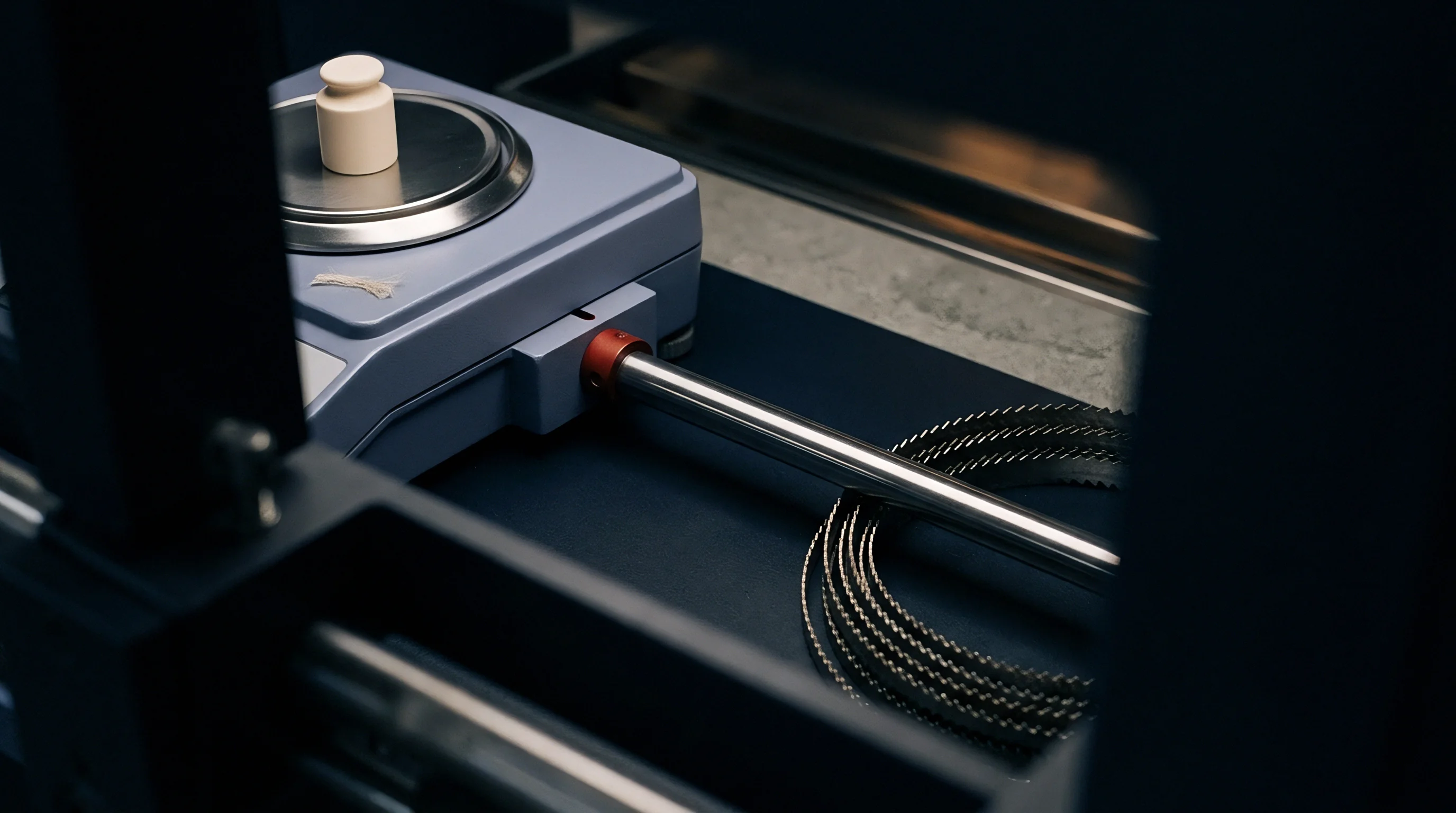
Vault
Precision weighing of bast fibers inside high-humidity testing environments creates distinct mechanical difficulties for micro-gram balances. Once relative humidity clears 65 percent, moisture condensing onto internal pan suspensions and balance housings introduces systematic mass inflation. At six decimal places (0.1 microgram resolution), a microbalance registers thin moisture films forming on stainless steel pans, glass draft shields, and the fibers themselves.
During commercial flax linear density audits under ISO 1973, these micro-gram instabilities often mask true gravimetric differences between test facilities, triggering mistaken batch rejections or incorrect fineness grading.
Microbalances require thorough thermal isolation.
Draft shields help suppress localized convection, but high ambient humidity sharpens thermal gradients across the balance chamber. Heat given off by internal electronics produces small convection cells whenever the surrounding air carries heavy moisture. The rising moist air exerts upward drag on the weighing pan, generating negative drift on dry material and erratic positive drift on hygroscopic fiber bundles.
Standard laboratory air conditioning units frequently cycle by plus or minus two degrees Celsius, enough to cause localized relative humidity swings of up to eight percent inside unsealed enclosures.

Chamber Convection and Air Density Fluctuations
Temperature differentials across draft shields alter local air buoyancy and distort gravimetric linear density readings. Bast fibers like long-staple flax and decorticated hemp take up water rapidly. Placed into a chamber set to 65 percent relative humidity and 20 degrees Celsius, an unconditioned sample gains mass throughout the weighing cycle.
Convective currents inside the shield destabilize the zero point, preventing the balance from settling within typical five-second integration windows.
Relative humidity fluctuations of five percent at twenty degrees Celsius alter moist air density by zero point zero six grams per cubic meter, causing microgram-level balance baseline drift.
Stable measurement requires filtered air circulation that avoids direct impingement on the balance chassis. Isolated weighing enclosures set away from room HVAC diffusers hold baseline drift below zero point five micrograms over two hours. Adding a secondary glass draft shield inside the main housing drops internal air velocity below zero point zero one meters per second.
This dual-barrier setup shields the weighing pan environment, allowing reliable gravimetric audits on low-dtex bast fibers.
The list below identifies primary sources of gravimetric measurement failure in high-humidity laboratories during bast fiber audits.
- Suspension Condensation occurs when ambient water vapor settles on microbalance pan supports, adding variable tare mass during extended measurement series.
- Thermal Convection Currents arise from electronic component heat generation, producing vertical air drag against the underside of the weighing pan.
- Relative Humidity Cycling driven by standard facility HVAC control loops creates transient air density changes within the weighing chamber.
- Operator Body Heat transfers through unshielded enclosure glass, altering local air temperature and corrupting baseline balance equilibrium.
- Hygroscopic Enclosure Materials absorb ambient moisture during high-humidity cycles and bleed vapor into the draft shield during drier periods.
Laboratories frequently blame fiber heterogeneity for inter-laboratory density discrepancies when the actual culprit is uncalibrated environmental drift in high-humidity test rooms.

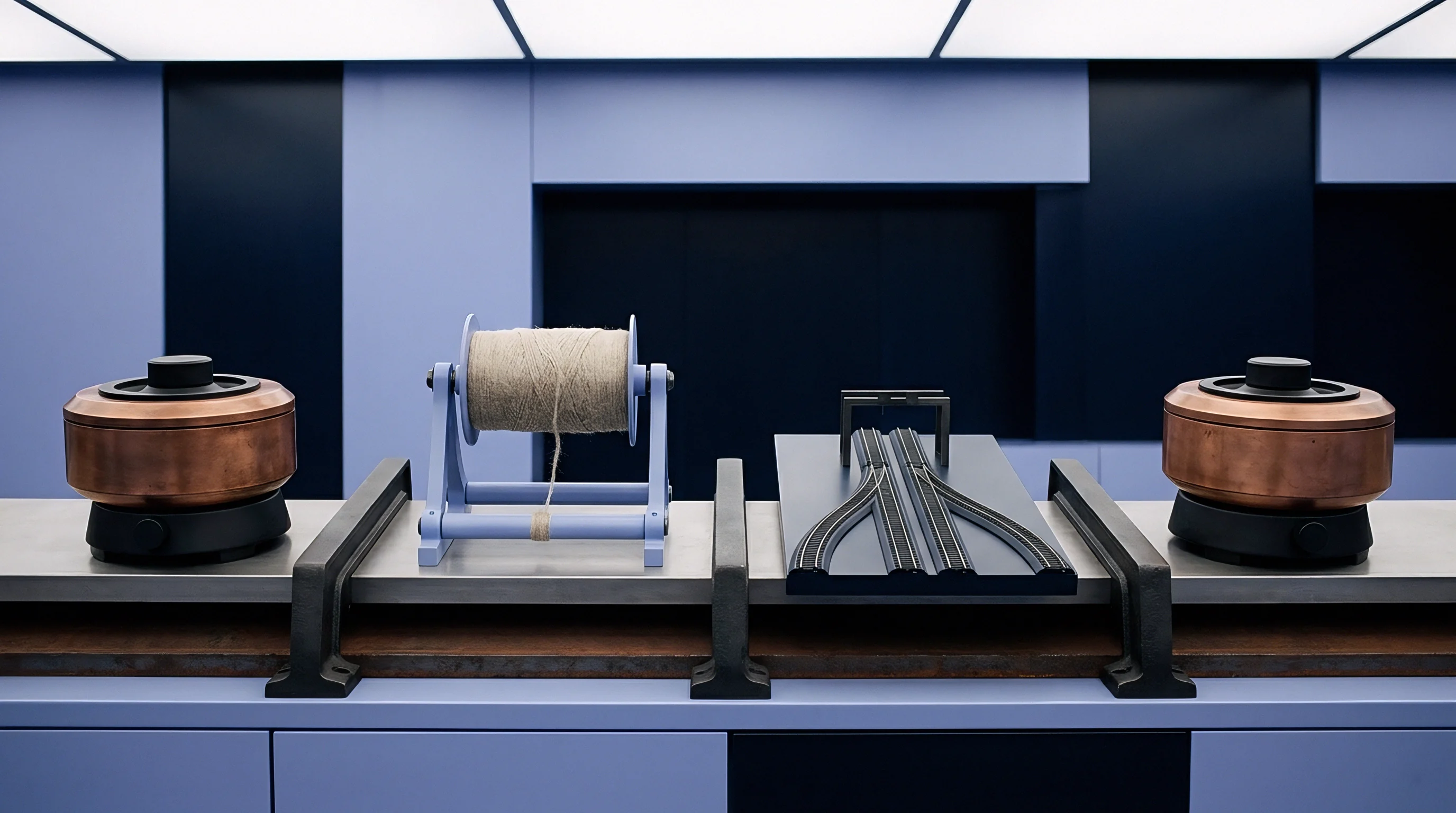
Sorption
Bast fibers feature complex cell walls filled with cellulose, hemicellulose, and pectin. The pectin-rich regions between cells serve as the main sorption sites for atmospheric moisture. While synthetic filaments absorb virtually no vapor, flax line exhibits pronounced sorption hysteresis: a bundle conditioned from a wet state reaches a different equilibrium moisture content than one conditioned from bone-dry conditions at the exact same relative humidity.
Flax fibers absorb ambient water rapidly.
Determinations of linear density in dtex or tex depend on dry mass or standardized commercial moisture regain under ISO 6741. During high-humidity audits, exposed bast bundles take on ambient water vapor until reaching local equilibrium. At 65 percent relative humidity, scutched flax line levels off at roughly eleven point five percent regain.
At 75 percent relative humidity, regain climbs to fourteen point two percent within thirty minutes, inflating calculated linear density by more than two percent without any physical change to the cellulose core.
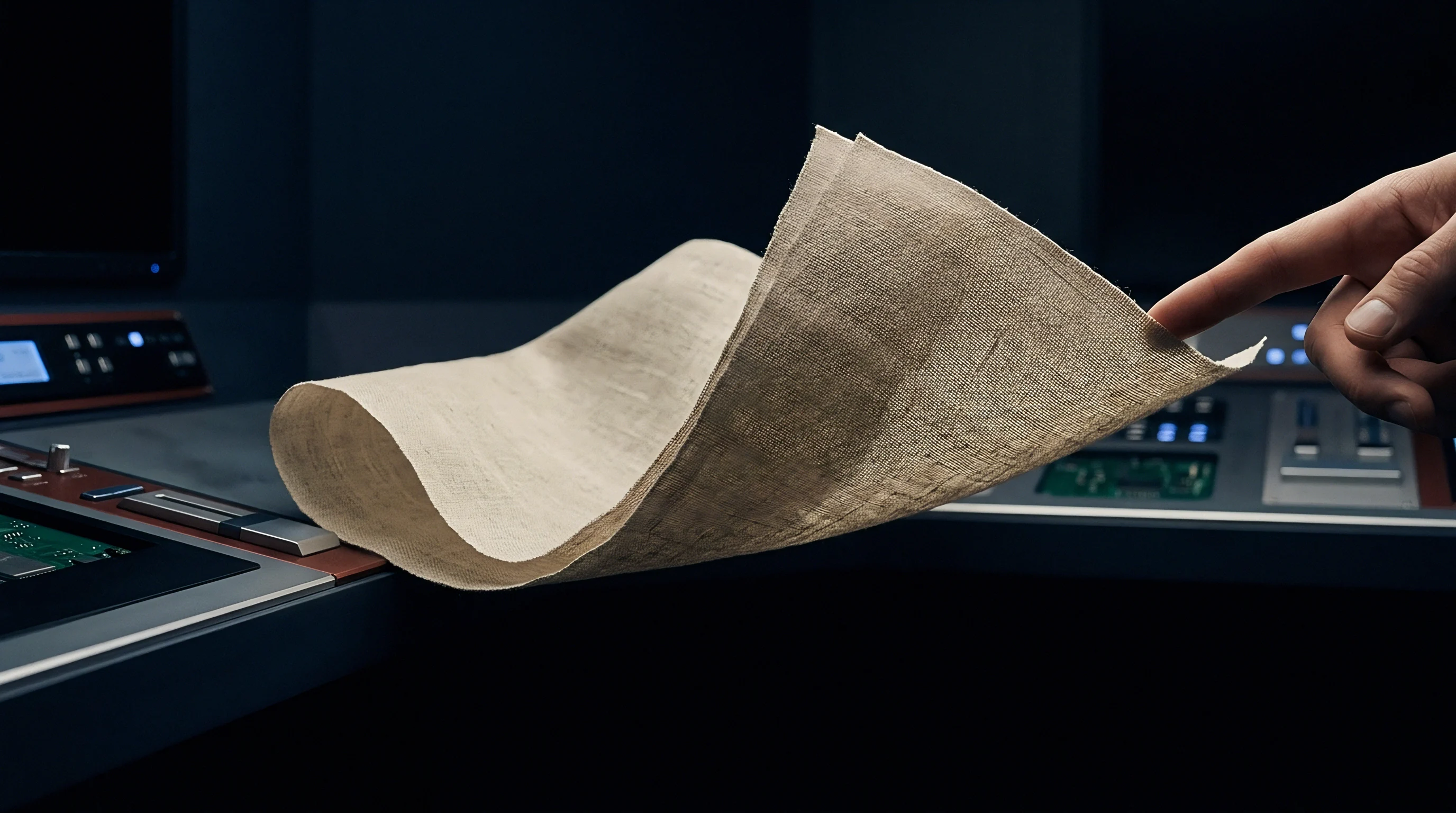
Why Do Microbalance Audits Diverge at High Humidity?
Discrepancies between laboratories trace directly to mismatched moisture uptake rates and inconsistent conditioning histories. Facilities in tropical regions or humid spinning districts often struggle to maintain the standard ISO 139 atmosphere of 20 degrees Celsius and 65 percent relative humidity. If Laboratory A tests flax bundles at 62 percent relative humidity while Laboratory B audits them at 71 percent relative humidity, gravimetric linear density values diverge beyond standard tolerances, sparking commercial grading disputes.
| Relative Humidity (%) | Equilibrium Regain (%) | Apparent Linear Density (dtex) | Mass Deviation from ISO Standard (%) | Measurement Uncertainty (dtex) |
|---|---|---|---|---|
| 55.0 | 9.20 | 1.820 | -2.06 | ±0.012 |
| 60.0 | 10.35 | 1.839 | -1.03 | ±0.014 |
| 65.0 (Standard) | 11.50 | 1.858 | 0.00 | ±0.015 |
| 70.0 | 12.80 | 1.880 | +1.18 | ±0.018 |
| 75.0 | 14.20 | 1.903 | +2.42 | ±0.022 |
| 80.0 | 16.10 | 1.935 | +4.14 | ±0.028 |
| Data normalized for high-grade scutched water-retted flax line fiber with a nominal oven-dry linear density of 1.666 dtex. Conditioning held for 24 hours per test point. | ||||
Because hysteresis paths govern final mass, bast fibers entering a test vault from damp storage hold more moisture under standard conditions than fibers brought in dry. Pre-drying samples at 50 degrees Celsius in a low-humidity oven before standard conditioning resets this sorption memory, yielding consistent linear density results across testing sites.
Fibre linear density governs yarn count.
Without pre-conditioning, uncorrected moisture uptake distorts commercial test reports, sometimes shifting a lot’s apparent fineness classification by up to two full metric grades during trade qualification.
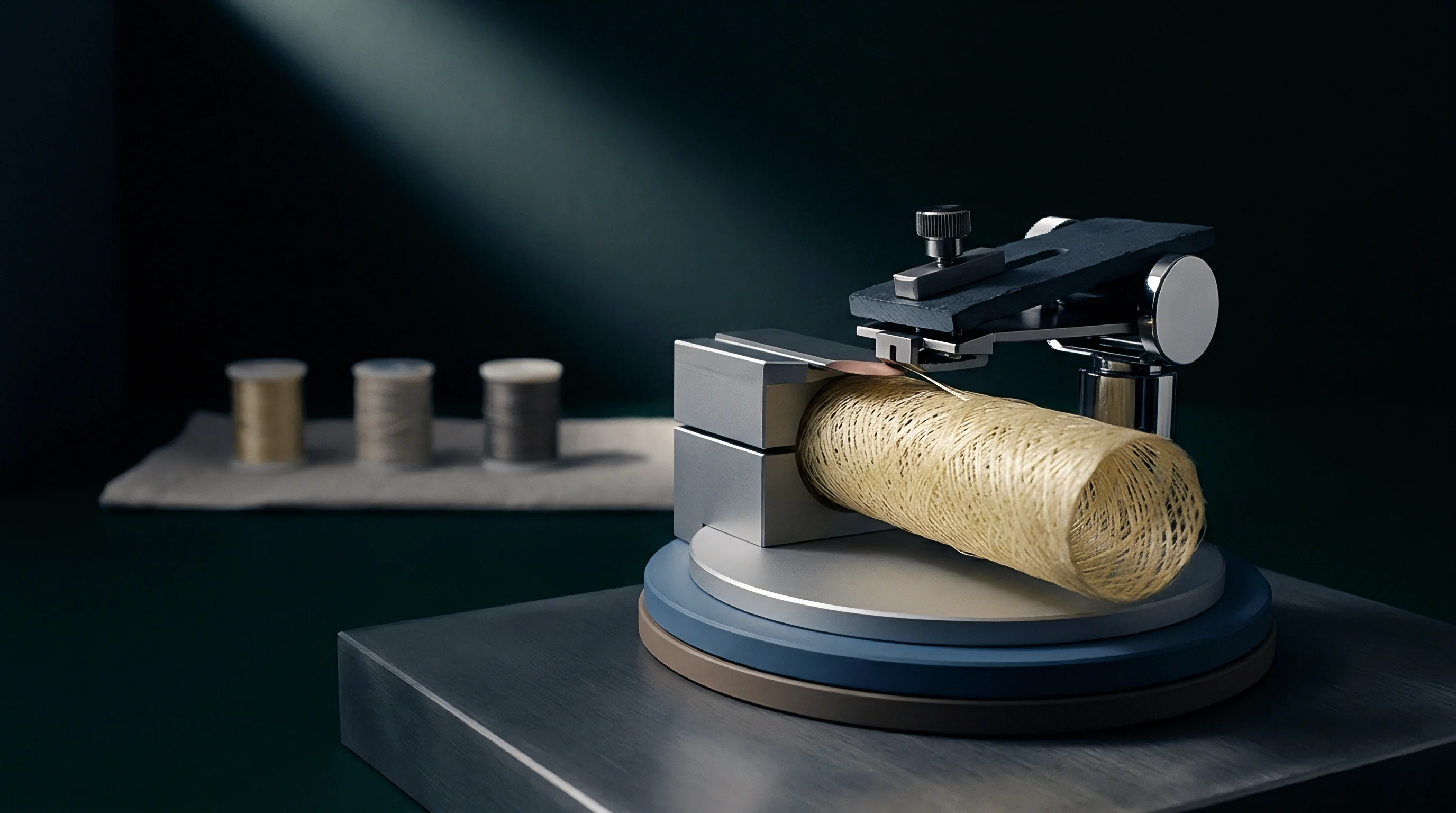
Buoyancy
Air displacement across balance counterweights and fiber samples exerts differential forces on micro-gram sensors. Under Archimedes’ principle, any object displaced in air experiences an upward buoyant force matching the mass of the displaced air. Solid bast fibers have a density around one point five four grams per cubic centimeter, whereas stainless steel calibration weights sit near eight grams per cubic centimeter, creating an uneven buoyant response between sample and standard.
Air density changes alter net buoyancy.
High humidity lowers air density because water vapor is lighter than dry nitrogen and oxygen. At fixed barometric pressure, moist air provides less buoyant lift than dry air. As humidity climbs, this reduced upward force on both the sample and internal reference weights shifts the balance zero point.
Omitting air density corrections introduces systematic error when evaluating sub-milligram fiber bundles.

Mathematical Formulation of Air Density and Buoyancy Corrections
Determining true fiber mass requires continuous tracking of ambient temperature, barometric pressure, and relative humidity or dew point in the weighing area. Air density follows the CIPM-2007 formulation, simplified for laboratory gravimetric use:
Air Density = (0.34848 p – h (0.00252 t – 0.020582)) / (273.15 + t)
where air density is in kilograms per cubic meter, barometric pressure p is in hectopascals, relative humidity h is a percentage, and temperature t is in degrees Celsius. True fiber mass is then calculated against the calibration weight density and the conditioned fiber’s solid density:
True Mass = Apparent Mass (1 – (Air Density / Calibration Weight Density)) / (1 – (Air Density / Fiber Density))
| Temperature (°C) | Relative Humidity (%) | Barometric Pressure (hPa) | Calculated Air Density (kg/m³) | Buoyancy Correction Multiplier |
|---|---|---|---|---|
| 18.0 | 50.0 | 1013.25 | 1.2132 | 1.000639 |
| 20.0 | 65.0 (Standard) | 1013.25 | 1.2014 | 1.000633 |
| 22.0 | 80.0 | 1013.25 | 1.1883 | 1.000626 |
| 25.0 | 85.0 | 1000.00 | 1.1685 | 1.000615 |
Buoyancy adjustments mathematically neutralize systematic baseline offsets caused by differences in lab elevation and seasonal atmospheric pressure swings.
Buoyancy adjustments remain incomplete unless atmospheric pressure and water vapor partial pressures are logged at the exact moment of microbalance balance zeroing.
Real-time atmospheric tracking addresses the gravimetric baseline differences found between coastal testing rooms and high-altitude spinning mills.
Static
Electrostatic charges on bast fiber bundles introduce substantial parasitic forces to microbalance sensors. High humidity typically aids charge dissipation across surface moisture films, but rapid sample prep, aggressive combing, or handling with synthetic tools still generates strong localized charges along individual flax strands. These charges interact with balance walls, glass draft shields, and weighing pans, exerting false vertical and lateral forces on the sensor mechanism.
Static charges degrade balance stability.
Dry air exacerbates charge retention.
Depending on polarity, electrostatic pull can tug the pan up or push it down, mimicking mass fluctuations of tens of micrograms. For bast fiber bundles weighing only zero point five to two milligrams, an uncorrected ten-microgram static force translates to a five percent error in dtex. Ionizing equipment must neutralize charges on both the sample and the weighing chamber before recording final values.
Elimination of Parasitic Charges in Gravimetric Audits
Consistent microbalance operation relies on grounded workstations and active ionization. Point-source AC ionizers installed inside the draft shield eliminate surface charge on fiber bundles within five seconds. Operators must wear grounded wrist straps and handle specimens with conductive stainless steel or ceramic forceps; non-conductive plastic tweezers build up static potentials that interfere directly with microbalance restoration coils.
The numbered procedure below details the physical steps for electrostatic charge neutralization and ground path verification during microbalance audits.
- Verify that the microbalance chassis connects directly to an active earth ground point via a braided copper bonding strip with resistance below one ohm.
- Activate the spatial de-ionizing blower positioned inside the balance vault enclosure at least fifteen minutes prior to commencing fiber weighings.
- Place the cut bast fiber specimen bundle onto a grounded conductive ceramic sample tray using anti-static titanium forceps.
- Pass the loaded sample tray directly under a focused point-source ion bar operating at five kilovolts alternating current for three seconds.
- Transfer the fiber bundle onto the microbalance weighing pan, close the motorized draft shield, and allow electrostatic force dissipation to settle.
- Observe the real-time mass reading display for ten seconds to ensure zero electrostatic drift before accepting the final gravimetric figure.
Skipping static dissipation allows stray electrical forces to skew gravimetric calculations, compromising round-robin reproducibility and fiber fineness classifications.


Calibration
Aligning linear density results across different testing sites requires strict calibration routines and standardized protocols. Round-robin testing frequently uncovers inter-lab variances above eight percent when facilities use mismatched reference weights, uncalibrated humidity sensors, or inconsistent cutting tools. ISO 1973 outlines general gravimetric methods, but consistent execution depends on uniform sample preparation and balance verification.
Unconditioned samples invalidate the audit.
Microbalances used for bast fiber testing need daily single-point internal calibration using built-in weights, along with monthly external verification using Class E1 micro-weights traceable to national standards. Because high humidity can contaminate the surface of stainless steel calibration masses, reference weights should be kept in desiccators at 20 degrees Celsius and 30 percent relative humidity when not in use.
Inter-Laboratory Audit Round-Robin Variance Controls
Controlling gauge length during cutting is critical for linear density accuracy. Calculated density is bundle mass divided by length: a zero point one millimeter error on a fifty-millimeter specimen creates a zero point two percent systematic error in the final figure. Precision double-bladed cutters with tungsten carbide edges ensure uniform lengths and remove cutting variability between operators.
| Fineness Grade | Nominal Density (dtex) | Within-Lab Tolerance (dtex) | Inter-Lab Reproducibility Limit (dtex) | Maximum Permissible Deviation (%) |
|---|---|---|---|---|
| Extra Fine Line | 1.20 – 1.50 | ±0.015 | ±0.035 | 2.50 |
| Fine Line | 1.51 – 1.80 | ±0.020 | ±0.045 | 2.65 |
| Medium Line | 1.81 – 2.20 | ±0.025 | ±0.055 | 2.75 |
| Coarse Tow / Line | 2.21 – 3.00 | ±0.035 | ±0.080 | 3.00 |
Enforcing compliance requires clear decision criteria for resolving commercial grade disputes.
The list below outlines the decision criteria required when auditing bast fiber linear density test reports across regional laboratories.
- Environmental Verification demands continuous temperature and relative humidity telemetry logs covering the forty-eight hours preceding specimen weighing.
- Equilibrium Mass Stability mandates that consecutive gravimetric readings taken three minutes apart vary by less than zero point two micrograms.
- Cutting Gauge Calibration requires optical micrometer verification of blade separation distances on a monthly schedule.
- Buoyancy Adjustment Logging requires raw mass outputs, ambient atmospheric pressures, and calculated air densities to accompany every certified report.
- Hysteresis Normalization mandates documented proof of specimen pre-drying at fifty degrees Celsius prior to standard atmosphere conditioning.
Standard contracts require inter-laboratory gravimetric linear density variances above two point five percent to trigger automatic referee re-testing by an independent certified testing facility.
Under ISO 17025 accreditation standards, test certificates submitted without matching ambient pressure and humidity logs fail validation during trade disputes.


Arbitration
Commercial flax contracts settle on certified fineness, hackling yield, and moisture-free clean mass. Linear density sets the limit on spinnable yarn count: a lot verified at 1.65 dtex spins cleanly into fine Nm 39 wet-spun yarn, whereas 1.85 dtex limits production to Nm 33 before excessive end-breakage halts the frame. Unresolved microbalance drift leads directly to misclassified grades and financial loss for mills or merchants.
Commercial mass dictates the final invoice.
Retting variance alters sorption rates.
Drafting forces depend on fineness.
If Laboratory A measures a shipment at 1.68 dtex and Laboratory B reports 1.82 dtex because of balance drift in high humidity, the contractual valuation changes markedly. On a 40-tonne contract of scutched flax line priced at nine Euros per kilogram, a five percent linear density gap represents a lost yarn yield worth zero point sixty-five Euros per finished meter of high-density cloth. Standardized gravimetric protocols resolve these discrepancies before they turn into claims.
Yield Arithmetic and Landed Cost Adjustments
In a standard trade dispute, consider a 20-tonne consignment of water-retted flax line contracted at 1.70 dtex. The receiving mill audits incoming bales in an unsealed room at 78 percent relative humidity using an uncorrected microbalance, measuring an apparent 1.84 dtex. On that basis, the buyer issues a debit note demanding an eight percent price concession for poor spinning performance.
Re-evaluating the lot under strict environmental controls (20 degrees Celsius, 65 percent relative humidity, chamber de-ionization, and buoyancy correction) confirms a true density of 1.71 dtex, well within the contract tolerance of plus or minus two percent. Documented gravimetric controls protect the supplier from an unfounded fourteen thousand four hundred Euros penalty on the 20-tonne lot.
Unresolved gravimetric measurement errors shift calculated landed fabric production costs without changing a single physical fiber parameter on the spinning floor.
Systematic corrections for humidity, buoyancy, and electrostatic interference preserve consistency in bast fiber trading. Aligning microbalance procedures across commercial laboratories ensures recorded linear densities reflect actual fiber dimensions, safeguarding contract terms and spinning mill yields.