ISO 2370 Gravimetric Bundle Linear Density Test Method Execution
ISO 2370 gravimetric testing determines flax bundle linear density in millitex by weighing fifty-millimetre cut bundles under strict atmospheric conditioning.

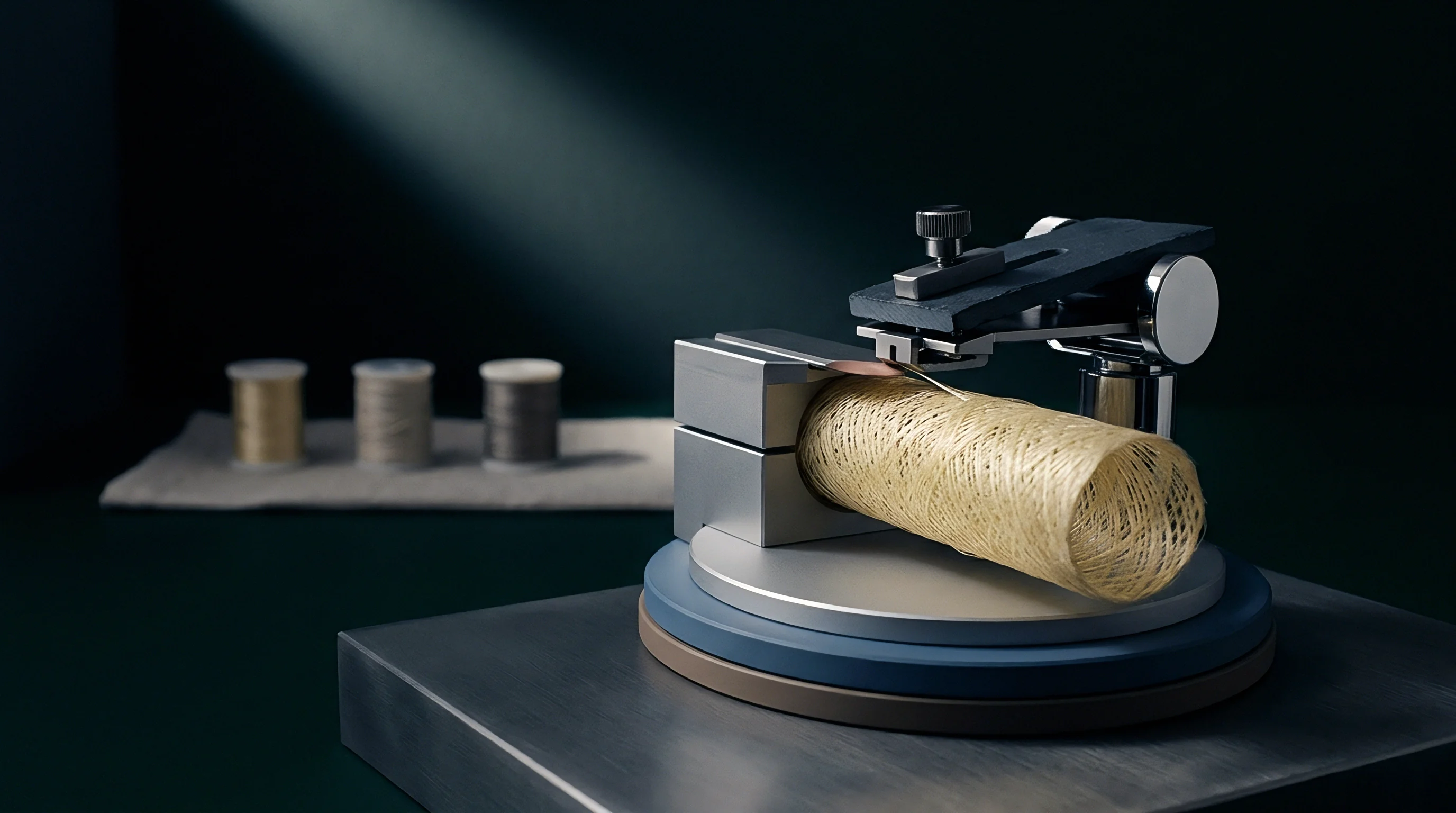
Clamp
Fibre bundle linear density evaluation relies on cutting pre-tensioned technical flax strands to exact length. ISO 2370 establishes the gravimetric protocol where bundles of combed, parallelised flax fibres are secured under defined tension, trimmed cleanly at both ends, and weighed on a high-precision microbalance. This measurement determines the mass per unit length of technical fibre bundles, expressed in millitex or tex.
The resulting linear density figure directly governs spinnable yarn count limits, drafting cohesion inside the drawing frame, and the mechanical yield of hackled flax slivers.
Technical flax fibres exist as composite bundles bound by inter-cellular pectin, hemicellulose, and lignin matrices. Unlike single-stem synthetic filaments, a flax fibre bundle exhibits variable cross-sectional geometry along its longitudinal axis. Executing ISO 2370 demands precise mechanical isolation of the middle segment of the technical fibre strand, avoiding the tapered root and tip ends where linear density degrades reliability.
Fibre Bundle Parallelisation Routine
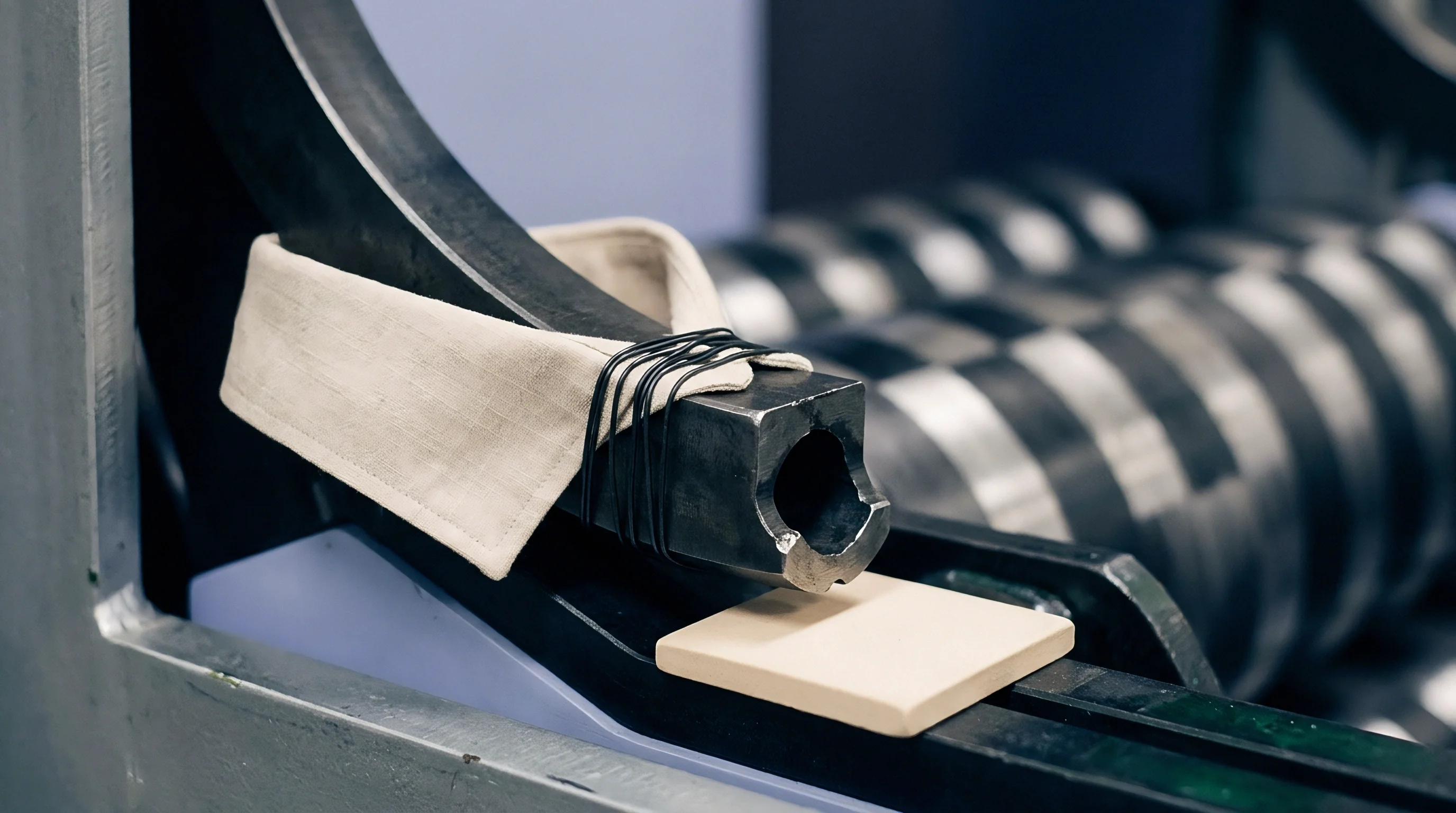
Manual combing removes loose short fibres, entangled knots, and surface debris from raw scutching ribbons. The analyst selects representative sliver or strick samples following ISO 9862 sampling routines. Using a hand comb equipped with steel pins spaced at 15 to 20 pins per centimetre, the operator draws the flax bundle repeatedly through the pin bed until all individual technical strands align parallel to one another.
Alignment requires consistent hand tension to prevent mechanical crimping or false elongation. The operator mounts the combed bundle into a dual-clamp apparatus, applying a standard pre-tension force of 50 centinewtons per bundle. This mechanical load ensures that every individual technical fibre sits taut across the cutting span without exceeding the elastic yield point of the raw bast structure.
A cut bundle length of fifty millimetres isolates the central uniform section of long line flax while removing variable tapering tip ends.
Guillotine Cut Geometry
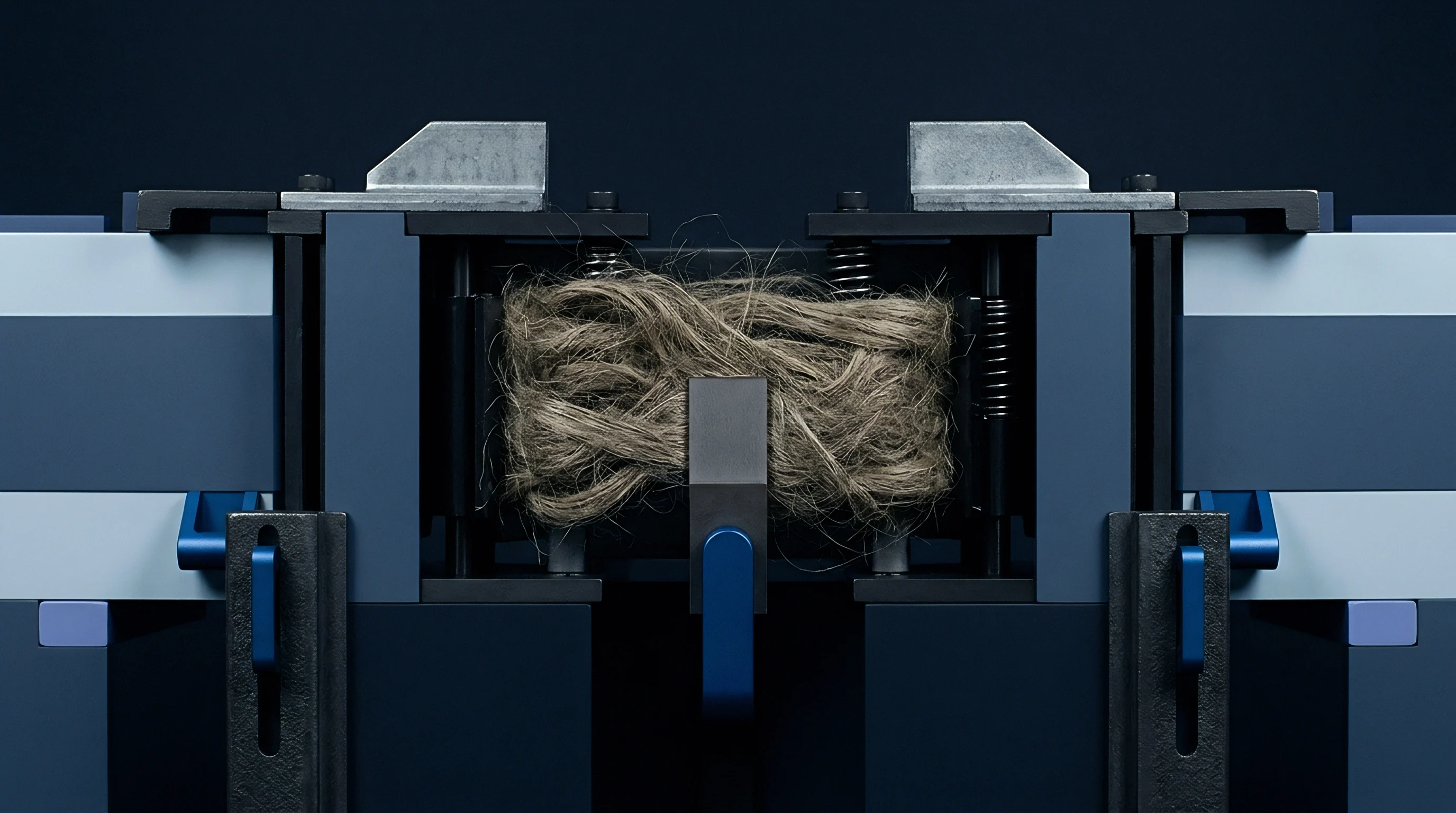
Blade edges configured in parallel alignment isolate specimen segments at uniform spatial intervals. ISO 2370 specifies cutting distances of 10 millimetres, 20 millimetres, or 50 millimetres depending on the clamp microtome fixture employed. For long-line hackled flax, a 50-millimetre cut length minimizes edge fraying errors and maximizes total weighed mass, improving balance resolution.
Guillotine blades demand regular edge sharpening. Dull cutter blades push or crush technical fibres during clamping, altering the effective cut length and dragging broken ultimates out of the specimen block. The precision shear assembly operates perpendicular to the aligned fibre axis within a tolerance of plus-or-minus 0.1 degrees.
Clean shearing action prevents fibre pull-out, preserving the exact volumetric segment defined by the blade separation gap.
ISO 2370 section 6.2 shifts the acceptable cut length tolerance from plus-or-minus 0.2 millimetres down to 0.05 millimetres, altering the valid specimen rejection threshold for high-count line flax contracts.


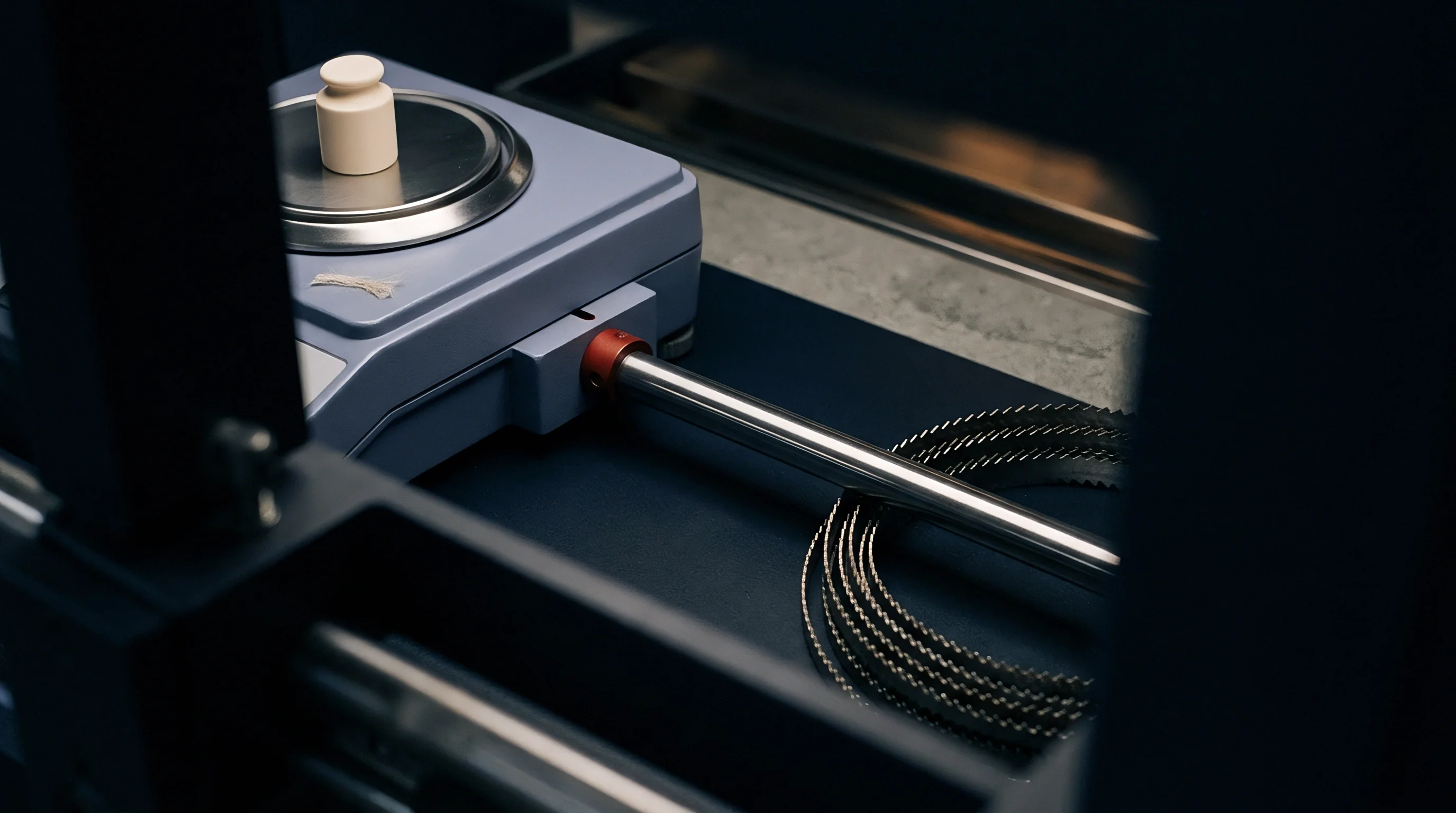
Scale
Gravimetric precision demands strict moisture control across all weighed flax specimens. Bast fibres absorb surrounding atmospheric water vapour rapidly, shifting raw bundle mass by several percent within minutes of ambient exposure. ISO 2370 dictates conditioning all test samples to moisture equilibrium inside a standard temperate atmosphere prior to cutting and weighing.
Reaching moisture equilibrium requires twenty-four hours under standard test conditions of 20 plus-or-minus 2 degrees Celsius and a relative humidity of 65 plus-or-minus 4 percent, per ISO 139 rules. Weighed mass accuracy hinges on microbalance sensitivity, requiring analytical balances capable of measuring down to 0.001 milligrams.

Atmospheric Equilibrium Parameters
Relative humidity control prevents mass fluctuations caused by rapid water absorption in bast structures. Dry flax bundle mass varies linearly with ambient relative humidity changes above 50 percent. When transfer from the conditioning chamber to the balance pan takes longer than thirty seconds, unconditioned room air skews mass readings, artificially inflating reported linear density values.
| Material State | Conditioning Temperature | Relative Humidity | Minimum Conditioning Time | Balance Resolution Target |
|---|---|---|---|---|
| Scutched Long Line Flax | 20 plus-or-minus 2 °C | 65 plus-or-minus 4 % | 24 Hours | 0.001 mg |
| Combed Hackled Sliver | 20 plus-or-minus 2 °C | 65 plus-or-minus 4 % | 12 Hours | 0.001 mg |
| Enzyme-Retted Tow Strand | 20 plus-or-minus 2 °C | 65 plus-or-minus 4 % | 12 Hours | 0.0005 mg |
| Bleached Roving Specimen | 20 plus-or-minus 2 °C | 65 plus-or-minus 4 % | 6 Hours | 0.0005 mg |
Specimen preparation errors distort gravimetric results before the balance pan settles. Identifying physical failure modes during bundle combing and trimming prevents unrepresentative mass data from entering mill compliance reports.
- Incomplete Epidermal Stripping Loose bark fragments attached to the fibre bundle add non-cellulosic mass, inflating the calculated linear density by up to eight percent.
- Fiber Misalignment During Clamping Non-parallel alignment of technical fibres within the cutter block leads to skewed diagonal cuts that artificially increase measured bundle length.
- Static Mass Dispersal Electrostatic charges on synthetic velvet preparation boards cause fine ultimate fibres to separate from the bundle before mass measurement.
- Moisture Desorption During Handling Warm hands touching test specimens transfer body heat and moisture, altering equilibrium specimen mass prior to pan placement.
Air currents sweeping directly across open balance pans distort mass readings during microgram specimen determination.

Calculus
Converting weighed bundle mass into standard textile fineness units requires precise mathematical formulation. The fundamental ISO 2370 formula expresses bundle linear density in millitex, representing milligrams per kilometre of fibre length. The calculation combines cut specimen mass, total bundle strand length, and total fibre count when ultimate fibres are enumerated under microscopy.

Gravimetric Mass Equation
Fibre linear density expresses the relationship between specimen weight and physical cut length. For a collective bundle specimen where individual fibres are counted under magnification, linear density Tt in millitex follows the mathematical relation where m equals total specimen mass in milligrams, L equals cut length in millimetres, and N equals the total number of individual technical or ultimate fibres inside the cut specimen block.
The core mathematical expression is:
Tt = (m / (N L)) 10^6
When evaluating collective technical fibre bundles without counting individual ultimates, the collective linear density Tt_bundle in tex simplifies to total mass in milligrams divided by cut length in millimetres. Conversion to metric fibre fineness number Nm follows the inverse relationship where Nm equals 1000 divided by linear density in tex.
Consider a practical laboratory test scenario across three distinct commercial flax fibre streams under ISO 2370 execution rules. Assume standard laboratory atmospheric conditioning at 20 degrees Celsius and 65 percent relative humidity, with a fixed cutting length L of 50 millimetres. Standard cutter fixtures isolate ten specimen replicates per fibre lot.
Across Grade A hackled long-line flax, Grade B scutching tow, and Grade C enzyme-retted line flax cut to a standard length of fifty millimetres, specimen mass yields vary significantly. For Grade A, ten cut specimen bundles yield a cumulative dry mass m of 4.85 milligrams across an aggregated count N of 500 counted technical fibres. For Grade B scutching tow, ten cut bundles produce a cumulative mass m of 8.20 milligrams for 400 technical fibres.
For Grade C enzyme-retted line flax, ten cut bundles yield 3.10 milligrams for 450 technical fibres.
Calculating Grade A hackled long-line flax linear density:
Tt_A = (4.85 mg / (500 50 mm)) 10^6 = (4.85 / 25000) 10^6 = 0.000194 10^6 = 194 millitex (0.194 tex)
Metric fineness Nm_A = 1000 / 0.194 = 5154 Nm
Calculating Grade B scutching tow linear density:
Tt_B = (8.20 mg / (400 50 mm)) 10^6 = (8.20 / 20000) 10^6 = 0.000410 10^6 = 410 millitex (0.410 tex)
Metric fineness Nm_B = 1000 / 0.410 = 2439 Nm
Calculating Grade C enzyme-retted line flax linear density:
Tt_C = (3.10 mg / (450 50 mm)) 10^6 = (3.10 / 22500) 10^6 = 0.0001378 10^6 = 137.8 millitex (0.1378 tex)
Metric fineness Nm_C = 1000 / 0.1378 = 7257 Nm
Fine line flax registers lower millitex values. The calculated metrics show clear physical differentiation: Grade C enzyme-retted flax holds the finest bundle structure, achieving 137.8 millitex, which allows wet spinning into fine yarn counts up to Nm 80. Grade B tow exhibits coarse linear density at 410 millitex, restricting its commercial application to coarse dry-spun counts below Nm 18.
| Fibre Stream | Cut Length (mm) | Specimen Mass (mg) | Fibre Count in Cut | Derived Linear Density (mtex) | Derived Metric Fineness (Nm) |
|---|---|---|---|---|---|
| Hackled Long Line Flax (Grade A) | 50.0 | 4.85 | 500 | 194.0 | 5154 |
| Scutching Tow Strand (Grade B) | 50.0 | 8.20 | 400 | 410.0 | 2439 |
| Enzyme-Retted Line Flax (Grade C) | 50.0 | 3.10 | 450 | 137.8 | 7257 |
| Water-Retted Dew-Combed Line | 50.0 | 3.95 | 480 | 164.6 | 6075 |
At a standardized bundle length of 50 millimetres and a target specimen mass of 5 milligrams, an uncorrected moisture deviation of 1.5 percent shifts the calculated fineness by 0.12 millitex.
The industry standard figure of 194 millitex for hackled long-line flax rests on dew-retted Western European stock tested under standard temperate conditioning with 50-millimetre bundle cuts. Shift the retting method from dew retting to warm-water retting, and the baseline bundle mass drops by 12 to 15 percent due to enhanced pectin removal, shifting the expected bundle fineness down toward 165 millitex.
Inaccurate bundle linear density measurements lead buyers to select incorrect drafting ratios, generating excessive yarn breakage and adding five percent to spinning waste costs.


Discrepancy
Errors during gravimetric specimen preparation distort reported fineness values across mill test reports. Non-uniform retting degrees leave localized pectin concentrations that inflate bundle mass without enhancing mechanical fibre strength. Identifying analytical error sources ensures raw fibre purchasing specifications match real spinning mill requirements.
Systematic errors arise from specimen handling, blade wear, balance zero-point drift, and improper specimen conditioning, with tow fibres exhibiting a broader fineness spread. Laboratory technicians control calibration routines tightly to prevent compound errors from distorting batch qualification dossiers.

Non-Cellulosic Mass Contamination
Residual epidermis and shive particles alter specimen weight without contributing to true spinnable fibre density. Unretted woody shive fragments glued to the outer surface of technical fibres carry higher volumetric mass than pure cellulosic ultimate walls. When a cutter isolator chops through a shive-laden bundle section, the resulting weighed specimen registers an artificially coarse linear density.
- The operator levels the microbalance housing using the embedded spirit bubble and sets the display zero.
- Calibration check weights of one milligram and five milligrams verify sensor linearity across the operational range.
- Tweezers transfer the cut bundle specimen directly onto the center of the weighing pan without hand contact.
- The balance draught shields close completely, allowing air currents inside the chamber to settle for fifteen seconds.
- The digital mass display stabilizes, and the technician records the dry specimen weight to the nearest microgram.
Static charge displaces delicate fibre cut ends. Uncontrolled static build-up on microbalance weighing pans causes repulsion forces that make milligram specimens appear lighter or unstable during reading acquisition. Anti-static ionizer bars sweeping across the balance chamber neutralize surface charges before taking mass measurements.
ISO 2370 mandates a minimum specimen count of twenty bundle cuts per laboratory lot to reduce the coefficient of variation below six percent.
| Error Mechanism | Primary Cause | Quantitative Impact on Mass | Analytical Offset (mtex) | Correction Procedure |
|---|---|---|---|---|
| Residual Shive Contamination | Under-retted bast epidermis fragments | Plus 5 to 12 % mass | Plus 15 to 35 mtex | Secondary hand-combing prior to cutting |
| Blade Edge Compression | Dull guillotine shearing edges | Minus 2 to 4 % mass | Minus 8 to 15 mtex | Replace cutter blades every 500 cuts |
| Moisture Desorption | Unconditioned laboratory transfer | Minus 3 to 6 % mass | Minus 10 to 22 mtex | Weigh inside climate-controlled enclosure |
| Operator Tension Variation | Manual clamping force inconsistency | Plus/Minus 3 % length | Plus/Minus 9 mtex | Install automated dead-weight pre-tensioner |
Elevated bundle weight readings often stem from natural pectin variations rather than residual shive contamination in the hackled sliver.
Parity
Inter-laboratory test results require rigorous statistical control to confirm measurement reproducibility across different facilities. When a buyer cross-checks an origin supplier test report, bundle linear density averages must align within statistical limits. ISO 2370 defines sampling replicate requirements to ensure that reported millitex values accurately represent multi-tonne shipping lots.
Evaluating the coefficient of variation across bundle test sets isolates true lot variation ~ which stems from agricultural growth conditions, field retting heterogeneity, and hackling machine settings ~ from testing procedure errors.
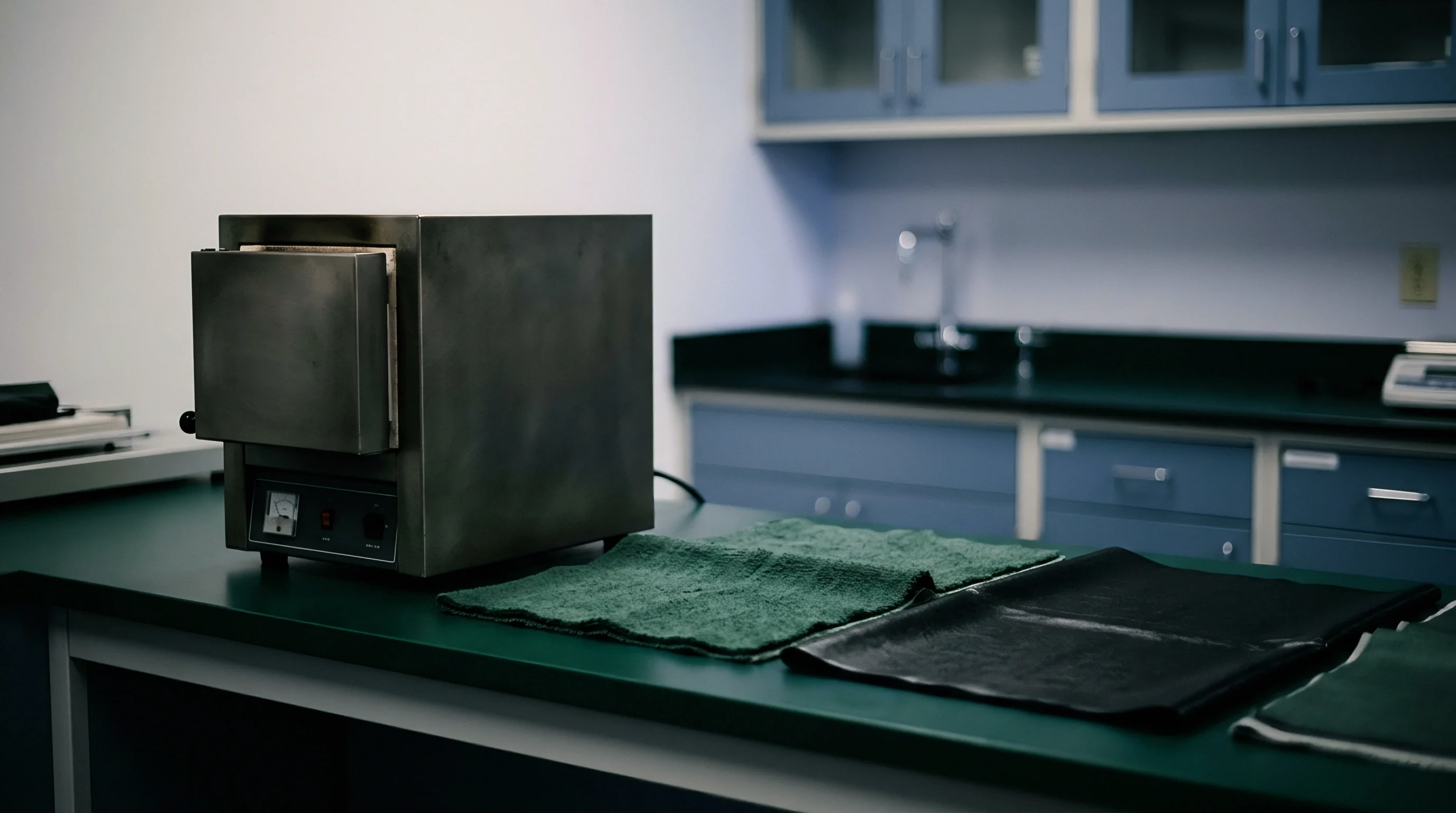
What Bundle Sample Size Balances Statistical Power against Laboratory Execution Time?
Determining the optimal specimen replicate count depends directly on the observed variation within the fibre lot. ISO 2370 specifies a baseline of twenty cut bundle specimens per submitted sample lot. Testing fewer than ten bundle replicates increases the confidence interval width beyond acceptable limits, preventing precise fineness grading.
Because microbalances require vibration isolation, when testing high-uniformity combed line flax slivers, fifteen bundle cuts provide sufficient statistical power to resolve linear density variations down to 5 millitex. For raw scutched tow lots showing high physical heterogeneity, testing thirty replicates remains necessary to achieve a narrow standard error.

Coefficient of Variation Limits
Acceptable fineness thresholds define the boundary between uniform hackled line flax and irregular tow stock. Well-hackled long line flax exhibits a fineness coefficient of variation between 4.5 and 6.5 percent across twenty test bundle cuts. Unretted or unevenly scutched tow lots frequently show variation coefficients exceeding 12 percent.
Laboratory test dossiers showing average bundle fineness values of 180 millitex with a 14 percent coefficient of variation indicate blended tow contamination inside a declared long-line flax sliver order, as unretted shive inflates weighed bundle mass. A cautious buyer demands secondary testing before approving the lot for wet spinning frame loading.
- Coefficient of Variation Threshold Lots exhibiting a fineness coefficient of variation above eight percent require ten additional test bundle replicates to confirm mean linear density.
- Shive Content Reconciliation Bales with gravimetric shive levels exceeding 0.5 percent undergo secondary mechanical combing prior to specimen cutting.
- Target Millitex Compliance Line flax bundles scoring above 1.5 millitex undergo regrading for lower count spinning routes to avoid spinning frame draft interruptions.
Whether high-throughput optical image analysis can achieve equivalent measurement reproducibility without manual bundle preparation remains an open debate across technical testing laboratories.

Settlement
Commercial yarn pricing reflects the verified linear density of raw flax bundles before spinning frames are loaded. Flax fibre trading contracts index pricing directly to hackling yield, staple length, and gravimetric bundle fineness. Finer technical bundles yield higher metric yarn counts, fetching higher market prices per finished metre of spun yarn.
Wet spinning mills set maximum allowable bundle fineness limits for every targeted yarn count, as coarse bundles increase end-breakage rates. When incoming raw line flax measures 220 millitex instead of a specified 180 millitex, the mill must drop the target spinning count from Nm 39 down to Nm 26, altering the finished fabric weight and reducing commercial margin.

Spinnable Count Thresholds
Finer bundle linear density values permit spinning fine warp yarns without excessive frame end breaks. A gravimetric bundle fineness of 140 to 160 millitex supports wet spinning up to Nm 60 counts, suitable for fine shirtings and lightweight apparel fabrics. Bundles measuring 200 to 250 millitex suit medium home-textile yarns around Nm 26 to Nm 33.
Sliver linear density governs yarn count limits. Dry spinning operations utilize coarser tow bundles ranging from 350 to 500 millitex, producing heavyweight upholstery yarns and industrial canvas yarns between Nm 6 and Nm 14. Gravimetric testing under ISO 2370 validates whether a raw fibre shipment can achieve target yarn counts prior to chemical roving preparation.
Coarser bundle linear density readings directly presage higher end-breakage rates during wet spinning at elevated draught ratios.

Landed Yarn Cost Adjustments
Invoice pricing structures incorporate penalty clauses when bundle linear density exceeds contract upper limits. A raw flax lot delivered at 210 millitex against an agreed contract limit of 180 millitex imposes operational financial losses on the mill. The buyer enforces a price discount of 3.5 percent for every 10 millitex deviation above contract target fineness.
Contract clauses specify that bundle linear density data must originate from accredited laboratories running ISO 2370 gravimetric routines with documented microbalance calibration records. Verified fineness data protects the buyer against paying line-flax prices for sub-standard tow blends.
Contractual yarn price tables index grade premiums directly to verified bundle fineness figures before bobbin winding begins.