Integrating Chemical Leaching Allowances into ISO Twenty-Two-Thousand Mass Balance Audits
Integrating chemical leaching allowances into ISO 22000 mass balance audits requires batch-specific mass-loss coefficients to prevent false yield claims.


Sieve
Mass balance verification in food-grade textile wet processing breaks down when chemical extraction losses are left out of raw material records. In ISO 22000 food safety management systems, mass balance accounting tracks raw material inputs against output volumes to verify product origin, purity, and system integrity. Processing flax fibre for food-grade filtration or food contact packaging requires aggressive wet treatments.
Alkaline scouring, acid demineralization, and solvent degreasing extract non-cellulosic matter from raw fibre bundles, causing yields to vary day to day. When auditors treat raw incoming flax mass as a fixed constant without subtracting chemical leaching allowances, mass balance calculations report artificial inventory gaps or hide illicit blending.
The physical transformation of flax fibre during wet refining significantly reduces mass by removing pectins, hemicelluloses, waxes, and residual minerals. Standard ISO 22000 traceability audits enforce strict batch input-output equality. An auditor inspecting a mill in Jiangsu or Flanders checks weighbridge slips for incoming raw flax against final rolled yardage records.
If ten tonnes of scutched flax enter the facility and eight tonnes of finished food-grade fabric leave, the unadjusted ledger indicates a two-tonne inventory loss. Audit teams lacking chemical processing expertise frequently classify this variance as unaccounted wastage or unreported diverted material. Integrating standardized chemical leaching allowances reconciles physical mass loss with regulatory accounting expectations.
- Uncalibrated Dissolution Deductions ~ Auditors accept flat percentage estimates for alkali pectin removal without checking batch liquor analysis records.
- Unmatched Weighbridge Documentation ~ Fibre mass delivered from scutching stores does not align with wet-processed output weights recorded at the finishing line.
- Omitted Moisture Standardizations ~ Raw flax bales arriving at twenty percent moisture content enter mass balance ledgers without conversion to dry weight baseline figures.
- Unregistered Solvent Leaching Rates ~ Chemical extraction runs targeting residual wax removal generate undocumented tare loss across consecutive production lots.
Standard accreditation checks under ISO 22005 for food supply chain traceability require explicit accounting for every mass drop during stage transitions. Scouring removes up to twelve percent of raw fibre weight through pectin solubilization. Acid washing removes ash and trace metal contaminants, dropping total batch mass by an additional one to three percent.
When these extraction steps occur without registered leaching allowances, the mass balance equation yields an accurate physical total only by accident. Audit teams must demand batch-specific laboratory verification of extraction loss factors before signing off on scope certificates.
ISO 22000 Clause 8.5.2 mandates mass accounting adjustments whenever acid digestion removes non-target organic solids from the processing stream.
European Union Regulation 2023/2006 Section 4 specifies that unverified mass loss claims invalidate the transaction certificates for food contact material batches.


Chemistry
Acid digestion and alkaline scouring reduce raw flax mass by removing non-cellulosic encrusting substances during wet refining. Raw scutched flax fibre consists of approximately seventy to seventy-five percent alpha-cellulose. The remaining fraction comprises fifteen percent hemicellulose, five percent pectin, two percent wax and fats, and three percent lignin and ash.
For food-grade applications, including teabag filter media and casing twines, these non-cellulosic constituents must be extracted to prevent chemical migration into consumables, using acid to strip pectin and solvents to remove fats. Each refining phase targets a specific chemical fraction, altering the physical mass balance of the batch.

Solvation Losses across Scouring and Retting
Alkaline scouring uses sodium hydroxide at concentrations between two and five percent by weight of bath liquor, operating at ninety degrees Celsius. This process saponifies fatty acids and hydrolyzes water-insoluble pectins into soluble sodium pectates. The resulting loss of binder material separates fibre bundles into individual technical fibres, reducing overall batch mass by eight to fourteen percent depending on crop origin and retting severity.
Subsequent acid leaching employs dilute hydrochloric or citric acid at pH 2.5 to remove calcium and magnesium ions bound within the cell wall matrix, accounting for a further 1.5 percent reduction in mass.
Raw flax fibre absorbs atmospheric moisture readily, carrying standard commercial moisture regain allowances of twelve percent. Scoured and dried flax fibre exhibits altered hygroscopic properties, shifting post-treatment regain equilibrium to approximately 8.5 percent. An auditor verifying mass balance must separate moisture loss from true chemical solvation loss.
Failure to isolate dry matter extraction leads to skewed yield calculations that misrepresent raw material consumption.
| Stage | Primary Reagent | Solubilized Fraction | Mass Loss Range | ISO 22000 Ledger Adjustment |
|---|---|---|---|---|
| Hot Scouring | NaOH (3% w/v) | Pectins and Hemicellulose | 8.0% to 12.5% | Direct Tare Deduction |
| Acid Leaching | Citric Acid (pH 2.5) | Trace Metals and Ash | 1.0% to 2.2% | Chemical Extraction Factor |
| Solvent Degreasing | Ethanol/Azeotrope | Surface Waxes and Lipids | 1.2% to 2.0% | Non-Solids Allowance |
| Peroxide Bleaching | H2O2 (Stabilized) | Residual Lignin Oxidation | 0.5% to 1.8% | Bleach Loss Coefficient |

Audit Metrics for Lignin and Pectin Loss
Quantitative verification of leaching loss relies on gravimetric measurements taken before and after chemical treatment. The mill laboratory determines the oven-dry mass of raw material inputs using standard thermal drying at one hundred five degrees Celsius until mass stability occurs. Following wet refining, hydro-extraction, and drying, the technical team measures the oven-dry mass of the processed fibre output.
The arithmetic difference defines the chemical leaching allowance for that specific production lot.
When mills operate without lot-by-lot chemical testing, they fall back on generic default yield loss factors. Chinese mills processing European scutched flax often cite a flat fifteen percent total process loss allowance across all high-grade lots. Field verification shows actual chemical dissolution variance ranges between nine and seventeen percent based on field retting conditions in France and Belgium.
Applying static loss estimates allows mills to accumulate unrecorded physical fibre reserves or cover up the addition of uncertified lower-grade cotton or synthetic tow.
- Scouring Tank Batch Records ~ Temperature logs, sodium hydroxide concentration readings, and initial raw fibre weight tickets logged before liquor immersion.
- Liquor Analysis Certificates ~ Spectrophotometric or gravimetric analysis of spent wash water confirming dissolved organic solid concentrations.
- Post Scour Dryer Tare Slips ~ Oven-dry mass measurements recorded immediately following industrial hydro-extraction and heated drying cycles.
- Chemical Addition Manifests ~ Reagent input volumes showing exact acid or alkali tonnage consumed during batch extraction operations.
Integrating analytical testing into ISO 22000 audit protocols establishes an evidence trail for mass reduction. Spent liquor analysis measures chemical oxygen demand and total dissolved solids in effluent streams, providing secondary proof that mass dropped via chemical solubilization rather than physical material diversion. The auditor calculates the mass of dissolved organic carbon in wastewater tanks and matches it against the tare reduction declared on the production ledger.
Process water retention is frequently factored into routine mass balance calculations to offset solubilization mass losses.


Conversion
Batch mass accounting relies on exact mass-loss mathematical factors calculated from empirical laboratory testing rather than nominal estimates. Converting incoming raw flax mass into food-grade material output requires precise tracking of dry mass, moisture regain adjustments, and chemical leaching fractions. In an ISO 22000 mass balance framework, the absolute dry input mass must equal the absolute dry output mass plus the mass of dissolved solids found in processing effluents.

Why Do Solvation Allowances Drift across Seasons?
Flax crop harvests vary annually in chemical composition due to weather conditions during field retting. Wet retting seasons increase biological pectin degradation in the field, reducing the remaining pectin content available for chemical extraction in the mill. Consequently, chemical leaching loss drops from twelve percent in dry harvest years to eight percent in wet harvest years.
Mills using static conversion equations fail to account for seasonal drift, causing systematically biased mass balance calculations.
Mass balance equations must adjust dynamically using batch-level lab measurements. The conversion formula calculates the final permissible output mass by multiplying raw dry input mass by one minus the empirical leaching allowance factor, adjusted for target moisture regain. When crop conditions alter initial wax and pectin contents, laboratory personnel update the leaching allowance factor before running the production lot through the scouring line.
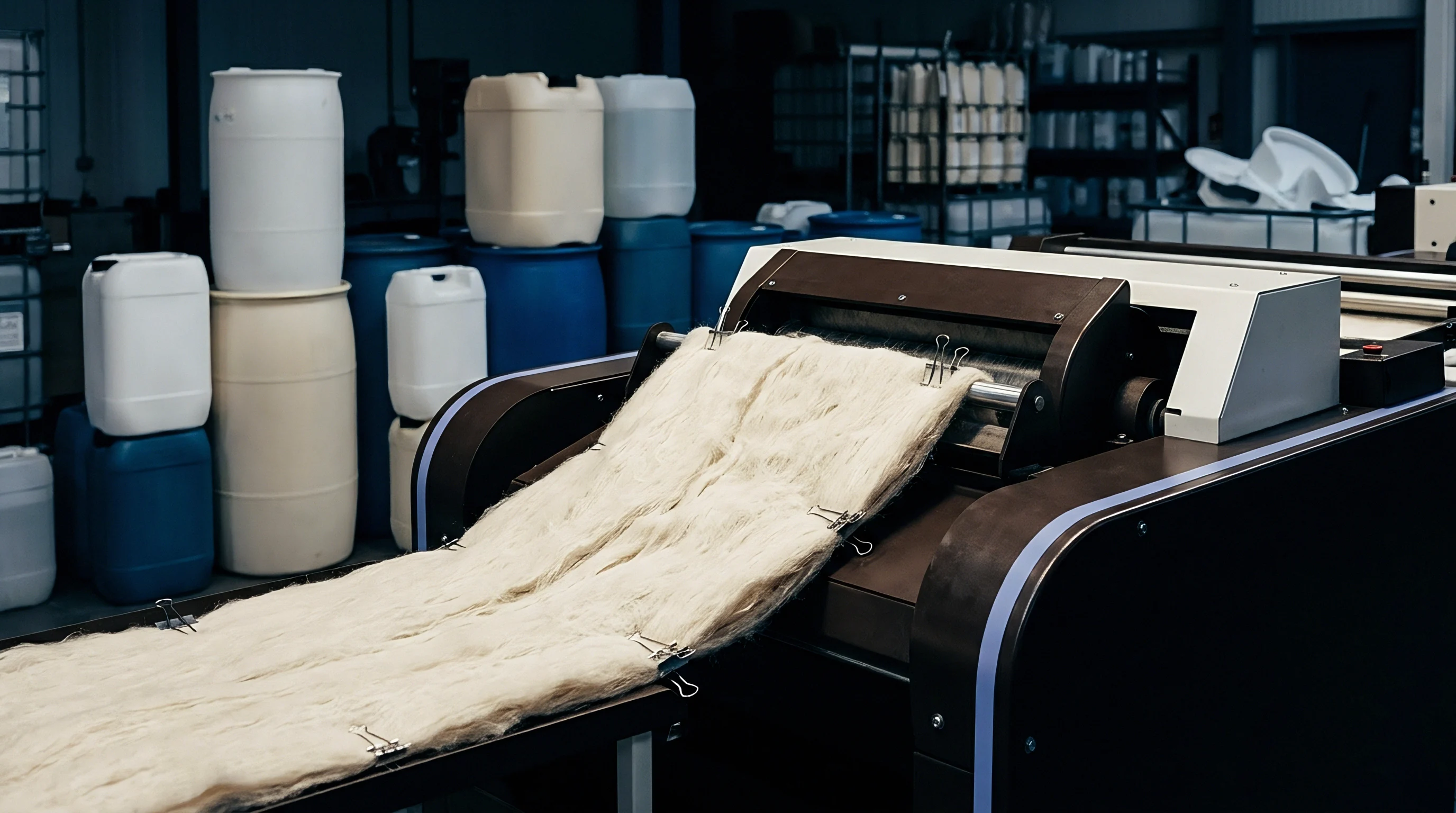
Worked Calculation for Batch Mass Balancing
A ten-tonne consignment of raw scutched flax arrives at a processing plant for conversion into food-grade tea filtration tissue under ISO 22000 audit rules. The initial weighbridge slip shows exactly 10,000 kg of raw flax at 12.0% moisture content. The absolute dry mass of the input lot equals 8,800 kg.
Laboratory extraction tests on sample swatches yield an 8.0% pectin loss, a 2.0% wax/fat loss, and a 1.5% ash/metal extraction loss, establishing a total chemical leaching factor of 11.5% (0.115).
Executing the chemical treatment removes 1,012 kg of dissolved dry solids into the effluent treatment stream, leaving 7,788 kg of pure dry cellulose fibre. Following hydro-extraction and controlled drying to an 8.5% standard food-grade moisture regain level, the final finished fabric lot weighs precisely 8,511 kg. Without applying chemical leaching allowances, the unadjusted ledger would register an apparent lost inventory of 1,489 kg (14.89%).
With the 11.5% leaching allowance properly integrated, the calculated output baseline matches the physical output within a narrow 0.1% margin of operational tolerance.
- Extract representative five-gram samples from incoming raw flax bales prior to scouring.
- Conduct standardized Soxhlet extraction using petroleum ether to measure surface wax content.
- Submerge samples in boiling two percent sodium hydroxide solution for two hours to determine pectin content.
- Rinse, dry at one hundred five degrees Celsius, and weigh to establish the baseline dry mass loss percentage.
- Enter the empirical mass loss coefficient into the ISO 22000 material accounting software before processing the commercial lot.
Unverified dissolution losses convert genuine physical processing losses into unrecorded mass inventory fraud during ISO 22000 verification.
Physical sampling always overrides historical yield factors when raw flax crop conditions change.


Discrepancy
Unaccounted variance between raw material input and certified finished output jeopardizes international supply chain accreditation. Audit teams checking ISO 22000 compliance set mass balance reconciliation tolerances to catch illegal substitutions, material leaks, or fraudulent volume inflation. When physical yields diverge from calculated limits beyond permitted thresholds, the audit system flags a mass balance discrepancy.
These variances originate either from inaccurate moisture measurement or unrecorded chemical leaching allowances.

Financial Exposure from Mass Variance
Mass balance discrepancies carry immediate commercial consequences for buyers and mills. Certified European Flax fibre carries a significant price premium over uncertified domestic Asian flax fibre. If a mill under-reports chemical leaching losses by five percent, it creates a ghost inventory of certified fibre on paper.
This ghost volume can be assigned to uncertified, cheaper raw material inputs, effectively laundering low-grade stock into certified food-grade packaging runs. Sourcing practices audit these variances to protect brand integrity and prevent regulatory fines in destination markets.
When an auditor discovers an unverified mass yield surplus, the certification agency suspends the facility’s scope certificate. For a mill exporting food contact linen materials to the European Union, certificate suspension halts customs clearances, triggers mandatory port inspections, and exposes importers to supply chain liability under EU food contact regulations.
| Variance Category | Mass Loss Deviation | Audit Action | Financial Risk Level | Commercial Remedy |
|---|---|---|---|---|
| Negligible Alignment | 0.0% to 0.5% | Unconditional Approval | Zero Risk Exposure | Standard Invoice Settlement |
| Minor Leaching Offset | 0.6% to 2.0% | Technical Correction Required | Low Operational Risk | Adjust Batch Ledger Factors |
| Moderate Gap | 2.1% to 5.0% | Batch Scope Suspension | High Liability Risk | Mandatory Re-Testing Audit |
| Severe Divergence | Greater than 5.0% | Full Certificate Revocation | Critical Commercial Loss | Contract Terminated with Claims |
Reconciliation Thresholds for ISO Audits
ISO 22000 mass balance frameworks enforce strict numerical thresholds to evaluate batch compliance. A total mass deviation within plus or minus 0.5% of calculated yields passes inspection without intervention. Deviations between 0.6% and 2.0% require technical explanations backed by chemical liquor analysis.
Any variance exceeding 2.0% triggers an automatic audit non-conformity report, freezing product dispatch until independent laboratory verification reconciles the physical mass balance.
- Minor Variance Under Two Percent ~ Accept lot with documentation adjustment if liquor analysis confirms equivalent dissolved organic solids.
- Moderate Variance Between Two and Five Percent ~ Freeze batch certification pending re-testing of post-scour hydro-extractor tare weights and dry mass regain.
- Major Variance Exceeding Five Percent ~ Reject transaction certificate application, issue non-conformity report, and order full physical inventory audit.
- Systemic Unrecorded Gain ~ Suspend mill qualification immediately when finished output mass exceeds corrected input raw material mass.
Audit discipline depends on transparent technical thresholds. Incorporating chemical leaching allowances transforms qualitative claims into verifiable figures. Importers who include chemical conversion criteria in their supply contracts ensure that mills cannot hide production errors or unauthorized fibre blending behind vague chemical loss assertions.
Mass balance discrepancies exceeding three percent trigger immediate suspension of batch conformity under European Union food contact material auditing rules.
Whether certification bodies will standardize online spectrophotometric liquor monitoring across Chinese mills remains uncertain.


Ledger
Sourcing agreements bind mills to documented mass conversion factors backed by third-party laboratory verification. Legal protection for buyers requires embedding precise technical audit language directly into commercial supply contracts and purchase orders. Standard trade terms referencing generic ISO 22000 compliance offer insufficient defense against mass balance manipulation.
Contracts must define exact chemical leaching measurement methods, testing frequencies, and liability assignments for unverified mass variances.

Commercial Warranty Clauses for Material Yields
A robust sourcing contract includes explicit mass balance reconciliation clauses. These clauses mandate that the supplier maintain real-time batch conversion logs that track dry weight inputs, chemical additive consumption, effluent total dissolved solids, and dry weight outputs. The contract stipulates that chemical leaching allowances must be derived from certified ISO 17025 laboratory tests performed on every raw material crop lot.
If an audit reveals unapproved mass adjustments or missing chemical loss documentation, the seller forfeits certified price surcharges and absorbs full re-audit expenses.
Enforcement provisions specify financial remedies for non-compliance. When customs authorities or third-party auditors reject a batch due to invalid mass balance records, the mill must reimburse the buyer for landed costs, testing fees, and lost commercial margin. Contract warranties must explicitly state that failure to reconcile mass balances invalidates origin claims under non-preferential trade rules.

Enforcement Mechanics in Destination Markets
Customs enforcement agencies evaluate non-preferential origin claims using mass balance audit trails. Under European Union UCC rules, converting raw flax fibre into food-grade yarn or tissue confers origin only if the manufacturing process constitutes a substantial economic transformation. If mass balance records fail to match raw material input origin certificates due to unrecorded chemical leaching, customs inspectors reclassify the consignment as non-compliant or fraudulent.
Customs penalties, delayed port shipments, and retroactive tariff assessments follow immediately.
Systemic traceability relies on disciplined record-keeping across international borders. By integrating verified chemical leaching allowances into ISO 22000 mass balance audits, brands, buyers, and mills secure their supply chain declarations against regulatory scrutiny, establishing transparent accountability from raw field harvest to certified food-grade end product.
Non-preferential origin claims collapse when mass balance accounting fails to reconcile solvent extraction tare weights.
Failing to embed chemical leaching allowances into procurement contracts exposes buyers to mandatory customs seizures and retroactive tariff penalties.