Variable Manifold Dynamic Pressure Governing Bast Fiber Bundle Cohesion in Continuous High Speed Insertion
Sub-millisecond manifold pressure stepping prevents bast fiber bundle splitting, holding air-jet loom efficiency above ninety percent without increasing hairiness.

Plume
Pneumatic Shear and Fiber Bundle Cohesion Decay
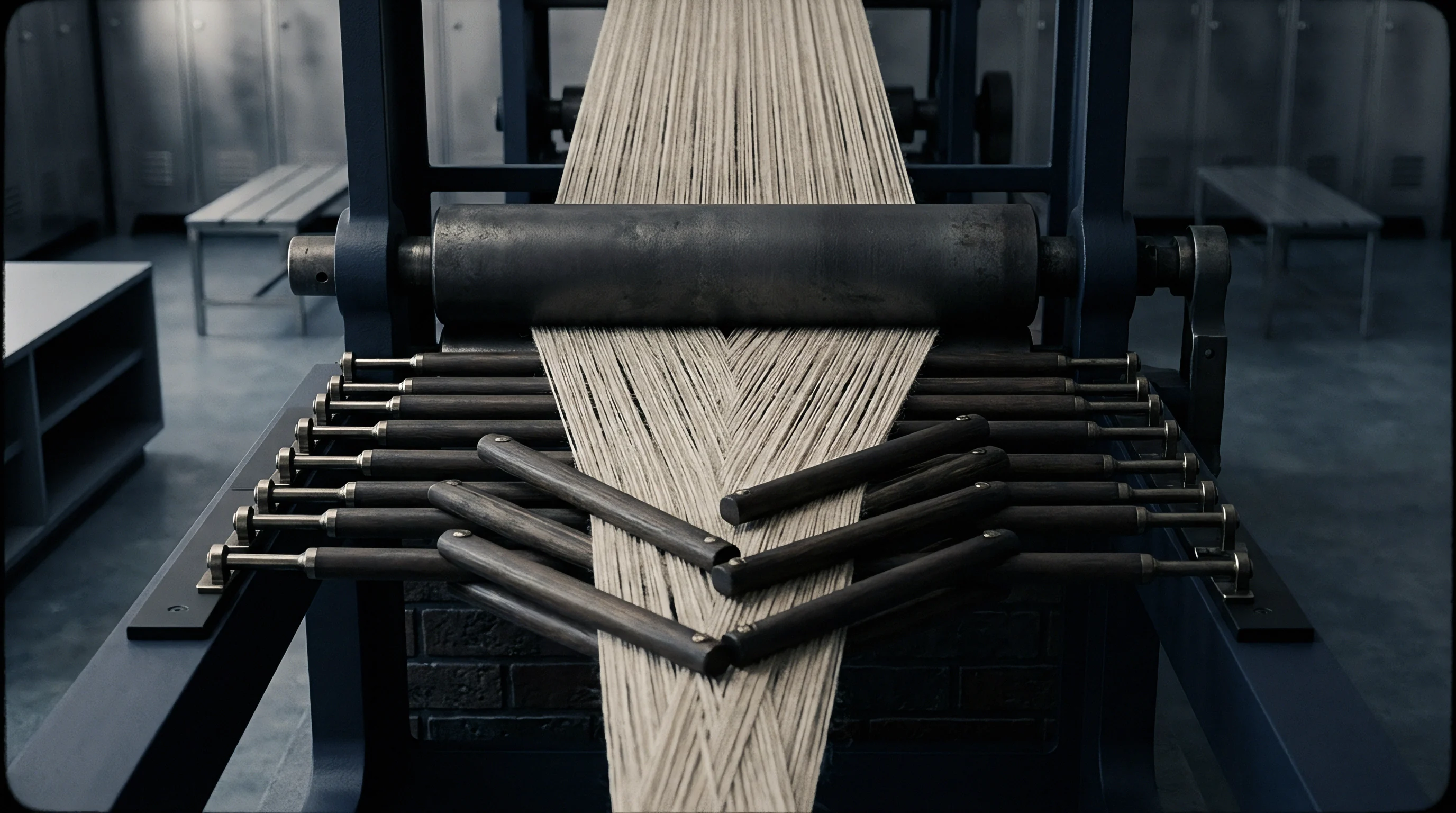
High-velocity pneumatic insertion subjects bast yarn bundles to extreme aerodynamic shear forces inside the main nozzle. Unlike continuous synthetic filaments or crimped staple cotton, flax and hemp yarns consist of discrete ultimate fibers bound together by inter-cellular pectin matrices. When entering an ejection tube operating at static header pressures between 0.35 MPa and 0.50 MPa, sudden air acceleration produces sharp velocity differentials between the air stream and the yarn surface.
Pneumatic insertion demands yarn stability.
Aerodynamic drag strips loose ultimate fibers from the outer surface of the yarn. Tensile loads concentrated on the bundle exterior overcome pectin cohesion before the yarn tip leaves the nozzle extension. Fiber peel stress scales with the square of relative air velocity, turning minor pressure surges into severe bundle structural breakdown.
High air speed strips twist.

Initial Peel Stress Thresholds
Air forces force outer fibers outward, creating yarn expansion and increasing total friction along the insertion channel. High static supply pressures deteriorate structural integrity before the yarn enters the profile reed channel.
| Supply Pressure (MPa) | Air Velocity (m/s) | Fiber Peel Stress (cN/tex) | Disintegration Index (%) | Twist Retention (%) |
|---|---|---|---|---|
| 0.30 | 165 | 1.2 | 2.1 | 98.5 |
| 0.38 | 210 | 2.8 | 6.4 | 94.1 |
| 0.45 | 245 | 4.9 | 15.8 | 87.3 |
| 0.50 | 270 | 6.7 | 28.3 | 79.6 |
Excessive air pressure strips protective twist from the yarn body. As ultimate fibers separate from the main mass, the effective cross-sectional area expands, generating drag that decelerates insertion. Fiber peel causes decelerated flight.
Pectin bonds within bast fiber bundles fail under aerodynamic drag when air speed exceeds yarn delivery velocity by a defined threshold margin.
Maintaining manifold pressure just above the yarn flight threshold preserves bundle integrity across high-speed weaving cycles.

Profiling
Pneumatic insertion across wide reed widths relies on sequential relay nozzles fed by secondary air distribution headers. Main nozzle pressure launches the yarn tip into the profile reed channel. Secondary nozzles fired in synchronized groups maintain velocity across insertion widths up to 220 centimetres.
Air timing governs shed stability.

Which Manifold Step down Prevents Trailing Edge Fiber Collapse?
Stepping down manifold supply pressure across sequential relay groups prevents trailing edge collapse while preserving tip acceleration. Operating early relay groups at 0.38 MPa while reducing down-line manifolds to 0.24 MPa lowers total kinetic energy imparted to the trailing yarn section. Step timing protects outer fibers.
This pressure gradient prevents fiber separation without losing insertion timing.
Air duration angles govern the exact milliseconds each valve remains open. Extended blowing cycles generate turbulence inside the reed channel, twisting fiber ends into dense fly agglomerations.
- Trailing Edge Fraying occurs when late relay nozzles fire at excessive pressure, blowing short ultimate fibers out of the yarn center before the shed closes.
- Tip Buckling and Fold-Over happens when front-end manifold pressure drops below the kinetic threshold required to pull the stiff bast tip straight.
- Channel Turbulence Swirls develop in the profile reed when blowing angles overlap beyond prescribed millisecond durations, creating radial shear that unravels yarn twist.
- Pneumatic Drag Stoppages emerge when weak cohesion along the fiber center permits individual ultimates to detach, catching adjacent warp ends.
Contracts governed by ISO 7211 specify tolerance limits for pick insertion faults that trigger automated loom shutdown sequences.
Excessive pressure across relay manifolds increases compressed air consumption per loom hour while generating severe yarn hairiness that fouls the profile reed channel.


Disruption
Fiber detachment during high-speed yarn insertion deposits significant quantities of lint throughout the weaving shed. Bast fly consists of short ultimate fibers and dried pectin flakes stripped away by pneumatic shear forces inside the reed channel. Lint blocks reed teeth.
Fly Generation Mechanics in Reed Channels
Lint accumulates between reed dents, restricting clear path dimensions for subsequent picks. Deposited fibers cling to sizing films on adjacent warp ends, forming small entanglements that resist shed opening. Stoppages reduce shed output.
Fouled reed channels cause frequent warp shed mis-picks. Machine sensors detect shedding obstructions, triggering automated loom stops that erode overall shed efficiency figures.

Sizing Interventions for High Shear Pneumatics
Polyvinyl alcohol and modified starch sizing agents encapsulate exterior fibers, raising bundle cohesion to withstand pneumatic impact. Proper sizing protects yarn integrity. Sizing formulations applied to bast warps maintain elastic film boundaries under rapid pressure fluctuations.
- Formulate PVA and modified starch size blends to achieve a coat mass of eleven percent dry pick-up on the warp yarn.
- Calibrate squeeze roll pressures in the sizing machine to secure uniform film penetration into the bast fiber center.
- Program the main nozzle manifold pressure to step down five percent below nominal yarn breaking strength thresholds.
- Adjust relay valve opening times to match measured tip velocity, preventing air stagnation inside the profile channel.
Operating air-jet looms at 0.38 MPa manifold pressure with Nm 26 linen weft yields a yarn hairiness index increase of 42 percent across a 190 cm reed width.
Yarns with low bundle cohesion are routinely defended by spinning mills as meeting nominal tensile specs despite failing under high-speed pneumatic shear.


Tolerance
Quantifying yarn structural limits demands empirical evaluation under controlled pneumatic insertion parameters. Trials conducted on 100 percent linen continuous air-jet looms demonstrate direct relationships between manifold pressure settings, yarn hairiness growth, and loom stoppage rates. Tip acceleration maintains insertion path.

Comparative Pneumatic Pressure Trial Settings
Trial parameters evaluate plain weave linen fabric produced at 720 picks per minute on a 190 centimetre wide air-jet machine. The warp uses Nm 30/1 (33.3 tex) wet-spun flax at 24 ends per centimetre. The weft uses Nm 26/1 (38.5 tex) dry-spun flax at 20 picks per centimetre.
Total weft insertion length measures 2.05 metres per cycle. Short picks halt production.
Three pneumatic manifold pressure profiles demonstrate structural performance variances across identical yarn lots.
| Pressure Regime | Tip Velocity (m/s) | Weft Stops (per 10^5 picks) | Fly Rate (g/m²) | Air Draw (Nm³/hr) | Shed Efficiency (%) |
|---|---|---|---|---|---|
| Regime A: High Constant 0.45 MPa | 26.4 | 14.2 | 1.85 | 48.2 | 84.6 |
| Regime B: Stepped 0.38 to 0.24 MPa | 24.1 | 3.8 | 0.62 | 34.5 | 91.4 |
| Regime C: Low Constant 0.28 MPa | 19.8 | 22.5 | 0.41 | 26.1 | 78.2 |
Regime B achieves superior performance metrics by balancing tip kinetic energy against fiber bundle cohesion limits. Stepping manifold pressure down along the reed path reduces fly generation by 66 percent relative to Regime A while increasing machine efficiency to 91.4 percent. Header pressure remains steady.
Regime C fails due to insufficient tip acceleration. Low air pressure allows tip buckling, causing frequent short-pick loom shutdowns despite low fly accumulation figures. Clean air prevents valve sticking.

Preserving Fiber Bundle Alignment
Process engineers establish exact operating envelopes before running high-speed bast yarn lots. Systematic verification of manifold behavior prevents shed productivity loss.
- Pressure Profile Mapping involves measuring pneumatic impulse profiles at each relay position using inline transducers prior to production runs.
- Sizing Film Audit tests film elasticity under variable relative humidity to verify shell integrity during high-speed air contact.
- Nozzle Alignment Check verifies that relay orifices center precisely within the reed channel, eliminating asymmetric forces that untwist delicate fibers.
- Pneumatic Header Balance matches mill compressor station capacity against shed demand peaks to prevent header pressure drops.
Stable fiber cohesion under transient air flow determines total weaving shed output far more than maximum insertion speed settings.
The exact physics governing high-frequency pressure wave propagation inside micro-porous bast fiber bundle centers remains incomplete in modern aerodynamic models.


Settlement
Commercial viability in high-speed linen manufacturing depends on balancing compressed air overhead against finished fabric quality grades. Energy cost per loom hour directly reflects pneumatic efficiency across the shed. Power consumption drives loom costs.

Compressor Load and Loom Hour Cost Balance
Operating continuous insertion looms requires continuous compressor station power. Lowering manifold delivery pressure from 0.45 MPa to an optimized 0.34 MPa step-down profile cuts electrical power demand by 1.2 kW per loom hour. Across a shed of 60 machines operating 8,000 hours annually, compressed air savings reach significant figures.
First quality cloth earns full price.
| Cost Component | High Constant 0.45 MPa ($) | Optimized Stepped Profile ($) | Net Variance ($) |
|---|---|---|---|
| Compressed Air Power | 3,420 | 2,450 | -970 |
| Loom Stoppage Downtime | 1,840 | 490 | -1,350 |
| Four-Point Defect Penalties | 2,150 | 620 | -1,530 |
| Net Landed Metre Cost | 0.741 / m | 0.356 / m | -0.385 / m |
Reducing stop frequencies minimizes woven cloth repair labor while raising first-quality yields evaluated under ASTM D5430 inspection rules. Proper pneumatic tuning preserves fabric hand by retaining yarn structural twist. Pressure stability protects profits.

Contractual Specification Clauses for Bast Weft Yarns
Procurement documents incorporate certified yarn cohesion thresholds for air-jet suitability. Buyers protect margins by linking yarn technical delivery specifications directly to shed performance metrics.
Standard supply agreements incorporate quality annexes specifying maximum yarn hairiness growth rates under standardized pneumatic nozzle exposure tests.