Modeling Multi-Thread Elasticity and Viscoelastic Stress Relaxation in Ultra High Density Flax Warp Sheets
Dynamic let-off back-stepping and multi-term Maxwell relaxation modeling prevent tension-decay stop marks in dense flax warps.

Rheology
Technical flax bundles exhibit high initial tensile stiffness combined with rapid stress relaxation under constant strain. Bound within a pectin and hemicellulose matrix, these continuous bast filaments respond to mechanical loads through elastic stretch and viscous dissipation. When hundreds of flax ends are packed into a warp sheet above 40 ends per centimeter, yarn behavior transitions from isolated mechanics to a collective viscoelastic response.
Dry-spun flax typically has an initial modulus between 18 GPa and 35 GPa depending on fiber length and twist factor, though shifts in ambient humidity or sizing moisture can reduce this value sharply. Tensioning a thread aligns microfibrils along the fiber axis almost instantly; elementary fibers then slip past one another within the middle lamella.
Traditional deformation models for individual flax threads rely on linear spring-dashpot systems. In ultra-high-density warp sheets, however, single-strand linear models fail because adjacent yarns exert compressive and frictional forces along their contact lines. The entire sheet behaves as a non-linear viscoelastic continuum that relaxes across distinct time scales: a fast phase occurring within milliseconds of shed opening, and a slow phase extending over loom stoppages of tens of minutes.
Capturing this behavior requires models capable of handling both immediate elastic strain and multi-stage viscous flow.
Viscoelastic Fundamentals of Spun Flax Bundles
Structural anisotropy in bast fiber cellulosic chains governs how strain spreads across the yarn cross-section. Tensile loads during warping and weaving pull directly on crystalline cellulose domains, generating an immediate elastic response, while amorphous regions rich in pectin and lignin undergo shear deformation that is either irreversible or slowly reversible, leading to abrupt fracture. Under sustained tension, flow within this amorphous matrix dissipates strain energy, lowering internal stress across the yarn sheet.
While this relaxation reduces the hold-open force needed for the warp, it shifts baseline sheet tension once the loom restarts.
Yarn twist directly regulates stress relaxation across multi-thread sheets. Low twist angles allow rapid inter-fiber slippage, driving steep tension drops during dwell periods. Higher twist angles suppress axial slippage by generating radial compression that locks neighboring fibers together, forcing deformation into elastic extension of the fiber helix.
High twist also increases yarn diameter variation and surface roughness, which raises thread-to-thread friction through the reed and heddle eyes. Mill practice must balance the twist multiplier against sizing add-on to preserve elastic memory without inducing excessive frictional wear during shedding.
| Yarn Count (Nm) | Twist Factor (alpha) | Sizing Pick-Up (%) | Instant Modulus E1 (GPa) | Relaxation Time Tau1 (s) | Relaxation Time Tau2 (s) |
|---|---|---|---|---|---|
| Nm 26 | 115 | 8.5 | 22.4 | 0.42 | 185.0 |
| Nm 39 | 120 | 10.0 | 26.1 | 0.38 | 210.0 |
| Nm 39 | 135 | 10.0 | 28.7 | 0.31 | 245.0 |
| Nm 52 | 130 | 11.5 | 31.2 | 0.25 | 290.0 |
| Nm 60 | 140 | 12.5 | 34.5 | 0.19 | 330.0 |

Generalized Maxwell Model for Multi-Filament Strands
Simulating how dense flax warps respond to dynamic shedding requires a Generalized Maxwell architecture ~ a set of parallel spring-dashpot elements paired with an equilibrium spring. Total sheet stress equals the sum of forces across individual Maxwell branches plus the non-relaxing elastic component. Because high-speed rapier looms operate at frequencies between 4 Hz and 8 Hz, short relaxation time constants are essential for predicting peak dynamic loads.
Elastic springs handle instantaneous tension spikes during shed inversion, while dashpots account for viscous flow within the inter-fiber matrix.
To account for multi-thread interaction, the single-strand Generalized Maxwell formulation must be expanded into a coupled matrix equation. Contact pressure between threads creates normal forces that boost effective dashpot viscosity in adjacent strands. At setts above 45 ends per centimeter, lateral confinement suppresses radial yarn movement during axial stretch, raising the dynamic modulus by 12% to 18% over single-thread test values.
Adding a non-linear coupling coefficient to the stiffness matrices allows accurate modeling of widthwise tension gradients from the selvedges to the beam center.
Viscoelastic relaxation in dense flax warps reduces standing tension by up to forty percent during extended stoppages, altering beat-up mechanics upon loom restart.

Hydromechanical Influence on Viscoelastic Decay
Water acts as a plasticizer in the amorphous cellulose and pectin regions of bast fibers. Absorbed moisture severs hydrogen bonds between neighboring cellulose chains, boosting molecular mobility and accelerating stress relaxation. Above 70% relative humidity, flax yarns show increased strain rates under modest static loads, leading to warp sag during idle shifts.
Below 50% relative humidity, the fibers stiffen, pushing relaxation time constants higher and amplifying dynamic tension spikes during shedding.
Sizing agents alter these hydromechanical pathways by coating the yarn exterior and penetrating outer fiber layers. Polyvinyl alcohol and refined starches form cross-linked networks that suppress outer-fiber slippage under tension, immediately raising the yarn modulus. Sizing films also slow moisture uptake, stabilizing relaxation time constants against fluctuating ambient shed conditions.
Overly rigid sizing formulations, however, embrittle the fiber bundle, lowering strain-to-break limits and raising end breaks at beat-up.
Identifying which mathematical formulation best captures the transition between inter-fiber frictional locking and viscous matrix flow in ultra-dense warps remains an active question in textile mechanics.


Creel
Preparing high-density flax warps requires tight control over thread tension consistency from creel to warping drum. Unwinding hundreds of packages introduces strand-to-strand tension variances driven by shifting package diameters, ballooning mechanics, and worn friction discs. In dense sheets, even minor initial tension disparities cause uneven stress relaxation across the beam.
Ends wound at higher tension suffer faster stress decay, leaving localized slack threads during weaving that create wavy selvedges and irregular pick spacing.
Friction through creel guide eyes and tensioners accumulates thread strain long before sizing. Raw flax yarns carry shives, surface rough spots, and protruding fibers that induce pronounced stick-slip behavior against metal or ceramic contact surfaces. High packing density compounds these stresses: as threads pass through narrow reed dents, lateral contact converts axial tension into normal forces that lock neighboring ends together.
Rigorous sheet alignment and careful tensioner calibration are necessary to limit cross-thread friction at high warping speeds.

Inter-Thread Friction in Ultra High Density Warp Sheets
Contact mechanics between unsized flax threads follow non-linear friction laws. Rather than acting as smooth cylinders, flax strands have polygonal, irregular cross-sections along their length. High thread densities force adjacent yarns into continuous surface contact under lateral pressure, meaning pulling an individual thread through a tight sheet requires overcoming both sliding friction and mechanical entanglement.
Static friction coefficients for raw flax against flax fall between 0.35 and 0.48, dropping to 0.22 once a hydrophobic size is applied.
Thread density directly governs normal pressure during beam winding. Increased pressure squeezes neighboring yarns together, flattening their cross-sections and enlarging contact areas. This expanded contact area raises inter-thread shear resistance, preventing strands from relaxing independently.
Neighboring ends instead relax in clusters, creating broad tension bands across the warp sheet that distort shed opening geometry during weaving.
- Inter-Fiber Entanglement causes localized tension spikes when stray bast fibers join neighboring ends in the leasing reed.
- Package Diameter Decay elevates unwinding tension at the creel, shifting baseline strain across trailing warp sections.
- Guide Eye Wear Lines etch micro-grooves into ceramic tensioners, adding drag to fine-count flax threads.
- Static Charge Accumulation causes thread repulsion in dry sheds, disturbing sheet alignment prior to the sizing trough.
- Asymmetric Sizing Squeeze introduces density variations across the warp width, altering local stress relaxation rates.

Lateral Pressure Distribution across High Sett Beams
Winding a warp sheet onto a weaver beam builds cumulative radial pressure that compresses underlying yarn layers. Because high-sett flax warps have minimal crimp and a high modulus, they transmit this compressive force straight down to the beam barrel. As outer layers wrap under tension, they squeeze inner layers, triggering internal stress relaxation within the package.
Over time, inner wraps can lose up to 30% of their initial winding tension while outer wraps remain under high strain.
Modulating beam winding hardness prevents this uneven tension decay through the depth of the package. Applying a linear drop-off tension profile ~ gradually reducing winding tension as beam diameter increases ~ offsets internal radial compression. This controlled winding suppresses barrel deflection and flange bowing on wide looms operating above 1.9 meters, while maintaining uniform yarn delivery during unwinding to minimize tension relaxation differences on the loom.
Maintaining identical thread path lengths through the creel during high-density warping prevents differential tension decay prior to sizing.
Shed
Shedding subjects the warp sheet to periodic, high-frequency strain cycles superimposed on static baseline tension. As heddle frames rise and fall to separate warp sheets, thread paths lengthen and generate peak dynamic strains. In dense warps exceeding 40 ends per centimeter, the low strain-to-break of bast fibers strictly limits allowable shed opening height, as peak strains must stay well below the yield point of the sized yarn to avoid plastic deformation or thread breakage.
Beat-up adds transient impact pulses at the cloth fell. As the reed drives a newly inserted pick into the crowded warp, it pushes the fell forward against standing sheet tension, sending high-tension shockwaves backward toward the back-rest roller. Although flax’s viscoelasticity dampens part of this pulse, high setts restrict dissipation, concentrating strain energy within the first ten centimeters of warp adjacent to the fell.

Cyclic Dynamic Strain during Loom Shedding
Dynamic warp tension varies with loom speed, crank angle, and harness geometry. At 450 picks per minute, a modern rapier loom completes a shedding cycle every 133 milliseconds. Flax ends experience rapid tension ramp-up as the shed opens, peaking at full lift before relaxing during shed closure.
Total strain combines geometric extension of shed depth with the static baseline set by the let-off.
Because flax has short relaxation time constants under rapid strain, high-speed shedding induces cyclic work hardening. Over the first few hundred cycles, yarn elastic modulus increases incrementally, narrowing its safety margin. As viscous dissipation mechanisms become exhausted under high-frequency cycling, the warp sheet shifts toward rigid elastic behavior with diminished energy absorption, raising fatigue failures where ends rub against heddle eyes.
| Loom Speed (RPM) | Shed Opening Height (mm) | Static Strain (%) | Peak Shed Strain (%) | Peak Tension (cN/tex) | Tension Decay Rate (cN/tex/s) |
|---|---|---|---|---|---|
| 300 | 52 | 1.2 | 2.8 | 14.2 | 4.5 |
| 360 | 52 | 1.2 | 3.1 | 16.8 | 6.2 |
| 420 | 52 | 1.2 | 3.5 | 19.5 | 8.1 |
| 450 | 48 | 1.0 | 3.1 | 17.2 | 7.8 |
| 500 | 48 | 1.0 | 3.6 | 21.0 | 10.4 |
| Data recorded using piezoelectric inline thread sensors on clean PVA-sized dry-spun flax warps at 65% RH. | |||||

Beat-Up Peak Tensions and Cumulative Work Hardening
Beat-up force requirements scale non-linearly with pick density and warp cover factor. Driving a thick flax pick into a tight warp matrix ~ such as heavy linen canvas or industrial filtration cloth ~ can demand peak reed forces exceeding 3500 N per meter of fabric width. The warp must absorb this pulse without exceeding ultimate tensile limits.
While the abrupt strain spike triggers a rapid viscoelastic response, the brief duration of beat-up limits how much strain energy dissipates per pick.
Repeated beat-up impacts accumulate strain energy that degrades yarn structure over time. High strain pulses cause micro-fibrillar debonding inside technical fiber walls and introduce micro-cracks in the middle lamella, eroding inter-fiber cohesion. Although sizing temporarily prevents fraying, once the protective size film breaks under cyclic impact, internal degradation accelerates, leading to end breaks directly behind the reed.
Standard ISO 13934-1 tensile testing overstates flax warp survivability under weaving conditions by failing to capture high-frequency dynamic fatigue accumulation.
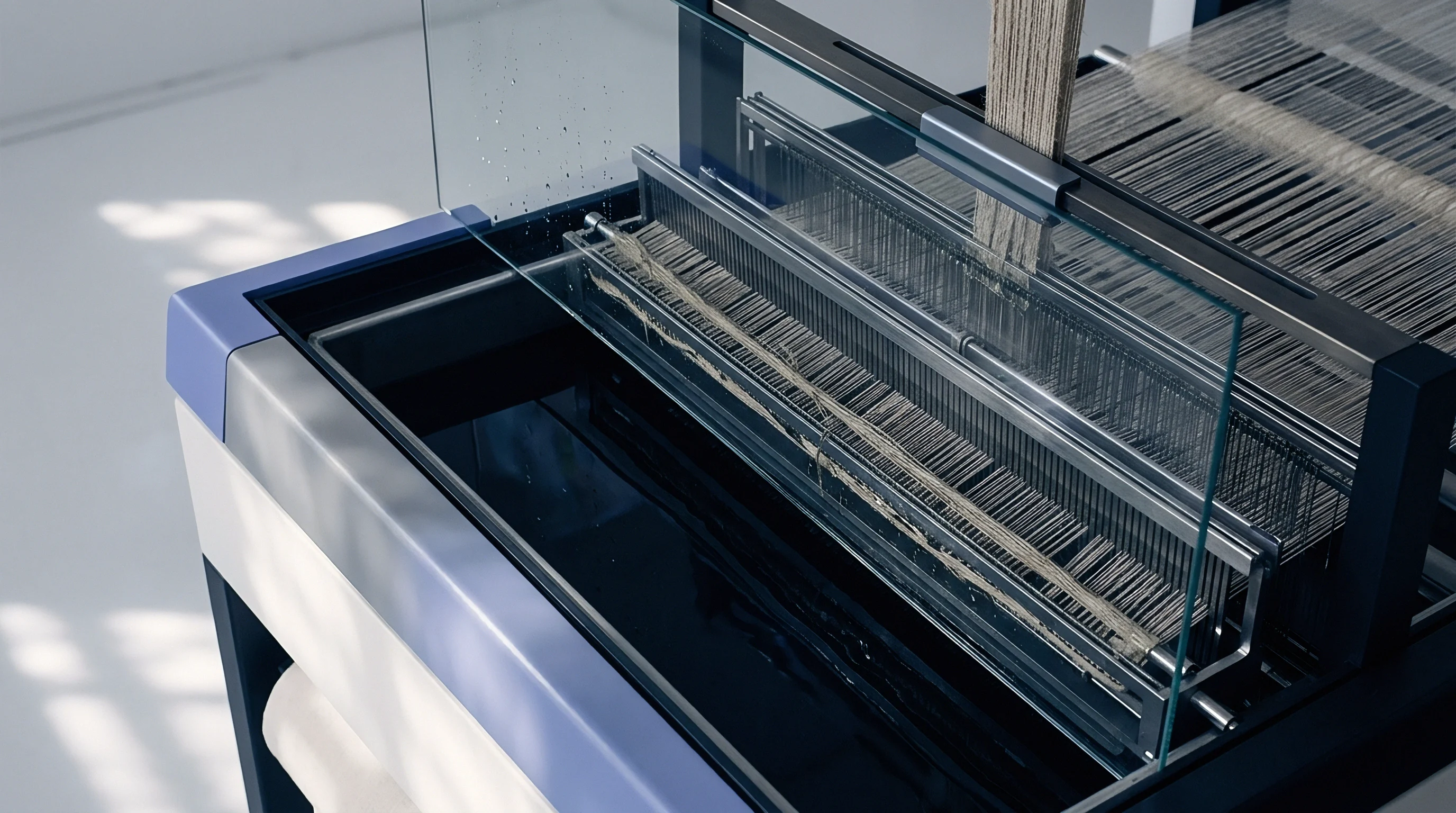
Asymmetric Harness Lift and Non-Uniform Yarn Stretching
High-density weaves like multi-shaft twills or satins demand asymmetric harness movements. To maintain a clean shed line, ends passing through rear harness frames must undergo greater geometric extension than those in front frames. In low-extension flax warps, this variance creates pronounced tension differences across frame groups, forcing rear-frame threads to operate at higher mean tension and undergo faster viscoelastic relaxation.
Offsetting rear-frame tension elevation requires depth-adjusted harness staggering or asymmetric shed timing. Staggering harness frame motion distributes beat-up loads over time, dampening peak tension pulses. Adjusting back-rest roller position horizontally and vertically alters the length ratio between front and back shed sections, balancing extension across all frames to minimize differential relaxation and ensure steady warp delivery.
- Mount precision electronic load cells beneath back-rest roller bearing blocks to measure sheet-wide baseline tension.
- Cycle the loom manually to full shed opening, recording peak dynamic tension across all active harness frame groups.
- Adjust individual harness frame depth settings until dynamic tension variance between front and rear frames falls below five percent.
- Set back-rest roller height relative to the breast beam plane to create an asymmetric shed that slackens top-shed ends during beat-up.
- Calibrate let-off motor parameters to feed warp length dynamically during peak shed extension.
- Verify thread tension uniformity across selvedge, quarter-point, and center sections with a hand-held electronic tensiometer.
Incorrect harness lift profiles permanently deform rear-frame warp threads, causing horizontal bands and warp-wise streaks in the finished linen fabric.

Dwell
Unplanned loom stoppages hold the warp sheet under static shed tension, exposing flax ends to extended viscoelastic relaxation. Whether a stop stems from a filling break, warp break, or shift change, threads held in an open shed remain under continuous strain. Over minutes or hours, internal viscous flow bleeds off tension.
When the loom restarts, the relaxed sheet lacks the baseline tension needed for clean shedding and beat-up, causing immediate stops and fabric defects.
Tension decays exponentially during a stop, relaxing fastest within the first sixty seconds. The total drop depends on yarn moisture, sizing composition, baseline static tension, and shed position at stoppage. Stopping with a fully open shed induces maximum relaxation in top and bottom ends, whereas stopping at shed closure minimizes static strain and limits tension decay.
Managing these stoppage profiles is critical for maintaining quality in high-density linen weaving.
Why Does Tension Drop Rapidly during Unplanned Mill Stoppages?
Stress dissipation in bast fibers occurs through molecular realignment within non-crystalline cellulose under constant strain. Stored elastic energy converts to thermal and viscous losses as polymer chains slide past one another ~ a process that happens quickly in flax because short elementary fiber fragments are bound by amorphous pectin. High initial tension driving this motion decays rapidly, reducing the driving force and slowing relaxation over longer stop intervals.
High sheet density amplifies the impact of tension loss when restarting the loom. Dropping warp tension reduces fell resistance to reed impact, allowing the cloth fell to shift backward. On the first restart pick, the reed strikes the fell out of position, creating a dense pick band known as a stop mark.
Automated let-off and take-up compensation algorithms must advance or reverse warp position precisely to offset this viscoelastic tension loss.

Transient Stress Relaxation Curves in Flax Warp Bundles
Plotting warp tension against log-time during a stoppage produces a characteristic two-stage relaxation curve. Stage one, covering zero to sixty seconds, shows a steep linear drop on logarithmic axes driven by fast molecular realignment. Stage two, extending from one minute to several hours, transitions to a shallower slope governed by slow inter-fiber matrix shear.
For an Nm 39 flax warp at 44 ends per centimeter and an initial static tension of 22 cN/tex, tension drops 28% within sixty seconds and 42% after thirty minutes of dwell.
Restoring target tension after a stop requires accurate intervention by the let-off system. Modern rapier looms use automatic tension correction that back-steps the weaver beam prior to the first pick, physically tensioning the relaxed sheet to re-establish target static tension before shedding resumes. Miscalculating this back-step distance either snaps warp ends from over-tensioning or causes a loose pick mark from under-tensioning.
- Automatic Let-Off Reversal calculates required beam back-rotation from measured stop duration and shed humidity.
- Shed Closing Commands return harness frames to a level shed position if a stoppage exceeds thirty seconds.
- Thermal Compensation Routines adjust tension set-points in response to temperature shifts inside the weave room.
- Pneumatic Back-Rest Boosters apply localized load to the back-rest roller immediately before motor startup.
Blaming persistent stop marks in high-sett linen on natural fiber variation usually masks poor calibration of the loom’s let-off tension compensation.

Draft
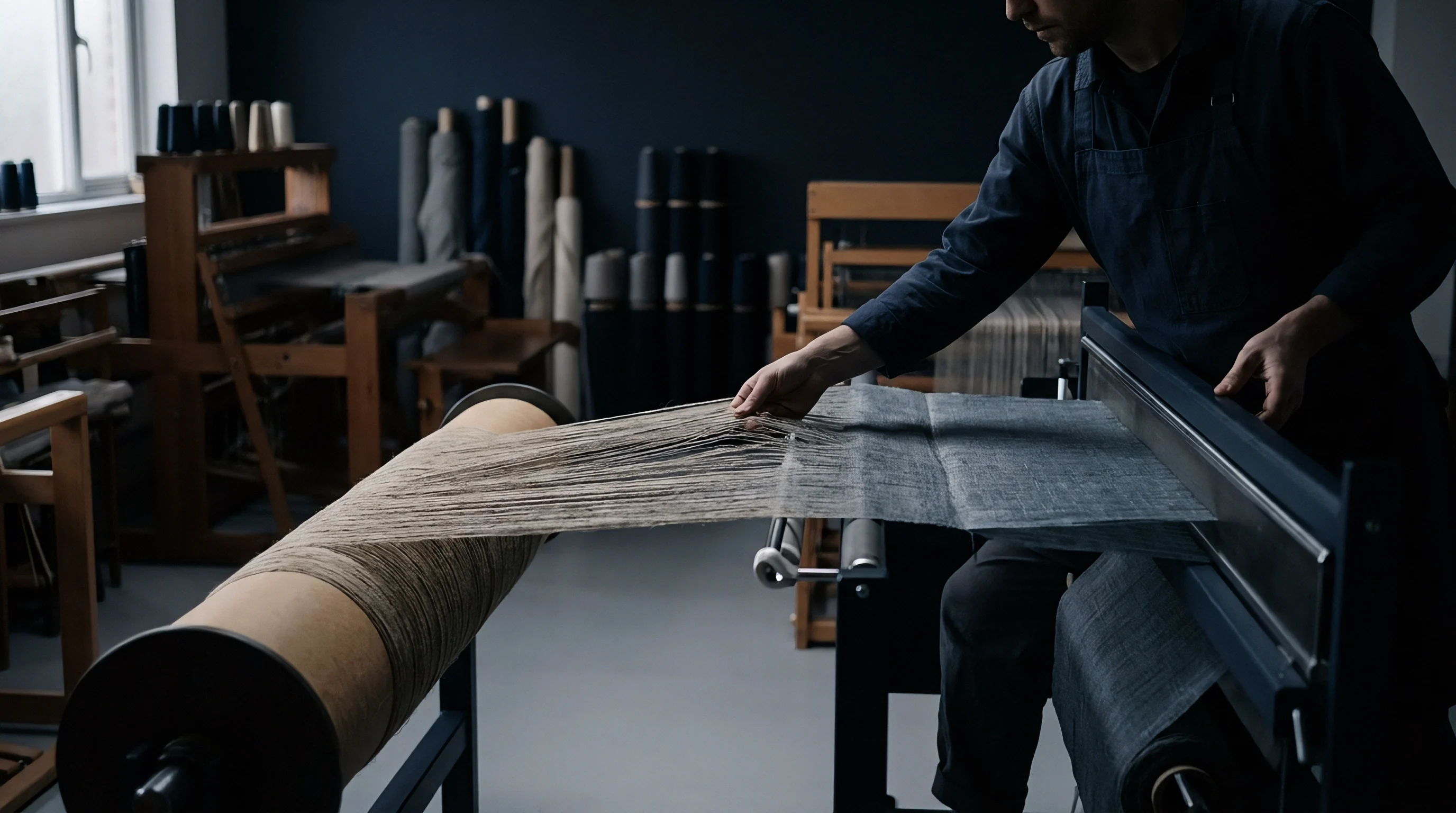
Modeling multi-thread viscoelasticity requires mathematical formulations that combine linear elasticity with time-dependent viscous elements. Standard single-element Maxwell models fail to capture both rapid dynamic response during shedding and slow static relaxation during dwell periods. A Generalized Maxwell model using two distinct relaxation times alongside a continuous elastic spring effectively predicts flax warp behavior across operating regimes.
Solving these constitutive equations yields accurate estimates of tension decay, dynamic strain amplification, and crimp conversion rates during weaving.
Predicting performance in high-density sheets requires thread-density coefficients that scale inter-thread friction and lateral confinement pressure. As thread density approaches maximum packing limits, neighboring yarns restrict thread movement, increasing effective stiffness of the warp sheet. Constitutive equations must scale yarn modulus terms upward against ends per centimeter to maintain accuracy in dense weaves.
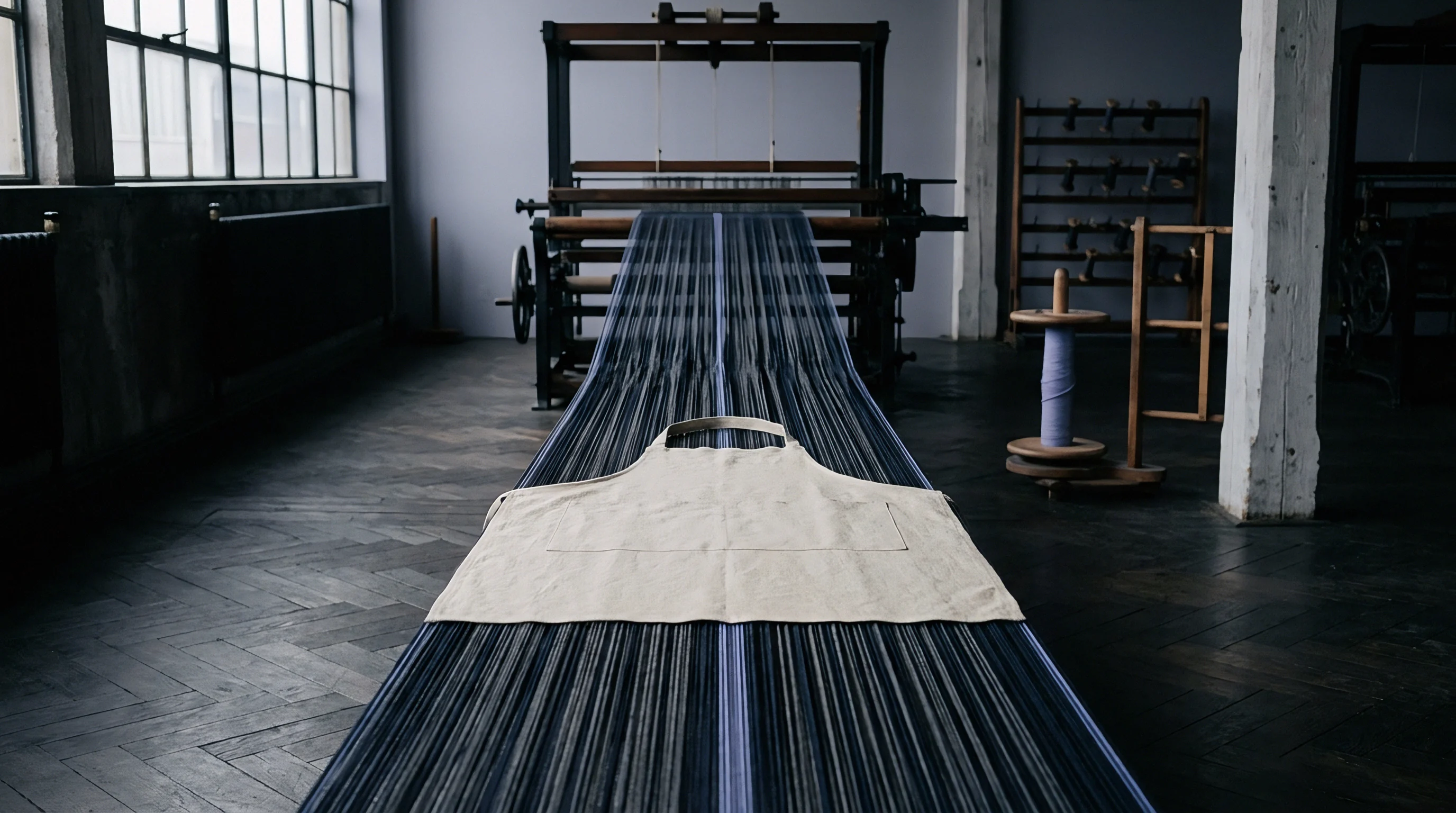
Mathematical Formulation of Multi-Thread Viscoelasticity
Total stress in a multi-thread viscoelastic warp sheet subjected to arbitrary strain histories follows a hereditary integral formulation. Provided strains remain within the linear viscoelastic limit of the sized flax strand, the Boltzmann superposition principle applies. Expressing the relaxation modulus as a Prony series allows efficient numerical integration inside loom control algorithms.
The time-dependent stress equation is:
sigma(t) = E_infinity epsilon(t) + integral from 0 to t of (d epsilon(tau) / d tau) d tau
In this equation, E_infinity represents the long-term equilibrium modulus of the flax thread, E_1 and E_2 are stiffness coefficients for fast and slow relaxation modes, and tau_1 and tau_2 are their corresponding time constants. For a dense warp, E_1 captures shedding dynamics on the order of tenths of a second, while E_2 handles stoppage dwells over minutes. These parameters are determined experimentally through step-strain relaxation tests on sized yarn bundles using standard tensile testing equipment.
Consider a worked example: an Nm 39 dense flax warp sheet at 45 ends per centimeter, under an initial strain epsilon_0 of 1.5% applied instantaneously at loom stop (t = 0). Experimental parameters for this sized yarn are E_infinity = 12 GPa, E_1 = 10 GPa, E_2 = 8 GPa, tau_1 = 0.5 seconds, and tau_2 = 120 seconds. Substituting these values into the step-strain relaxation formula sigma(t) = epsilon_0 tracks internal yarn stress over time.
At t = 0 (the moment of loom stop), initial stress sigma(0) equals 0.015 (12 + 10 + 8) GPa = 0.450 GPa, or 450 MPa. After a dwell of t = 1.0 second, the fast relaxation component exp(-1.0 / 0.5) = exp(-2) drops to 0.1353, while exp(-1.0 / 120) sits at 0.9917. The resulting stress sigma(1.0) equals 0.015 GPa = 0.015 GPa = 0.3193 GPa, or 319.3 MPa.
This is an immediate stress drop of 29.0% in a single second, driven almost completely by the fast relaxation arm E_1.
After a 5-minute stoppage (t = 300 seconds), exp(-300 / 0.5) approaches 0, while exp(-300 / 120) = exp(-2.5) drops to 0.0821. The stress sigma(300) equals 0.015 GPa = 0.015 GPa = 0.1898 GPa, or 189.8 MPa. Total stress relaxation over 5 minutes reaches 57.8% of the initial value.
This calculation shows why let-off systems must apply substantial back-stepping torque before restarting, recovering the lost 260.2 MPa of internal thread stress to prevent severe pick marks.
Constitutive Equations for Elastic Recovery and Dynamic Creep
Dynamic creep develops when cyclic shedding peaks overlay baseline warp tension. As cycles repeat, unrecovered viscous strain builds up, causing progressive warp elongation. Strain response under cyclic loading combines instantaneous elastic recovery with non-linear, time-dependent creep compliance.
Modeling this accumulation requires a damage factor that reduces effective load-bearing area of the yarn bundle as micro-fibrils decouple.
Deformation models must account for temperature-dependent viscous shift factors using Arrhenius kinetics. In weaving sheds lacking tight climate control, temperature swings alter flax relaxation spectra significantly: higher ambient temperatures lower matrix viscosity, accelerating creep and causing warp sag. Feeding real-time temperature data into the let-off control loop adjusts baseline tension dynamically, keeping fell geometry stable despite mill temperature swings.
Dynamic tensile modulus in sizing-stabilized flax warps increases by fourteen percent under four-hertz cyclic shedding due to rapid micro-fibrillar alignment.
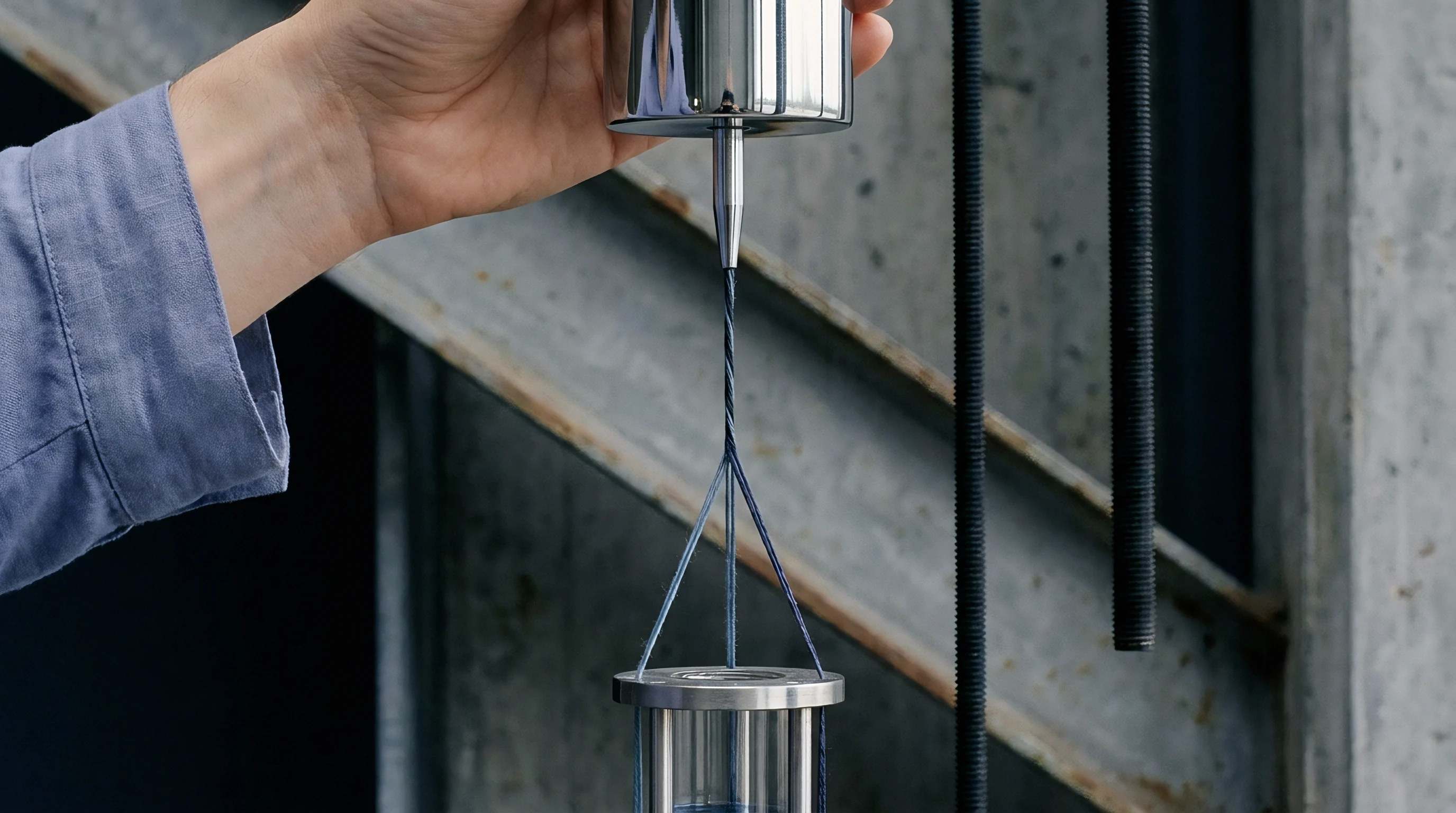
Non-Linear Crimp Redistribution under Multi-Thread Tension
Interlacing warp ends with picks during beat-up forces warp threads to bend around the straight pick path, forming warp crimp. In high-density fabrics, crowded warp ends resist bending, requiring higher tension to force crimp into the pick. This elastic deformation interacts directly with crimp geometry: high warp tension flattens warp crimp, transferring curvature to pick threads and increasing fabric width contraction during weaving.
Crimp redistribution is time-dependent. Viscoelastic relaxation in flax fibers bent around the pick permanently sets the crimp over time. If fabric tension drops abruptly upon doffing, unrelaxed elastic stresses cause immediate fabric relaxation and width distortion.
Maintaining controlled warp tension throughout beam run-out ensures stable crimp distribution, preventing width variations and off-square skewing in finished rolls.
- Sizing Polymer Glass Transition Temperature dictates the threshold above which warp relaxation rates double under dynamic tension.
- Yarn Cross-Section Flattening Ratio measures elliptical thread deformation under beam packing pressure and shedding forces.
- Equivalent Creep Compliance defines time-dependent strain accumulation per unit of applied tensile stress.
- Crimp Conversion Coefficient quantifies the percentage of thread length converted from a straight path into weave crimp during beat-up.
Standard purchasing contracts for high-count flax yarns often specify a minimum degree of polymerization for PVA size to ensure consistent viscoelastic behavior across spinning lots.

Margin
Viscoelastic stress relaxation in high-density flax warps directly affects loom productivity, fabric grading, and total manufacturing costs per meter. Machine stoppages from warp breaks or stop marks erode shed efficiency. For high-sett linen running on air-jet or rapier looms, operating costs per loom-hour are high; when efficiency drops from an expected 88% down to 74% because of uncontrolled relaxation, landed fabric costs climb, eroding margins on weaving contracts.
Quantifying these financial impacts requires tracking downtime, warp scrap rates, and finishing losses tied to yarn elasticity. Stiff or poorly lubricated warps generate heavy fuzzing and shed waste at the reed, driving up air-jet nozzle clogs and rapier mis-picks. Yield drops whenever warps slacken.
Using predictive viscoelastic models in warp prep and loom setup protects margins by optimizing running speeds and reducing defects during four-point inspections.
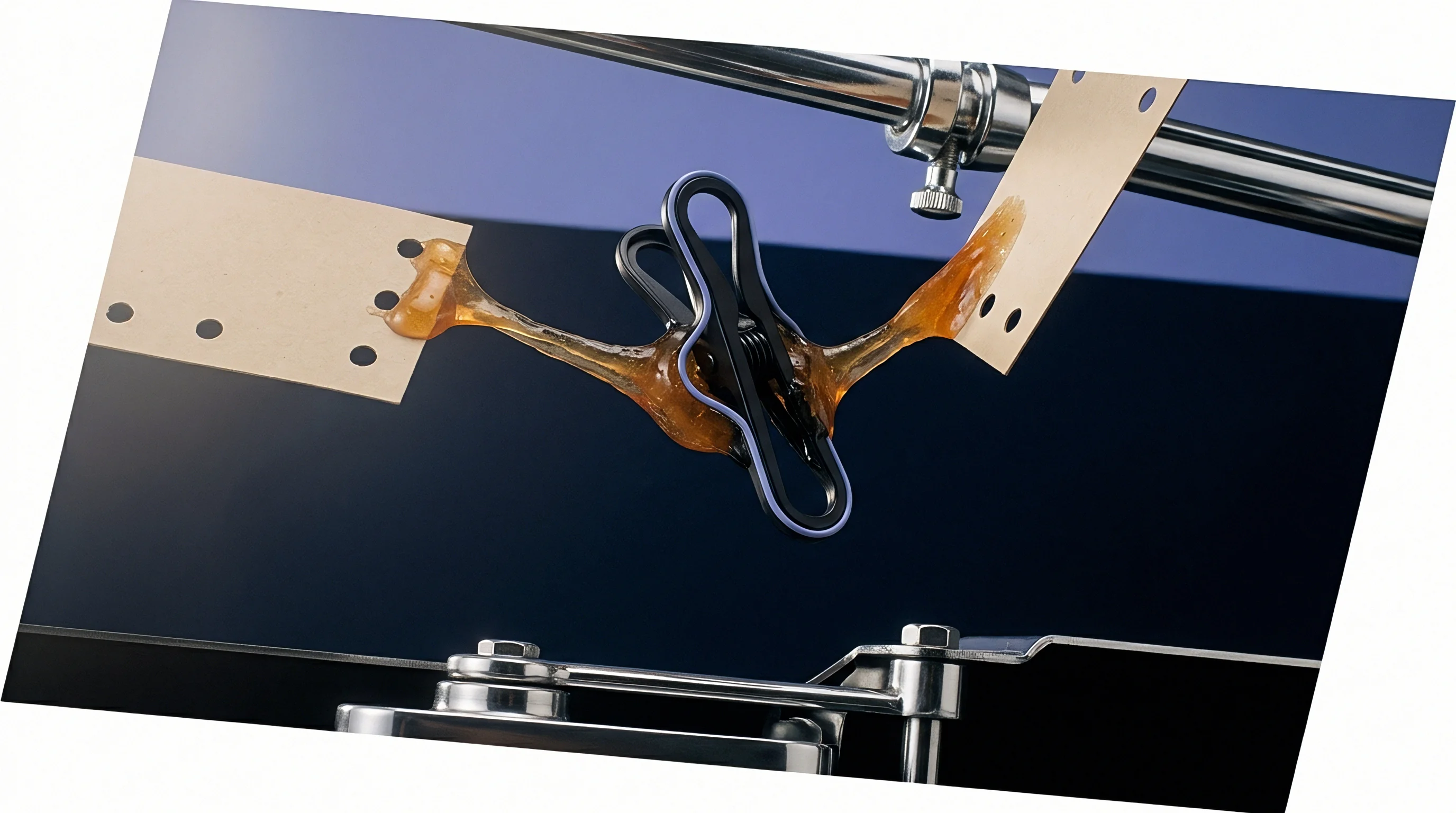
Loom Hour Efficiency Losses from Viscoelastic Slack
Loom-hour costs encompass fixed overheads such as depreciation, operator wages, climate control, and facility space. A modern high-speed rapier loom running dense flax costs between 28 and 42 Euros per loom-hour, depending on region and automation level. When warp slack triggers false warp-stop sensors or causes stop marks that require manual fixing, lost loom-hours add up quickly.
Stoppage analysis shows that 60% of quality-driven speed reductions on high-density linen looms stem directly from warp tension instability after a stop. Dropping loom speed from 480 RPM down to 380 RPM to prevent relaxation-related end breaks extends run times by 26%, raising loom-hour allocation per meter of finished cloth and turning profitable orders into net losses.
| Warp Density (ends/cm) | Target Speed (RPM) | Actual Speed (RPM) | Shed Efficiency (%) | Stop Marks per 100m | Landed Cost (EUR/m) |
|---|---|---|---|---|---|
| 36 | 480 | 470 | 91.2 | 0.4 | 6.85 |
| 42 | 450 | 420 | 86.5 | 1.2 | 8.10 |
| 48 | 420 | 360 | 78.0 | 3.8 | 10.45 |
| 52 | 400 | 310 | 69.5 | 7.5 | 13.90 |
| 56 | 380 | 260 | 58.0 | 14.2 | 19.20 |
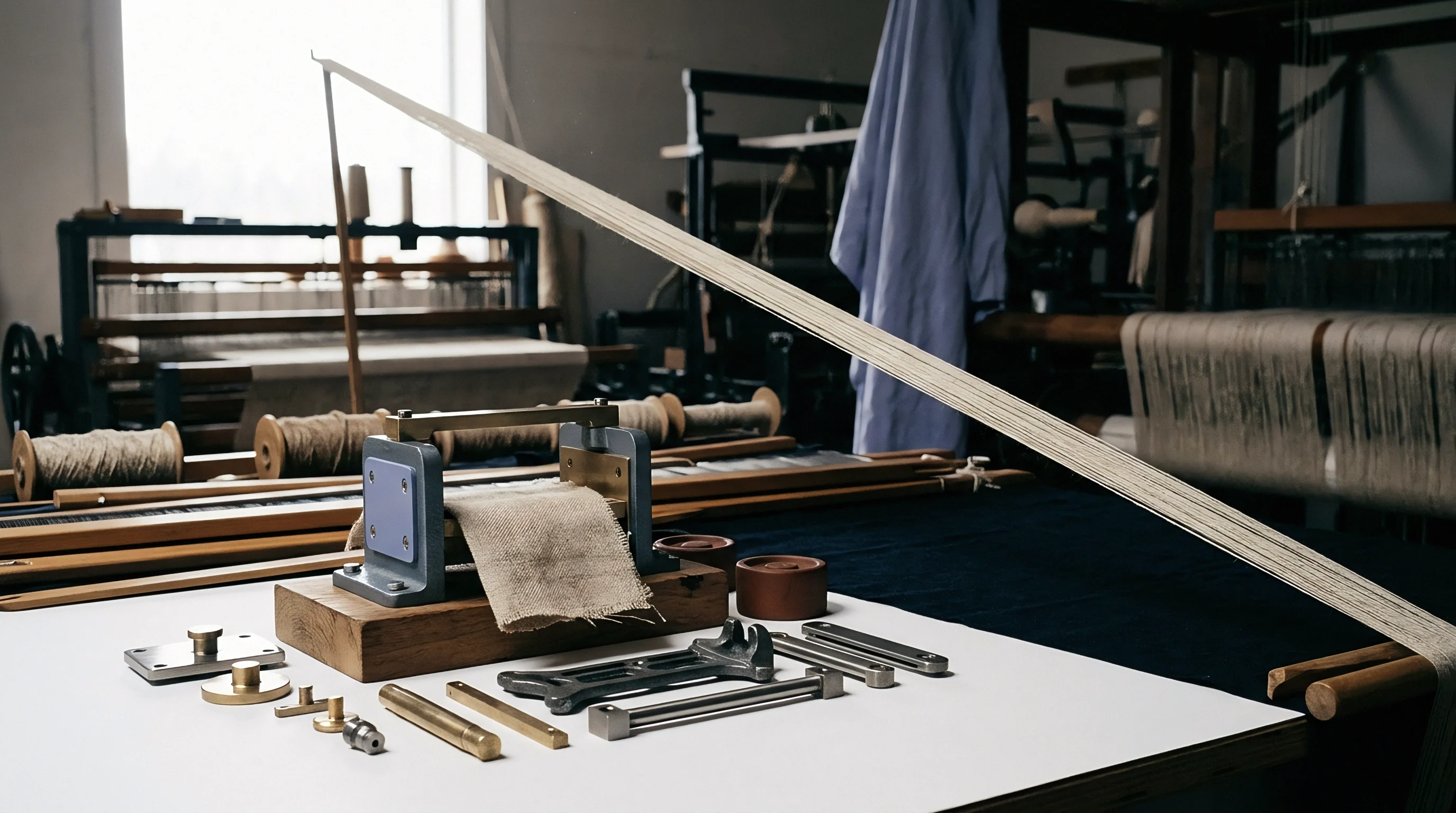
Cost Breakdown of High Sett Linen Warp Preparation
Warp preparation accounts for a large share of overall conversion costs in fine linen manufacturing. Sizing chemistry, drying energy, and warping labor must all be absorbed by the total woven meterage off a beam. When viscoelastic warp defects cause roll rejections during final inspection, preparation costs per saleable meter shoot up.
High-quality size formulations with modified starches, synthetic lubricants, and acrylic film formers add direct chemical cost. However, cutting back on sizing add-on or using lower-grade agents to save up front sharply increases end breaks and tension relaxation losses on the loom. Investing in tailored sizing chemistry alongside precise electronic let-off control reduces overall landed costs by maximizing loom efficiency and first-quality yield.
Uncompensated warp stress relaxation increases loom stoppage rates on high-density linen warps by up to three stops per loom-hour, directly reducing shed margin performance.
Calculating cost per linear meter requires combining raw yarn costs, warping overhead, sizing spend, and allocated loom-hour charges adjusted for real shed efficiency. High-sett flax warps running under optimized viscoelastic parameters achieve higher weaving efficiency, yielding lower landed costs per meter despite higher sizing expenditure. Managing multi-thread elasticity through predictive modeling and precise let-off calibration remains the primary lever for maintaining profitability in high-density linen mills.