Dynamic Mass Transfer Limits in High Speed Hydrothermal Middle Lamella Plasticization for Bast Fibres
Optimizing hydrothermal fluid shear and chelation kinetics lowers middle lamella boundary layer mass transfer resistance, enabling high-speed drafting of fine flax.


Steam

Hydrodynamic Boundary Layer Dynamics at Elevated Sliver Speeds
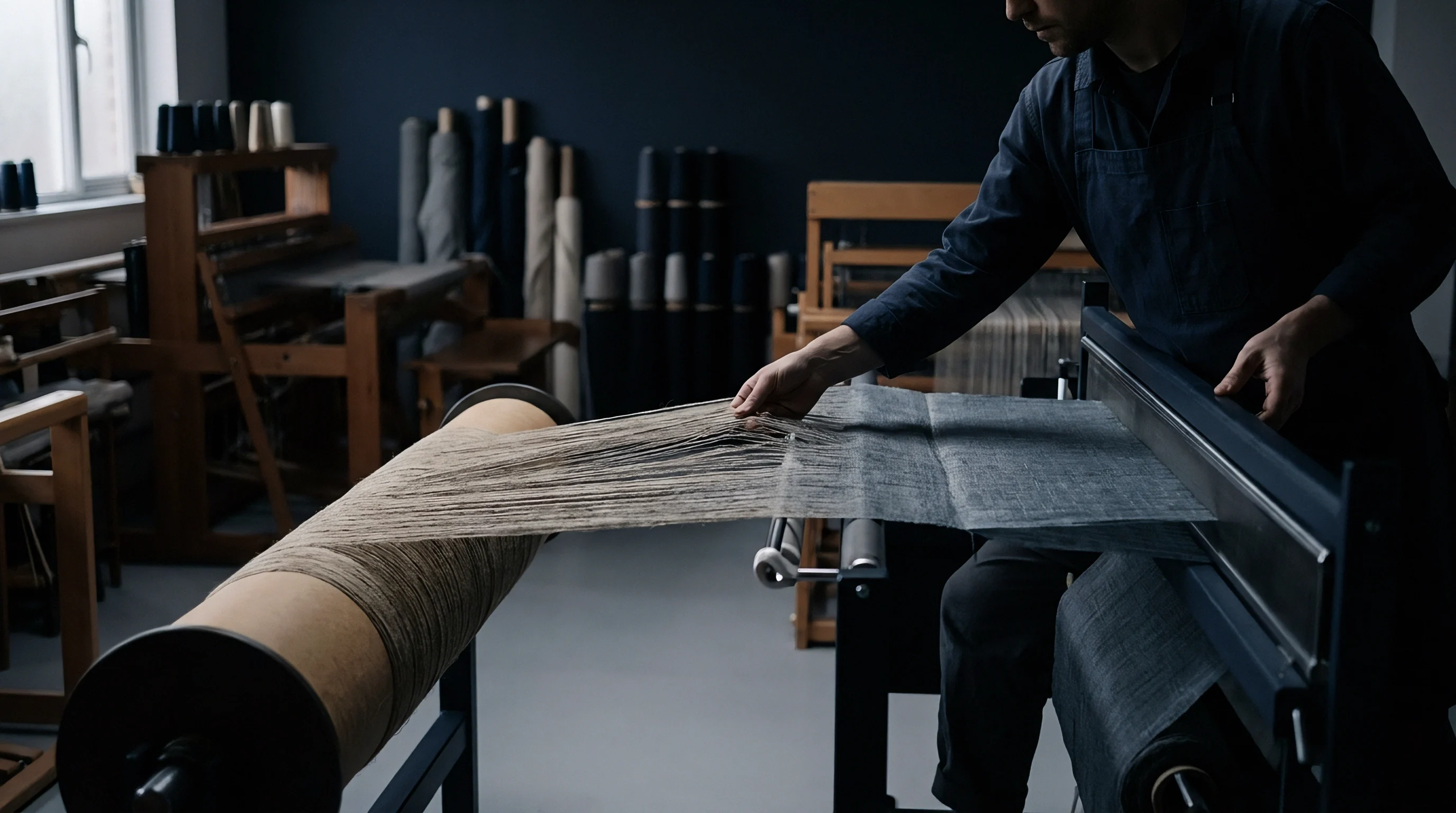
Continuous hydrothermal processing of flax roving and scutched line sliver demands rapid exchange of thermal energy and aqueous liquid across the boundary of dense technical fibre bundles. When fluid moves across a running bundle at line velocities exceeding 120 metres per minute, liquid boundary layer resistance becomes the limiting factor for pectin solubilization. Fluid shear forces form a stagnant film surrounding the bundle perimeter.
This stagnant aqueous layer acts as an insulating blanket, severely restricting the mass transport of water molecules into the tightly packed inter-fibre capillaries of the middle lamella.
The thickness of this hydrodynamic boundary layer scales inversely with the square root of the Reynolds number governing the fluid flow inside the treatment chamber. At low production speeds, fluid residence times permit passive thermal equilibrium and complete fluid penetration into bundle cores measuring 80 to 120 micrometres in diameter. Elevated production speeds reduce dwell times in the fluid zone to less than 1.5 seconds.
Under these dynamic constraints, simple bulk fluid temperature monitoring fails to guarantee that the core of the bast bundle reaches the target plasticization temperature.
Intra-bundle penetration requires dynamic mechanical agitation or pressure-differential injection to disrupt the stagnant film. Without active turbulence, boundary layer mass transfer relies entirely on molecular diffusion across a static liquid barrier. Molecular diffusion rates through water at elevated temperatures remain orders of magnitude slower than forced convective transport.
Process lines operating without shear-inducing liquor nozzles experience localized outer-shell plasticization while the interior core of the bast bundle remains un-hydrated and rigid.
- Boundary Layer Starvation occurs when fluid velocity matching limits the volumetric exchange rate at the outer filament boundary, preventing internal capillary uptake.
- Thermal Lag Deficit develops when core heating times exceed total liquid exposure time, leaving interior calcium pectate matrices unsoftened.
- Solute Saturation Creep arises when stagnant boundary liquor becomes saturated with dissolved galacturonic acid fragments, arresting further matrix dissolution.
- Channeling Short-Circuiting takes place when pressurized liquor bypasses dense bundle centers to flow exclusively through high-permeability macro-voids between sliver slivers.
Capillary pressure within the dry bast fiber matrix resists liquid entry until surface wetting is complete. Hydrothermal processing environments operating above 95 degrees Celsius rely on reduced water viscosity to accelerate flow through micro-voids. Lower viscosity alone cannot overcome the physical displacement obstacle presented by trapped intra-bundle air.
Dynamic degassing combined with continuous boundary-layer disruption determines whether liquid plasticizers reach the inter-elementary pectin layers before the fibre exits the active heating vessel.
The balance between fluid boundary layer thickness and internal bundle diffusion rates raises questions regarding the maximum permissible sliver packing density during continuous high-speed drafting.

Gradient
Concentration Profiles and Thermal Diffusion across the Middle Lamella
Plasticization of the bast fibre middle lamella depends on breaking the cross-linked calcium pectate network that binds individual elementary fibres into technical bundles. The rate of galacturonic acid chain displacement is dictated by the steepness of the chemical and thermal slopes established across the bundle cross-section. Heat moves inward from the liquid boundary via thermal conduction, while water and ionic chelating agents migrate through micro-capillary networks via Fickian diffusion.
The effective diffusion coefficient within the pectin-hemicellulose matrix is roughly three orders of magnitude lower than the self-diffusion coefficient of bulk water.
| Fluid Velocity (m/s) | Boundary Layer Thickness (µm) | Effective Diffusion Coeff (m²/s) | Mass Transfer Coeff (m/s) | Internal Mass Biot Number |
|---|---|---|---|---|
| 0.2 | 45.2 | 1.45 × 10⁻¹¹ | 2.80 × 10⁻⁵ | 15.4 |
| 0.5 | 28.6 | 1.82 × 10⁻¹¹ | 4.43 × 10⁻⁵ | 19.5 |
| 1.2 | 18.4 | 2.15 × 10⁻¹¹ | 6.89 × 10⁻⁵ | 25.6 |
| 2.5 | 12.7 | 2.38 × 10⁻¹¹ | 1.02 × 10⁻⁴ | 34.3 |
| 5.0 | 9.0 | 2.45 × 10⁻¹¹ | 1.44 × 10⁻⁴ | 47.0 |
Temperature accelerates both intra-bundle diffusion coefficients and matrix hydrolysis rates according to Arrhenius kinetics. Raising treatment liquor temperature from 85 to 115 degrees Celsius increases the kinetic rate constant of calcium pectate bond cleavage by a factor of 4.2. High temperature without adequate liquid volume creates steep internal chemical gradients.
Pectin breakdown fragments accumulate in the outer micro-channels, creating a viscous gel barrier that restricts liquid transport into dry interior zones.
At a bulk liquor flow velocity of 2.5 metres per second and a temperature of 105 degrees Celsius, the internal mass Biot number exceeds 30, confirming that internal matrix resistance completely controls overall plasticization speed.
Internal osmotic pressure increases as thermal hydrolysis cleaves long-chain polygalacturonic acids into short, soluble oligosaccharides. High osmotic pressure inside micro-voids causes local swelling of the middle lamella, expanding inter-fibre distances by up to 18 percent. This structural expansion alters intra-bundle capillary geometry mid-process.
Expanded capillaries allow faster convective fluid transport, but excessive swelling weakens the mechanical bundle integrity required to resist premature draft breakage during high-speed processing.
Thicker bast bundles require proportionally longer exposure times to achieve core hydration regardless of liquor temperature.

Plasticity
Polymer Glass Transition and Polymer Chain Mobility in Hydrated Pectin
Rigid, un-plasticized pectin exhibits a glass transition temperature between 140 and 160 degrees Celsius in the bone-dry state. Hydration with hot aqueous liquor acts as a plasticizing force, lowering the glass transition temperature of the amorphous pectin-hemicellulose phase to below 45 degrees Celsius. Water molecules insert themselves between adjacent polygalacturonic acid chains, disrupting intermolecular hydrogen bonding and increasing free volume within the polymer matrix.
When processing speeds shorten the liquid exposure window, incomplete water sorption leaves regions of pectin above their native glass transition, resulting in brittle fibre fracture during mechanical attenuation.
Chelating additives such as citric acid or sodium hexametaphosphate accelerate glass transition depression by sequestering divalent calcium ions (Ca2+). These ions form rigid salt bridges between carboxylate groups on adjacent galacturonan chains. Removing calcium ions destabilizes the ionic network, converting a rigid gel into a soft, water-soluble polymer melt.
The rate of chelation depends entirely on the dynamic arrival rate of chelating molecules at internal binding sites, directly coupling chemical mass transfer limits to mechanical plasticization metrics.
- Fill the treatment vessel with softened water adjusted to pH 5.5 and heat the bulk liquor to a stable 110 degrees Celsius.
- Inject continuous sliver at a baseline entry velocity of 80 metres per minute to establish hydro-dynamic stabilization.
- Ramp volumetric liquor recirculation until the differential pressure gauge across the sliver nozzle reads a constant 180 kilopascals.
- Dose sodium hexametaphosphate into the continuous feed line at 2.5 grams per litre while monitoring exit bundle flexibility via inline optical bending sensors.
Hydrothermal processing parameters must maintain the pectin phase in its rubbery state throughout the entire drafting zone. If the sliver cools below the hydrated glass transition temperature prior to drafting, the middle lamella re-solidifies, locking the bundle in its coarse state.
A fully hydrated pectin matrix under dynamic shear deforms plastically without micro-cracking when held at least 30 degrees Celsius above its effective glass transition point.
Mechanical shear applied during drafting alters the molecular orientation of softened hemicellulose chains. Controlled drafting forces extend relaxed polymer chains along the longitudinal axis of the fibre. This alignment reduces drafting resistance and promotes uniform bundle division down to elementary filaments.
Insufficient plasticization combined with excessive draft speed generates violent stick-slip sliding mechanisms, destroying yarn evenness and producing high nep concentrations in subsequent spinning steps.
Inadequate hydrothermal dwell time directly causes elevated roving breakages, reduced spinning frame speeds, and excess fly waste across the mill floor.

Sliver
Staple Length Distribution and Bundle Attenuation under High Shear
The ultimate goal of middle lamella plasticization is the controlled separation of heavy, scutched bast ribbons into fine, uniform technical filaments without fracturing individual elementary fibres. Elementary bast fibres possess an average length of 20 to 45 millimetres and a diameter of 10 to 25 micrometres. Technical bundles feeding into high-speed drafting frames often measure over 100 micrometres in width.
Effective plasticization permits internal shear sliding between elementary units, yielding a fine sliver with high drafting tenacity and low linear density.

What Line Density Triggers Boundary Layer Starvation?
Line density governs the cross-sectional geometry of the sliver within the hydrothermal vessel. When sliver linear density exceeds 5.0 grams per metre, internal bundle compaction prevents fresh treatment liquor from reaching the core filaments. Boundary layer starvation initiates when the hydraulic resistance of the compact sliver mass exceeds the available pump pressure.
Mass transfer analysis indicates that sliver linear densities above 3.5 grams per metre require compulsory active mechanical opening prior to fluid immersion to maintain uniform liquid contact.
| Dwell Time (s) | Mean Filament Fineness (Nm) | Drafting Force (N) | Nep Count (per 100m) | Staple Length CV (%) |
|---|---|---|---|---|
| 0.5 | 180 | 42.5 | 310 | 38.2 |
| 1.0 | 260 | 28.1 | 185 | 29.5 |
| 1.5 | 340 | 18.4 | 92 | 22.1 |
| 2.0 | 410 | 12.2 | 45 | 17.4 |
| 3.0 | 425 | 11.8 | 42 | 16.8 |
Incompletely plasticized bundles retain rigid pectin nodes that resist drafting shear forces. When these nodes pass through the drafting roller gap, the machine cannot separate the bound filaments. The drafting rollers crush unsoftened bundles, fracturing individual elementary fibres transversely instead of separating them longitudinally along the middle lamella.
Microscopic inspection reveals transverse cracks and damaged cell walls, reducing the potential tensile strength of the spun yarn by up to 35 percent.
- High Roving Twist Factors require extended thermal dwell times because tight mechanical twisting restricts fluid penetration into the internal core micro-channels.
- Low Water Recirculation Rates accelerate local accumulation of extracted hemicellulose, increasing liquor viscosity and diminishing boundary layer mass transfer coefficients.
- Excessive Draft Ratios applied to under-plasticized material generate non-uniform sliver thick-and-thin places known as drafting wave periodicities.
- Abrupt Temperature Drops at the delivery roller exit cause rapid matrix re-gelation, arresting bundle attenuation before target fineness is reached.
Achieving stable high-speed drafting relies on matching the chemical kinetics of pectin breakdown to the physical speed of the sliver transport system. Under-softened slivers display high drafting force spikes that cause frequent yarn end-breaks, while over-softened slivers lose bundle cohesion entirely and draft draftlessly into weak sliver fragments.
Suppliers frequently claim that dark, un-plasticized sliver streaks are natural growth variations rather than the direct outcome of localized mass transfer starvation inside the hydrothermal reactor zone.


Metric

Laboratory Qualification Protocols and Spectroscopic Plasticization Verification
Verification of middle lamella plasticization depth demands objective analytical methods rather than tactile assessment. Quantitative determination relies on measuring residual galacturonic acid concentrations, residual calcium contents, and bundle fineness distributions. Standard chemical methods extract residual pectin through ammonium oxalate digestion followed by spectrophotometric analysis at 520 nanometres.
Fully plasticized line flax suitable for high-speed wet spinning typically retains less than 1.2 percent water-insoluble pectin by dry weight.
Fourier Transform Infrared Spectroscopy (FTIR) provides rapid non-destructive evaluation of the plasticization state by monitoring the esterification degree of the pectin matrix. The absorption peak at 1740 wavenumbers (cm⁻¹) corresponds to the carbonyl group (C=O) of esterified carboxyls, while the peak at 1600 wavenumbers represents the free carboxylate ion (COO⁻). The ratio of the area under the 1740 peak to the combined areas of 1740 and 1600 peaks establishes the residual esterification index.
Lower indices correlate directly with enhanced water solubility and improved middle lamella softeners.
A contract specification stipulating a minimum residual pectin esterification index below 0.35 guarantees uniform bundle division during subsequent wet-drafting operations.
Physical measurement of fibre bundle fineness is performed in accordance with standard test method ISO 2370. The gravimetric length-and-weight technique measures the linear density of a prepared bundle sample expressed in Tex or Metric Number (Nm). Un-treated scutched line flax registers fineness values between Nm 90 and Nm 140.
Effective hydrothermal plasticization increases bundle fineness to Nm 350 through Nm 450, signifying successful division of coarse bundles into fine, multi-cellular units.
- Sampling Frequency Protocols stipulate pulling three five-gram sliver samples per 500-kilogram lot, taken from the outer, middle, and inner layers of the continuous processing unit.
- Standard Moisture Conditioning Requirements mandate placing samples in a standard atmosphere of 20 degrees Celsius and 65 percent relative humidity for 24 hours prior to Stelometer tenacity testing.
- High-Performance Liquid Chromatography Limits cap free monomeric galacturonic acid in the wash effluent at 0.4 grams per litre to confirm matrix extraction without cellulose degradation.
- Cross-Sectional Microscopy Standards require analyzing a minimum of 250 bundle cross-sections under polarized light to quantify core-to-shell plasticization uniformity ratios.
Failure to meet chemical and physical metric benchmarks during incoming material audit provides ground for immediate lot rejection prior to spinning feed allocation.
Supply agreements carrying explicit clauses for maximum residual calcium content under ISO 1973 eliminate disputes over yarn breaking force variation caused by hard, un-hydrated middle lamella nodes.


Tariff

Yield Arithmetic, Spinnable Limits, and Landed Metre Cost Calculations
The economic justification for high-speed hydrothermal plasticization sits in the yield arithmetic governing yarn spinning floors. Bast fibre processing costs accumulate rapidly when incomplete mass transfer reduces the maximum spinnable yarn count. Scutched line flax processed through inadequate hydrothermal lines yields coarse yarn counts around Nm 26 (38 Tex), suitable only for heavy upholstery or coarse canvas.
Proper plasticization enables spinning down to Nm 60 (16.6 Tex) or Nm 80 (12.5 Tex), doubling or tripling the total commercial linear metres produced per raw kilogram of raw material.
A standard financial scenario evaluates a 10,000-kilogram lot of scutched flax line stock landed at 4.50 Euros per kilogram. Processing through a low-speed, traditional soaking line yields a 72 percent hackling and drafting recovery rate of spinnable sliver, with 28 percent lost as low-value tow and waste. Optimizing hydrothermal mass transfer kinetics via high-pressure shear nozzles elevates spinnable sliver yield to 84 percent by preventing filament bundle breakage and minimizing fly waste.
The additional 1,200 kilograms of high-grade line sliver drastically shifts the unit manufacturing economics.
| Parameter | Sub-Optimal Mass Transfer | Optimized Hydrothermal Mass Transfer |
|---|---|---|
| Line Velocity (m/min) | 45 | 160 |
| Spinnable Sliver Yield (%) | 72.0 | 84.0 |
| Max Practical Count (Nm) | 26 | 60 |
| Yarn End-Breaks (per 1000 sp/hr) | 48 | 14 |
| Energy Cost (€/kg sliver) | 0.68 | 0.31 |
| Finished Fabric Cost (€/linear m) | 3.85 | 2.42 |
Operating a spinning frame at 8,500 RPM with poorly plasticized roving leads to high end-breakage rates averaging 48 breaks per 1,000 spindle hours. Each breakage requires operator intervention, introduces piecing defects into the yarn package, and creates machine idle time. Optimizing middle lamella plasticization drops end-breakage rates to 14 breaks per 1,000 spindle hours, boosting mill efficiency from 78 percent to 93 percent.
Elevated efficiency directly translates into lower overhead allocation per kilogram of finished yarn.
Increasing spinnable count from Nm 26 to Nm 60 reduces the required raw fibre mass per linear metre of 150-centimetre wide plain weave fabric from 210 grams down to 91 grams.
Higher production speeds reduce the thermal energy input required per kilogram of processed fibre. Although high-speed treatment vessels demand higher pump pressures and fluid heating loads, the dramatic increase in throughput from 45 to 160 metres per minute drops the thermal energy cost per kilogram of sliver from 0.68 Euros to 0.31 Euros. Lower operational energy consumption combined with higher fabric yields reduces total landed fabric cost from 3.85 Euros to 2.42 Euros per linear metre for a standard 140 grams per square metre linen apparel fabric.
Controlling mass transfer kinetics in hydrothermal plasticization systems ensures that premium raw bast fibre investments translate directly into high-value, fine-count yarn packages with minimal waste generation across the entire textile value chain.