Determining Pectin Solubilization Thresholds for Fine Wet Spun Flax Roving
Fine wet-spun flax roving demands 45 to 65 percent native pectin extraction, leaving 1.2 to 2.0 percent polyuronides to prevent drafting slubs and fiber lap-ups.


Boundary
Fine wet spinning of flax relies on separating collective technical bundles down to individual ultimate fibres. The middle lamella binding elementary bast cells is a matrix dominated by rhamnogalacturonan-I, homogalacturonan, and associated neutral hemicellulose side chains cross-linked by divalent calcium ions. In raw scutched and hackled line flax, non-cellulosic encrusting substances account for 18 to 24 percent of the dry stem mass, with pectic substances making up 3.5 to 5.2 percent of that dry weight.
Spinning yarns finer than metric count Nm 39 (equivalent to 25.6 tex or approximately 70 lea) requires breaking down this inter-fibre adhesive without destroying the structural strength needed to drag the roving package through the roving frame and into the spinning bath.
Pectin removal must stay within 45 to 65 percent of the initial native content. Dropping residual polyuronide content below 1.2 percent by weight of bone-dry fibre triggers premature fibre slippage, floating fibres, and ballooning breaks in the drafting zone. Above 2.4 percent, mechanical drafting rollers fail to cleave the bundle to elementary fibre dimensions.
Coarse bundles entering the spinning nip create heavy slubs, high yarn count variance (CVm exceeding 22 percent), and weak tensile strength at the bobbin.
Cohesion collapses across the drafting field when residual polyuronides drop below one percent.
Thermal softening happens in a hot water trough right before the drafting rollers. Water kept between 60 and 70 degrees Celsius softens remaining pectins so the ultimate fibres glide past one another under roller nip pressure. If chemical solubilization during roving preparation was too mild, heat in the trough cannot break the calcium pectate bonds within the three-to-six-second dwell time.
If extraction was too harsh, individual flax fibres break apart entirely in the hot bath, causing sloughing and roller laps.
Improper solubilization during roving pretreatment causes distinct physical failures across the mill floor:
- Drafting zone starvation occurs when over-boiled roving loses tensile cohesion before the front rollers, creating severe thin places and sliver parting.
- Roller lap accumulation happens when excess free pectin hydrogels cling to polyurethane drafting aprons and fluted steel delivery rollers, forcing operator intervention.
- Gum-banded slubbing results from unextracted middle lamella segments passing intact through the drafting nip, forming rigid thick faults that fail yarn clearers.
- Package channel tracking develops during uneven roving package boilout, where inner windings stay under-retted while outer layers suffer structural fibre degradation.
Boundary conditions depend on retting origin. Dew-retted European flax from coastal France and Belgium shows more initial microbial breakdown and broader variation than water-retted or chemically scoured fibre. Dew-retted long line roving requires tight extraction windows because field fungi have already chopped up homogalacturonan backbones.
Heilongjiang dew-retted flax usually carries higher shive adhesion and heavier lignin cross-linking, requiring higher pretreatment temperatures without degrading the cellulose backbone.
The degree of methyl-esterification in native flax pectins dictates how easily they are extracted by heat. It remains unclear whether mapping esterification distribution along individual rhamnogalacturonan chains can reliably predict drafting forces across seasonal crop variations.


Liquor
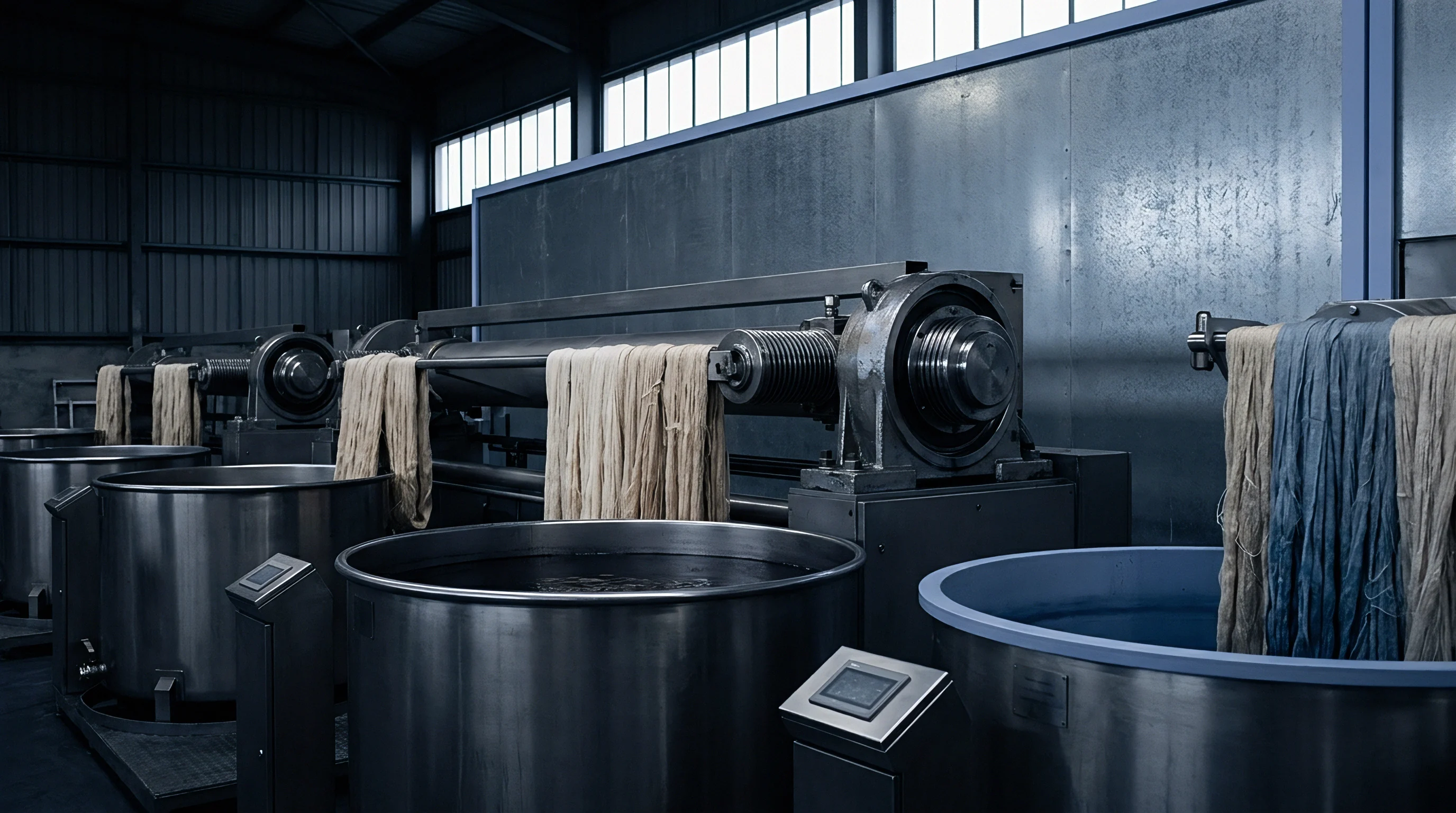
Boiling flax roving packages on perforated stainless steel tubes requires precise chemistry in pressurized dyeing machines. The bath solubilizes pectins through alkaline extraction and cation complexation. Sodium carbonate supplies buffered alkalinity to saponify methyl esters on pectin chains without triggering peeling reactions along cellulose microfibrils.
Caustic soda dissolves pectins faster, but it degrades low-molecular-weight polysaccharides and drives total fibre loss past economic limits.
Chelating agents control extraction by pulling divalent calcium and magnesium bridges out of the pectate network. Tetrasodium ethylenediaminetetraacetate or polycarboxylic acids complex these alkaline earth ions, converting water-insoluble calcium pectate into soluble sodium pectate. Typical industrial baths use 1.5 to 3.0 grams per litre of sequestering agent with 3.0 to 6.0 grams per litre of soda ash.
Adding an alkali-stable non-ionic wetting agent ensures quick, even liquor penetration through high-density roving bobbins wound at 0.32 to 0.38 grams per cubic centimetre.
A boiling bath containing four grams per litre of sodium carbonate and two grams per litre of chelator removes half the native pectin within forty minutes at ninety-five degrees Celsius.
Can Alkali Boiling Replace Acid Demineralization?
Direct exposure to warm weak acids prior to alkali processing alters the pectin dissolution rate. A preliminary rinse using 1.0 to 1.5 millilitres per litre of formic or acetic acid at 45 degrees Celsius exchanges multivalent cations with protons, converting calcium pectates into free pectic acid. This weak acid wash weakens the middle lamella, enabling the subsequent alkaline boil to execute at lower temperatures or reduced duration.
Eliminating the acid demineralization stage forces liquor temperatures above 105 degrees Celsius during the boil, degrading cellulose crystalline structure and cutting overall yarn tenacity by up to 15 percent.
| Process Route | Reagents and Concentrations | Bath Temp | Cycle Time | Pectin Loss | Cellulose Loss |
|---|---|---|---|---|---|
| Mild Soda Boil | 4.0 g/L Na2CO3, 1.5 g/L EDTA | 92 °C | 45 min | 42 to 48 % | 0.8 to 1.2 % |
| Standard Industrial Boil | 5.5 g/L Na2CO3, 2.5 g/L EDTA | 98 °C | 50 min | 52 to 58 % | 1.4 to 1.8 % |
| Acid Demineralized Boil | 1.5 mL/L HCOOH pre-wash, 4.0 g/L Na2CO3 | 90 °C | 35 min | 58 to 64 % | 1.1 to 1.5 % |
| Aggressive Caustic Scour | 2.0 g/L NaOH, 2.0 g/L Na2CO3, 2.0 g/L EDTA | 105 °C | 30 min | 72 to 80 % | 3.5 to 5.2 % |
Differential pressure across the package controls how evenly pectins extract. Circulation pumps reverse flow between inside-out and outside-in every five minutes, with pressure gauges maintaining 0.8 to 1.2 bar. A pressure drop below 0.6 bar across the bobbin wall points to channeling, which leaves inner roving under-extracted.
Pressure above 1.5 bar compresses the package, hardens roving edges, and creates uneven radial pectin distribution that disrupts downstream yarn counts.
Rinsing halts extraction before fibre damage sets in. Two hot overflow rinses at 70 and 50 degrees Celsius wash out mobilized polyuronides and remaining alkali. The package is neutralized with 0.8 millilitres per litre of acetic acid to reach a core pH of 5.5 to 6.2.
Trapping alkaline liquor inside damp bobbins during storage leads to auto-oxidation of outer bast fibres.
Uneven lot-to-lot retting produces variable roving boilout results, even when boiling recipes are kept constant across seasons.

Metric
Measuring residual pectin fractions ensures wet spinning settings match raw fibre chemistry. The laboratory uses colorimetric spectroscopy to determine total polyuronides in samples drawn from various radial depths of the package. Dried, defatted flax bundles undergo enzymatic or acid hydrolysis to break insoluble pectins into galacturonic acid monomers.
Reacting the hydrolysate with m-hydroxydiphenyl in concentrated sulfuric acid and sodium tetraborate generates a chromogen absorbing at 520 nanometres, with concentration read against D-galacturonic acid standard curves.
Fourier transform infrared spectroscopy offers a quick, non-destructive check for the plant floor. In the spectrum of flax bundles, absorption bands track pectin condition: 1740 inverse centimetres marks carbonyl stretching in esterified carboxyl groups, while 1610 inverse centimetres indicates carboxylate ions. Comparing peak intensity at 1740 against the baseline cellulose vibration at 1160 inverse centimetres calibrates well with chemical titrations, signaling how the roving will slip under warm-water drafting rolls.
- Cut twenty-gram cross-sections from three randomly chosen roving bobbins per five-hundred-kilogram treatment lot.
- Extract neutral lipids and wax components using petroleum ether in a Soxhlet apparatus for four hours.
- Boil the dewaxed sample in a 0.5 percent ammonium oxalate solution at 85 degrees Celsius for two hours to isolate water-soluble and chelator-soluble polyuronides.
- Filter the extract through sintered glass crucibles and precipitate the pectic acid using acidified ethanol.
- Quantify the precipitated galacturonic acid via spectrophotometric absorbance or dried gravimetric cake determination against tare weight.
Thermogravimetric analysis supplements colorimetry by tracing thermal degradation. Untreated flax shows a decomposition shoulder between 220 and 280 degrees Celsius from pyrolytic breakdown of pectins and hemicelluloses. As chemical extraction progresses, this shoulder shrinks.
Roving prepared for fine counts shows minimal weight loss in this early range, pushing primary decomposition toward 330 degrees Celsius, where alpha-cellulose breaks down.
ISO 2370 establishes airflow calibration tolerances for flax fiber linear density that must be cross-checked against residual gum content.
Wet bundle tensile testing measures middle lamella cohesion directly. Submerged in water at 65 degrees Celsius for five minutes, single roving segments clamped ten millimetres apart are pulled at a constant rate of extension. Raw roving shows peak slip forces over 45 Newtons per kilotex.
Roving solubilized for fine yarns shows wet slip resistance between 12 and 18 Newtons per kilotex; values under 8 Newtons signal fibre stripping and high spinning waste.
Contract specifications under Bureau International pour la Standardisation des Fibres Artificielles rules mandate certified moisture content, residual boiling loss percentages, and metric counts for delivered roving. Missing these criteria allows immediate rejection of the consignment.
Roll
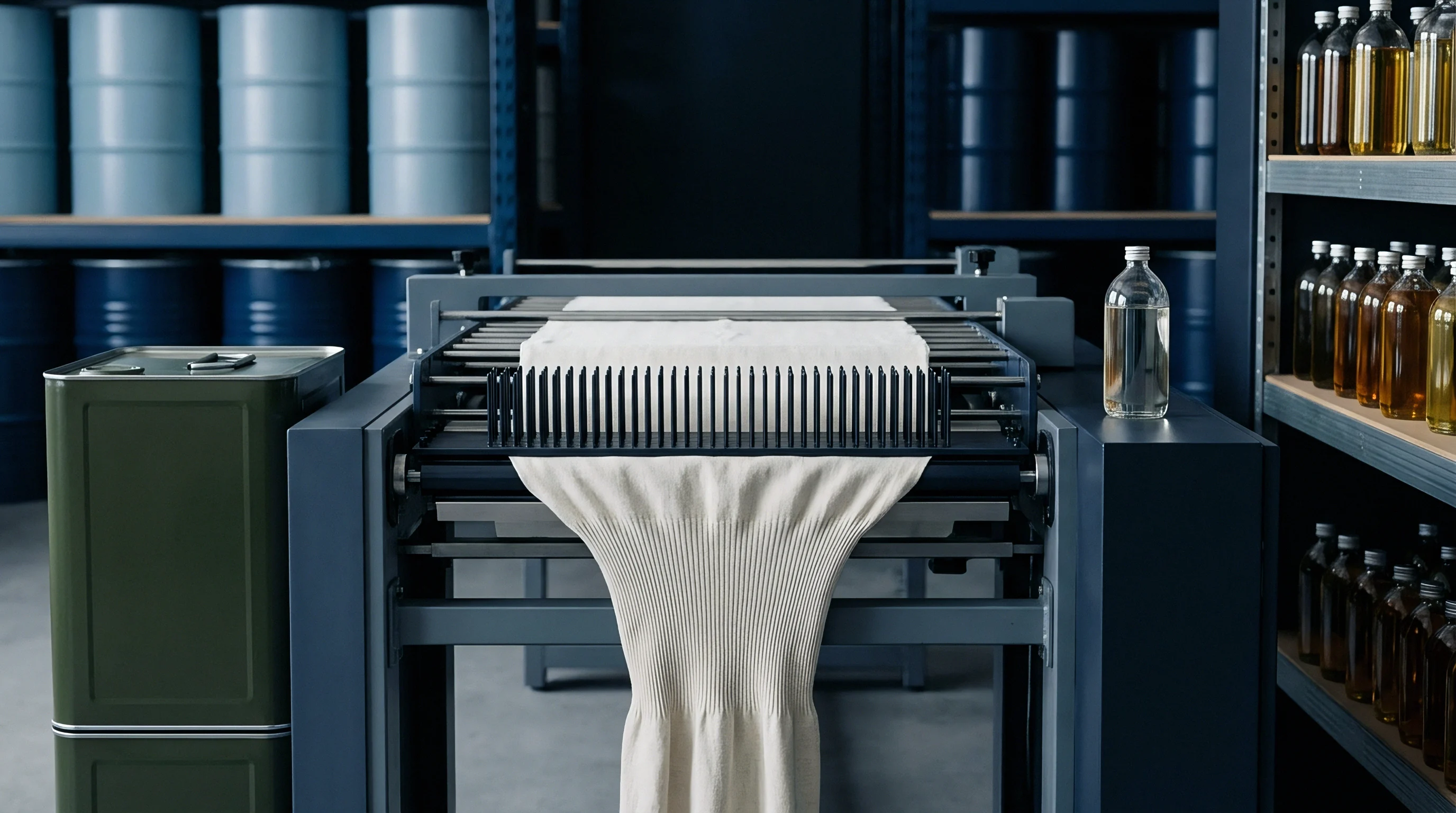
The drafting zone converts chemical solubilization into physical attenuation. Roving bobbins mount on an overhead creel and unwind under controlled tension into an immersion trough of circulating water held at 60 to 75 degrees Celsius. Residence time in the bath softens remaining pectin hydrogel.
The saturated strand feeds between slow back retaining rollers into the drafting field, where front rollers turn fifteen to thirty-five times faster, drawing ultimate bast fibres apart along the hydrated middle lamella.
Nip pressure on the delivery rollers dictates drafting stability. Fluted stainless steel bottom rollers run against top rollers coated in vulcanized synthetic rubber rated at 80 to 90 Shore A hardness. If drafting force overcomes the friction of the rubber nip, slipping creates periodic thick spots in the yarn.
If nip pressure exceeds 18 decanewtons per centimetre, over-extracted fibres crush, tearing elementary cellulose walls.
What Residual Gum Fraction Permits High Drafts?
Draft ratios above thirty require low residual gum to avoid yarn breaks. Spinning fine yarn at metric count Nm 78 (12.8 tex) relies on residual pectin between 1.3 and 1.6 percent. This range lets ultimate fibres separate cleanly into an average of 12 to 18 elementary fibres per cross-section.
Higher residual gum binds fibres into coarse clusters, raising the limit on minimum yarn count and producing stiff yarn unfit for fine cloth.
| Yarn Count | Draft Ratio | Trough Temp | Residual Pectin | Drafting Force | Yarn CVm |
|---|---|---|---|---|---|
| Nm 24 (41.6 tex) | 12 to 16 | 58 °C | 2.1 to 2.4 % | 28 to 34 cN/tex | 16.5 % |
| Nm 39 (25.6 tex) | 18 to 22 | 64 °C | 1.8 to 2.0 % | 22 to 26 cN/tex | 18.2 % |
| Nm 60 (16.6 tex) | 24 to 28 | 68 °C | 1.5 to 1.7 % | 15 to 19 cN/tex | 20.5 % |
| Nm 85 (11.7 tex) | 28 to 34 | 72 °C | 1.3 to 1.5 % | 11 to 14 cN/tex | 23.8 % |
| Nm 105 (9.5 tex) | 32 to 38 | 75 °C | 1.1 to 1.3 % | 8 to 11 cN/tex | 26.5 % |
Controlling process stability requires continuous monitoring of water conditions across the wet-spinning frame trough:
- Temperature consistency keeps the water bath within two degrees Celsius of target, preventing localized drafting force shifts.
- Continuous liquor renewal flushes dissolved pectic fragments before gummy deposits drop back onto drawing aprons.
- Conductivity management prevents accumulated hardness ions from re-crosslinking free carboxyl groups as roving passes through the bath.
Roving reach settings match the distance between roller nips to the staple length distribution created by pectin removal. While raw flax retains bundle lengths matching original hackled stricks of 400 to 600 millimetres, solubilized roving shears down toward individual elementary cell lengths of 20 to 45 millimetres. Reach is shortened to 55 or 70 millimetres on modern wet frames.
A reach set too wide leaves floating fibres that bunch into nep-like slubs; a reach shorter than lingering bundle elements shatters intact fibres, filling the trough with debris.
Cohesion along the drafting line balances roller grip against chemical release.
Outlay
The economics of fine linen spinning hinge on extraction yield and ring frame speed. Take a processing lot of 10,000 kilograms of hackled long line flax graded Courtrai standard 4/5, priced at 8.20 Euros per kilogram landed. Roving preparation on gill drawing sets and roving frames generates four percent waste prior to chemical treatment.
Boiling the remaining 9,600 kilograms of roving packages down to the fine spinning threshold extracts 7.5 percent total dry solids ~ pectins, waxes, soluble hemicelluloses, and mechanical fines flushed out by the liquor.
Net roving weight reaching the spinning room drops to 8,880 kilograms. Direct chemical, energy, and water costs for the boil add 0.78 Euros per kilogram of treated roving. Cumulative landed expenditure reaches 89,446 Euros, bringing effective raw material cost to 10.07 Euros per kilogram of spin-ready roving.
Any variation in pectin solubilization that disrupts frame stability compounds these expenses across the department.
At metric count Nm 60 (16.6 tex), when residual pectin stays in the 1.5 to 1.7 percent target range, end breaks average 45 per 1,000 spindle-hours at 6,200 revolutions per minute. Pneumatic waste stays at 2.2 percent, yielding 8,684 kilograms of first-quality wound yarn on cones. Gross manufacturing cost per kilogram comes to 18.40 Euros.
Woven into plain linen shirting at 125 grams per square metre and 150 centimetres loom width, yarn accounts for 3.45 Euros per linear metre of greige cloth.
If over-boiling drops residual polyuronides to 0.9 percent, the economics break down. Spindle breaks jump to 135 per 1,000 spindle-hours, forcing frame speeds down to 4,800 revolutions per minute to keep up with operator allocations. Pneumatic collection waste climbs to 6.8 percent from constant roller laps and strand partings.
First-grade yarn output drops to 8,276 kilograms, with remaining mass downgraded to low-value carded tow blends sold at a 60 percent discount. Amortization and labor costs rise per unit given the 22 percent output loss. Spinning cost surges to 23.10 Euros per kilogram, driving raw fabric cost to 4.33 Euros per linear metre.
Losing control of chemical solubilization erases commercial margin before yarn reaches the warper.