Intermediate Drafting Package
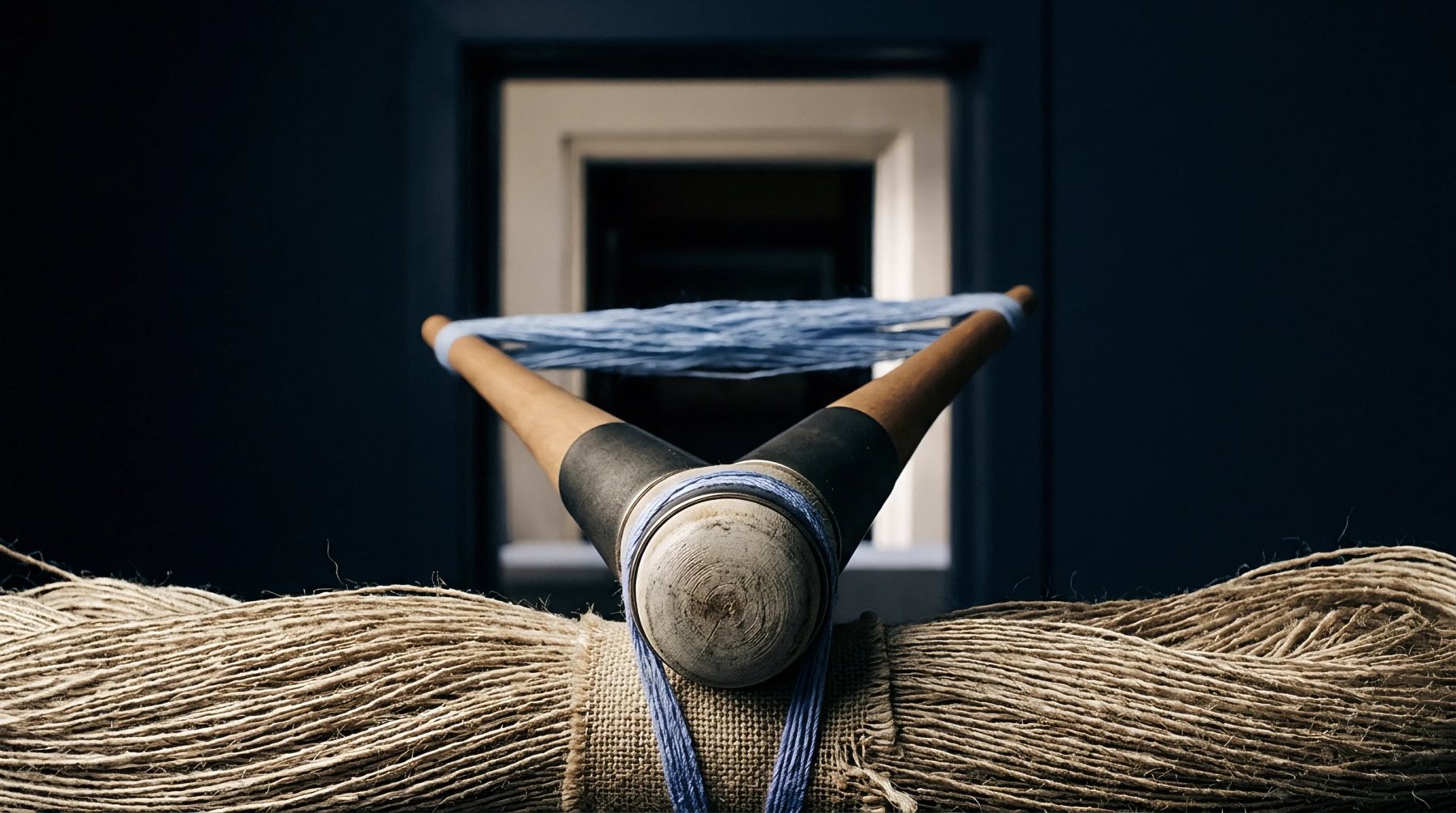
Low-twist, lightly consolidated strands wound onto perforated plastic or stainless steel bobbins prepare hackled flax line for final attenuation. In the linen manufacturing chain, wet spun flax roving constitutes the final intermediate product between multi-head drawing frames and wet ring spinning frames. The strand carries just enough mechanical twist, inserted by a flyer frame, to prevent disintegration during wet processing while permitting individual fibre bundles to slide apart under the draft rollers.
The term applies solely to twisted, package-wound bast roving intended for submerged or hot-water wet drafting, excluding dry-spun rovings that bypass chemical or thermal softening baths entirely.
Package Preparation Chemistry
Processing begins at the roving frame, where finisher sliver drafts down and receives three to six turns per meter of protective twist before winding onto perforated tubes at controlled packaging tension. These packages undergo chemical boiling or hot-water pre-treatment directly on the bobbin, either in dedicated pressure vessels or within the wet ring frame trough itself. Warm water bath conditions, typically maintained between fifty and sixty degrees Celsius, soften the intercellular pectin matrices holding the elementary cells into coarse composite bundles.
This thermal conditioning transforms wet spun flax roving into a pliable, malleable state where drafting forces on the ring frame drop, enabling attenuation down to fine metric yarn counts such as Nm 39 or Nm 50. Insufficient package permeability prevents uniform liquor penetration, producing dry cores that jam drafting rollers and snap under spinning tension.
Spinning Room Handover
Operational staff verify roving weight per unit length, expressed in grams per meter or indirect roving counts, logging values on the roving lot tag and spinning creel ledger. Moisture content, package build hardness, and twist consistency are monitored continuously across shifts to avoid sloughing-off during unrolling in wet spinning creels. When roving packages arrive with irregular density, the subsequent hot water soak yields uneven pectin softening, causing drafting waves and elevated yarn hairiness.
Wet spun flax roving represents an internal mill transfer material and does not enter commercial open-market export channels as finished goods. Factory acceptance criteria dictate that roving failing linear mass consistency thresholds must be stripped from bobbins and diverted back to carding, because irregular roving guarantees mass variations that cannot be cleared downstream by automatic winding machines.