Degumming Splitting Variance Governing Draft Dynamics in Short Staple Spinning Lines
Degummed flax bundle fineness variance dictates top roller nip stability, requiring wider apron gaps and higher break drafts to control drafting waves.

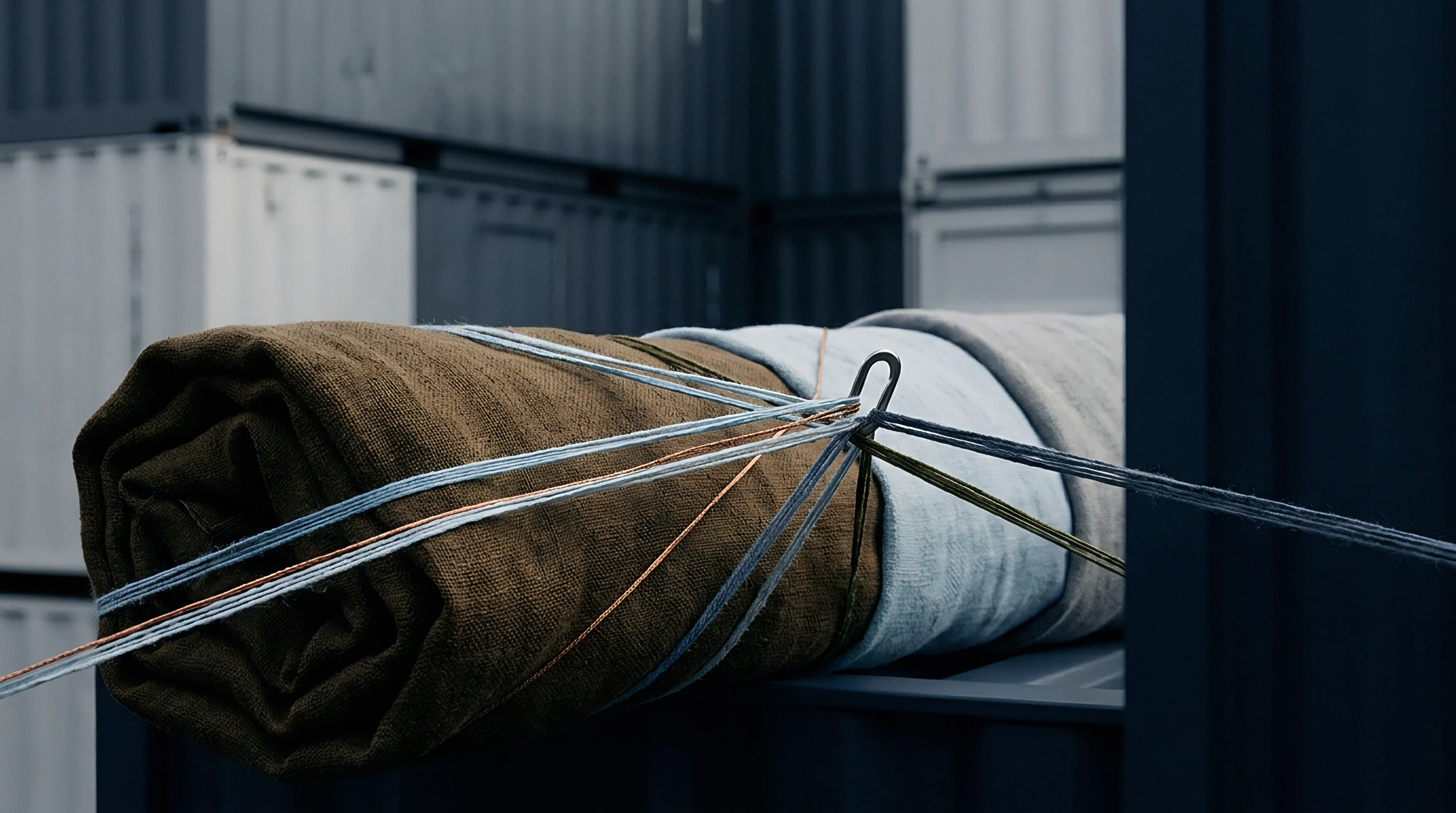
Clamp

Fiber Bundle Nipping Dynamics in High-Speed Top Roller Pairs
Top roller weighting on short staple ring and rotor spinning frames relies on uniform fiber strand geometry to exert constant normal force across the nip line. Primary bast fiber bundles arriving from industrial chemical degumming retain significant residual cross-linking from middle lamella pectins and hemicelluloses. Individual elementary flax filaments measuring 1.5 to 3.0 decitex remain bound into composite technical structures that range from 8 to 25 decitex.
When these coarse bundles enter a drafting system engineered for single-denier cotton or synthetic fibers, the roller nip gap widens dynamically to accommodate the larger bundle cross-section.
Deflection of the synthetic elastomeric roller cot during passage of an unsplit 22 decitex technical bundle relieves pressure on neighboring fine filaments. Slippage occurs across adjacent finer fibers because the top roller rubber cannot form a continuous contour around disparate bundle diameters. Measurements taken on cot durometers between 65 and 75 Shore A demonstrate that localized deflection spikes create instantaneous clamping force drops exceeding forty percent along the contact line.
Pneumatic weighting arms set to 18 decanewtons per top roller cushion some displacement, yet high-frequency nip opening persists. Floating fibers within the main draft zone lose contact with drafting aprons, accelerating prematurely into the delivery stream. Short staple spinning efficiency depends directly on keeping this nip opening amplitude below three micrometers during high-speed drafting.

Elastic Deformation and Cot Hardness Selection
Choosing roller cot durometer values balances gripping friction against structural wear. Softer cots rated at 63 Shore A deform around coarse bast bundles, maintaining contact with adjacent single filaments. Rapid abrasion occurs when running bast fibers treated with harsh alkaline boiling, as microscopic residual shive fragments act as abrasives under continuous pressure.
Harder cots rated at 80 Shore A resist grooving and abrasion over extended production cycles. Static gripping force decreases under these hard surfaces, leading to uncontrolled fiber sliding when drafting forces exceed 12 newtons. Top roller loading systems running degummed bast stock require targeted adjustments to spring pressure or pneumatic pressure settings to stabilize the nip envelope.
Varying bundle diameters alter the total frictional force exerted by top and bottom draft rollers. Standard cotton sliver exhibits a narrow fiber diameter distribution with a coefficient of variation below fourteen percent. Cottonised flax sliver produced through incomplete degumming frequently exhibits a bundle diameter coefficient of variation exceeding forty-five percent.
Every increase in bundle fineness variance shifts the effective nip point forward and backward along the line of draft. Axial movement of the nip point generates short-term mass variations in the output yarn, visible as thin and thick places on capacitance-based evenness testers. Controlling this mechanical instability requires matching degumming extraction thoroughness with roller loading geometry prior to entering high-draft spinning frames.
Uncontrolled nip movement leaves open whether mechanical spring weighting or active pneumatic force compensation provides superior short-term mass stability across extreme bundle fineness distributions.


Liquor

Alkaline Extraction Parameters and Middle Lamella Solubilization
Chemical degumming converts rigid, glued bast ribbons into flexible, spinnable staple fiber suitable for short staple machinery. Boiling raw scutched flax in sodium hydroxide solutions removes non-cellulosic binder substances located within the middle lamella. Pectin solubilization occurs at high temperatures, breaking down polygalacturonic acid chains that anchor elementary filaments together.
| Treatment Route | Reagent Concentration | Process Temp (°C) | Duration (min) | Mean Fineness (dtex) | Residual Pectin (%) |
|---|---|---|---|---|---|
| Alkaline Boil | 12 g/L NaOH + 2 g/L Na2CO3 | 105 | 90 | 3.8 | 0.85 |
| Chelating Alkaline | 8 g/L NaOH + 3 g/L EDTA | 98 | 120 | 2.9 | 0.42 |
| Enzyme Assisted | 2 g/L Pectinase + 4 g/L NaOH | 55 | 180 | 2.2 | 0.31 |
| Acid-Alkali Two-Stage | 4 g/L H2SO4 then 10 g/L NaOH | 100 | 60 / 90 | 1.8 | 0.18 |
| Test conditions: ISO 2370 linear density evaluation on 100-bundle samples per lot following conditioning at 65% RH and 20°C. | |||||
Controlling liquor alkalinity maintains cellulose structural integrity while stripping matrix gums. Sodium hydroxide concentrations above fourteen grams per liter degrade cellulose polymer chains, lowering fiber tenacity below 35 centinewtons per tex. Low concentrations leave residual pectin levels above one percent by mass, preventing full fiber splitting during subsequent mechanical carding.
Sodium carbonate additions buffer the bath, preserving tensile strength while promoting uniform liquor penetration into dense fiber bundles. Chelating agents such as ethylenediaminetetraacetic acid bind calcium and magnesium ions that harden pectin complexes. Removing these divalent ions allows pectins to dissolve completely at lower thermal thresholds.
Excessive removal of hemicellulose during over-degumming causes microfibrillar collapse within elementary cell walls. Fibers turn brittle, shattering into short dust fragments under the aggressive action of carding cylinders and licker-in wires.

Enzymatic Pectinase Cleavage and Selective Splitting
Targeted biochemical extraction employs endo-polygalacturonase enzymes to cleave specific glycosidic linkages in pectin networks. Enzymes penetrate microscopic surface fissures in the bast wall, dissolving middle lamella components without attacking structural crystalline cellulose. Temperature regulation during enzyme digestion requires precision within two degrees Celsius of the enzyme optimum.
Fibre tenacity drops below acceptable spinning limits when residual pectin falls under zero point fifteen percent due to structural wall breakdown.
Rinsing cycles after digestion eliminate suspended pectin residues before precipitation occurs. Re-deposited pectin acts as a stiff binder during fiber drying, re-aggregating split filaments into coarse bundles. Thermal drying temperatures must remain below eighty degrees Celsius to prevent thermal hornification of wet-swollen fibers.
Dry fibers treated with optimal enzymatic profiles yield a narrow fineness spectrum centered between two and three decitex. Homogeneous linear density enables high-speed drafting without causing excessive roller lift or localized drafting force spikes.
Degummed bast stock with low residual binder Content splits predictably under mechanical carding without breaking elementary filaments.

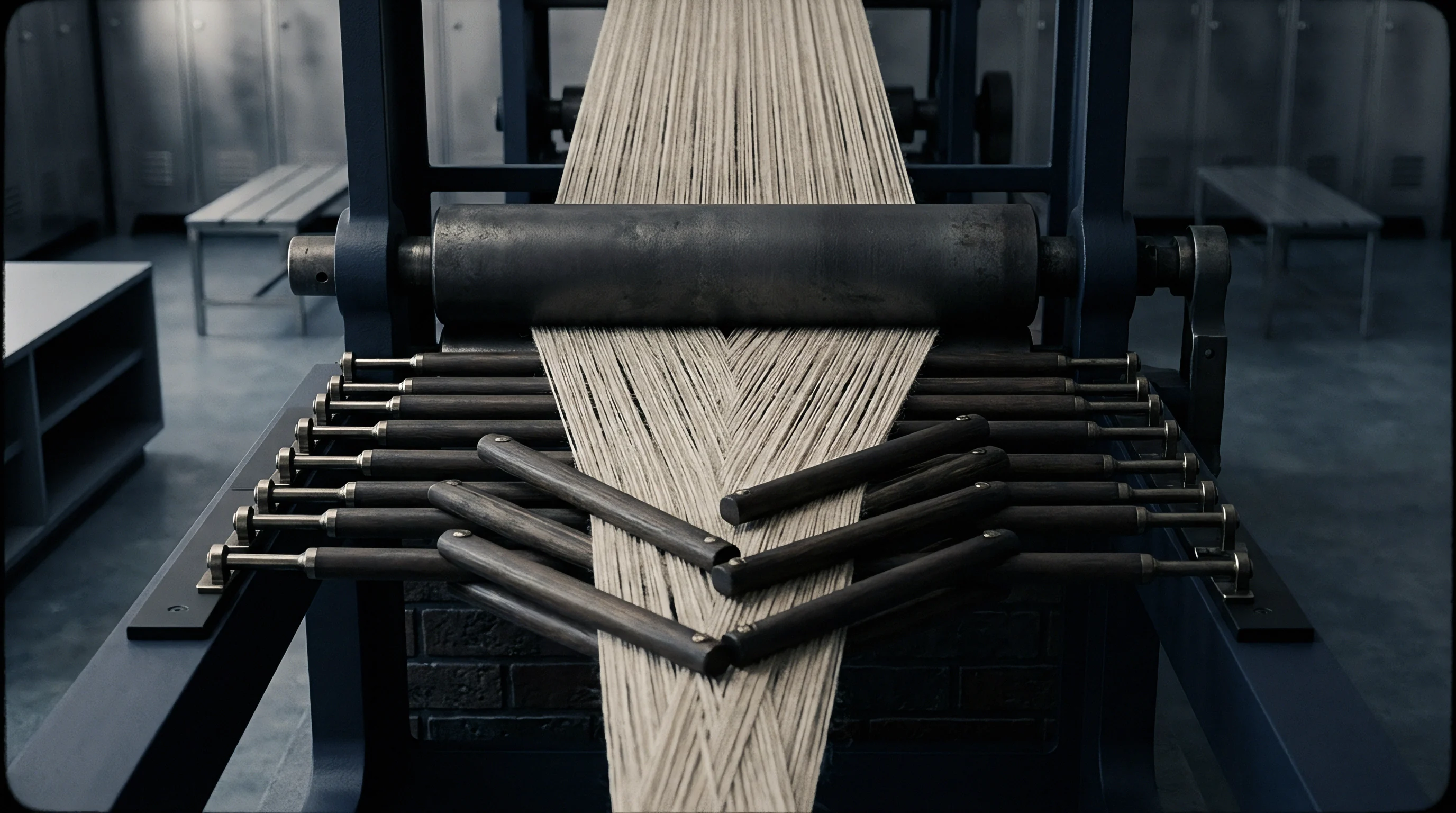
Slip

Drafting Force Fluctuations and Stick-Slip Phenomena
Inter-fiber friction inside the drafting zone governs how individual filaments accelerate relative to neighboring strands. Bast fiber surfaces feature prominent nodes, micro-fibrillar cross-markings, and variable cross-sectional shapes that generate irregular friction profiles. When a carded sliver containing a mix of fine elementary fibers and coarse unsplit bundles passes through an apron drafting zone, inter-fiber friction fluctuates rapidly.
Drafting forces measured in break-draft zones reveal severe stick-slip behavior when processing poorly split stock. Static friction between coarse bundles holds the fiber matrix together until tension builds to a critical threshold. The matrix releases suddenly, sliding forward as a clump into the main drafting zone.
This periodic release generates drafting waves, creating mass variation peaks spaced at intervals corresponding to the average fiber length. High drafting wave amplitude degrades yarn evenness, increasing the Uster mass CV percentage from an acceptable twelve percent to over twenty-two percent. Slippage control relies on controlling both static friction coefficients and dynamic sliding forces within the fiber strand.

Can Nonlinear Fiber Friction Cause Periodic Drafting Waves?
Inter-fiber frictional forces change nonlinearly as drafting speed increases. At delivery speeds exceeding 400 meters per minute on rotor frames or 25 meters per minute on ring frames, transit times within the apron zone drop below critical relaxation thresholds for bast fibers. Rough surface nodes catch mechanically, generating localized tension spikes that pull whole bundle clusters past the front roller nip point before main draft attenuation completes.
- Coarse bundle accumulation clogs drafting aprons when unsplit bundles exceeding fifteen decitex lodge in the clearance gap, causing localized strand arrest and heavy end breaks.
- Short fiber floating occurs when short elementary fragments below twenty millimeters lose contact with guidance aprons, creating flying lint that settles into downstream yarn channels.
- Drafting wave amplification develops when friction variations match the mechanical resonance of top roller weighting springs, inducing persistent cyclic count variations.
- Front roller slip occurs when drafting force exceeds the friction grip of the top cot, halting strand attenuation and loading the front cylinder with wrapped fiber.
Spinning lubricants applied during carding or draw-frame blending modify these friction dynamics. Emulsion sprays containing water-soluble synthetic esters reduce static friction while stabilizing dynamic sliding resistance. Applying lubricant at zero point five percent by weight lowers drafting force variance, suppressing stick-slip peaks during high-ratio main draft operations.
Moisture content inside the spinning room influences surface friction directly. Ambient relative humidity held below fifty percent induces electrostatic charge buildup on dry bast fibers, causing mutual repulsion and erratic strand ballooning. Relative humidity above sixty-five percent softens residual surface pectins, raising static stickiness and triggering severe roller wrapping.
Incorrectly tuned break draft ratios under high stick-slip conditions increase yarn count variations, driving winding machine clearers to cut yarn repeatedly and reducing overall mill efficiency.


Spacing

Break Draft Geometry and Gauge Setting Calibration
Setting distance between drafting roller nips governs how fiber bundles detach from the incoming sliver. Short staple cotton frames use front-to-back gauge distances matched to cotton fiber length distributions, typically between 34 and 44 millimeters. Cottonised flax fibers exhibit a broader length distribution, ranging from fifteen-millimeter elementary fragments to fifty-five-millimeter composite bundles resulting from incomplete mechanical hackling or cutting.
| Blend Ratio (Flax/Cotton) | Break Draft Ratio | Front-to-Middle Gauge (mm) | Middle-to-Rear Gauge (mm) | Apron Clearance (mm) | Top Roller Force (daN) |
|---|---|---|---|---|---|
| 20 / 80 | 1.15 | 42.5 | 46.0 | 2.8 | 16 |
| 35 / 65 | 1.22 | 44.0 | 48.0 | 3.2 | 18 |
| 50 / 50 | 1.30 | 46.5 | 50.0 | 3.5 | 20 |
| 70 / 30 | 1.38 | 48.0 | 52.5 | 4.0 | 22 |
Positioning roller nips too close together breaks longer bast bundles, creating artificial short fiber content that lowers final yarn strength. Setting roller nips too far apart leaves an uncontrolled floating zone where short fibers move without guidance, forming thick slubs in the drafted strand. Optimized spacing establishes a break draft zone wide enough to break temporary inter-fiber bonds without rupturing individual cellulose filaments.
Break draft ratios require adjustment based on bast blend percentages. Pure cotton processing utilizes low break drafts from 1.10 to 1.18 to pre-tension the sliver. Blends incorporating thirty percent or more degummed flax require elevated break drafts between 1.25 and 1.40 to overcome high initial bundle cohesion generated by surface nodes and residual gums.
- Mount precision setting gauges directly between the bottom steel roller collars while weighting pressure is relieved.
- Adjust the middle roller bridge axially until feeler gauges confirm identical clearance across all spinning positions on the frame rail.
- Lock bridge retaining bolts to a torque specification of 25 newton-meters to prevent shift under mechanical vibration.
- Insert selected cradle spacer clips to set top-to-bottom apron clearance matching the target sliver linear density.
- Apply pneumatic weighting pressure and verify top roller parallelism using an optical alignment bar.
Apron clearance spacers dictate the vertical pressure exerted on the fiber strand within the main drafting zone. Standard cotton production uses small spacers measuring 2.4 to 2.8 millimeters. Processing degummed bast stock demands larger spacer clips between 3.2 and 4.0 millimeters to prevent choking within the apron guide cavity.
ISO 2060 yarn linear density testing mandates conditioning samples for twenty-four hours at twenty degrees Celsius and sixty-five percent relative humidity prior to balance weighing.
Excessive apron clamping density forces coarse bast bundles against top apron inner surfaces. Increased drag stops apron rotation, producing un-attenuated sliver passes that lock up spinning positions and ruin roller cots.
Sudden count variation spikes are often attributed to natural crop retting variations rather than incorrect break draft roll spacing on the spinning floor.


Tally

Degumming Mass Loss and Landed Fiber Economics
Commercial acquisition of raw bast fiber operates on dry scutched mass, but yarn manufacturing relies on net spinnable output after chemical and mechanical purification. Raw flax stock loses substantial weight during chemical degumming as non-cellulosic constituents dissolve. Pectin, hemicellulose, lignin, and surface waxes comprise eighteen to twenty-eight percent of raw fiber weight depending on retting degree and crop origin.
Processing costs compound as material mass decreases across each preparation step. A raw scutched flax lot purchased at two euros and fifty cents per kilogram yields only seven hundred and twenty grams of fully degummed fiber per kilogram of raw input. The effective fiber material cost rises to three euros and forty-seven cents per kilogram before accounting for chemical reagents, water heating energy, and effluent treatment overheads.
Carding and combing operations generate additional mass losses. Coarse unsplit bundles, shive residue, and short fragments get removed as card waste and noils. High-grade cottonised flax processing incurs a carding waste rate between twelve and eighteen percent.
Combing steps designed to achieve fine yarn counts remove an additional fifteen to twenty-two percent as short fiber comber noils.
Standardized purchase contracts protect buyers by linking final invoice billing to dry mass yields and residual chemical content limits.
Raw bast fiber lots containing over three percent non-cellulosic impurity yield less than sixty-five percent net spinnable fiber after complete degumming and carding steps.
- Guaranteed spinnable yield clause establishes price adjustments when clean dry fiber recovery falls below agreed baseline levels following standard chemical extraction.
- Residual binder concentration limit imposes financial penalties if residual pectin content exceeds zero point eight percent by mass, covering down-stream carding efficiency losses.
- Staple length distribution tolerance mandates maximum allowed percentages of fibers exceeding forty-five millimeters, protecting short staple spinning draft zones from mechanical wraps.
- Moisture regain standard limit adjusts commercial lot mass using ISO 6741 official regain values, preventing overpayment for absorbed ambient humidity.
Yarn count potential determines final revenue per machine hour. Clean degummed fiber with average bundle fineness of 2.2 decitex spins to a limit count of Ne 30 (20 tex), achieving higher commercial valuation per kilogram. Poorly degummed stock averaging 4.5 decitex hits a spinning count limit of Ne 14 (42 tex), restricting yarn application to coarse heavy fabrics with lower market margins.
Contractual agreements specifying ISO 2370 compliance for fineness and ISO 6741 for commercial mass ensure that delivered lots meet agreed spinnable quality levels before payment release.


Proof

Laboratory Qualification Standard Test Methods
Quality verification for degummed bast fibers requires rigorous physical and chemical laboratory testing before release to spinning lines. Sampling routines follow ISO 2859 inspection procedures, taking representative fiber bundles across multiple bale locations. Testing verifies fineness distribution, staple length statistics, tenacity, and residual binder levels.
| Parameter | Test Method | Target Range | Rejection Threshold | Impact on Spinning |
|---|---|---|---|---|
| Fineness (Linear Density) | ISO 2370 / Gravimetric | 2.0 – 2.8 dtex | > 3.5 dtex | Roller deflection, nip opening, slippage |
| Staple Mean Length | ISO 6989 / Comb Sorter | 32 – 38 mm | < 26 mm or > 42 mm | Drafting waves, short fiber fly, slubs |
| Single Fiber Tenacity | ISO 3060 / Pressley | 35 – 45 cN/tex | < 28 cN/tex | End breaks, low yarn tensile strength |
| Residual Pectin Content | Spectrophotometric | 0.30 – 0.60 % | > 0.95 % | Coarse bundles, friction instability |
| Shive and Trash Content | ISO 11090 / Trash Analyzer | < 0.20 % | > 0.50 % | Neps, cot abrasion, rotor deposit |
Fineness measurement utilizes gravimetric cut-and-weigh techniques or airflow instruments calibrated specifically for non-circular bast cross-sections. Standard Micronaire instruments calibrated solely for cotton produce inaccurate linear density readings when measuring flat or polygonal flax elementary fibers. Converting airflow readings through calibrated correction curves ensures true decitex values for drafting calculations.
Staple length distributions measured via comb sorter methods define the short fiber content. Fibers shorter than 12.7 millimeters cannot be controlled by drafting aprons and pass directly into waste collection systems. High short-fiber percentages raise yarn mass variation Uster CV% and increase spinning end-breakage rates.
Single-fiber tensile testing on automated single-strand testers measures breaking tenacity and elongation at break. Fibers damaged by excessive chemical extraction exhibit low breaking elongation below two percent. Low elongation reduces work-to-break values, causing frequent thread breaks under high spinning tension in ring spinning balloons.
Residual pectin analysis uses colorimetric carbazole assays following hot acid extraction. Spectrophotometric absorbance measurements at 520 nanometers quantify galacturonic acid concentrations against reference calibration curves. Low residual pectin values confirm adequate middle lamella breakdown, ensuring predictable splitting dynamics during high-draft short staple processing operations.