Correlating Decortication Strain Rates with Hackled Bast Fibre Tenacity Dispersion
High decortication strain rates increase cell wall dislocations, lowering Weibull modulus and creating tenacity dispersion that causes wet spinning end breaks.
Impact
High-speed mechanical extraction subjects raw bast stems to localized velocity gradients exceeding several hundred meters per second. During mechanical scutching and turbine decortication, fluted rollers and rotating beaters strip the woody core, known as shive, from the surrounding phloem tissue. The kinetic energy imparted to the stalk breaks inter-cellular pectic bonds within the middle lamella.
Higher roller speeds increase processing throughput but induce rapid transient deformation forces along the longitudinal axis of the technical fibre bundles.
The mechanical strain rate during decortication is calculated as the change in strain over the duration of impact:
strain rate = velocity / clearance
where velocity represents the peripheral speed of the decorticating flutes in meters per second, and clearance defines the distance between the beater knife and the counter-edge anvil in meters. Processing flax straw through breaker rolls operating at low strain rates near 10 s⁻¹ generates modest shear forces. High-speed industrial turbine decorticators operating at beater velocities of 1,200 rpm across a 1.2 mm clearance create strain rates exceeding 1,000 s⁻¹.
These extreme deformation rates alter the structural structural state of the harvested bast fibre.
Increasing the mechanical strain rate changes the locus of structural failure during straw breakdown. At low strain rates, fracture occurs predominantly within the non-cellulosic middle lamella matrix, releasing clean, intact technical fibre bundles from the shive core. At elevated strain rates, the mechanical impulse exceeds the relaxation time of the amorphous pectic polymers.
Strain energy cannot dissipate through viscous flow within the middle lamella. Tensile and transverse shear stress concentrates across the secondary cell walls of individual elementary fibres.
| Decortication Route | Strain Rate (s⁻¹) | Residual Shive Content (%) | Mean Technical Length (mm) | Bundle Tenacity (cN/tex) |
|---|---|---|---|---|
| Manual Scutching Brake | 12 | 4.8 | 780 | 58.2 |
| Low-Speed Fluted Breaker | 120 | 2.9 | 720 | 54.6 |
| Standard Scutching Turbine | 550 | 1.4 | 640 | 47.1 |
| High-Speed Turbine Decorticator | 1,150 | 0.8 | 510 | 39.4 |
| Tested under controlled relative humidity of 65% and 20°C in accordance with ISO 139 conditioning standards using dew-retted line flax stock. | ||||
Turbine speeds dictate strain rates.
Retting reduces middle lamella adhesion.
Data recorded across variable turbine speeds indicates that while high strain rates reduce residual shive content below 1.0%, they reduce the mean length of the scutched technical fibre strands. The aggressive mechanical impact strips woody material efficiently but shears the primary structural bast bundles. Extracting fibre at elevated decortication speeds maintains throughput targets without altering raw bundle tensile figures on short-gauge laboratory certificates.


Defect

Cell Wall Dislocation and Micro-Fracture Mechanics
Cell wall structural integrity degrades rapidly when mechanical strain exceeds critical deformation limits. Individual elementary bast fibres consist of concentric cell wall layers where cellulose microfibrils are aligned at an angle of 8° to 10° relative to the fibre axis. When decortication machinery subjects these crystalline microfibrils to high-rate impact and bending forces, the microfibrils buckle under compressive stress.
This localized structural instability forms micro-damage zones known as kink bands or cell wall dislocations.
Dislocations appear under polarized light microscopy as bright transverse striations across the fibre width. Birefringence analysis confirms that the parallel alignment of cellulose crystallites is disrupted within these localized regions. High decortication strain rates increase the spatial density of these dislocations per unit length of fibre.
Stems processed through low-strain mechanical scutchers display an average of 3 to 5 dislocations per millimeter. Stems subjected to high-speed turbine decortication show dislocation frequencies exceeding 18 per millimeter.
Decortication strain rates exceeding 500 s⁻¹ reduce hackled line fibre yield by 14% while broadening single fibre tenacity coefficient of variation past 32%.
Micro-cracks shorten fibre fatigue life.
Dislocations drop tenacity sharply.
The accumulation of micro-fractures alters the mechanical failure response of single elementary fibres under axial tension. Under load, stress concentrates at these structural dislocations rather than distributing uniformly along the cell wall. The dislocations act as crack initiation sites, lowering the ultimate breaking force of individual filaments.
Tenacity measured on isolated single fibres drops from 68 cN/tex in low-damage control samples down to 34 cN/tex in fibres extracted under extreme strain rates.

Microstructural Inspection Protocol
- Sample twenty technical fibre strands randomly from incoming scutched flax bales using multi-point cross-sectional sampling.
- Mount isolated elementary fibres on glass slides using an optical mounting medium with a refractive index of 1.515.
- Examine each fibre under polarized light microscopy at 400x magnification across a continuous 10 mm length.
- Count every transverse dislocation band exhibiting full cross-sectional birefringence extinction under cross-polarizers.
- Calculate mean dislocation density per millimeter and record the intra-sample coefficient of variation.
Ignoring dislocation density during scutching audit leads to catastrophic yield losses when bundles break prematurely under high pin density hackling fields.

Clamp

Hackling Combing Mechanics and Strain Response
Scutched fibre strands undergoing mechanical dressing pass through a sequence of pin fields designed to parallelize the technical bundles. The hackling machine clamps the upper third of the fibre hank inside rubber-lined steel jaws while rotating comb bars draw steel pins through the suspended bundle. Pin density increases progressively across hackling stations, moving from 1 pin per centimeter at the coarse entry field up to 26 pins per centimeter at the fine finishing field.
The mechanical tension applied by hackling pins interacts directly with pre-existing cell wall dislocations. Scutched flax that experienced low strain rates during decortication retains structural continuity along the middle lamella. The hackling pins comb out short fibers, loose shive, and unretted cortical tissue while leaving the long line fibre intact.
Scutched flax containing high dislocation densities behaves differently under comb tension. Mechanical stress applied by the fine hackling pins causes technical fibres to snap at internal kink band sites.
Severe decortication strain converts expensive long line bast fibre into low-margin combing tow long before the roving enters the wet spinning trough.
Pin density changes hackling yield.
Damaged line fibre becomes tow.
Premature fibre breakage during dressing shifts the material balance between hackled line fibre and combing tow. Long line fibre represents high-grade material capable of spinning fine yarn counts. Tow consists of short, disorganized fibre fragments suitable only for coarse counts or dry-spun yarns.
High decortication strain rates reduce hackled line yield from 62% down to 44% of scutched input mass, shifting valuable biomass into low-value tow categories.

Hackling Yield and Separation Defect Modes
- Transverse Fragmenting occurs when pre-damaged elementary fibres snap at dislocation sites, causing long line bundles to fracture into tow-length segments within the pin field.
- Pin Splitting Excess develops when aggressive hackling combs tear weak middle lamellae apart laterally, producing ultrafine filaments that tangle around the comb bars.
- Root End Splintering arises when unretted thick basal fibres fail under high comb tension, releasing uncombed shive clusters into the combed sliver.
- Clamp Slippage Pullout takes place when smooth or degraded rubber clamp jaws lose friction grip, allowing entire technical hanks to be dragged into the tow collection box.
High scutching strain converts long line yield into tow yield regardless of how gently the hackling combs dress the fiber bundle.

Gauge
Measurement of elementary fibre tensile performance requires precise boundary isolation along the testing axis. Single fibre tensile testing performed according to ISO 11566 evaluates individual filaments mounted across slotted paper tabs. Test results depend heavily on the selected clamp distance, known as the gauge length.
Testing bast fibres at short gauge lengths isolates intrinsic cell wall strength, while testing at long gauge lengths measures the probability of encountering a structural defect within the stressed volume.
Weibull distribution statistics describe the ultimate tensile strength variability of natural fibres. The cumulative failure probability P of a fibre subjected to axial stress σ at gauge length L is expressed by:
P(σ) = 1 – exp
where L₀ represents the reference gauge length, σ₀ is the Weibull scale parameter indicating characteristic tenacity, and m is the Weibull shape parameter. The shape parameter m quantifies tenacity dispersion. A high value of m indicates a uniform fibre population with narrow strength variation.
A low value of m indicates wide strength dispersion driven by randomly distributed cell wall defects.

Is High Gauge Length Masking Microstructural Flaws?
Testing single fibres over extended clamp distances increases the probability of capturing pre-existing structural flaws. At a 3 mm gauge length, the test specimen may bypass widely spaced dislocation zones, yielding artificially inflated tenacity figures and high shape parameters. At a 20 mm gauge length, virtually every tested segment contains multiple kink bands created during decortication.
The measured tenacity drops rapidly as gauge length increases, proving that high-strain decortication introduces defect populations that dominate tensile failure over long spans.
| Strain Rate (s⁻¹) | Gauge Length (mm) | Mean Tenacity (cN/tex) | Weibull Scale σ₀ (cN/tex) | Weibull Shape m | Tenacity CV (%) |
|---|---|---|---|---|---|
| 10 | 3.0 | 64.2 | 68.5 | 5.2 | 18.4 |
| 10 | 10.0 | 58.1 | 62.4 | 4.8 | 21.2 |
| 10 | 20.0 | 51.4 | 55.0 | 4.3 | 24.6 |
| 1,150 | 3.0 | 42.8 | 46.2 | 2.9 | 36.5 |
| 1,150 | 10.0 | 31.5 | 34.1 | 2.3 | 44.8 |
| 1,150 | 20.0 | 22.4 | 24.8 | 1.9 | 53.1 |
Short gauge tests exaggerate strength.
Flaw distribution governs fibre failure.
Contracts specifying ISO 11566 single fibre testing at a 10 mm gauge length fail to penalize hidden cell wall dislocations created during high-velocity turbine scutching.
Evaluating tenacity dispersion data reveals that high decortication strain rates compress the Weibull shape parameter m to values below 2.5 across standard 10 mm gauge lengths. This mathematical shift reflects an erratic tenacity distribution. The material contains a mixture of undamaged fibre segments alongside severely fractured nodes.
When these fibres are spun into yarn, the weak nodes fail under low drafting tensions, destroying yarn structural evenness.
Inserting a minimum Weibull shape parameter requirement of m greater than 3.5 under ISO 11566 testing into the purchase contract forces suppliers to reject over-decorticated fiber lots.


Trough

Wet Spinning Drafting Dynamics and Breakage Mechanics
Hot water bath immersion weakens the inter-cellular pectic matrix prior to ring drafting. In industrial wet spinning frames, hackled line flax sliver passes through a trough containing water heated to 60°C – 70°C. The elevated temperature softens residual middle lamella pectins, permitting individual elementary fibres to slide past one another when pulled by the front drafting rollers. The draft ratio controls the attenuation of the roving into a thin strand before twist insertion.
Drafting behavior depends on structural uniform strength along each fibre strand. Fibres featuring low tenacity dispersion slip smoothly past neighboring filaments, creating a uniform flow of mass through the drafting nip. When the roving contains fibres with high tenacity dispersion and high dislocation density, drafting dynamics deteriorate.
Weak fibres snap inside the wet trough under normal drafting tension. Broken filaments bundle into small agglomerations, forming neps and slubs in the drafted strand.
Mechanical damage introduced during raw fiber extraction propagates downstream as end breakages on ring spinning frames.
Weak spots cause end breaks.
Spinning draft pulls bundles apart.
High end-breakage rates reduce spinning efficiency and demand manual operator intervention. End breakages occur when the tensile force imposed by the ring traveler exceeds the instantaneous strength of the thin drafted strand. A wide tenacity dispersion means that weak fibre segments align frequently across the yarn cross-section, causing structural failure at normal spinning tensions.
The translation efficiency of single fibre tenacity into finished yarn tenacity drops from 58% for low-strain fibres down to 34% for high-strain fibres.
| Decortication Strain Rate (s⁻¹) | Weibull Shape m (Fibre) | Roving CV (%) | Spindle End Breaks (/1000 sp-hr) | Yarn Tenacity Nm 40 (cN/tex) | Tenacity Translation (%) |
|---|---|---|---|---|---|
| 10 | 4.8 | 11.2 | 14 | 31.4 | 54.0 |
| 120 | 4.2 | 12.8 | 22 | 28.6 | 52.3 |
| 550 | 2.8 | 16.5 | 48 | 21.2 | 45.0 |
| 1,150 | 2.3 | 21.4 | 96 | 14.8 | 37.5 |

Spinning Qualification Decision Parameters
- Target Yarn Count Determination establishes the maximum theoretical metric count (Nm) achievable given the average staple length and tenacity dispersion profile of incoming slivers.
- Trough Temperature Calibration sets water bath heating within 65°C ± 2°C to ensure optimal pectin softening without degrading underlying hemicellulose binders.
- Roller Gauge Setting adjusts the distance between back and front drafting nips to match the modified staple length distribution resulting from hackling breakage.
- Traveler Mass Selection matches ring traveler weights to instantaneous strand tenacity, minimizing tensile overload on weak defect nodes during package winding.
Whether chemical enzymatic softening in the wet spinning trough can fully relax high-strain dislocation sites before drafting tension induces filament breakage remains unproven across industrial mill trials.

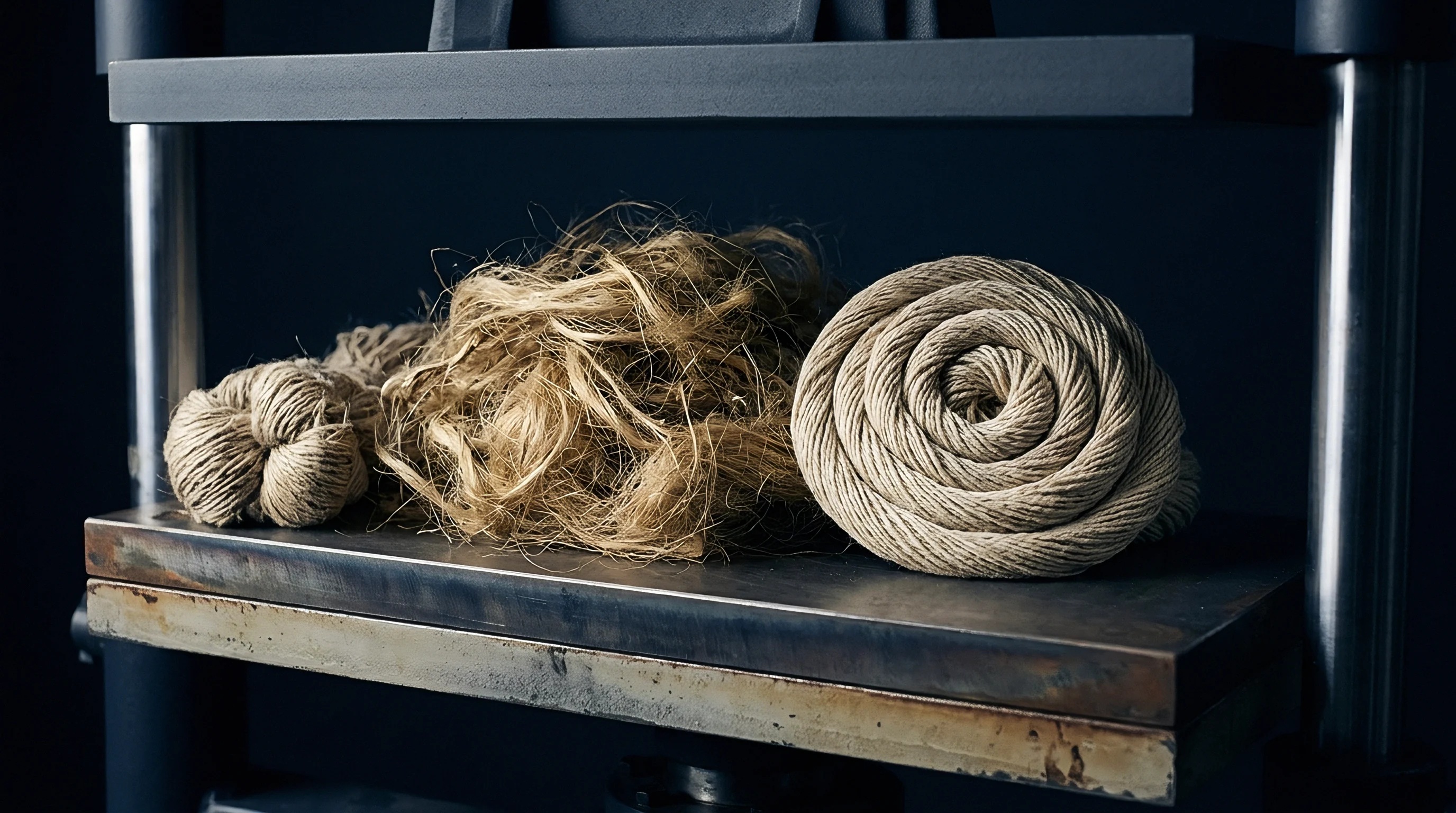
Ledger
Cost Conversion from Raw Scutched Straw to Woven Metre
Commercial valuation models calculate clean fibre recovery ratios rather than relying on initial raw bale invoice pricing. Raw fibre purchasing sheets often show high-speed turbine decorticated flax priced at a discount compared to low-strain scutched line flax. Low-strain decorticated fibre commands $3,200 per metric ton, whereas high-strain turbine-decorticated stock sells for $2,450 per metric ton.
This initial price differential of $750 per ton tempts procurement specialists seeking raw material cost reductions.
The yield arithmetic across processing steps reverses this initial price advantage. High decortication strain rates reduce hackling line yield from 62% down to 44%, shifting a significant mass of raw fibre into tow. Hackled line fibre produces high-value Nm 40 wet-spun yarn, whereas tow sells into coarse dry-spun markets at 35% of line yarn value.
The loss of line yield increases the effective raw material cost per kilogram of hackled line sliver.
Yield loss shifts final price.
Consider a sourcing practice purchasing raw material to deliver 10,000 meters of finished 150 g/m² woven linen fabric requiring 1,500 kg of Nm 40 wet-spun line yarn. Using gentle, low-strain decorticated flax stock requiring a 62% hackling line yield, the buyer consumes 2,419 kg of scutched flax at $3.20/kg, total material cost $7,740. Hackling produces 1,500 kg of line fibre and 919 kg of tow.
Reselling the tow at $1.15/kg returns $1,056, netting an effective raw line fibre cost of $6,684.
Executing the same order with high-strain decorticated stock yielding only 44% line fibre requires purchasing 3,409 kg of scutched flax at $2.45/kg, total material cost $8,352. Hackling yields 1,500 kg of line fibre and 1,909 kg of tow. Reselling the larger tow volume at $1.15/kg returns $2,195, netting an effective raw line fibre cost of $6,157.
While the net raw material cost appears $527 cheaper for high-strain stock, downstream spinning line inefficiencies rapidly invert the financial outcome.
Processing high-strain line fibre with a Weibull shape parameter m of 2.3 increases wet spinning end breakages from 14 to 96 per 1,000 spindle-hours. Spinning frame efficiency drops from 94% down to 78%, raising conversion labor and machine overhead costs by $0.85 per kilogram of yarn. Finished yarn tenacity falls from 31.4 cN/tex down to 14.8 cN/tex, forcing weaving sheds to apply excess sizing agents and reduce loom speed by 22% to avoid warp breakages.
Sizing and loom downtime add $0.18 per meter to fabric weaving costs. The final landed cost of the fabric woven from high-strain fibre reaches $4.12 per meter, compared to $3.68 per meter for fabric produced from low-strain line flax. The landed cost calculation confirms that paying a premium for low-strain decorticated line flax generates net savings per finished fabric metre.