Bast Fibre Bundle Morphology and Decortication Yield Standards
Decortication parameters and pectin hydrolysis determine line fibre fineness, hackling yield retention, and final yarn count limits in high lea spinning.
Stem
Phloem tissue located between the outer epidermis and the inner woody core houses the primary structural units of industrial bast crops. In raw Linum usitatissimum, these primary structural units organize into longitudinal fiber strands ranging from 40 to 100 centimeters in length. Individual elementary cells within each bundle measure between 15 and 40 millimeters long, exhibiting cross-sectional diameters of 12 to 28 micrometers.
High-resolution transmission electron microscopy reveals a thick secondary cell wall dominated by highly crystalline cellulose microfibrils oriented at a narrow 10-degree angle relative to the fiber axis. Bark tissue collapses under drought.

Cellular Architecture and Intercellular Adhesion
Middle lamella structures composed of complex pectin networks, galactans, and rhamnogalacturonans cement adjacent elementary fibers into coherent structural bundles. Structural integrity depends on divalent calcium ion cross-links within the unesterified homogalacturonan regions of these pectin polysaccharides. Adjacent bundles interlock throughout the stem bark, forming a continuous reticulated sleeve.
Cross-sectional profiles display irregular polygonal shapes with thin internal lumens. Cellulose microfibrillar alignment provides exceptional longitudinal tensile strength, while the soft inter-cellular pectin matrix governs transverse shear susceptibility during mechanical extraction.
| Fiber Species | Elementary Cell Length (mm) | Elementary Cell Diameter (µm) | Microfibril Angle (deg) | Cellulose Content (wt %) | Technical Bundle Length (cm) |
|---|---|---|---|---|---|
| Flax (Linum usitatissimum) | 20 – 40 | 15 – 25 | 8 – 11 | 70 – 78 | 40 – 90 |
| Hemp (Cannabis sativa) | 15 – 25 | 18 – 30 | 2 – 6 | 65 – 72 | 100 – 250 |
| Jute (Corchorus capsularis) | 2 – 5 | 10 – 20 | 7 – 12 | 58 – 63 | 150 – 300 |
| Ramie (Boehmeria nivea) | 60 – 250 | 40 – 80 | 7 – 9 | 80 – 85 | 60 – 180 |
Phloem Tissue Mechanical Properties
Torsional rigidity within the vascular cambium varies along the height of the plant. Basal stem sections possess thicker cell walls with higher lignification, reaching up to 5 percent dry weight lignin, whereas apical regions present thin-walled bundles rich in soluble pectins. Tensile testing of isolated technical bundles shows ultimate breaking tenacity values between 45 and 65 centinewtons per tex, with an elongation at break rarely exceeding 2.2 percent.
Radial stress during bending fractures the brittle xylem cylinder without rupturing the ductile bast bundle sleeve. Pectin binds adjacent cell walls.
Morphological uniformity along the stalk dictates downstream mechanical release during industrial processing. Stalk diameter variations greater than 0.5 millimeters over a 10-centimeter span alter the mechanical engagement of processing machinery. Thinner stems produce smaller bundle diameters, yielding higher specific surface areas that accelerate biochemical degradation during field exposure.
Uniform bundle architecture ensures predictable mechanical stress distribution across breaker equipment.
Thicker middle lamellae resist mechanical cleavage, retaining coarse technical structures that limit wet-spinning draft ratios.


Decortication
Mechanical extraction of bast bundles relies on crushing the rigid woody core while preserving the continuous fiber network located in the cortex. Deseeded straw enters a sequence of paired fluted breaker rolls set to precise clearance tolerances. Breaker rolls apply compressive loads that fracture the inner shive cylinder into short segments measuring 2 to 10 millimeters.
Scutching turbines strike the straw. Rotating turbine blades fitted with steel beaters scrape away broken woody shives through controlled impact shear, leaving parallel long-staple technical strands suspended in the machine grips.
Mechanical Shear and Shive Extraction Dynamics
Impact forces from scutching turbine beaters strip shive tissue through differential momentum transfer. High-speed video analysis indicates optimum shive release when turbine tip speeds maintain velocity between 12 and 15 meters per second. Excessive blade clearance leaves residual shive adhering to the bundle ends, while insufficient clearance shears technical fibers, converting valuable line stock into low-value short tow.
Air currents generated by turbine rotation assist in blowing freed core particles through perforated grid plates under the turbine chamber.
- Verify raw straw moisture levels using ISO 6741 oven-drying procedures to ensure total moisture stays between 12 and 14 percent before feeding.
- Calibrate the mechanical nip gap on initial breaker roll pairs to exactly 1.8 millimeters to prevent crushing core bundles into fine unseparable dust.
- Adjust secondary fluted roll clearances down to 1.2 millimeters, increasing flute pitch frequency to intensify bending stress on stem segments.
- Set primary scutching turbine blade clearances against counter-beating edges to 3.5 millimeters for dew-retted stock or 4.2 millimeters for unretted material.
- Inspect scutched line stock output hourly for residual shive mass percentages, adjusting turbine rotor speed in 50 RPM increments when shive content exceeds 1.5 percent dry weight.

Fiber Damage Modes and Waste Streams
Mechanical stresses introduced during shive removal generate structural defects within technical bundles. Transverse crimping and internal micro-cracks reduce the tensile capacity of individual fiber bundles by up to 30 percent. Waste streams segregate into scutched tow, short fibers, shive fragments, and fine cortical dust.
Scutched tow consists of entangled, broken long fibers dragged down by turbine beaters. Shive fragments pin the sliver. Process efficiency balances total fiber recovery against the ratio of intact line fiber to broken tow.
Processing unretted or unevenly dried straw forces technicians to widen turbine clearances, leading to supplier complaints that raw material density variations caused the elevated shive retention in delivered line bales.

Retting
Biochemical cleavage of middle lamella components solubilizes intercellular pectins, permitting clean separation of bast strands from surrounding xylem and epidermal tissues. Microorganisms, primarily Clostridium species in water systems or Bacillus and fungal strains during field exposure, secrete extracellular enzymes. Polygalacturonase, pectate lyase, and xylanase hydrolyze alpha-1,4-glycosidic bonds within homogalacturonan chains.
Controlled breakdown leaves cellulose cell walls intact while destroying the structural cement binding bundles to the stem core. Yield drops when over-retting occurs.

Biochemical Mechanisms of Pectin Degradation
Enzymatic hydrolysis targets galacturonic acid sequences within middle lamella networks. Dew methods rely on atmospheric moisture and indigenous saprophytic fungi, such as Cladosporium herbarum, to colonize stems left lying in swaths. Fungal hyphae penetrate cuticular pores, secreting enzymes that degrade calcium pectate complexes over three to six weeks.
Water methods immerse straw bundles in warm anaerobic tanks at 32 to 37 degrees Celsius, completing pectin solubilization within 72 to 96 hours through rapid bacterial fermentation.
Dew-retted stalks processed at 16 percent moisture yield 15.2 percent line fibre under standardized scutching turbine clearances.
| Retting Method | Duration (Days) | Stem Moisture (wt %) | Line Fibre Yield (wt %) | Residual Shive (wt %) | Linear Density (tex) |
|---|---|---|---|---|---|
| Field Dew Retted (Standard) | 28 | 14.5 | 16.2 | 1.1 | 1.85 |
| Field Dew Retted (Under-retted) | 14 | 13.0 | 11.4 | 4.8 | 3.40 |
| Field Dew Retted (Over-retted) | 42 | 16.0 | 9.8 | 0.4 | 1.15 |
| Warm Water Tank (Anaerobic) | 4 | 15.0 | 18.5 | 0.6 | 1.45 |
| Enzyme-Assisted Tank (Pectate Lyase) | 1 | 14.0 | 19.1 | 0.3 | 1.20 |
Over-Retting Degradation and Under-Retting Coarseness
Insufficient pectin breakdown retains strong chemical bonds between bast fibers and the woody core. Under-retted straw demands aggressive mechanical impact during decortication, increasing fiber breakage and leaving heavy residual shive attached to output bundles. High moisture ruins breaker rolls.
Extended exposure permits cellulolytic enzymes to attack secondary cell walls, cleaving cellulose polymer chains and lowering degree of polymerization from 8000 down to 2000. Over-retted fibers display severe strength losses, disintegrating into short tow during mechanical scutching.
Fineness governs the drafting limit.
Inadequate moisture monitoring during field exposure triggers cellulolytic degradation, destroying bundle tenacity and converting up to 40 percent of potential line stock into low-margin short tow.

Comb
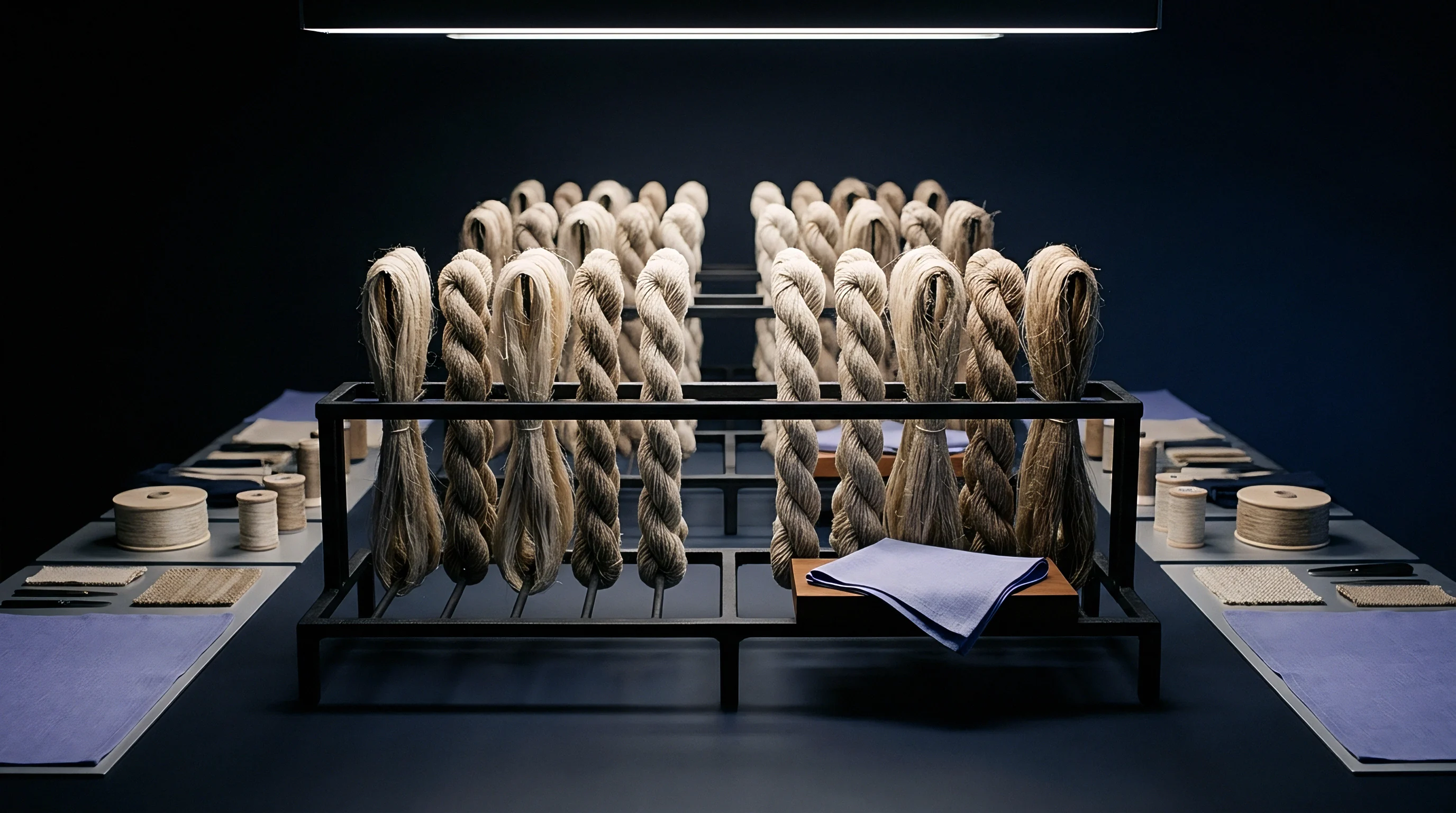
Hackling operations dress scutched line fibers by drawing bundles through progressive series of sharp steel pins mounted on rotating aprons or vertical comb bars. Pin density increases systematically from coarse entry fields with 1 pin per centimeter up to fine finishing fields carrying 24 pins per centimeter. Hackling splits coarse technical bundles along their longitudinal middle lamella planes, reducing linear density while removing short fibers, residual shive, and tangled knits.
Wet spinning requires softened core. Parallelization of long fibers creates uniform continuous sliver suitable for drawing.

Bundle Division and Pin Density Gradients
Mechanical splitting depends on transverse friction and shear forces imposed by moving hackling pins. As bundles pass through high-density pin fields, mechanical friction tears weak pectin boundaries between adjacent elementary cells. Coarse bundles measuring 5 to 10 tex split into fine technical bundles measuring 1.2 to 2.2 tex.
Hackling pins split the bundle. Controlled tension across pin fields prevents bundle snap while maximizing longitudinal division efficiency.
ISO 2370 linear density declarations exceeding 1.8 tex trigger mandatory grade demotion from line flax to scutched tow pricing structures.
- Pin Density Sequence establishes progressive mechanical bundle division across twelve discrete hackling fields without inducing mass fiber rupture.
- Holder Clamping Force prevents root and tip slippage under heavy comb drag, preserving bundle length distribution integrity throughout dressing cycles.
- Tow Extraction Airflow removes fine comb waste continuously from pin beds, preventing needle clogging and fiber re-deposition on dressing line sliver.
- Sliver Channel Draft applies slight longitudinal draft tension during bundle collection, orienting split technical fibers into uniform parallel sliver structures.
Line to Tow Mass Splitting
Mass distribution during dressing divides input stock into hackled line sliver and combed hackling tow. High-grade scutched flax yields approximately 60 to 70 percent hackled line fiber and 30 to 40 percent comb tow. Hackling tow consists of short broken fibers and heavily split fine elements captured by lower comb beds.
Finer bundles carry higher count. Tow fractioning increases when processing dry, brittle, or under-retted raw material due to excessive transverse snapping.
Standard delivery contracts state that line fiber lots showing hackling yield losses exceeding 35 percent dry weight relative to reference laboratory dress samples grant buyers the right to penalize invoice values by 1.5 percent per percentage point of excess yield loss.


Metrology
Fibre linear density testing establishes commercial value and spinning limit potential. ISO 2370 defines gravimetric determination of linear density for flax fibers, expressing values in tex or millitex. Standardized conditioning at 20 degrees Celsius and 65 percent relative humidity precedes all physical testing, according to ISO 6741 protocol.
Bundle tenacity measurement utilizes press-clamp arrangements, such as Stelometer apparatus operating under ISO 3060 specifications with a 3.2-millimeter gauge length. Heavy shive breaks the yarn.
Does Gravimetric Airflow Match Optical Microscopic Fineness?
Gravimetric airflow instruments estimate specific surface area by measuring pressure drops across compressed fiber plugs. Optical cross-sectional microscopy measures real geometric boundary areas of individual bundles directly. Discrepancies emerge because bast bundle cross sections deviate significantly from ideal circular geometry, presenting flattened polygonal profiles with variable internal lumens.
Airflow methods underestimate fineness in incomplete split bundles containing occluded voids, while optical image analysis requires extensive sample sizes to achieve statistical confidence across irregular bundle distributions. Moisture changes bundle mass readings.
Unsplit technical bundles beneath two tex inevitably increase end breakage rates during wet spinning at high lea counts.
- Conditioning Certification ISO 6741 verifies 24-hour equilibration inside climate chambers held strictly at 20 degrees Celsius and 65 percent relative humidity prior to gravimetric weighing.
- Bundle Tenacity ISO 3060 records breaking strength in centinewtons per tex using flat bundle clamps spaced at exactly 3.2 millimeters with constant rate of extension drive systems.
- Gravimetric Fineness ISO 2370 details cut-and-weigh length measurements across a minimum of 500 individual split bundles to establish mean linear density and coefficient of variation percentages.
- Residual Shive Gravimetric Content details mass percentages of non-bast woody matter remaining after manual sorting and dry sieve separation on 100-gram sample lots.

Length Distribution and Shive Content Determination
Staple length characterization of hackled line fiber utilizes comb sorter apparatus to map length frequency histograms. Long line fractions maintain mean staple lengths above 600 millimeters, while short tow fractions cluster below 150 millimeters. Residual shive testing requires manual or mechanical separation of woody particles from 100-gram raw fiber samples followed by precise gravimetric weighing.
Linear density dictates yarn limit. Standard specifications bound acceptable line fiber shive content below 1.0 percent dry mass.
Whether automated optical image analysis can completely replace manual cut-and-weigh gravimetric methods for ISO 2370 compliance across variable dew-retted lots remains disputed among international testing laboratories.


Outturn
Mass conversion balances convert unretted field straw mass into finished spun yarn length. Raw harvested straw contains approximately 15 percent moisture, 70 percent woody core and epidermal waste, and 15 percent total usable bast fiber. Processing 10,000 kilograms of dry straw yields roughly 1,500 kilograms of scutched line fiber and 500 kilograms of scutched tow.
Tow commands lower market prices. Hackling 1,500 kilograms of scutched line fiber converts 65 percent into 975 kilograms of hackled line sliver and 35 percent into 525 kilograms of comb tow.

Mass Conversion Balance and Count Potential
Line sliver converts to spun yarn through wet-spinning or dry-spinning operations. Wet spinning immerses roving in hot water troughs at 60 to 70 degrees Celsius, softening residual pectin middle lamellae to permit draft splitting down to individual elementary cells. Fine wet-spun yarns achieve counts of Nm 60, corresponding to 16.6 tex, whereas dry spinning retains technical bundles, limiting practical count potential to Nm 18, or 55.5 tex.
Higher yarn counts require finer hackled bundle linear densities entering the roving frame.
Assume a commercial processing lot starting with 20,000 kilograms of dew-retted flax straw priced at 0.35 Euros per kilogram landed. Mechanical decortication yields 16 percent scutched line fiber, equal to 3,200 kilograms, and 6 percent scutched tow, equal to 1,200 kilograms. Scutching operational costs add 0.12 Euros per kilogram of input straw.
The effective cost of raw scutched line fiber reaches 2.93 Euros per kilogram after crediting scutched tow sales at 0.80 Euros per kilogram.
Subsequent hackling converts 3,200 kilograms of scutched line fiber into 2,080 kilograms of hackled line sliver, achieving a 65 percent hackling yield, while generating 1,120 kilograms of comb tow. Hackling machine operation costs 0.45 Euros per kilogram of input line fiber. Crediting comb tow sales at 1.10 Euros per kilogram establishes a final net landed cost of 4.22 Euros per kilogram for hackled line sliver ready for wet spinning.
High residual pectin levels accelerate ring-traveller wear while narrowing the wet-spinning draft window.
Spinning 2,080 kilograms of hackled line sliver into Nm 39 fine linen yarn, equivalent to 25.6 tex, yields 1,976 kilograms of spun yarn, accounting for a 5 percent spinning waste allowance. The total accumulated manufacturing outlay, including roving, hot-water wet drafting, ring spinning, and winding, equals 3.80 Euros per kilogram of yarn produced. Total yarn landed cost stands at 8.02 Euros per kilogram.
Woven into a standard 150 grams per square meter plain-weave cloth at 1.6 meters wide, each linear meter contains 240 grams of yarn, fixing the raw fiber material cost contribution at exactly 1.92 Euros per finished fabric meter.
Yield calculations depend directly on raw straw pectin degradation levels. Processing under-retted straw drops hackling sliver conversion yields from 65 percent to 52 percent, driving hackled sliver costs up to 5.18 Euros per kilogram. Higher raw fiber breakage forces mills to drop target spinning limits from Nm 39 down to Nm 26, increasing fabric weight per meter and altering the total financial ledger on finished cloth deliveries.