Slasher Sizing Tension Control for High Speed Linen Warping
Linen slasher sizing demands precise creel-to-beamer tension zoning under fifty centinewtons per end to prevent destroying residual yarn elongation.

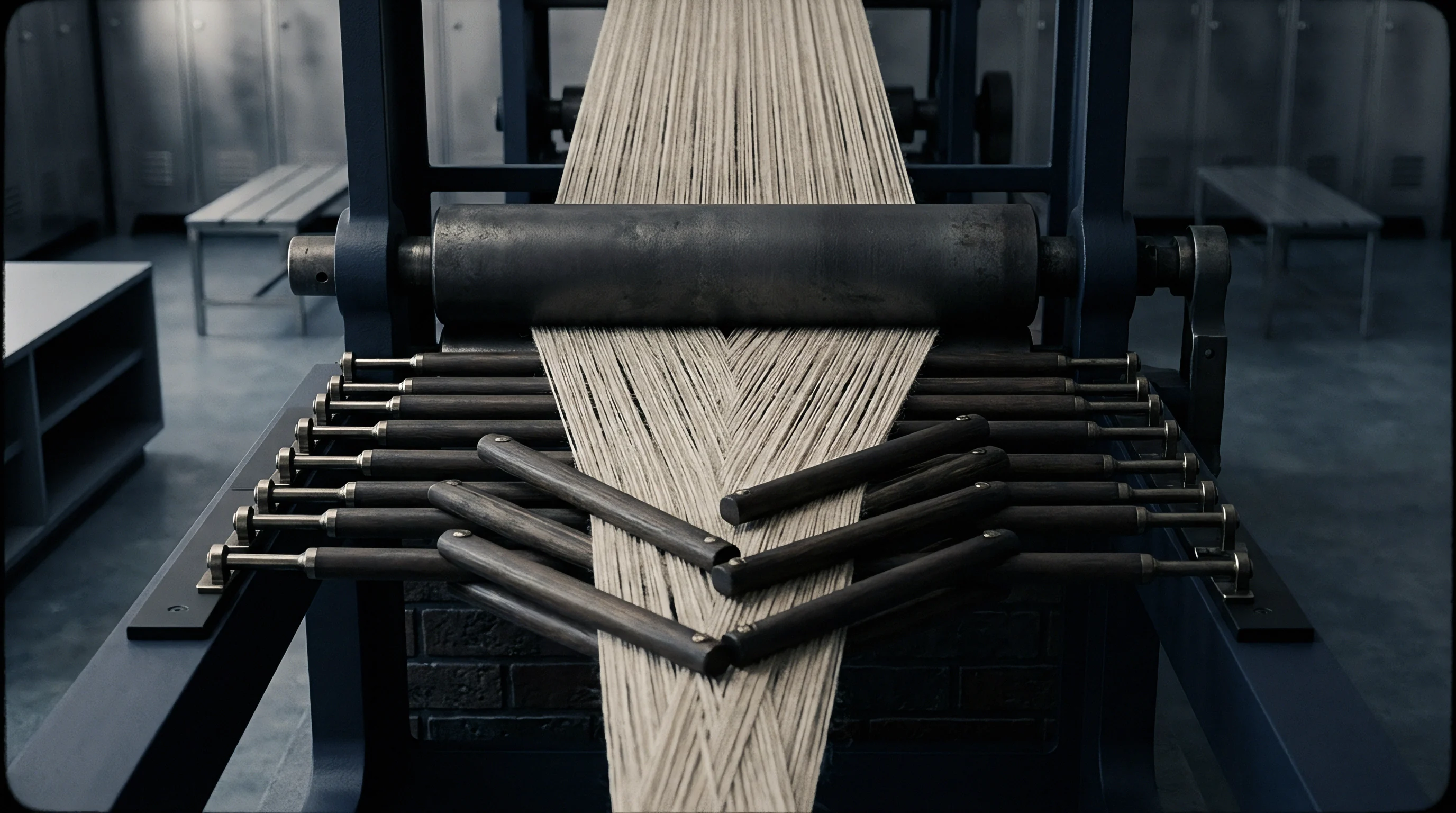
Creel
Running pure flax warps at slasher speeds above eighty metres per minute exposes every variation in the raw crop. Wet spun flax has an ultimate tensile elongation of barely two percent, whereas cotton can absorb four to seven percent elongation during sizing without losing elasticity. If creel let-off tension exceeds twenty-five centinewtons per end, flax warps surrender whatever stretch remains, driving rapier loom stops up to twelve per hundred thousand picks.
Dead-weight rope brakes on section beam journals introduce cyclic tension surges as the beam depletes. A full section beam with a one thousand millimetres flange diameter weighs over four hundred kilograms. As the package unrolls toward its hundred-millimetre core, mechanical brakes chatter, creating transient tension spikes up to sixty centinewtons on individual ends.
Tension surges exceeding thirty centinewtons on wet flax ends permanently reduce yarn breaking elongation below one percent.
Modern bast-fiber creels isolate each beam position with pneumatic disc brakes tied to ultrasonic distance sensors. These sensors track package depth continuously so digital electro-pneumatic regulators can drop line pressure in direct proportion to the shrinking beam radius. Load cells under the first merge roll calculate total sheet tension, allowing a dancer roll assembly to smooth out high-frequency ripples before the ends reach the size box.
Can Pneumatic Braking Overcome Native Yield Variance?
Flax fibers vary naturally in pectin content, stalk maturity, and nodal spacing, causing unwinding resistance to differ from beam to beam across the creel. These tension differences create alternating slack and tight bands across the warp sheet width. Wet slack ends sag and wrap around guide rolls upon entering the bath, while tight ends take the full draft, stripping their crystalline cellulose core of remaining stretch.
- Driven uncurling rolls flatten ribboned selvage bundles before liquid impregnation.
- Pneumatic disc assemblies modulate calliper pressure across individual beam journals every two hundred milliseconds.
- Segmented guide rollers eliminate surface drag across the incoming warp sheet.
- Ultrasonic diameter detectors calculate instantaneous package radii to adjust proportional back-pressure.
Shed supervisors check this tension across the creel rail using handheld tensiometers over fifty continuous ends. Spreads greater than five centinewtons across the width point to failing journal bearings or worn friction pads.
Nip
Sizing wet spun linen requires precise bath immersion and roll mechanics. The yarns have a stiff, irregular cross-section with surface hairiness made up of coarse technical fiber bundles. Size liquor must penetrate the outer perimeter and bind loose fibril tips without oversaturating the hydrophobic core.
At ninety metres per minute, yarn spends less than 0.6 seconds in the size box vat.
Two-box systems split the warp to keep end density below twenty ends per centimetre of roller width. Overcrowding a single box forces wet yarns to overlap in the squeeze nip, cementing adjacent fibers together as the adhesive sets and causing severe fiber peel during dry splitting.
| Yarn Count (Nm) | Size Formulation Base | Box Temperature (°C) | Nip Pressure (kN) | Wet Pick-Up Target (%) | Size Add-On Dry (%) |
|---|---|---|---|---|---|
| Nm 26 (38.5 tex) | Modified Potato Starch / Polyvinyl Alcohol | 85 | 18 | 65 to 70 | 7.5 to 8.5 |
| Nm 39 (25.6 tex) | Carboxymethyl Cellulose / Polyacrylate | 82 | 14 | 60 to 65 | 6.5 to 7.5 |
| Nm 50 (20.0 tex) | Low-Viscosity Polyvinyl Alcohol Blend | 80 | 11 | 55 to 60 | 6.0 to 7.0 |
| Nm 60 (16.7 tex) | Polyacrylate / Soluble Polyester Binder | 80 | 9 | 50 to 55 | 5.5 to 6.2 |
Squeeze roll hardness determines both nip width and fluid extraction. Hard synthetic rubber rollers at seventy Shore D produce a narrow twelve-millimetre nip zone under sixteen kilonewtons of linear force. That concentrated pressure drives the aqueous size into exterior nodal cavities while stripping off excess surface starch.
Softer rolls permit liquid pooling, leaving thick, brittle coatings that flake off in the loom drop wires.
Squeeze Roll Deflection and Impregnation Draft
Linear loads across a two-metre roll cause the steel core to flex unless the shell is ground with a compensating crown. Without crown compensation, heavy pressure at the selvages leaves insufficient extraction through the center, resulting in an eight percent variation in dry size add-on across the width. Center yarns stay overly wet, driving up drying energy needs and causing ends to cling to the drying cylinders.
Tension between the immersion feed roll and final squeeze nip is the most critical stretch zone on the line. Wet linen softens quickly in an alkaline or neutral bath at eighty-five degrees Celsius, so immersion stretch must be held below 0.8 percent. Driven nip rolls powered by dedicated servomotors sync their speed with the draw rolls to within one hundredth of a percent.
Drafts exceeding one percent tear fragile nodes in the bast fibers, creating hidden weak spots that fail during shed opening on air-jet looms.
Failing to hold wet stretch under one percent inside the liquor vat converts eighty percent of downstream loom stops into brittle warp breaks.
If roll pressure drifts out of balance, uneven drying encrustations create wide bands of abrasive roughness across the beam, fouling downstream reeds and shredding fine filaments.

Drum
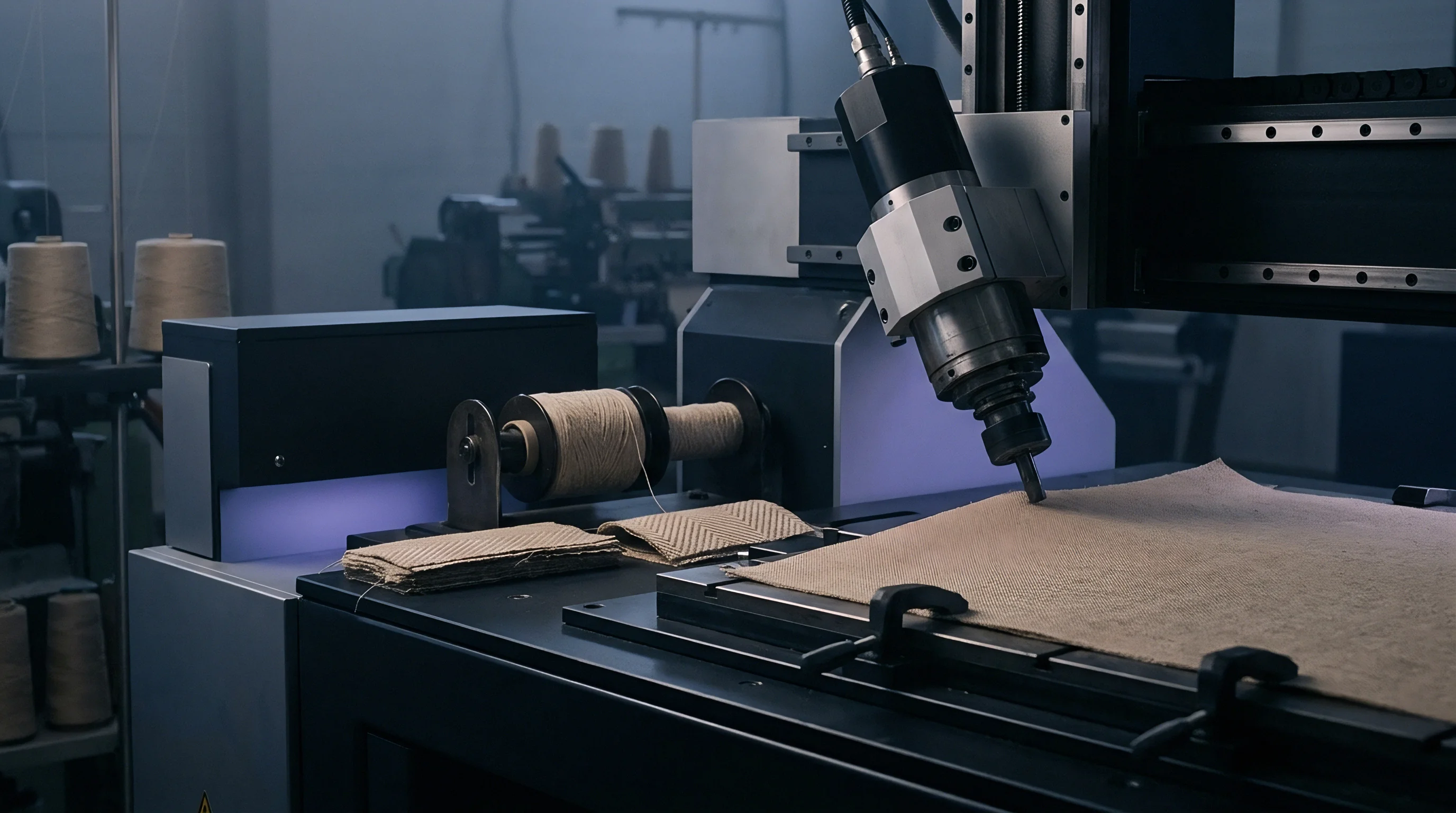
Drying wet sized linen requires staged heat transfer across multiple teflon-coated cylinders. Although linen transfers thermal energy quickly, low transverse conductivity can case-harden wet adhesive films if high heat is applied right out of the squeeze nip. An eleven-cylinder dryer divides steam pressure across four temperature zones, starting at seventy-five degrees Celsius on initial contact cans to set the liquid film without boiling moisture inside the yarn core.
Trapped steam boiling within the yarn bundle causes blistering, rupturing the adhesive film under vapor pressure and forcing fibrils outward instead of laying them flat against the core. Intermediate cylinders step up to ninety-five and one hundred and ten degrees Celsius, before final cooling cylinders drop sheet temperature to forty-five degrees Celsius ahead of dry leasing.
- Entry group temperature setting holds seventy-five degrees Celsius to settle the wet size envelope without blistering interior steam.
- Intermediate drying gradient increases gradually across eight cylinders to evaporate residual water at ninety-eight degrees Celsius.
- Final cylinder cooling drops the sheet temperature below fifty degrees Celsius to solidify synthetic size binders.
- Intermediate load cell monitoring keeps inter-cylinder warp tension between thirty and forty centinewtons per yarn end.
Cylinder surface speeds must be decoupled across the dryer section to accommodate yarn shrinkage. As linen dries from seventy percent wet pick-up down to its equilibrium moisture content of eight percent, it contracts longitudinally. Running cylinders on a single drive train forces shrinking yarns to drag across the steel surface, building internal stress, while excessive slack causes sagging, cylinder wraps, and laps.

Can Multi-Drive Cylinders Prevent Core Micro-Cracking?
Assigning individual drive motors to cylinder pairs allows micro-speed adjustment along the drying run. Syncing each motor to real-time load-cell feedback lets the line adjust surface speed to follow the natural shrinkage curve of the wet bast yarn. This electronic gearing keeps warp tension from exceeding thirty-five centinewtons per end as the size transitions from a liquid emulsion to a rigid polymer film.
A dryer running twenty-eight hundred ends of Nm 39 linen yarn consumes considerable steam energy. Condensate siphons inside each drying can must operate continuously to clear internal water layers. Stationary siphon shoes sweep away water films to maintain uniform surface heat across the cylinder face.
Temperature drops over blocked siphon bands leave damp yarn stripes that fail to cure the polyvinyl alcohol binder, creating raw, sticky patches on the beam.
Cooling cans must drop the yarn surface temperature below the glass transition point of the sizing polymers before the sheet touches stationary split rods. Hot, tacky sizing tears away from the sheath on contact with stainless steel split bars, undoing previous surface smoothing.
Split
Separating the bonded warp sheet after drying imposes the highest mechanical stress of the sizing process on individual filaments. Because size liquor glues adjacent parallel ends together inside the dryer, chrome-plated lease rods are used to snap these adhesive bonds apart. Dividing eighty ends per inch across seven staggered lease rods separates the sheet into distinct layers matching the original section beam count.
Higher slasher speeds shift the splitting zone forward. At ninety metres per minute, the separation point moves closer to the rod surface, sharpening the cleavage angle and concentrating bending stress directly on the brittle flax fibers. If this cleavage line fluctuates, surface fibers pull out of the yarn structure, forming fuzz balls that migrate straight into the loom drop wires.
Acoustic emission intensity during dry lease separation indicates whether starch binders are fracturing cleanly or stripping lateral fiber bundles.
Lease rod diameter dictates the parting geometry. Large fifty-millimetre rods create a gradual separation angle, reducing instantaneous tensile shock on fine counts, whereas small twenty-five-millimetre rods force a sharp fracture line that can shear size film off the flax core. Rod surfaces require mirror-polished hard chromium plating over sixty-five Rockwell C to prevent grooving from abrasive flax dust.
| Processing Stage | Yarn Tension (cN/end) | Elongation Loss (%) | S3 Hairiness Index | Tensile Strength (cN/tex) |
|---|---|---|---|---|
| Creel Delivery | 18 to 22 | 0.00 | 820 | 28.5 |
| Size Box Immersion | 22 to 26 | 0.45 | 610 | 27.8 |
| Drying Cylinder Run | 30 to 35 | 0.30 | 310 | 29.2 |
| Dry Split Rods | 45 to 55 | 0.65 | 440 | 26.9 |
| Beamer Winding Head | 35 to 40 | 0.15 | 460 | 26.7 |
Zig-zag expansion combs spread the separated warp sheet to the required loom beam width. Dent spacing must match the target loom reed count to avoid angular yarn deflection at the headstock. An oscillating traverse mechanism moves the comb horizontally by five millimetres during winding, preventing ends from cutting stationary wear grooves into the comb teeth.
Whether air-cushion split bars with vibration damping can reduce the post-lease S3 hairiness rebound on high-speed pure flax warps below current mechanical thresholds remains an open engineering question.

Yield
Winding the sized warp sheet onto the loom beam dictates weaving efficiency. The headstock must maintain consistent radial density from the barrel to the flange rim. Under-tensioned linen warps produce soft beams, allowing high-tension ends to sink into soft lower layers during insertion on rapier looms at six hundred picks per minute, causing warp traps.
Excessive winding tension can crush the aluminum barrel while stripping away the last 0.5 percent of fiber elasticity. Modern beamer drives use DC or AC flux vector servomotors to taper tension downward as the package grows from a two-hundred-millimetre core to an eight-hundred-millimetre full beam. This taper follows a hyperbolic curve, reducing winding pull by fifteen percent over the build cycle.
Presser rolls apply regulated pneumatic pressure against the growing beam surface to force out trapped air, creating a compact cylinder with flat package faces. Misaligned presser rolls produce conical beams where ends on the loose side wind slack while those on the tight side stretch toward permanent deformation.
Weaving shed operating costs depend directly on warp quality from the slasher. Take a shed running ninety-six rapier looms on plain weave Nm 39 linen fabric with twenty-eight warp ends per centimetre across a 150 centimetre reed width, totaling forty-two hundred warp ends. At six hundred picks per minute and twenty picks per centimetre, each loom weaves eighteen metres of fabric per hour.
A warp sized under poor tension control drops loom efficiency to seventy-eight percent due to four warp breaks per hour. With each repair taking three minutes of downtime, output per loom falls to fourteen metres per hour. Across ninety-six looms operating twenty-four hours, that translates to a loss of 9,216 metres of fabric daily.
Tightening tension control at the slasher reduces warp stops to 0.8 per loom hour, boosting shed efficiency to ninety-one percent and restoring full target output.
International textile supply agreements set strict bounds on yarn quality for delivered weaver beams. Contracts enforce ASTM D5430 four-point inspection standards and mandate that total stretch loss during warp sizing cannot exceed 1.2 percent of raw yarn elongation values.