Optimizing Warp Preparation Parameters for High Count Linen Yarns
Control unwinding tension below 12 cN, apply 12% modified starch-PVA size at 35 mPa·s, and beam at 70 Shore D with 8% moisture to maintain shed efficiency.

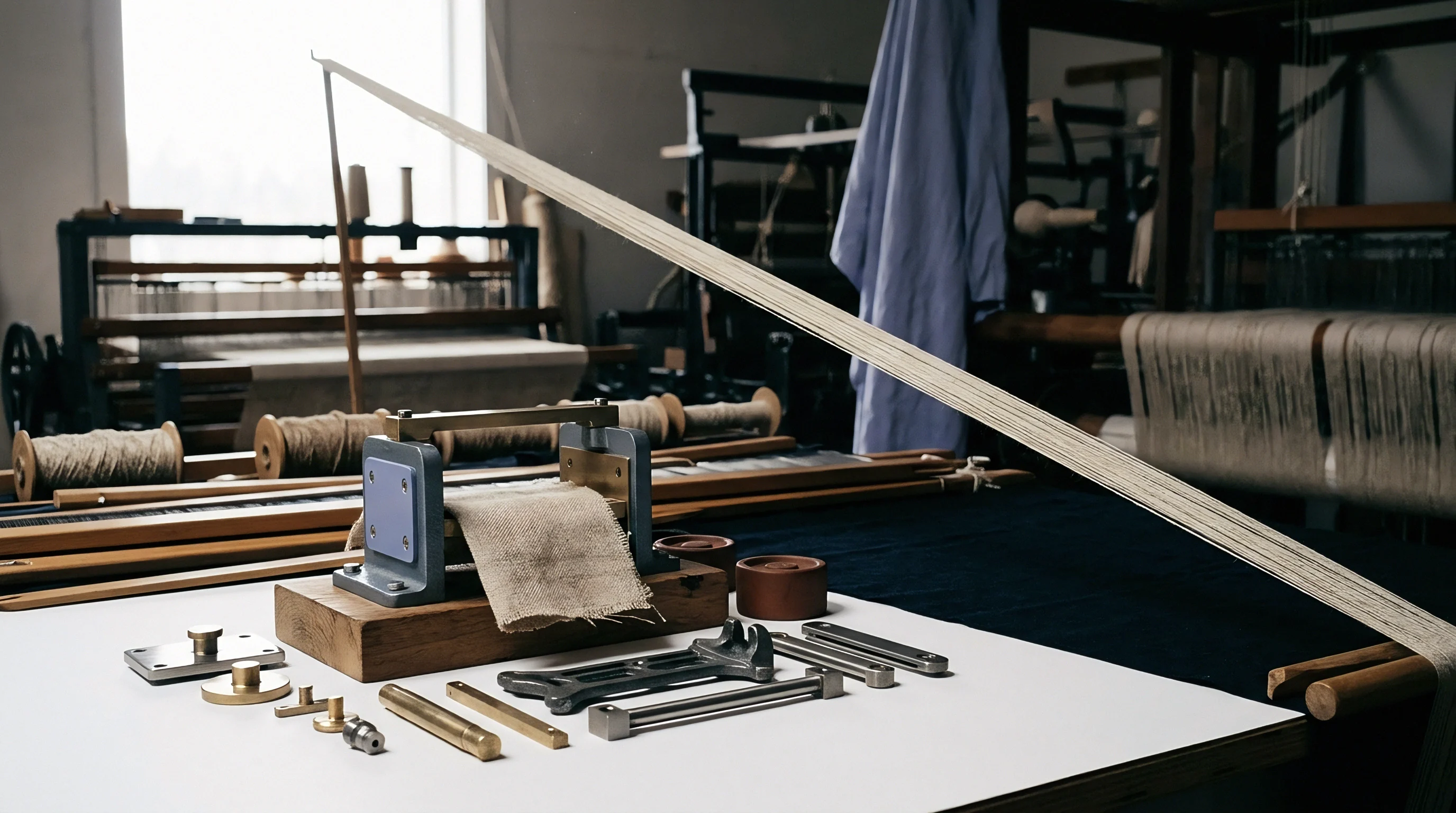
Creel
Package delivery tension dictates the breakage rate of wet-spun flax before the warp ever meets a drop wire. When handling fine counts between Nm 60 and Nm 100 (100 to 166 dtex), total elongation to break rarely exceeds 2.2 percent. A standard cotton yarn tolerates transient peak tensions because it stretches six to eight percent prior to rupture.
Its high initial modulus converts every localized friction spike at the package nose or guide eyelet into immediate yarn failure, so setting the unwinding package brake to a flat nominal value guarantees end breaks during the outer-to-inner package transition.
Modern warper creels running fine linen rely on central motorized disc tensioners or self-compensating leaf-spring arrays. Static friction across matte ceramic pigtails generates micro-chafing that strips individual bast fibrils, which then gather behind the guide eyes in small lint rings known in the mill as slub pills. When one of these lint agglomerations pulls through, the resulting tension surge snaps the end or leaves a slack thread on the swift.
Replacing porcelain eyelets with polished sintered corundum inserts reduces dynamic friction coefficients below 0.15. Creel alignment demands a laser-verified path from cone tip to gathering comb.
A ten-gram package tension surge on an Nm 80 wet-spun warp produces an immediate break at two percent elongation.
Direct warping is used for uniform base beams intended for sizing, while sectional warping handles short production runs and pattern samples. In sectional warping of high-count linen, band buildup requires strict geometric control: the inclination angle of the drum cone must match the exact radial increment of the yarn layer. If the traverse feed per drum revolution deviates by even 0.05 millimetres per turn, lateral support at the section edge collapses, causing adjacent ends to slip down into lower layers.
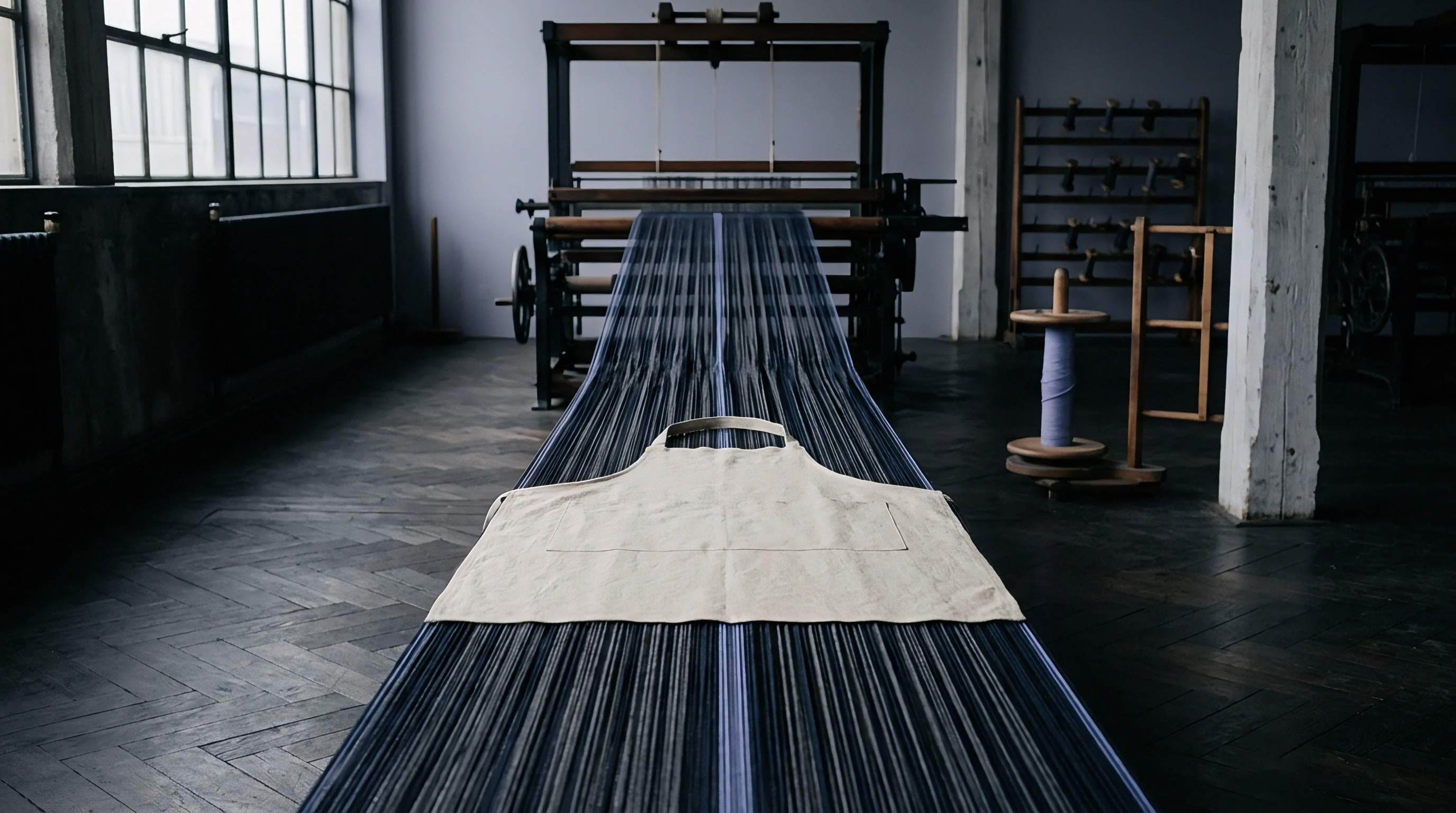
Drafting Clear Paths across the Warping Reed
Entering the section warping reed presents a sharp risk of uneven friction. Flax yarn diameter fluctuates over single metres due to seasonal growth cycles and retting variance. Heavy nodes strike the dent wires, deflecting them and creating transverse pinch points.
To limit lateral crowding, the expansion reed uses an alternating open-dent layout, and lease insertion is run at low velocity to prevent shock loads on fragile cross-sections.
- Creel balloon limiters arrest uncoiling whips before yarn touches metal hardware.
- Rotary disc tension units keep yarn pull below twelve centinewtons across the package cycle.
- Electronic stop motions trap broken ends instantly to prevent tail migration beneath neighboring bands.
- Anti-static ionization bars suppress surface static charges that cause fine flax strands to cling to the reed frame.
Running sectional warpers above 400 metres per minute on pure linen counts over Nm 70 causes balloon collapse, as air drag forms whipping loops that knot behind the guide plates. Mill practice keeps warping speeds between 220 and 320 metres per minute depending on relative humidity. Wet-spun yarns dry quickly under the convective airflow of high drum surface speeds; once package moisture drops below eight percent, brittle failures rise on the creel.
Unequal unwinding forces then produce loose warp ribbons that drop below the drop wires, causing persistent slack-warp loom stops.
Liquor
Formulations designed for fine ring-spun cotton peel off high-count flax within five hundred picks of shedding. Flax bundles present a highly crystalline, lignified cell wall with minimal microscopic porosity compared to cotton’s convoluted lumen. The size film cannot lock deeply into the yarn core mechanically without stripping the natural cohesion of the pectin matrix.
Sizing must encapsulate surface fuzz while anchoring just deep enough to reinforce fiber bundle shear resistance. Modified potato starches, carboxylated synthetic polymers, and cold-water soluble polyols form the basis of stable linen sizing.
Low-viscosity modified ether starches, substituted with hydroxyethyl groups, provide uniform film ductility without brittleness. Standard native starches form rigid crystalline films that shatter under the cyclic flexural fatigue of rapier shedding. Combining a modified ether starch with fully hydrolyzed polyvinyl alcohol yields high film tensile strength and controlled elastic recovery.
The ratio between starch derivative and synthetic polymer determines both the desizing route and the adhesive bond strength to the cellulose bundles.
Sizing liquor for Nm 70 flax must carry twelve percent solids at eighty-two degrees Celsius under standard ISO 3801 sizing verification.
Refractometer readings alone do not show size quality on the plant floor. Viscosity checks made with a Zahn cup or rotary viscometer show whether binder is penetrating into the core. Excessive penetration locks internal fibrils into a rigid rod, ruining flexural flexibility: once a high-count linen yarn loses its ability to bend, it snaps clean at the heddle eye under warp deflection.
Target size penetration sits at twenty to thirty percent of yarn cross-sectional area, leaving the internal core free to flex.
Where Does Peak Friction Concentrate on Fine Flax?
Abrasive wear strikes the yarn during reed beat-up and heddle displacement. Drop wires cause continuous rub, but heddle eyes subject the yarn to both reversed directional bending and lateral abrasion. At forty picks per centimetre, a single millimetre of linen warp undergoes hundreds of abrasive cycles before passing the fell line.
Lubricants added directly to the size box lower this kinetic friction coefficient; sulfonated tallow oils and microcrystalline wax emulsions integrate smoothly into aqueous starch-PVA solutions without separating in the circulation loop.
| Yarn Count | Solids Content | Viscosity at 80°C | Starch-PVA Ratio | Wax Additive | Dry Size Add-On |
|---|---|---|---|---|---|
| Nm 50 (200 dtex) | 10.5 % | 42 mPa·s | 70 : 30 | 1.2 % | 9.5 % |
| Nm 66 (151 dtex) | 11.8 % | 38 mPa·s | 60 : 40 | 1.5 % | 11.0 % |
| Nm 80 (125 dtex) | 12.5 % | 34 mPa·s | 50 : 50 | 1.8 % | 12.2 % |
| Nm 100 (100 dtex) | 13.5 % | 31 mPa·s | 40 : 60 | 2.0 % | 13.8 % |
Preparing the bath requires controlled temperature ramping. Starch ether needs twenty minutes of dispersion in cold water before indirect steam injection starts gelation at ninety degrees Celsius. Adding synthetic binders too early leads to polymer agglomeration and gummy skids on the yarn surface.
Once fully solubilized, circulation in the storage tank must maintain turbulent flow to avoid skinning along the perimeter.
Squeeze
Nip mechanics inside the size box govern the balance between wet pick-up and film encapsulation. Fine linen cannot tolerate heavy mechanical pressure that flattens circular yarn into asymmetrical ribbons. An asymmetrical yarn rotates unpredictably during shedding, presenting shifting cross-sections to the passing insertion element.
Dual-box configurations or single boxes equipped with double nip rollers distribute compression evenly: the first nip drives air out of the yarn core, while the finishing nip sets the wet pick-up percentage.
Elastomer hardness on the squeeze rolls dictates contact nip width and peak pressure distribution. Squeeze rollers jacketed in synthetic nitrile rubber at 65 to 70 Shore A yield the most uniform pressure gradient for fine counts. Harder rolls below 80 Shore A create a razor-thin nip band that exerts excessive pressure on fine bast bundles, severing delicate surface fibrils.
Softer rollers broaden the nip footprint, causing hydro-planing that deposits thick, irregular puddles of wet size on the yarn surface.
A soft rubber roll broadens the nip footprint while an over-hard core crushes delicate flax fibrils.
Adjusting linear nip load requires pneumatic cylinder calibration linked directly to line speed. During creep speed or stops, size liquor solidifies rapidly on idle yarns, creating hard, brittle sections. Modern sizing frames use proportional pressure reduction systems: as line speed drops from sixty metres per minute down to five metres per minute, pneumatic pressure falls in step to prevent excessive wet pick-up during long residence times.
- Viscosity stabilization precedes any adjustment of roll loading cylinders.
- Roll concentricity verification eliminates rhythmic wet bands across the warp sheet.
- Tension matching across box feed rollers isolates wet yarns from stretching forces.
- Immersion depth setting regulates dwell time inside the sizing liquor chamber.
Moisture retention across the wet warp sheet entering the drying section must stay within narrow limits. When wet pick-up exceeds 110 percent of bone-dry yarn weight, drying energy demands double and the warp risks surface scorching. Under-squeezing leaves excess size liquor spanning gaps between adjacent ends, forming liquid bridges that weld yarns into solid sheets and trigger severe breakage at the lease rods.
Even pressure across the nip ensures clean yarn separation.

Split
Cylinder drying sections require zoned temperature profiles to prevent thermal shock and skin boiling of the size film. Linen conducts heat rapidly, but starch-polymer coatings crust over if exposed to high heat too early. When the outer layer crusts while moisture stays trapped in the core, steam pressure ruptures the film, leaving hollow shells of brittle size.
The opening cylinders run at ninety degrees Celsius, rising to one hundred and ten degrees Celsius in the middle tier, and tapering to seventy degrees Celsius at the exit.
Teflon coatings on the first four cylinders prevent polymer buildup on metallic drum faces. Size buildup on drying cans acts like coarse sandpaper, stripping the coating off ends as the cylinder rotates. Tension between the drying cans and the front delivery pull roll must remain below 1.2 percent elongation.
Because wet flax exhibits almost no plastic deformation under tension, stretching it sets permanent strain into the molecular structure, lowering remaining elongation in the loom shed.
Which Viscosity Range Preserves Sizing Penetration?
Penetration depth depends on sizing liquor fluidity as well as nip pressure. When dynamic viscosity climbs past fifty millipascal-seconds on Nm 80 yarn, size cannot enter the voids between outer fibers. The coating forms an unanchored sleeve that shears off under heddle eye friction, dropping heavy lint below the drop wires.
Viscosities below twenty-five millipascal-seconds migrate entirely to the center through capillary action, leaving the surface without a binder sheath. The operating window rests between thirty and forty millipascal-seconds.
| Zone Stage | Cylinder Surface Temp | Yarn Contact Time | Warp Tension Line | Target Moisture Content |
|---|---|---|---|---|
| Pre-Drying (Cans 1-2) | 85 – 90 °C | 1.8 seconds | 18 cN/end | 45 – 55 % |
| Core Drying (Cans 3-6) | 105 – 115 °C | 3.6 seconds | 16 cN/end | 18 – 22 % |
| Final Drying (Cans 7-10) | 95 – 100 °C | 3.6 seconds | 14 cN/end | 9 – 11 % |
| Cooling Section | Ambient (22 °C) | 2.1 seconds | 12 cN/end | 7.5 – 8.5 % |
Dry splitting at the front of the sizing machine is the most mechanically severe stage of warp preparation. Once dried, yarns bonded by migrated size films must be separated using circular lease rods. If the warp sheet enters the splitting zone with residual moisture below seven percent, the starch-PVA bonds turn glassy and brittle.
Forcing those yarns apart fractures both the size matrix and the underlying flax fibers, raising hairiness values tenfold.
Staggering lease rods in an open layout reduces the bending angle of individual warp ends. Hard chrome-plated steel rods with mirror polishes prevent frictional wear. Primary dividing rods split the sheet into halves, quarters, and eighths before final end separation at the comb.
High-count linen benefits from wet splitting before drying, which halves the force needed for dry separation, though debate continues over whether wet splitting weakens uncured size film more than aggressive dry splitting damages fiber surfaces.
Beam
Winding onto the loom beam sets the final condition of the warp sheet before it enters the weaving shed. Uneven density across the beam barrel leaves soft pockets where high-tension shedding pulls ends deep into the pack. When an end embeds beneath adjacent coils, the loom stops on a false warp break or snaps the thread during beat-up.
Constant winding tension managed through load-cell dancer rolls ensures solid beam packages from barrel core to flange perimeter.
Loom beam density for fine linen must reach 65 to 75 Shore D. Achieving this packing density requires heavy pneumatic pressure rolls acting directly on the winding face. Roller deflection must not exceed 0.2 millimetres across a three-metre width. Crowning the pressure roll compensates for bending, maintaining uniform consolidation from the flanges to the center.
Uneven consolidation causes selvage ends to advance at different rates, producing wavy selvedges.
A contract clause mandating eight percent delivered moisture stops the shed from weaving brittle linen.
Conditioning sized warp beams before mounting them on the loom restores essential elasticity to the flax cellulose. Bone-dry starch coatings lack resilience. Exposing finished beams to a resting hall held at 65 to 70 percent relative humidity and twenty degrees Celsius for forty-eight hours allows moisture to equalize throughout the pack, bringing moisture content between 7.5 and 8.5 percent.
A beam taken hot and dry straight from the sizing head to the loom suffers triple the warp break frequency of an equilibrated beam.
Weaving capacity calculations depend directly on warp-stop frequencies per one hundred thousand picks. Consider a representative mill order running 10,000 metres of Nm 80 plain weave cloth at 38 ends per centimetre across a reeded width of 160 centimetres. Total ends on the loom equal 6,080.
If warp preparation leaves sizing defects, shedding friction produces three warp stops per hour on a rapier loom running at 450 picks per minute, dropping total weaving efficiency from an expected 88 percent down to 71 percent.
At 71 percent shed efficiency, weaving the 10,000-metre lot consumes 428 loom hours rather than the planned 345 hours. Those 83 lost loom hours consume production capacity and inflate shed overhead costs by roughly 1.85 euros per finished metre of cloth. Correct beam preparation and precise sizing add-on eliminate these stoppages, stabilizing loom operations at maximum rated velocity.