Multiscale Thermo Mechanical Modeling of Pectin Shear Failure in Climate Stressed Flax Lines
Heat and drought lower flax middle lamella pectin shear strength, reducing hackling long-line yield and dropping wet-spinning count caps from Nm 39 to Nm 26.

Deficit
Prolonged heat spikes above 28 degrees Celsius during stem elongation alter how bast fibre bundles assemble in Linum usitatissimum. Because secondary cell wall deposition speeds up under moisture deficit, the enzymatic synthesis of complex polysaccharides across the inter-fibre matrix falls behind. Stems grown in dry early-summer soils develop narrower cortex layers and tightly clustered elementary fibres separated by thinner middle lamellae.
Agronomic Heat Spikes during Stem Elongation
High temperatures accelerate transpiration while suppressing pectin methylesterase activity in developing tissue. As a result, inter-cellular boundaries in heat-stressed stems show noticeably lower material density. Restricted soil moisture also impairs phloem transport, distributing structural carbohydrates unevenly along the stem axis.
Under scanning electron microscopy, bast bundles from heat-stressed plots show an elevated volume of micro-voids between individual filaments.
Whether straw is dew-retted or water-retted, early thermal stress modifies the chemical sites required for fungal enzymatic breakdown. Once stems undergo heat-induced lignification, retting organisms cannot clear non-cellulosic matter at a uniform rate. Bales from drought-stressed regions yield darker, coarser technical bundles that resist clean division during scutching.

Middle Lamella Structural Reconfiguration in Warm Crops
Middle lamella cohesion depends on a precise balance between acidic polysaccharides and structural proteins. Under sustained heat, the plant produces pectin chains with noticeably shorter backbones. This shortened configuration lowers inter-bundle cohesive strength, leaving technical bundles prone to premature lengthwise splitting under tensile tension.
The structural integrity of technical bast fibre bundles relies directly on the cohesive energy density of the inter-cellular matrix.
Dividing technical fibres into spinnable elementary filaments requires an inter-cellular matrix that stays stable under downstream mechanical loads. Heat stress during growth lowers the threshold where moisture softens this binding layer. Severe heat during crop development produces fragile straw that breaks into short tow during initial turbine passage.


Pectin
Polysaccharide chemistry within the middle lamella controls how adjacent elementary filaments slide under load. The matrix consists of linear homogalacturonan segments punctuated by branched rhamnogalacturonan-I domains. The proportion of unesterified galacturonic acid residues governs how densely divalent calcium ions can bind, which sets the overall stiffness of the inter-cellular network.

Homogalacturonan Methoxylation and Divalent Calcium Binding
Carboxyl groups along the homogalacturonan chain capture calcium ions into junction zones, forming classic egg-box networks. Depending on cultivar response, high growing temperatures push methoxylation below 40 percent or above 75 percent. Low methoxylation leaves the chain vulnerable to aggressive enzymatic attack during retting; high methoxylation blocks calcium bridge formation altogether and weakens filament-to-filament bonding.
Backbone variations in galacturonan directly shift the glass transition temperature of the matrix polymer. Above 65 percent relative humidity, absorbed water acts as a plasticizer. The non-esterified carboxyl chains establish unstable hydrogen bonds with water molecules, promoting slippage along internal shear planes as soon as sliver drafting applies tension.
Drought-induced depolymerization of rhamnogalacturonan side chains breaks down surrounding matrix gels. Without adequate water, neutral side chains of galactose and arabinose lose their branched structure. The matrix loses the swelling pressure required to keep filaments apart, yielding dense, unyielding bundles that resist uniform liquor penetration during wet spinning.
- Homogalacturonan cleavage occurs when thermal stress alters endo-polygalacturonase activity during stem maturation, generating shorter polysaccharide chains with reduced load-bearing capacity.
- Calcium bridge depletion reduces inter-molecular ionic bonds across the inter-cellular matrix, allowing elementary filaments to slip under low mechanical tension.
- Side-chain neutral sugar loss decreases arabinose and galactose residues in rhamnogalacturonan-I networks, collapsing matrix gel swelling and increasing brittleness.
- Methoxyl group redistribution creates irregular blockiness along galacturonan backbones, impairing uniform divalent ion cross-linking across primary wall boundaries.
Matrix Hydrophilic Response under Variable Thermal Loads
Shifts in matrix carboxyl content caused by heat stress change how the middle lamella absorbs water. Dry fibre bundles remain brittle until reaching roughly 8 percent moisture, after which swelling accelerates. Heat-affected lots show a distinctly non-linear absorption isotherm, taking up as much as 14 percent moisture by weight under standard conditions of 20 degrees Celsius and 65 percent relative humidity.
| Stress Exposure Regime | Degree of Methoxylation (%) | Calcium Content (mg/g dry tissue) | Dry Matrix Shear Modulus (MPa) | Saturated Matrix Shear Modulus (MPa) | Glass Transition Temp at 65% RH (°C) |
|---|---|---|---|---|---|
| Baseline Control (20°C, irrigated) | 58.4 | 4.2 | 1240 | 310 | 52.5 |
| Moderate Thermal Stress (28°C, irrigated) | 48.2 | 3.1 | 980 | 215 | 41.0 |
| Severe Drought Stress (22°C, non-irrigated) | 39.1 | 2.4 | 850 | 160 | 34.8 |
| Combined Heat and Drought (32°C, non-irrigated) | 31.5 | 1.8 | 620 | 95 | 24.2 |
High growing temperatures lower the point at which the inter-cellular wall shifts from elastic deformation to viscous flow. As a working benchmark, each 5 percent drop in homogalacturonan methoxylation reduces wet matrix shear strength by roughly one tenth.

Shear
Describing bundle deformation mathematically requires multi-scale constitutive equations linking molecular mechanics to macroscopic sliver behavior. Inter-filament boundary zones act as thin thermo-viscoelastic layers under simultaneous axial tension and lateral pressure. Friction between sliding elementary filaments follows non-linear shear strain rate curves controlled by local moisture and temperature fields.
Viscoelastic Strain Rate Modeling across Filament Boundaries
Applying axial load to a long-staple bundle concentrates shear stress at overlapping filament zones. Along an embedded length L with filament radius r, stress transfer follows shear-lag kinetics defined by the matrix shear modulus Gm and the fibre elastic modulus Ef. The matrix begins to yield when interfacial shear stress exceeds the dynamic shear strength τmax of the wet inter-cellular layer.
High-speed drafting kinetics can be modeled via a modified Eyring rate process. Higher temperatures lower the dynamic yield stress, shifting failure from brittle intra-crystalline fracture to ductile inter-molecular slip. On dynamic mechanical analysis traces, loss tangent peaks drop sharply once thermal exposure nears the matrix transition zone.
When Does Middle Lamella Yield Precede Fibre Fracture?
Bundle failure follows one of two distinct paths based on temperature and deformation rate. Below 20 degrees Celsius, high tensile stress snaps elementary cellulose microfibrils before inter-cellular bonds give way. But when drafting trough water reaches 60 to 70 degrees Celsius during wet spinning, the shear strength of a heat-compromised matrix drops below the axial tensile strength of individual filaments, causing boundary slippage without fibre fracture.
A standard mill specification requires that wet-spun roving trough temperatures do not exceed 62 degrees Celsius to prevent premature bundle disintegration.
Dynamic finite element models show that micro-voids throughout the middle lamella speed up crack propagation. Stress builds around the voids left by missing polysaccharide side chains, starting micro-cracks at modest draft ratios. It remains an open question how rapid cyclic heating in industrial roving dryers affects the structural relaxation of these re-dried matrix networks over time.

Hackling
Mechanical hackling uses graded pin fields to divide coarse scutched ribbons into fine, spinnable slivers. The pins strike the fibre fringe at speed, generating rapid transverse shear forces that break weak inter-bundle linkages. If environmental stress has already degraded matrix cohesion, the pins shred whole bundles instead of splitting them cleanly, turning long line fibre into short tow.
Combing Pin Dynamics and Bundle Fragmentation Modes
Graduation across hackling frames runs from 1 pin per centimeter on coarse beds up to 18 pins per centimeter on fine bars. Clamps hold the scutched stricks firmly while rotating bars comb the exposed tail. When the inter-cellular matrix is fragile, the earliest coarse pins shatter the bundles, dropping excessive fibre into the tow boxes.
Fibre breakage climbs sharply when processing crops subjected to severe heat and drought together. Broken bundle fragments quickly clog the comb beds, adding friction to every following pass. Operators must balance pin velocity, bed height, and clamp hold-down pressure to keep fragile stricks intact.
- Reduce initial pin line speed by 12 percent when processing heat-stressed crops to lower peak impact shear forces on fragile long-staple fringes.
- Increase comb bed clearance by 1.5 millimeters on coarse hackling fields to prevent premature transverse snapping of bundle heads.
- Advance clamp transfer timing to reduce free-hanging fringe length during high-density pin passes, stabilizing strick guidance through fine comb bars.
- Maintain pin zone relative humidity strictly at 70 percent to maintain residual moisture in heat-impacted middle lamellae during high-speed comb engagement.

Long Line Yield Retranslation under Matrix Shear Failure
Pectin degradation in the middle lamella directly distorts scutching and dressing yields. Long line output falls while tow volume climbs, shifting the underlying economics of the scutching line. Furthermore, incomplete bundle division leaves elevated shive levels trapped throughout the long line sliver.
| Flax Crop Stress Classification | Hackling Long Line Yield (%) | Hackling Tow Yield (%) | Combing Waste Loss (%) | Mean Sliver Linear Density (ktex) | Sliver Tenacity (cN/tex) |
|---|---|---|---|---|---|
| Optimal Baseline (Mild season, irrigated) | 52.4 | 38.1 | 9.5 | 4.2 | 28.5 |
| Thermal Stress (Late-season heatwave) | 44.2 | 44.8 | 11.0 | 4.8 | 22.1 |
| Drought Stress (Extended dry spell) | 41.0 | 47.5 | 11.5 | 5.1 | 19.4 |
| Combined Heat and Drought (Severe season) | 33.8 | 53.2 | 13.0 | 5.8 | 14.2 |
Running heat-affected stock on standard machine settings results in heavy yield loss, lower maximum yarn counts, and excessive nep formation downstream.
Testing
Evaluating inter-cellular shear performance requires analytical tools sensitive enough to separate micro-scale mechanics from overall bundle noise. Micro-bond pull-out tests and dynamic mechanical thermal spectroscopy can measure interfacial shear strength across specific operating temperatures. Using these physical tests to grade raw fibre lots before spinning sets realistic operating limits.
Micro-Bond Interfacial Shear Protocols and Dynamic Spectroscopy
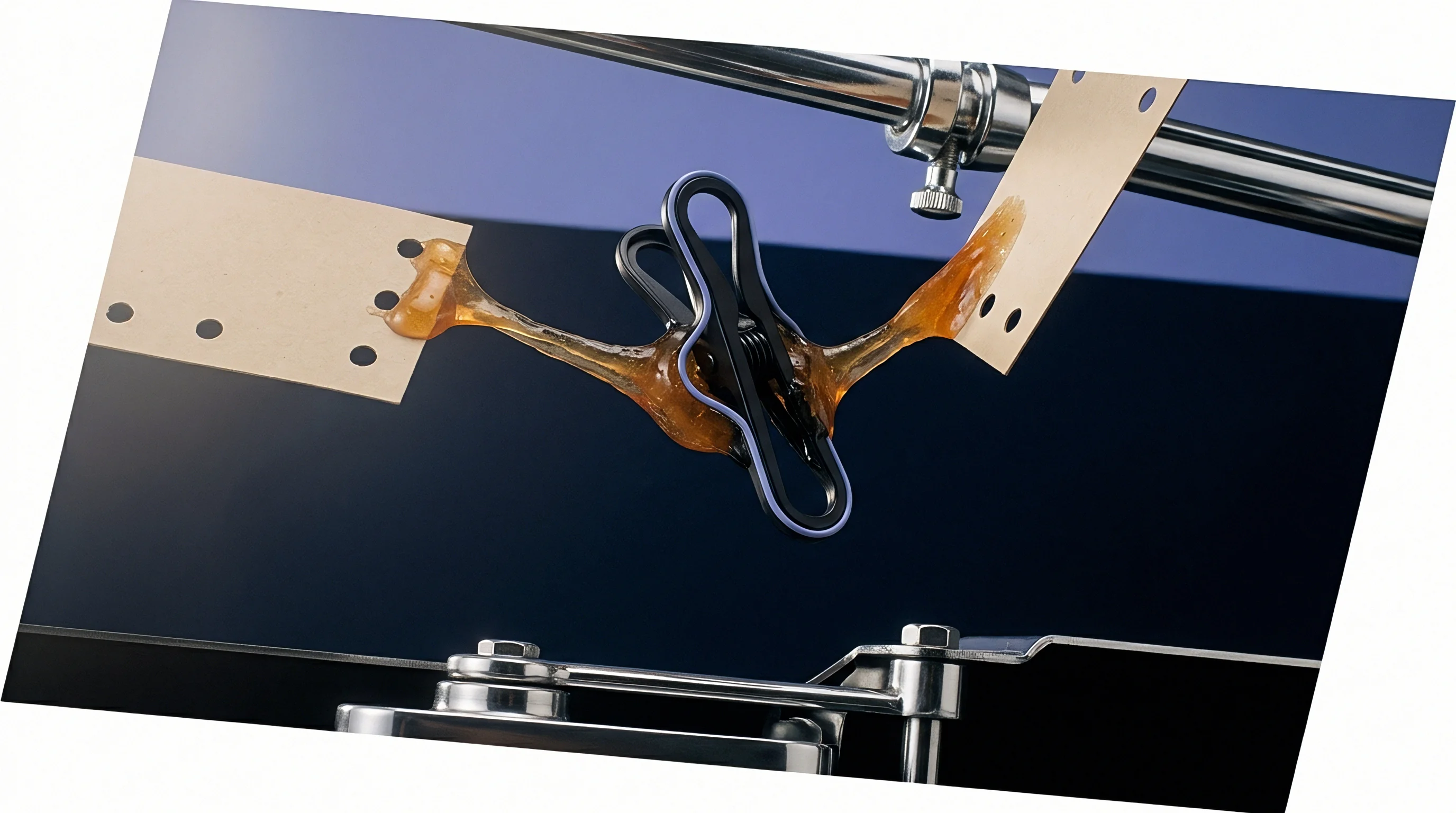
Micro-bond testing isolates an individual elementary filament inside a controlled droplet of matrix resin or a micro-clamp. Pulling the filament axially until it debonds from the droplet produces a load-displacement curve, from which peak pull-out force and average interfacial shear stress across the embedded area are calculated.
Dynamic mechanical thermal analysis tracks storage modulus, loss modulus, and damping across temperatures from -20 degrees Celsius to 120 degrees Celsius. Temperature sweeps on hydrated single-fibre ribbons identify glass transition points under set humidity levels. A lower transition temperature points directly to poor spinning stability in heated troughs.
- Mount single elementary flax filament across micro-tensile test frame grips maintaining a gauge length of exactly 10 millimeters.
- Apply micro-droplet of synthetic pectin or matrix analogue onto filament surface using automated liquid micro-dispenser.
- Cure mounted assembly inside environmental conditioning chamber at 20 degrees Celsius and 65 percent relative humidity for 24 hours.
- Place test frame inside micro-tensile load frame equipped with 5 Newton load cell and optical displacement transducer.
- Advance lower clamp downward at constant crosshead speed of 0.05 millimeters per minute until complete interfacial debonding occurs.
- Record maximum pull-out load and measure droplet embedment length using high-resolution optical microscopy.

Standard Method Adaptations for Heat-Impacted Lines
Standard valuation protocols need adjustments when handling heat-affected straw. ISO 2370 airflow fineness measurements skew high on damaged bundles because of internal micro-voids and collapsed ribbons. Technologists pair airflow data with optical cross-section analysis under ISO 1973 to determine true linear density.
A standard commercial purchasing contract clause specifies that raw fibre lots exhibiting mean interfacial shear strength below 12.5 MPa at 20 degrees Celsius incur a mandatory 8 percent invoice price reduction.
For EN ISO 2062 tensile methods, wet bundle tests require pre-soaking in deionized water at 60 degrees Celsius for 30 minutes. This thermal pre-soak exposes middle lamella degradation that standard room-temperature testing misses entirely.
Parity
Climate-induced fibre degradation alters the financial bridge from raw scutched flax purchases to finished fabric production. Depressed hackling recovery, coarser count limits, and frequent ring-frame breaks combine to drive up the cost per kilogram of spinnable yarn. Sourcing teams model these yield losses to calculate true landed parity prices before committing to contracts.

Spinning Count Limits and End-Breakage Economics
Fibres with degraded middle lamellae struggle under fine-count wet spinning. Shear slippage in the draft zone introduces thin spots, draft waves, and frequent breaks on the frame. Mills handling degraded fibre must restrict production to coarser yarn counts to keep frames running efficiently.
A target specification for fine wet-spun Nm 50 line yarn demands high bundle cohesion and undamaged matrix pectin. Heat-damaged lots cannot hold this count, forcing spinners to slow their frames or reassign fibre to coarse Nm 26 or Nm 18 production. That downgrade cuts the financial return per ton of processed raw fibre.
Landed Cost Models for Climate-Stressed Fibre Orders
Consider a 20-tonne commercial lot of scutched flax priced at 4.20 Euros per kilogram. Under normal conditions, hackling yields 52 percent long line sliver, spinning into Nm 39 yarn with 18 breaks per 1000 spindle-hours. This baseline delivers finished 200 gram per square metre woven fabric at 6.85 Euros per linear metre.
Processing a heat-damaged lot of the same nominal trade grade ~ suffering a 35 percent drop in matrix shear ~ cuts long line hackling yield to 38 percent and raises tow output. End-breakage jumps to 42 breaks per 1000 spindle-hours, forcing a 15 percent drop in frame speed and limiting spinnable count to Nm 26. These yield losses and operating penalties lift finished fabric cost to 8.92 Euros per linear metre.
| Processing Parameter / Metric | Optimal Baseline Lot | Moderate Thermal Impact Lot | Severe Stress Combined Lot |
|---|---|---|---|
| Raw Fibre Purchase Price (€/kg) | 4.20 | 4.20 | 3.60 |
| Hackling Long Line Yield (%) | 52.4 | 44.2 | 33.8 |
| Hackling Tow Credit Value (€/kg) | 1.85 | 1.85 | 1.50 |
| Maximum Spinnable Count Limit (Nm) | Nm 39 | Nm 28 | Nm 18 |
| Ring Frame End-Breakage (per 1000 sp-hr) | 18 | 31 | 54 |
| Yarn Production Cost (€/kg yarn) | 11.40 | 14.80 | 18.20 |
| Landed Metre Cost 200g/m² Fabric (€/m) | 6.85 | 8.15 | 9.65 |
Contract discounts offset the gap between raw offer prices and true mill performance. Buyers negotiate price adjustments tied to tested interfacial shear strength and expected hackling losses. Buying heat-damaged fibre without these corrections pushes heavy financial losses onto spinners and weavers unable to meet finished cloth specifications.