Standard Setup Rules for Four Point Greige Perches
Standard four-point greige perches require a 45-60 degree tilt, 1200+ lux D65 lighting, synchronized tension drive, and strict ASTM D5430 demerit point scoring.
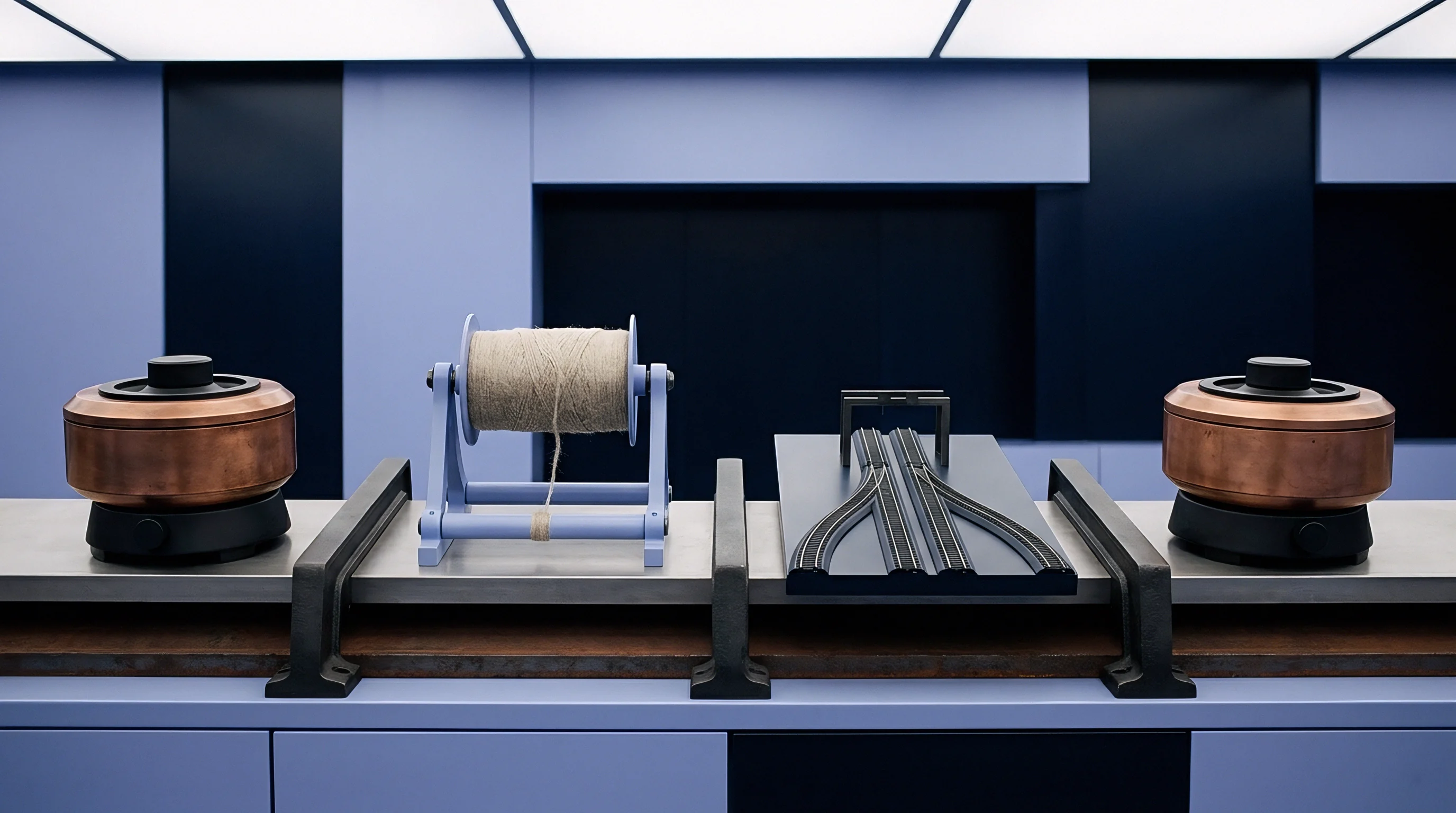

Bed
A three-hundred-meter roll of two-hundred-forty-gram plain linen sits on cradle rollers while the pull cylinder slips two centimeters against a greasy back selvedge. That slip throws off the digital length counter by four meters across the roll, shifting the recorded location of a continuous double end that ran through the reed over twelve loom hours. Standard perching setup for greige linen requires total mechanical stability before any demerit marks are noted.
If the table vibrates or sags under a heavy roll of flax, inspectors easily miss subtle warp shifts.
The physical viewing board serves as the dimensional baseline for the entire inspection station. Standards call for an inspection plane tilted between forty-five and sixty degrees off horizontal, placing the moving cloth perpendicular to the operator line of sight at a distance of ninety to one hundred centimeters. The perch table must span the loom full reed width with at least twenty centimeters of clearance on each side.
On two-hundred-twenty-centimeter rapier frames, that means an inspection surface two hundred sixty centimeters wide. Any crowning along the center distorts the fabric path, creating slack pockets where slubs and fine reed marks disappear.
Mechanical bed deflection across wide perches alters the viewing angle between cloth center and selvedges.
Table surface texture determines whether raw flax glides smoothly or gathers into crosswise folds. Equipment builders offer three main surface types: matte black high-density laminate, bead-blasted anodized aluminum, and frosted opal glass over an internal light box. Matte black laminate is the standard choice for front-reflection inspection, contrasting unboiled flax against a dark background without throwing glare into the operator face.
Surface gloss remains under five gloss units at sixty degrees.
An off-gauge perch inevitably skews defect counts.
Properly installed tables rely on dedicated grounding wires.
Dry linen yarns readily generate electrostatic charges during travel.
- Structural Steel Stiffeners welded beneath the table eliminate center-span sagging across perch widths exceeding two meters.
- Conductive Grounding Strips drain static electricity generated by dry flax rubbing across the laminate plate.
- Adjustable Angle Quadrants permit the operator to lock the frame at fifty degrees for heavy plain sailcloth and sixty degrees for fine handkerchief cambric.
- Honed Entry Bullnoses prevent sharp drag friction from abrading raised warp fuzz as the greige web enters the viewing field.
If the perch plate gives way under advancing fabric, inspectors misjudge defect lengths, logging single points for long distortions that should carry four-point penalties and trigger lot rejection.

Light
Light level on the board matters even more than an inspector eyesight. ASTM D5430 requires at least one thousand seventy-five lux ~ one hundred foot-candles ~ across the entire viewing plane. For unbleached linen, where raw bast fibers create a noisy background, lighting needs to reach twelve hundred to fifteen hundred lux to highlight thin spots, loose picks, and fine reed marks without straining eyes over an eight-hour shift.
Uncontrolled ambient lighting in the mill messes with perch readings.
Output drops noticeably as fluorescent tubes age.
Directional light makes raw slubs cast sharp micro-shadows.
Color rendering dictates whether an inspector can spot foreign fibers amidst normal variations in retted flax. Daylight lamps above the board maintain a color temperature of sixty-five hundred Kelvin, matching CIE Illuminant D65, with a Color Rendering Index of ninety-five or higher. High-frequency ballasts running above forty kilohertz prevent the stroboscopic flicker common with magnetic drivers, which can make fast-moving warp yarns look frozen or blurry.
Surface illuminance drops below 1075 lux when fluorescent tubes exceed twelve hundred burning hours without output verification.
The angle of incoming light sets surface defects apart from structure flaws. Hoods mounted at forty-five degrees to the angled board project light straight down the warp. This low-angle illumination casts distinct shadows behind slubs, knots, and broken picks, bringing them into sharp contrast.
Backlighting through an opal glass diffusion panel in the table adds five hundred to eight hundred lux from beneath. This transmission mode reveals reed marks, pinholes, dropped stitches, and faint weft bars that vanish under overhead lighting alone.
| Inspection Zone | Light Source Type | Target Illuminance | Correlated Color Temperature | Color Rendering Index |
|---|---|---|---|---|
| Direct Overhead Canopy | High-output LED linear array | 1200 to 1500 lux | 6500 K (D65) | 95 Ra minimum |
| Under-Bed Transmission Panel | Diffused opal LED panel | 500 to 800 lux | 6500 K (D65) | 90 Ra minimum |
| Side-Raking Surface Lamps | Adjustable narrow-beam LED | 800 to 1000 lux | 5000 K to 6500 K | 90 Ra minimum |
| Ambient Perimeter Shed | Shielded industrial fixtures | 200 to 300 lux max | 4000 K to 5000 K | 80 Ra minimum |
High-intensity lighting can overstate the visual prominence of normal flax slubs that disappear during chemical scouring and wet finishing operations.
Drive
Drive rollers pull greige fabric from the cradle, across the inspection surface, and onto the rewind roll. Managing pull tension is tricky with raw flax: the fiber breaks at just two to three percent elongation and offers very little stretch. If a drive roller jerks or pinches too hard, it pulls warp ends taut, flattening pick crimp and hiding weft distortions while the fabric moves.
Consistent web tension relies on proper frame rigidity.
Heavy flax fabrics require precise variable drive control.
Modern setups use independent vector-duty motors controlled by digital variable frequency drives. A draw roll coated in sixty-durometer vulcanized nitrile rubber grips the web across its width without crushing delicate bouclé slubs or scuffing plain yarns. Load-cell dancer rolls right before the viewing zone hold tension within a tight fifty to one hundred fifty Newtons per meter, preventing sag along the middle or curling along the selvedge.
Where Does Perch Tension Induce Skewing?
Uneven nip pressure across the draw roll pulls one selvedge faster than the other, pushing weft yarns off their ninety-degree alignment. On wide perches running fabric over two meters wide, a roller diameter difference of just one-tenth of a millimeter between ends produces noticeable bow and skew over fifty linear meters. Without synchronized differential drives, perching introduces artificial diagonal distortion, causing inspectors to penalize rolls for defects caused by the machine itself.
Excess pull at the take-up roller elongates slack linen picks and conceals start-up marks until wet processing relaxes the web.
Perch speed directly affects what an inspector catches. ASTM D5430 caps inspection speed at twenty-seven meters per minute, equal to thirty yards per minute. For dense weaves like heavy upholstery twills or damasks, drive inverters are usually set between twelve and eighteen meters per minute.
Running a fifty-meter roll past an operator in under two minutes virtually ensures that brief warp floats, single-end misdraws, and fine skin slubs pass by unseen.
Proper braking on the unwind roll keeps the fabric from sagging.
Sudden tension spikes can mimic reed lines in the web.
Slippage on the drive roll ruins the entire roll.
- Zero the electronic load-cell sensors on the dancer roll mechanism before threading the lead banner.
- Engage the pneumatic pressure cylinders to verify identical three-bar clamping force at both bearing housings.
- Run five meters of test cloth at five meters per minute while measuring linear speed with a calibrated hand tachometer.
- Inspect the advancing weft alignment against an optical square to verify that the draw assembly introduces zero mechanical skew.
- Accelerate the variable frequency drive to target inspection velocity while observing the dancer arm for resonant oscillation.
A loose brake at the unwind cradle hides far more start marks than a tight nip can reveal.

Tally
Evaluating greige flaws means turning physical defects into standardized numerical scores. Under ASTM D5430, the Four-Point System grades defects by their measured length rather than how noticeable they look. Faults in either warp or weft fall into four size brackets: up to seventy-five millimeters receives one point; seventy-five to one hundred fifty millimeters gets two points; one hundred fifty to two hundred thirty millimeters gets three points; and anything over two hundred thirty millimeters receives four points.
ASTM D5430 limits the points scored per linear yard.
Small defects tally up quickly across long production runs.
Poor roll winding produces unstable telescoping edges.
Overall quality relies on point density relative to total fabric area. Commercial agreements express final scores as points per one hundred square meters or points per one hundred square yards, calculated using standard formulas:
Points per 100 square meters = (Total points scored × 10,000) / (Inspected length in meters × Cut width in centimeters)
Points per 100 square yards = (Total points scored × 3,600) / (Inspected length in yards × Cut width in inches)
Consider an eighty-meter roll of plain linen sheeting with a cut width of two hundred twenty centimeters, woven at sixteen ends and fourteen picks per centimeter on an air-jet loom. If an inspector logs seven one-point slubs, four two-point broken ends, three three-point temple lacerations, and five four-point weft stop marks across its length, the point total comes to:
(7 × 1) + (4 × 2) + (3 × 3) + (5 × 4) = 7 + 8 + 9 + 20 = 44 total demerit points.
Applying the standard area formula produces the roll score:
(44 × 10,000) / (80 × 220) = 440,000 / 17,600 = 25.0 demerit points per 100 square meters.
ASTM D5430 restricts individual linear yard demerit penalties to four points regardless of defect severity or accumulation.
Can Split Slubs Trigger Double Penalties?
Questions often arise over whether a broken yarn flaw interrupted by clean picks is one continuous defect or multiple separate ones. ASTM D5430 specifies that faults separated by less than twenty-five millimeters of clean fabric count as a single defect measured from tip to tip. A thick slub measuring forty millimeters that drops for ten millimeters and reappears for sixty millimeters has a total length of one hundred ten millimeters, making it a single two-point defect instead of two one-point faults.
Where multiple slubs occur side-by-side on adjacent warp ends within the same linear meter, the four-point limit per meter caps the penalty.
| Defect Dimension Metric | Defect Dimension Imperial | Assigned Points | Representative Greige Linen Defects | Maximum Penalty Per Linear Unit |
|---|---|---|---|---|
| Length up to 75 mm | Length up to 3 inches | 1 point | Small seed slubs, single pinched picks, short oil spots | 4 points per linear meter or yard |
| Length 75 mm to 150 mm | Length 3 to 6 inches | 2 points | Medium slubs, reed marks, loose end floats, split weft | 4 points per linear meter or yard |
| Length 150 mm to 230 mm | Length 6 to 9 inches | 3 points | Long warp streaks, dropped filling bars, temple tears | 4 points per linear meter or yard |
| Length over 230 mm | Length over 9 inches | 4 points | Continuous double ends, heavy starting marks, mispicks | 4 points per linear meter or yard |
| Holes or openings up to 25 mm | Holes up to 1 inch | 2 points | Shuttle punctures, drop wire pinholes, selvage bite tears | 4 points per linear meter or yard |
| Holes or openings over 25 mm | Holes over 1 inch | 4 points | Blown picks, wide temple blowouts, torn cloth edges | 4 points per linear meter or yard |
| Demerit allocation adheres to ASTM D5430 Section 8 scoring rules. No single linear yard or meter accumulates more than 4 points for non-continuous defects. | ||||
Section 8.2 of ASTM D5430 mandates that any defect extending continuously over more than one meter automatically incurs four points for every single meter it crosses, overriding the standard sampling allowance and forcing immediate classification as commercial second quality.
Margin
Commercial grading thresholds mark the boundary between first-quality export fabric and discounted stock. Greige linen naturally records higher defect scores than ring-spun cotton or synthetic filaments because flax processing leaves behind bark bits, tow knots, and irregular fiber diameters. Sourcing agreements set point limits per one hundred square meters based on fabric weight and end use.
Cumulative point scores determine whether a shipment passes inspection.
Contract terms specify price adjustments for off-grade yardage.
Heavy apparel linen at two hundred forty grams per square meter typically allows twenty to twenty-five points per one hundred square meters for first quality. Dense upholstery fabrics made from plied wet-spun yarn allow up to twenty-eight points, given how hard it is to clear thick slubs on fast projectile looms. Lightweight shirting fabrics under one hundred twenty grams per square meter cut the threshold to fifteen points, as dyeing and finishing cannot hide warp lines or broken picks in sheer weaves.
| Cloth Construction Category | Nominal Weight | First Quality Point Ceiling | Second Quality Band | Lot Rejection Point Level |
|---|---|---|---|---|
| Fine Shirting Cambric (Plain) | 115 g/m² | 15 pts / 100 m² | 16 to 22 pts / 100 m² | Exceeding 22 pts / 100 m² |
| Medium Apparel Sheeting (Plain) | 160 g/m² | 20 pts / 100 m² | 21 to 28 pts / 100 m² | Exceeding 28 pts / 100 m² |
| Heavy Suiting / Drapery (Twill) | 240 g/m² | 25 pts / 100 m² | 26 to 34 pts / 100 m² | Exceeding 34 pts / 100 m² |
| Upholstery Canvas (Plain / Dobby) | 380 g/m² | 28 pts / 100 m² | 29 to 38 pts / 100 m² | Exceeding 38 pts / 100 m² |
When a roll falls into the second-quality band, contract terms apply automatic price cuts between eight and fifteen percent on that line item. Rolls exceeding the rejection limit are returned to the mill for full credit or rejected outright. If the overall average across a ten-percent sample of a shipment exceeds the contract limit, the buyer may reject the entire lot right at the dock.
Whether inline optical camera systems mounted on loom cross-beams will eventually replace manual perch inspection without over-flagging natural flax irregularities remains an open question across the industry.