Electronic Card Setup and Harness Tie Allocation for Rapier Looms
Electronic card setup and harness allocation demand aramid cord selection, precise solenoid timing, and strict splay angle management to maximize rapier loom output.

Cord
High-speed rapier looms with electronic jacquard shedding depend on exact coordination between the selection mechanism and the warp harness. Solenoids in modern electronic heads drive individual hooks directly from digital pattern files, bypassing mechanical cards. Harness tie cords routing through a comber board transfer this motion down to the warp ends, where selection accuracy hinges on cord stability, harness geometry, and return-spring tension at full operational speed.
Harness Cord Material Mechanics and Elastic Elongation
At operating speeds between 500 and 700 picks per minute, harness cords endure heavy friction and continuous tensile cycling. Standard polyester cords suffer progressive elastic drift over long runs; even a 1.5 percent elongation shifts the shed line by several millimetres, risking rapier tape collisions or split warp ends. Weaving dense linens or micro-filament synthetics generally requires aramid-core braided cords that have undergone thermal stabilization.
Braided aramid cords hold their structure under continuous loads up to 25 Newtons per hook, whereas standard polyester cores yield at lower thresholds and cause timing delays as hooks fall. High temperatures inside the loom shed worsen this physical elongation. The table below lists physical properties of harness tie materials under working shed conditions.
| Material Composition | Tensile Modulus (GPa) | Dynamic Elongation at 20N Load (%) | Thermal Drift Coefficient (mm/m per 10°C) | Service Life (Million Cycles) |
|---|---|---|---|---|
| Braided Aramid with Carbon Core | 120.0 | 0.18 | 0.04 | 150.0 |
| High-Tenacity Polyester (HT-PES) | 14.0 | 1.45 | 0.32 | 45.0 |
| Ultra-High-Molecular-Weight Polyethylene | 110.0 | 0.25 | 0.08 | 95.0 |
| Polyamide 6.6 Monofilament Core | 8.5 | 2.10 | 0.45 | 30.0 |
Comber Board Density and Harness Angle Calculation
Comber board layout sets the splay angle of harness cords as they descend from the knife frame to the reed. Keeping this angle within 12 degrees of vertical is essential; exceeding it creates heavy friction, localized heat, and fast eyelet wear. Height adjustments on the comber board shift the clearance available to the rapier heads.
Set the board too low, and the restricted shed height forces the rapier tape against lower warp ends; set it too high, and the splay angle varies too widely between centre and border cords.
A harness cord splay angle exceeding 12 degrees increases friction coefficients at the comber board eyelet by up to 40 percent, accelerating cord fraying.
Calculating the maximum harness angle requires measuring from the bottom hook position on the jacquard head to the top face of the comber board. Board width must equal the reed width plus draw-in expansion allowance. In dense constructions like linen damasks, outer cords rub hard against board drillings unless smooth ceramic eyelets are fitted to cut friction and prevent static charges building up on synthetic cords.
Poor cord selection or mismatched drilling density produces uneven shed openings across the warp sheet. Sagging in the lower shed line lets the flexible rapier head clip individual warp ends during insertion. The resulting end breaks trigger automatic loom stops, driving overall efficiency below commercial targets while scuffing the coating on costly rapier tapes.

Allocation
Harness tie allocation establishes how electronic jacquard hooks connect physically to warp ends across the reed width. Modern jacquard heads house matrix arrays from 1,440 to over 24,000 individual hooks. The allocation scheme translates pattern repeats into cord drops through the comber board, balancing pattern symmetry against harness density and selvage integration.

Hook Mapping Protocols and Harness Division Schemes
Straight harness ties link hooks directly to warp ends across consecutive pattern repeats. For repeating motifs, a single hook drives multiple cords routed through different sectors of the comber board. For instance, a 2,688-hook card operating on 12,000 warp ends yields a 4.46-repeat tie ratio.
Total cord count equals active warp ends plus dedicated selvage cords, and these must be distributed evenly across comber board zones to maintain uniform packing density.
Mixed harness ties combine straight repeats through the body with mirror ties or dedicated border structures. Running an independent selvage requires reserving hooks outside the main pattern allocation. Design software compiles graphical artwork directly into binary control files that send hook-by-hook solenoid instructions for every pick insertion.
Electronic File Translation and Solenoid Addressing
Control units process this pattern data through standardized binary files, mapping design pixels straight to solenoid addresses on driver boards. Translation software assigns hook numbers to harness cords according to the tie scheme stored in controller memory. Any misalignment in the mapping table creates severe pattern distortion across repeat boundaries.
Standard ISO 7211 construction mapping protocols dictate that harness allocation registers match physical comber board coordinates to prevent pick misregistration.
Card configuration interfaces assign individual driver boards to specific sections of the harness tie. During shedding, the controller fires electromagnetic solenoids to retain or release knife hooks. Standard tie plans reserve spare hooks along the module edges, giving operators room to adjust weaving width or repair broken cords without re-compiling the pattern file.
Allocation errors lead directly to miswoven pattern faults that ruin commercial fabric rolls. Common failure modes during card file setup include:
- Direct Solenoid Address Shift occurs when pattern data indexes offset by one hook position, producing horizontal streak faults across the fabric repeat width.
- Selvage Allocation Overlap arises when selvage hooks conflict with body weave commands, causing selvage thread breakage and edge curling during rapier insertion.
- Repeated Harness Cord Tangling develops when harness tie densities exceed 80 cords per square centimetre inside the comber board grid pattern.
- Unmapped Hook Inaction happens when missing address mapping lines leave solenoids unpowered, resulting in continuous warp end floats along the fabric face.
Adapting harness allocation architectures to sub-millisecond solenoid pulse speeds while preserving cord stability under 30,000-hook arrays remains an ongoing challenge for loom builders.

Synchronization
Dynamic synchronization links electronic pattern signals with physical rapier kinematics. High-resolution shaft encoders provide the feedback needed to trigger jacquard solenoids so that shed movement aligns exactly with rapier tape acceleration, preventing collisions with moving warp ends.
What Determines Electronic Solenoid Dwell Angle?
The main drive encoder sends continuous position data to the jacquard control cabinet, where solenoid circuits actuate selection hooks within a narrow rotational window. Depending on shedding cam geometry, this window usually opens between 280 degrees and 320 degrees of the shaft cycle. Higher loom speeds shorten the time available for reliable hook retention.
Rapier insertion requires a clean, symmetric shed opening. Flexible rapier heads enter the warp shed around 60 degrees into the rotation cycle and exit near 240 degrees. The jacquard motion must reach full height before the rapier reaches the outer selvedge.
The sequence below outlines the timing for high-speed rapier operation.
- Encoder detects main drive shaft position reaching 270 degrees in the rotational cycle.
- Jacquard control cabinet sends low-voltage impulse signals to selected electronic solenoid driver boards.
- Electromagnetic solenoids actuate retention latches, locking selected jacquard hooks against knife frames.
- Jacquard lifting knives begin upward travel at 300 degrees shaft position, lifting designated warp ends.
- Flexible rapier tape enters outer selvage shed opening at 65 degrees shaft position under full clearance.
- Giver rapier hands off weft yarn to taker rapier at shed centre at 180 degrees shaft position.
- Rapier heads exit shed fully at 240 degrees, allowing jacquard knife frames to start lowering.
- Shed closes fully at 330 degrees, allowing main loom beat-up movement to compress weft against fell.
Rapier Tape Motion Dynamics and Shed Clearance Windows
Rapier tape dimensions govern the required shed clearance. Flexible rapier drives operate with smaller openings than rigid systems, imposing less dynamic strain on warp yarns. Microprocessor-controlled stepper drives allow fine timing adjustments to shed closure, altering cover factor and density; closing the shed late holds warp tension higher during beat-up, which helps pack weft picks into dense canvas or damask fabrics.
Jacquard shed timing synchronized precisely with rapier tape velocity reduces warp yarn dynamic tension spikes by up to 25 percent.
Timing misalignments cause severe tape and yarn damage. If the shed closes prematurely, retracting tapes strike the upper warp sheet, causing yarn chafing, broken ends, and excessive tape wear. Calibration involves verifying optical sensor signals against encoder positions during slow-motion inching.
The opening curve itself follows the natural velocity profile of the rapier drive gear.


Tension
Balanced harness tension across the warp sheet ensures clean shed separation and prevents mis-shedding. Because electronic jacquard heads only raise warp ends actively, bottom pull-down systems ~ using helical steel springs or elastomeric cords under the loom frame ~ are required to pull ends down during shed closure.
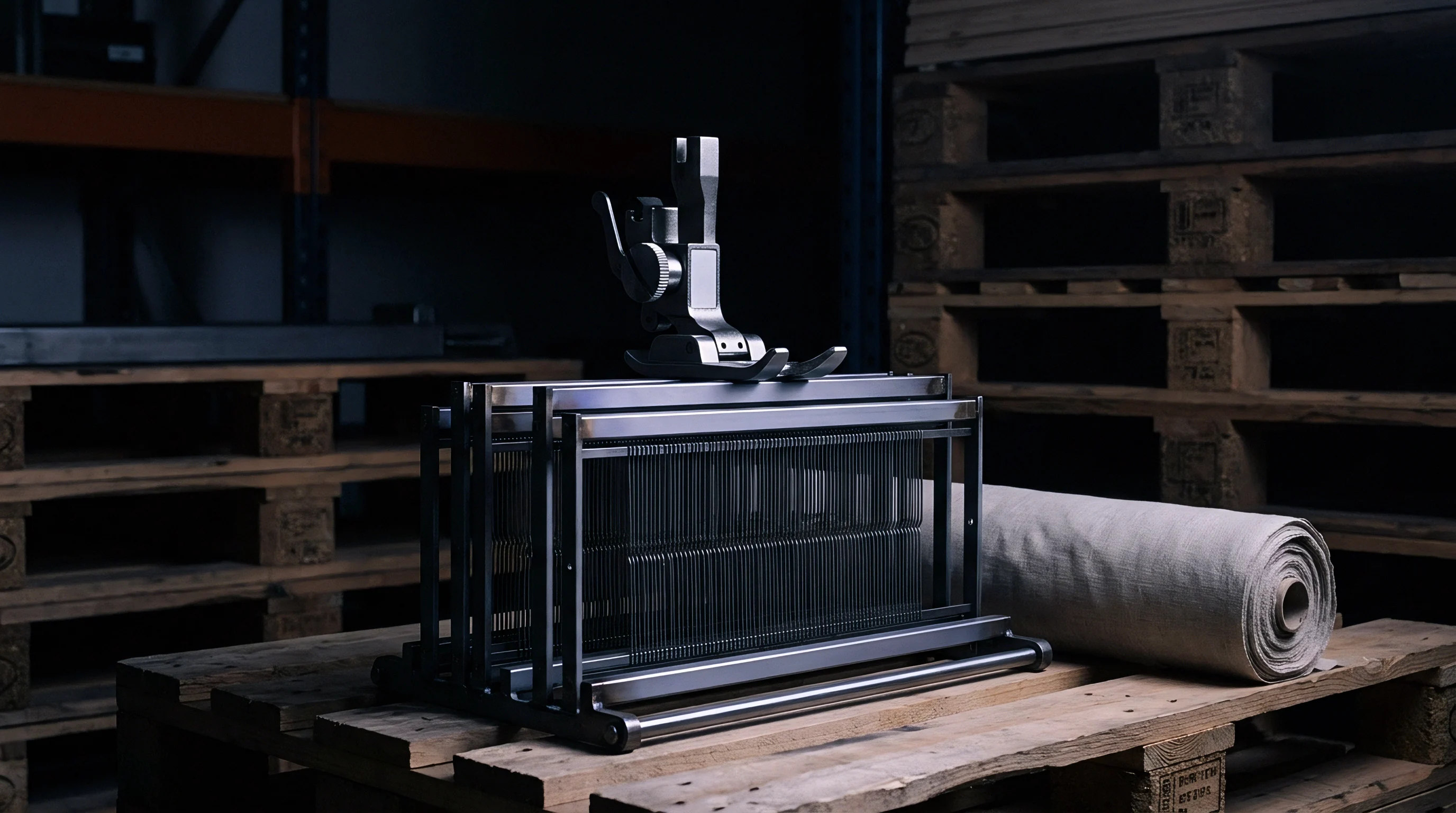
Bottom Harness Return Force Balancing
Spring systems exert constant downward tension on the harness cords. At high loom speeds, spring resonance can induce vertical flutter in the lower shed line. Poorly balanced return forces let bottom warp ends float into the path of the rapier tape, while fatigued springs cause mis-shedding.
Heavier yarn counts and dense linen constructions demand stiffer spring rates to overcome warp friction during lift.
| Fabric Construction Category | Yarn Count (Tex) | Warp Ends per cm | Recommended Spring Rate (N/mm) | Pre-Tension Force per Cord (N) |
|---|---|---|---|---|
| Fine Linen Apparel Damask | 14.5 (Nm 69) | 48.0 | 0.35 | 4.2 |
| Medium Heavy Furnishing Fabric | 42.0 (Nm 24) | 32.0 | 0.48 | 6.5 |
| High-Density Technical Canvas | 84.0 (Nm 12) | 22.0 | 0.72 | 9.8 |
| Lightweight Silk Jacquard | 5.5 (Nm 180) | 64.0 | 0.22 | 2.8 |

Warp Line Elevation and Rapier Guidance Alignment
Altering warp line elevation changes the tension split between top and bottom shed lines. Setting an asymmetric shed by lifting the back rest roller slightly above breast beam level increases top sheet tension to prevent slack yarn, while easing bottom sheet tension so ends clear rapier guide hooks. Improper levelling leaves float defects, while ungrounded static accelerates cord wear.
Asymmetric shed geometry enhances face clarity on complex jacquard structures by increasing top shed thread tension during pick insertion.
Monitoring tie tension involves checking static cord pull with the jacquard head at levelling position. Technicians raise or lower bottom grid plates to adjust spring anchor heights. Equal pre-tension across all cords ensures warp ends reach uniform shed heights at full knife lift; uneven tension causes diagonal streak defects on wide fabrics.
Premature harness cord failure often stems from mill relative humidity exceeding operating tolerances, which causes synthetic cord shrinkage and excessive baseline tension loading.

Accounting
Operating electronic jacquard rapier looms involves heavy capital and running costs closely tied to harness setup and changeover times. Hourly rates incorporate machine depreciation, power, climate control, and labor, making installation downtime a direct hit to mill profitability.
Harness Changeover Labor and Capital Amortization
Rebuilding a harness on a high-hook machine demands significant labor; a full retie on a 12,000-hook loom takes up to 120 skilled hours. Spreading these setup costs over short production runs inflates the cost per finished metre, while mispicks or accelerated cord wear on fine setts further erode margins.
Mills minimize setup overhead by utilizing versatile straight ties that support multiple pattern variations entirely through digital control software without physical re-tying. However, specialized technical weaves and custom border constructions still require dedicated allocation changes and machine downtime.

Worked Economic Model of Custom Harness Allocation
Evaluating harness allocation strategies requires weighing standard flexible ties against custom setups on specific production runs. Consider a high-density 10,000-metre order run on a rapier loom with an operating rate of 85.00 EUR per hour, a baseline speed of 550 picks per minute, and a pick count of 30 picks per centimetre (3,000 picks per metre).
The base running time calculates as:
Production time = (10,000 metres × 3,000 picks/metre) / (550 picks/minute × 60 minutes/hour) = 909.09 loom hours.
Under Case A (Standard Versatile Harness Tie), drop-wire and drawing-in setup requires 8 hours, and operating efficiency reaches 88 percent with standard clearance. Total machine running time comes to 909.09 / 0.88 = 1,033.06 hours. Adding the 8 hours setup gives 1,041.06 total loom hours.
At 85.00 EUR per hour, total machine cost reaches 88,490.10 EUR, or 8.85 EUR per metre.
Under Case B (Custom Harness Allocation rebuild), harness re-tying takes 96 labor hours at 45.00 EUR per hour (4,320.00 EUR labor cost) plus 36 hours of loom downtime (3060.00 EUR loom cost), totaling 7,380.00 EUR in setup. Tailored shed clearance increases machine speed to 610 picks per minute and efficiency to 92 percent. Net production time drops to (30,000,000 picks) / (610 × 60) = 819.67 hours.
Operating loom time is 819.67 / 0.92 = 890.95 hours, costing 75,730.75 EUR. Including setup, total cost is 83,110.75 EUR, or 8.31 EUR per metre.
The custom allocation saves 0.54 EUR per metre across the 10,000-metre order, absorbing the higher initial setup expense. Key operational criteria to evaluate before committing to a custom rebuild include:
- Minimum Order Volume Threshold must exceed 6,000 production metres to recover harness re-tying labor charges.
- Pattern Complexity Verification requires confirming that standard straight ties cannot produce required warp floats without density distortion.
- Loom Speed Advantage Assessment verifies that custom harness geometry yields at least a 7 percent increase in operational speed.
- Expected Harness Service Life must clear a minimum of 50 million weaving cycles before requiring comber board re-coring.
Long-term profitability relies on balancing digital pattern flexibility against physical harness limits. Procurement audits evaluating mill capacity track changeover downtime alongside fabric quality specs.