Calculating Reed Width Contraction Ratios across Variable Linen Pick Densities
Loom reed width for linen must scale non-linearly with pick density, expanding up to 20 percent over finished width to compensate for severe bast fiber crimp take-up.

Flax
Loom reed width calculations for pure linen turn on an inelastic fibre with low bending compliance, where wet-spun bundles dictate rapid crimp interchange across variable pick densities. Working reed width on a rapier or projectile loom always exceeds target greige and off-loom widths. Spun from long line or short tow bast fibres, linen yarns have a dry breaking elongation of 1.5 to 3.0 percent and an initial tensile modulus over 18 to 22 gigapascals.
That stiffness limits lateral yarn flattening under beat-up force. As pick density increases against a constant warp sett, the picks force warp ends through a sharper path, transferring transverse tension across the entire width of the sheet during interlacing.
Off-loom contraction occurs immediately as cloth leaves the temple cutters and passes the breast beam ~ a mechanical relaxation driven by yarn crimp recovery. A second contraction stage occurs during wet processing (scouring, bleaching, dyeing, and drying), where immersion relieves internal fibre strains and expands transverse fibre diameter. Getting the reed width right prevents selvedge rupture, temple tearing, wavy edges, and off-spec goods.
A linen warp dressed to 160 centimetres in the reed contracts to 147 centimetres greige and finishes at 139 centimetres under an 18-pick construction, yet drops to 132 centimetres finished when driven to 26 picks.
The total width contraction ratio links drawn-in reed width to final stable cloth width, expressed either as a decimal contraction factor or as a percentage of reed width. Calculations must separate off-loom greige contraction from finishing contraction. Wetted flax bundles swell up to 25 percent in diameter, pulling the woven grid inward lengthways and widthways as yarns re-jam.
Predicting this shift relies on empirical coefficients tied directly to pick count per centimetre and weave pattern.
A bad contraction estimate compromises shed throughput. Setting a reed too narrow forces finishers to stretch the cloth on stenter clippers, leaving a thin, boardy fabric with latent laundering shrinkage exceeding ASTM D3781 tolerances. Dressing too wide forces the mill to tumble out excess width, over-packing the picks and turning a light dress goods spec into heavy upholstery canvas.
In the end, reed width governs loom hours, warp preparation yardage, and raw fibre weight per finished metre.
Mechanics
Geometric balance between warp and weft crimp governs how far warp ends shift laterally. In a plain weave, each warp end alternates over and under successive picks. At low pick densities, inserted picks run relatively straight, forcing warp ends to take up most of the interlacing crimp.
As pick density approaches structural jamming, resistance from the crowded weft forces warp ends apart while bending the weft yarn itself. That added curvature pulls the outer selvedges toward the fabric centreline.
Pierce Geometry Applied to Bast Fibre Structures
Adapting Pierce geometry for linen means accounting for the elliptical cross-section of flax yarn bundles. Unlike round synthetic filaments, wet-spun linen yarn flattens imperfectly under beat-up, acting more like a stiff ribbon with high transverse shear stiffness. The contraction ratio reflects the path length of the weft as it weaves through the warp sheet.
The mathematical relation for transverse reed contraction takes the form:
C_w = 1 – (W_off / W_reed) = 1 – (p_w / (l_w))
Here C_w is fractional reed width contraction, W_off is off-loom cloth width, W_reed is yarn width inside the reed dents, p_w is warp end spacing, and l_w is modular weft yarn length per unit cell. As insertion increases from 12 to 24 picks per centimetre, the bending moment on the weft picks amplifies transverse crimp amplitude, drawing outer warp ends inward.

Jamming Limits and Cover Factor Pressures
Every fabric reaches a structural limit at its jamming point, set by yarn diameters and modular lengths. Linen weavers quantify this threshold using cover factor formulas adjusted for flax counts. Metric cover factor combines ends per centimetre with yarn count (Nm):
Cover Factor = Ends_per_cm / sqrt(Nm_warp) + Picks_per_cm / sqrt(Nm_weft)
Approaching a combined cover factor of 28 to 30 in plain linen weaves triggers sharp, non-linear contraction spikes. Weft picks can no longer seat at their beat-up coordinates without buckling the warp ends. The resulting lateral force pulls selvedges inward hard, stressing temple pins and causing frequent selvedge end breaks at the reed line.
- Yarn diameter ratio governs the neutral bending axis of the system; a coarse tow weft over fine line warp pushes crimp into the warp ends and suppresses width contraction entirely.
- Beat-up trajectory establishes mechanical displacement of inserted picks; late shedding packs picks tighter, increasing off-loom width contraction.
- Weft insertion tension regulates initial pick elongation; over-tensioned rapier picks snap back when released from the clamp, creating artificial off-loom contraction.
- Selvedge construction modulates inward draw forces; loose plain selvedges on twill bases cause edge distortion, while tight tape selvedges bind outer dent wires.
High warp tension combined with high pick count accelerates yarn flattening along contact arcs. With linen’s low resilience, that contact deformation stays locked in the greige fabric. Once tension drops on the cloth roll, stored elastic energy in bent weft picks releases, driving off-loom contraction within the first four hours.


Arithmetic
Calculating reed width requires an empirical contraction coefficient combining loom take-up and finishing shrinkage. With target finished width designated as W_fin, greige width as W_off, and reed width as W_reed, the total width contraction ratio R_total links initial denting width directly to warehouse inspection width:
W_reed = W_fin / (1 – R_total)
The overall contraction ratio R_total combines off-loom contraction R_loom and chemical finishing contraction R_finish sequentially:
R_total = R_loom + R_finish – (R_loom R_finish)
For single 100 percent linen yarns, R_loom increases linearly with pick density up to the jamming limit, where structural buckling causes contraction to curve upward exponentially. The variable off-loom contraction ratio R_loom follows the baseline formula:
R_loom = k_base + alpha (Picks_per_cm / sqrt(Nm_weft))
Here k_base represents structural weave crimp (0.025 for 1/1 plain weave, 0.015 for 2/2 twill, 0.010 for 5-end satin), alpha is the bast-fibre stiffness constant (typically 0.018 for dry-spun tow and 0.024 for wet-spun line flax), and the parenthetical term is weft cover factor.
| Weft Density (Picks/cm) | Weft Count (Nm) | Weft Cover Factor | Off-Loom Contraction (%) | Finished Contraction (%) | Calculated Reed Width (cm) for 140cm Finished |
|---|---|---|---|---|---|
| 12.0 | 26.0 | 2.35 | 4.8% | 8.5% | 153.0 |
| 15.0 | 26.0 | 2.94 | 5.8% | 9.8% | 155.2 |
| 18.0 | 26.0 | 3.53 | 7.2% | 11.4% | 158.0 |
| 21.0 | 26.0 | 4.12 | 8.9% | 13.1% | 161.1 |
| 24.0 | 26.0 | 4.71 | 10.8% | 15.2% | 165.1 |
| 27.0 | 26.0 | 5.30 | 13.2% | 17.6% | 169.9 |
As the figures show, raising pick density from 12 to 27 picks per centimetre nearly doubles width contraction from reed to finished cloth. Failing to widen the reed from 153.0 centimetres to 169.9 centimetres yields an unusable bolt that misses buyer width specifications.
Worked Case: Apparel Sheeting Vs Structural Canvas
Consider an apparel linen sheeting in a balanced plain weave with Nm 39 line flax warp and weft, targeting 140 centimetres finished width. At 18 picks per centimetre, the calculated weft cover factor sits at 2.88. Applying an empirical alpha of 0.024 and base crimp of 0.025 yields an off-loom contraction R_loom of 6.2 percent.
Post-loom scouring, reactive piece dyeing, and stenter drying add an R_finish of 6.0 percent. The combined contraction ratio computes to R_total = 0.062 + 0.060 – (0.062 0.060) = 0.118 (11.8 percent). The draughtsman drafts the warp to an active reed width of 140 / (1 – 0.118) = 158.7 centimetres.
Shift the construction to an upholstery canvas using the same Nm 39 warp at 22 ends per centimetre, but heavily beaten to 28 picks per centimetre with Nm 18 tow linen weft. Weft cover factor jumps to 6.60. Off-loom contraction climbs to 11.5 percent as dense tow weft severely crimps the warp ends.
Aqueous boiling and open-width washing add another 8.5 percent shrinkage. Cumulative contraction reaches R_total = 0.115 + 0.085 – (0.010) = 0.190 (19.0 percent). Holding a 140-centimetre finished width demands an active reed width of 140 / (1 – 0.190) = 172.8 centimetres.
The draughtsman must shift to a wider loom frame entirely, moving from a standard 190-centimetre profile to a 220-centimetre beam bed.
Underestimating reed contraction in heavy pick regimes pulls temple pins loose from the cloth edge, gouging the race board and splitting the selvedge yarns.
Variations in pick density alter how many warp ends are drawn per dent. At high pick counts, keeping a dense reed (e.g. 10 dents per centimetre with 2 ends per dent) causes excessive abrasive friction between warp bundles and stainless steel reed blades.
Switching the denting plan to a coarser reed (e.g. 5 dents per centimetre with 4 ends per dent) relieves friction but alters the contraction profile, allowing grouped ends to pack tighter and increasing lateral contraction by 0.5 to 1.2 percent at identical pick densities.
Rigging
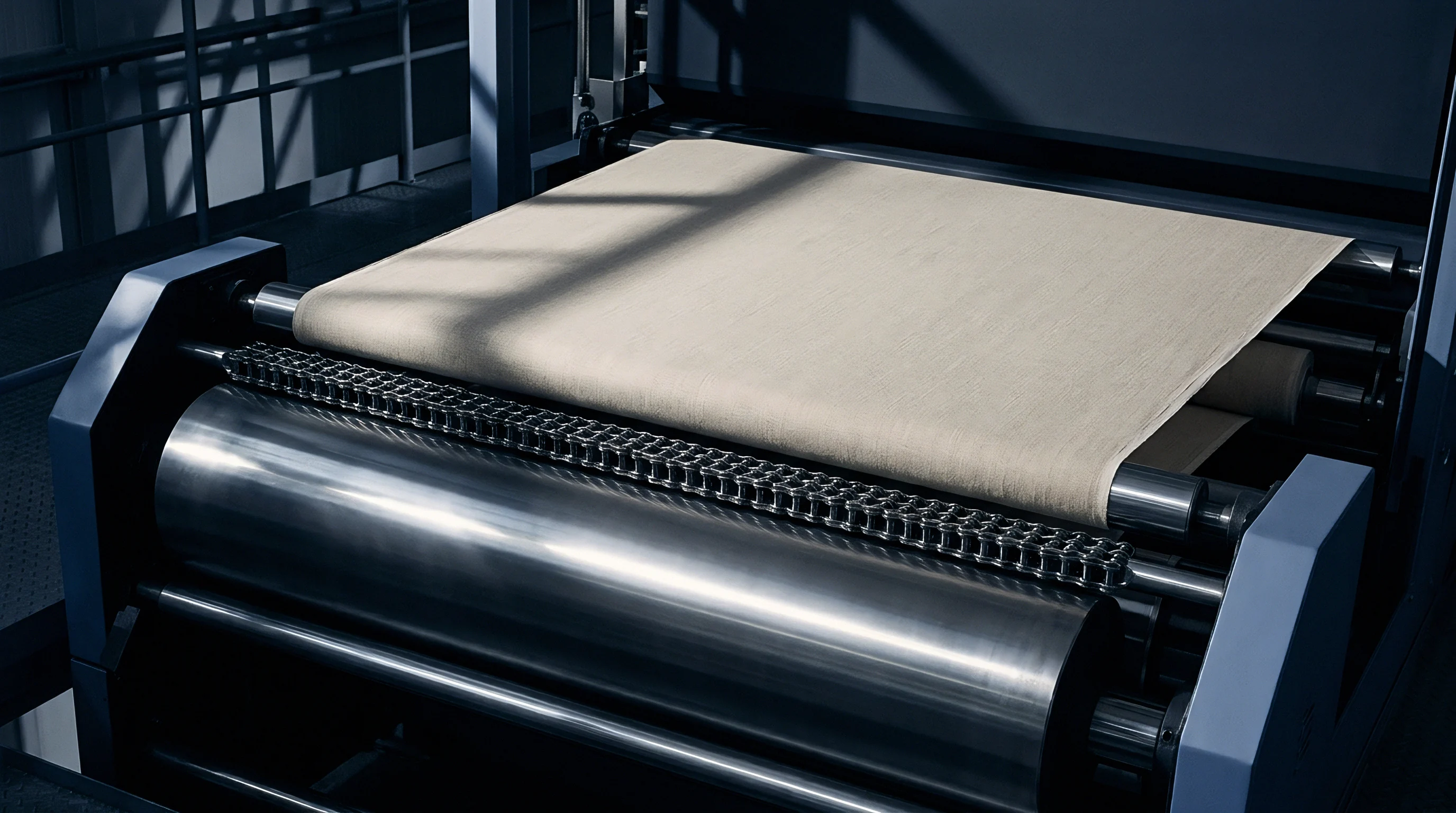
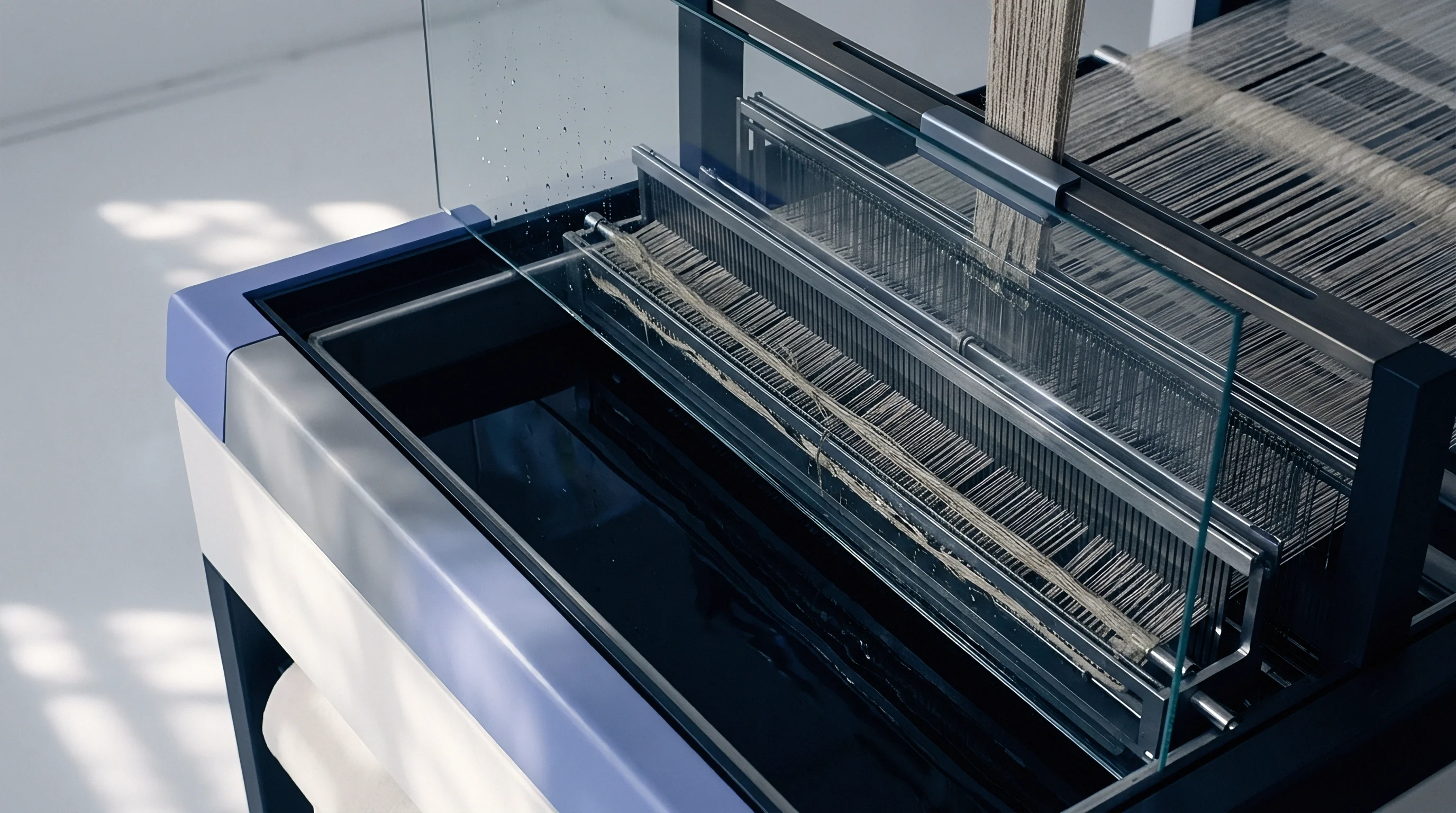
Loom setup requires translating calculated reed widths into physical settings across harness frames, temples, and let-off motions. High-speed rapier and projectile looms operate under high mechanical loads on dense linen fabric. The loom-shed superintendent must balance beam tension against temple holding capacity to avoid reed marks and edge breaks.
Asymmetric Tension and Contraction Shifts
Warp let-off tension directly alters the equilibrium between weft and warp crimp. Higher warp tension flattens warp ends, driving weft crimp up and accelerating width contraction as soon as cloth clears the temples. Tension across the warp sheet is checked with a mechanical tensiometer at the back-rest roller.
Target running tension for pure line linen falls between 0.35 and 0.50 centinewtons per dtex. Above 0.60 centinewtons per dtex, flax fibres approach their elastic limit and snap at crossing points in the reed dents instead of yielding during shed formation.
Temples hold greige width mechanically against the inward pull of the interlacing weft. Standard 3 to 5 ring temples are inadequate for linen woven across variable pick densities. Past 18 picks per centimetre, lateral draw force easily bends brass pins or tears the outer selvedge ends.
Dense linen requires cylinder temples with progressive pin inclinations ~ 12 to 22 rings fitted with hardened stainless pins angled at 15 degrees to hold the heavy ground.
- The overlooker disengages the let-off drive and adjusts back-rest roller height to get a flat shed line, keeping top and bottom shed tensions uniform during insertion.
- The warp sheet is centered precisely on the harness frames, aligning calculated reed width symmetrically with sley stroke to prevent uneven selvedge pull.
- Temple brackets are set within 2 millimetres of the reed at forward beat-up dead centre, shortening the unsupported zone where unchecked necking occurs.
- The electronic take-up regulator is calibrated via pick-wheel pulse tracking to compensate for the expanding diameter of the sand roller as cloth winds forward.
- Selvedge motion timing is advanced by 15 degrees relative to ground shedding, binding cut weft ends under peak tension so edges do not go slack.
Overly aggressive temple pins puncture needle holes that tear during scouring. Conversely, weak temple hold lets cloth narrow inside the reed sweep, forcing reed wires to abrade outer warp ends at an angle. That friction creates fuzzy ends, slubs, and striping along the outer five centimetres of the selvedge.
Finishing
Width contraction calculations remain incomplete without accounting for wet and thermal finishing. Greige linen reaches the finishing plant stiffened with hemicelluloses, pectins, and size. Removing these impurities relaxes and swells the yarn structure, triggering the second contraction phase.

Desizing, Scouring, and Caustic Swelling Dynamics
During caustic boiling-off, pectin removal lets individual elementary flax fibres slide inside their bundles. Flax absorbs up to 30 percent moisture by weight, swelling in diameter while shortening in length. In tightly beaten fabrics, that diameter expansion exerts lateral pressure, increasing crimp amplitude throughout the weave and pulling the cloth inward.
A plain weave linen at 22 picks per centimetre typically loses 6 to 10 percent of its greige width in scouring alone.
| Process Stage | Low Pick (13 picks/cm) | Medium Pick (19 picks/cm) | High Pick (25 picks/cm) | Structural Jammed (29 picks/cm) |
|---|---|---|---|---|
| Reed Width (Denting) | 155.0 cm | 160.0 cm | 168.0 cm | 176.0 cm |
| Off-Loom Greige Width | 147.2 cm | 148.5 cm | 150.1 cm | 152.8 cm |
| Boil-Off / Scour Width | 142.5 cm | 141.0 cm | 139.5 cm | 138.2 cm |
| Bleach / Dye Width | 141.0 cm | 139.2 cm | 137.0 cm | 134.5 cm |
| Stenter Final Set Width | 140.0 cm | 140.0 cm | 140.0 cm | 140.0 cm |
| Cumulative Contraction (%) | 9.68% | 12.50% | 16.67% | 20.45% |
The figures show how higher initial pick densities accelerate post-loom contraction. At 29 picks per centimetre, the fabric contracts more than 20 percent from initial reed width, requiring the finisher to manage tension and overfeed carefully on the stenter frame to hit 140 centimetres.

Stenter Settings and Residual Laundry Shrinkage
Stenter processing sets final dimensions through controlled drying and cross-stretching. If the reed width was set too narrow, the finisher has to pull the wet fabric out on stenter pins to meet target width. That forced stretching locks severe strain into the fibres.
When the fabric is later laundered, those frozen stresses release, causing 8 to 12 percent residual weft shrinkage and failing ISO 6330 standards.
Finishing mills sometimes try to counter high contraction using compressive shrinking machines like rubber-belt sanforizers. But sanforizing acts mainly on longitudinal warp shrinkage; excessive weft contraction has to be handled at the loom reed. A miscalculated reed width cannot be corrected in finishing without compromising either drape or dimensional stability.
Finishing specifications must stipulate residual relaxation shrinkage below three percent under ISO 5077 before approving bulk reed drafts.
Yarn bleaching state also skews contraction ratios. Using bleached linen warp and weft cuts finishing contraction in half compared to raw grey tow, since bleaching has already extracted soluble pectins and pre-swollen the cellulose bundles. A grey flax warp requires an extra 2.5 to 4.0 percent reed allowance for extraction during boiling.
Yield
Loom hours and finished linear yield drive unit economics on variable-pick linen lines. Flax weaves slowly compared to cotton or synthetics; rapier insertion speeds cap between 350 and 480 picks per minute due to fiber friction, surface hairiness, and tensile brittleness. Doubling pick density from 14 to 28 picks per centimetre halves daily linear metre output while raising warp yarn consumption per square metre through increased crimp take-up.

Pick Insertion Density and Net Loom Hours
Loom capacity is scheduled in machine hours based on target output length, running speed, efficiency, and pick density. The loom hours required to produce an order of L metres follow the standard relation:
Loom Hours = (L Picks_per_cm 100) / (Picks_per_Minute 60 Efficiency)
At 14 picks per centimetre, a rapier loom running at 400 picks per minute and 82 percent efficiency yields 14.05 metres of greige cloth per hour. Running at 28 picks per centimetre drops production to 7.02 metres per hour. At the same time, higher pick density increases warp breaks per hundred thousand picks, dragging operational efficiency from 82 percent down to 71 percent.
That combination nearly triples the machine hours needed per linear metre.
Warp consumption estimates must account for both reed width and crimp take-up. As reed width expands for higher pick densities, required beam width and total end count increase proportionally. For an order of 1,000 finished metres at 140 centimetres width:
- Low density order (14 picks/cm) requires an active reed width of 154 centimetres with 3,080 ends of Nm 26 warp, running at 7.0 percent warp crimp, consuming 183 kilograms of warp yarn.
- High density order (26 picks/cm) demands an active reed width of 168 centimetres with 3,360 ends of Nm 26 warp, running at 13.5 percent warp crimp, consuming 214 kilograms of warp yarn.
- Warp waste percentage rises from 2.5 percent to 4.8 percent on high-pick constructions due to shedding friction and lint accumulation.
- Direct power allocation per finished metre rises linearly with machine hours, adding direct overhead to dense constructions.
A miscalculated reed width directly impacts raw material costs. Drafting a dense linen fabric using standard cotton contraction assumptions leaves delivered width short by 5 to 8 centimetres. The mill then has to discount the fabric as off-width stock or re-weave the lot.
Sourcing managers verify that technical calculation sheets reflect flax-specific contraction ratios before approving production orders.
Weaving contracts should explicitly specify target finished width tolerances alongside testing protocols like ASTM D3774. Attributing severe width contraction to raw linen behavior usually reflects an uncalibrated reed calculation rather than an unavoidable material flaw. The physics of flax interlacing are deterministic; technical calculations must absorb contraction before the first end is drawn through the reed.