Broadloom Reed Contraction and Greige Linen off Loom Width Calculation
Derive broadloom linen reed space by calculating weft crimp and wet finishing contraction to guarantee minimum off-loom greige and finished commercial widths.
Geometry
Initial Reed Parameters
Calculating loom width for wide linen starts right at the reed wires, where the warp sheet is physically constrained before beat-up forces alter yarn spacing. On a 320-centimetre reed space running 100 percent wet-spun flax, width drops the moment the fabric leaves the temples. The warp ends, held under mechanical tension between 45 and 65 centinewtons per end during shedding, relax as soon as they clear the fell line.
That sudden relaxation works alongside the lateral crimp exchange driven by heavy bast weft picks. Greige width never matches reed width. Flax yarn is inherently stiff and exhibits low elongation at break ~ typically between 1.8 percent and 2.5 percent ~ so under loom tension, the weft takes an undulating path around warp ends that stay comparatively straight.
As the woven cloth moves toward the take-up roll, this released tension redistributes the strain throughout the structure: the warp shortens lengthwise, deepening the weft crimp and pulling both selvages inward.
How much width is lost between the reed and the cloth roll depends largely on the denting arrangement and the fabric’s cover factor. A square plain weave using 14 Lea wet-spun flax in both warp and weft, drawn at two ends per dent across 11 dents per centimetre, generates considerable interlacing resistance that forces yarn sideways. Contraction percentage is calculated as reed width minus off-loom greige width, divided by reed width, multiplied by one hundred.
In broadloom flax sheetings, this loss runs between 5.5 percent and 11.5 percent. Underestimating that contraction leaves the greige fabric narrower than the minimum threshold required for subsequent scouring, bleaching, and stenter pin-plate pickup.
Tension drop at the cloth fell alters bast thread interlacing paths immediately upon temple clearance.

Why Broadloom Linen Demands Dedicated Contraction Allowances
Broadloom frames running over 300 centimetres face an amplified contraction profile compared to standard 190-centimetre apparel looms. Edge temples provide mechanical stabilization only at the margins, leaving the vast interior unsupported. Conventional cylinder or ring assemblies hold only the outer 50 to 100 millimetres of the selvage; across the remaining 300 centimetres, weft recovery forces operate virtually unchecked.
When a rapier or projectile carries coarse bast yarn across an open shed of three metres, accumulator delivery tensions fluctuate. The moment the reed beats against the fell, the inserted pick tries to straighten, dragging warp ends inward toward the machine centerline.
Bast fibers have irregular cross-sections and pronounced surface nodes. Those nodes generate high inter-yarn friction, locking the threads in place before they can settle into ideal geometric packing. Because the yarn surfaces bind rather than slide, standard cotton contraction formulas will consistently leave wide greige flax too narrow.
Cotton yields under moderate beat-up forces through predictable plastic deformation, whereas flax resists, passing lateral stress vectors across the entire width of the loom shed. Leaving bast fiber friction out of the calculation guarantees the finished goods will fall short of commercial width minimums.
The consequences of an error here show up quickly on the mill floor. If greige yardage comes off the loom undersized, the finishing plant cannot stretch it out to specification on a stenter without pulling the warp dangerously taut. That degree of tension distorts weft alignment and snaps warp ends across continuous scouring ranges.


Contraction
Predictive Variables and Empirical Formulas
Determining off-loom greige width requires accounting for both warp crimp and weft contraction, which derive from yarn diameter and fabric sett. For wet-spun linen, theoretical yarn diameter in millimetres follows the relationship where diameter equals 1.18 divided by the square root of the metric yarn count (Nm), or, under the English Lea system, one divided by thirty-five times the square root of the Lea count. In dense plain weaves, each interlacing deflects adjacent threads.
Raising the picks per centimetre steepens the warp deflection angle, which forces the weft into deeper crimp waves once the fabric leaves the temples.
| Construction Type | Count Warp x Weft | Sett Ends x Picks / cm | Reed Space (cm) | Off-Loom Greige (cm) | Contraction % |
|---|---|---|---|---|---|
| Plain Sheeting Tabby | 14 Lea x 14 Lea | 14.0 x 13.0 | 335.0 | 308.5 | 7.91 |
| Heavy Rustic Tabby | 8 Lea x 8 Lea | 10.0 x 9.5 | 328.0 | 296.0 | 9.75 |
| Fine Broad Sheeting | 25 Lea x 25 Lea | 19.0 x 18.0 | 340.0 | 318.0 | 6.47 |
| Bedford Cord Stripe | 18 Lea x 14 Lea | 18.0 x 14.5 | 332.0 | 307.0 | 7.53 |
| Broken Twill 2/2 | 16 Lea x 16 Lea | 16.0 x 15.0 | 330.0 | 309.5 | 6.21 |
| Huckaback Toweling | 12 Lea x 10 Lea | 12.5 x 11.0 | 325.0 | 297.0 | 8.61 |
Mechanical Temple Dynamics
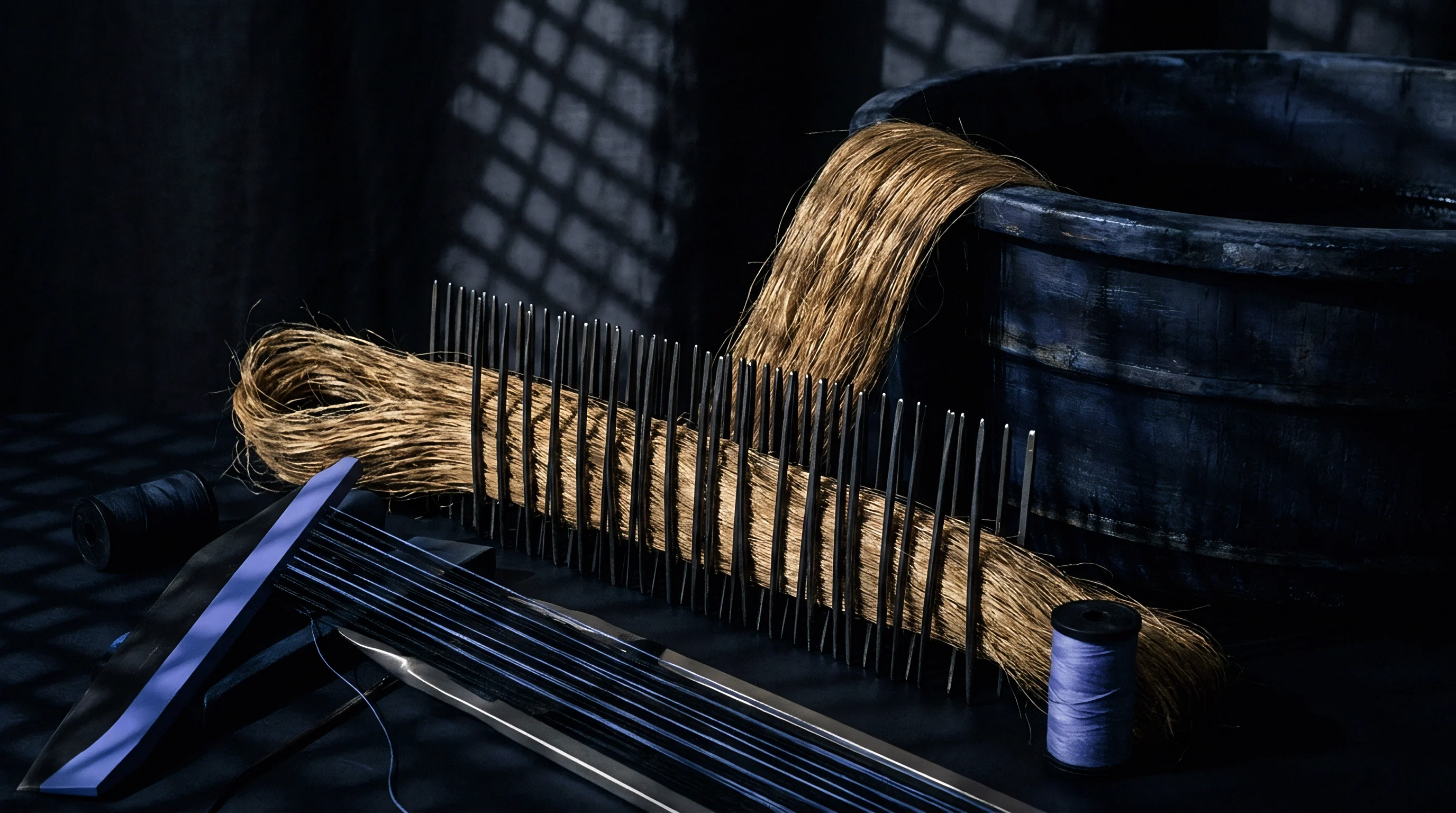
Temples hold the cloth edges out at the beat-up line, shielding outer reed dents from destructive lateral bending forces. On broadloom machinery exceeding three meters, temple selection dictates the boundary line between uniform contraction and localized necking. Standard three- to six-ring units cannot hold coarse linen.
Controlling stiff bast yarns requires full-width temple arrangements or multi-roller barrel assemblies carrying fifteen to twenty-four brass rings with high-angle steel pins.
If temples slip, outer warp ends drag violently against reed dent wires, stripping the yarn and producing the clusters of broken fibers commonly called fuzz balls or skinning. The pins must grip tenaciously without piercing or shredding the linen selvage. Because the edges are restrained while the center moves freely, contraction across the reed width follows a parabolic curve: edges stay relatively wide until clearing the front take-up roll, while the interior settles into a uniform shrinkage curve.
Localized contraction marks often stem from worn temple rings rather than environmental humidity fluctuations. Fabric that exits the loom under irregular lateral stress shows skewed picks that cannot be rectified during wet processing.


Mechanics
Crimp Redistribution across Broadloom Machinery
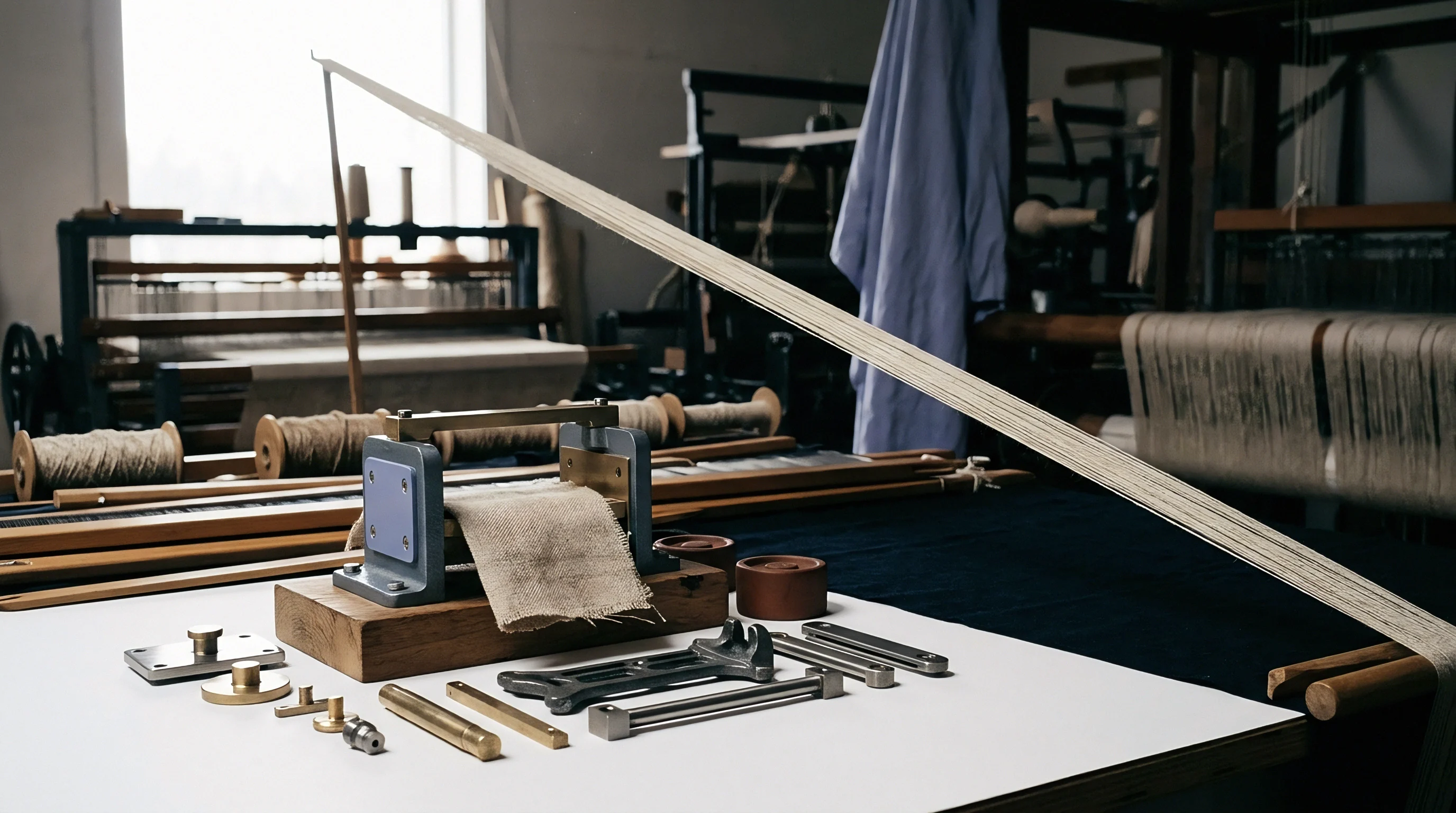
Loom kinematics directly govern the final off-loom equilibrium width of greige linen fabrics. On broadloom frames fitted with positive cam or electronic dobby motions, shed timing determines the mechanical pressure exerted on each inserted pick. Closing the shed early, where the harness cross occurs before the reed reaches the cloth fell, traps the pick under high warp tension, locking in high crimp amplitude and elevating reed contraction values.
Late shed closing allows the pick to rest loosely within an open shed during beat-up, yielding less crimp transfer and a broader off-loom width. Shed timing variations of five mechanical degrees alter broadloom fabric width by over twenty millimetres across a 320-centimetre reed spread.
Early shed closing locks high crimp into the weft, reducing off-loom width significantly.
Warp let-off and cloth take-up must operate in synchronized closed-loop tension regulation. Because flax lacks fiber elasticity, momentary let-off surges yield prominent starting marks and erratic picks-per-centimetre density. If pick density rises by two picks per centimetre above specification due to take-up slippage, contraction increases proportionally, as every extra interlacing forces additional crimp into the weft.
- Warp beam tension variance alters yarn elongation before the drop wires, changing how the cloth relaxes off the machine.
- Electronic back-rest movement absorbs peak shedding shock and preserves the uniform spacing of warp ends across the reed.
- Take-up roller grip rubber prevents micro-slippage of the slippery linen web under continuous high-tension haul-off.
- Loom shedding symmetry balances face and reverse crimp balance, preventing cloth curling at the selvages.
Weft Insertion Systems and Lateral Tension Vectors
Rapier systems hold a commanding position in broadloom linen manufacturing due to their positive control over rough, irregular bast yarns. Negative rapier systems release the yarn tip at the shed center, relying on friction to maintain tension, whereas positive rapiers hold the yarn end mechanically throughout the transfer, guaranteeing consistent pick tension from left to right selvage. Air-jet machines struggle on broadloom linen: the heavy mass, coarse fiber knots, and high surface hairiness of flax yarns cause unpredictable insertion trajectories and erratic pick tension across widths exceeding 280 centimetres.
Projectile systems remain operational in heavy flax mills, providing consistent insertion across four-metre widths, though projectile grippers require precise oiling to avoid oil-drop contamination on raw flax fibers.
Insertion velocity directly dictates yarn tension levels. Rapiers moving at 450 picks per minute pull the linen yarn from the cross-wound supply cones at speeds exceeding eighteen metres per second. Brake rings inside the weft accumulators must apply stable mechanical drag.
If accumulator braking spikes, the pick enters the shed stretched to its elastic limit, only to snap back violently when cut by the right-hand selvage knife. That snap-back draws the right selvage inward, producing asymmetrical reed contraction where the right half of the cloth contracts more severely than the left half.
Preventing this asymmetry comes down to routine accumulator brake maintenance and electronic tensiometer verifications. The physical properties of bast fibers require that mechanical variables remain tightly controlled across long runs.
Calculation

Stepwise Deterministic Model for Broadloom Linen
Setting the reed space for broadloom linen requires working backward from the required finished width through greige off-loom metrics. Two separate width losses must be built into the figure: shrinkage during wet processing and mechanical contraction off the loom. Wet finishing shrinkage includes boiling off, bleaching, and stenter setting losses, which routinely consume 4 percent to 8 percent of greige width depending on the chemical route.
To determine the necessary reed width, execute the following mathematical procedure.
- Establish the target finished width requirement, including allowances for edge trimming and seam lines.
- Divide target finished width by one minus the anticipated wet finishing width shrinkage decimal to establish minimum greige off-loom width.
- Calculate warp cover factor and weft cover factor using metric counts and thread densities to predict crimp displacement.
- Determine the empirical contraction coefficient corresponding to the total cloth cover factor and yarn count ratio.
- Divide the target greige off-loom width by one minus the reed contraction decimal to yield the exact reed space in centimeters.
- Divide the calculated reed space by the chosen reed dent count per centimetre to ascertain total active dents.
- Round active dents to the nearest whole integer and calculate total warp ends based on ends-per-dent reeding specifications.

Worked Structural Formulation
Assume an engineering specification calling for a finished linen sheeting fabric measuring 280 centimetres in usable width, with a finished weight of approximately 165 grams per square metre in a plain 1/1 weave. From standard wet-finishing trials on continuous desizing, boiling-off, and stenter lines, the transverse finishing shrinkage is established at 5.0 percent. The target greige width off the loom must therefore measure: 280 divided by (1 – 0.05), which equals 294.74 centimetres.
Round this requirement to 295.0 centimetres off-loom greige width to ensure compliance with the dimensional minimums.
The construction uses 20 Lea wet-spun flax yarn in both warp and weft. Converting 20 Lea to metric count yields: 20 multiplied by 1.693, which equals 33.86 Nm. The single yarn diameter equals 1.18 divided by the square root of 33.86, equaling 0.203 millimetres. The planned greige density off-loom is set at 16 ends per centimetre and 15 picks per centimetre.
Warp cover factor equals 16 multiplied by 0.203 multiplied by 10, giving a warp cover of 32.48 percent. Weft cover factor equals 15 multiplied by 0.203 multiplied by 10, giving 30.45 percent. The combined cover factor reaches 53.04 percent.
For a plain weave bast fabric exhibiting this cover factor, empirical mill tables mandate a reed contraction value of 7.2 percent under positive rapier weaving at 48 centinewtons warp tension.
Compute the total reed space: 295.0 centimetres divided by (1 – 0.072) equals 317.89 centimetres. Round this upward to specify an operational reed width of 318.0 centimetres. Using a reed count of 7.5 dents per centimetre with 2 ends per dent yields 15 ends per centimetre in the reed.
Multiply 318 centimetres by 15 ends per centimetre to reach 4,770 ground warp ends. Add forty catch-cord and selvage ends per side, totaling 4,850 ends drawn onto the warp beam. When the loom stops and the cloth relaxes, the 318.0 centimetres of reed width drops directly to 295.1 centimetres, satisfying the greige target.
Underestimating this contraction by just two percentage points drops the greige fabric to 288 centimetres off-loom. Finishing plants attempting to force that shortfall out on a stenter routinely split selvages during drying.
Flax
Moisture Regain and Bast Fiber Viscoelasticity
Flax possesses a unique cellular structure among industrial textile fibers. Bundles of single ultimate cells cemented together by calcium pectate and hemicellulose dictate its mechanical performance. Flax shows standard commercial moisture regain of 12.0 percent, but environmental humidity changes its internal physics dramatically.
As relative humidity rises, flax fibers absorb water into their amorphous non-crystalline cellulose regions. Water acts as a natural plasticizer within the pectin matrix, weakening hydrogen bonds between microfibrils. The fiber swells laterally by up to 20 percent while longitudinal elongation increases marginally.
This transverse swelling increases yarn diameter inside the loom shed.
| Relative Humidity (%) | Fiber Regain (%) | Tensile Strength (cN/tex) | Breaking Elongation (%) | Transverse Swelling (%) |
|---|---|---|---|---|
| 50 | 7.2 | 48.5 | 1.8 | 4.2 |
| 60 | 9.4 | 53.0 | 2.0 | 8.5 |
| 70 | 11.8 | 58.2 | 2.3 | 13.6 |
| 80 | 14.5 | 63.1 | 2.7 | 18.8 |
| 90 | 18.1 | 65.4 | 2.9 | 23.5 |
Unlike synthetic filaments or cotton, flax increases its tensile strength as it absorbs ambient moisture. This characteristic requires weaving sheds to maintain controlled ambient climates, typically 72 percent to 78 percent relative humidity at 21 to 24 degrees Celsius. The elevated humidity keeps the warp threads strong enough to withstand high beat-up pressures.
This high moisture environment causes maximum cross-sectional yarn swelling during weaving, increasing contact pressure at every crossover. When the off-loom greige cloth moves to an unconditioned storage warehouse where relative humidity drops to 50 percent, the yarns lose moisture, deswell, and contract. This environmental deswelling introduces an additional secondary contraction, shrinking fabric width by 1.0 to 1.5 percent while resting on the greige inspection table.
Relative humidity shifts in greige storage induce secondary width loss through natural fiber deswelling.
Flax run too dry lacks elasticity, shedding large volumes of lint that choke rapier guides and fill shed floor air extractors. Mills operating without tight psychrometric controls suffer wide variations in off-loom widths across seasonal transitions: summer production runs weave wider and contract differently than dry winter lots woven on identical loom settings.
Standard purchase agreements require mill certifications showing environmental tracking data across the manufacturing run to eliminate seasonal lot variation.
Finishing

Converting Off-Loom Greige to Finished Commercial Width
Greige broadloom linen fabric leaving the weave room remains unrefined, stiff, and loaded with natural pectins, waxes, sizing starches, and flax shive fragments. Boiling-off and scouring in continuous alkaline baths dissolves these non-cellulosic impurities, stripping between 8 percent and 15 percent of total greige fabric weight. As pectins dissolve, internal yarn tensions locked during the mechanical beat-up release completely.
The yarns assume their natural circular geometries, causing the cloth structure to consolidate rapidly. In an open bath, this wet relaxation drives substantial area shrinkage: warp length decreases by 6 to 10 percent, while width shrinks by 4 to 8 percent.
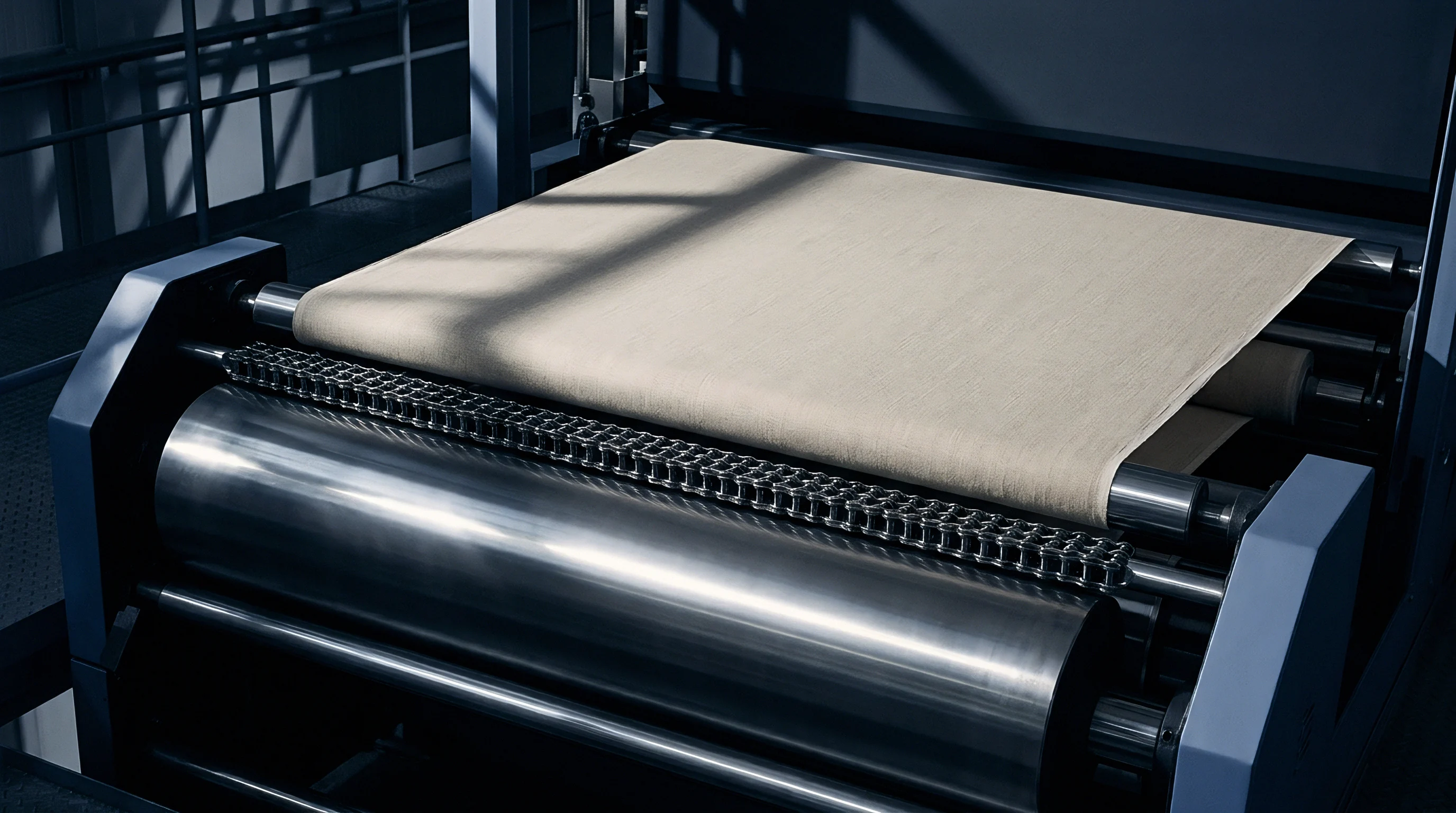
The finisher uses high-capacity stenter frames to govern final width dimensions. The stenter uses two parallel mechanical chains equipped with needle pins or spring clamps to grasp fabric selvages, pulling the wet linen outward to a fixed width while advancing through heated drying chambers. Overfeeding the fabric longitudinally allows the warp crimp to adjust while cross-stretching sets the targeted width.
Flax displays very low thermoplasticity and cannot be heat-set like polyester. Finished width retention in 100 percent linen relies entirely on hydrogen-bond rearrangement achieved through drying wet fibers under lateral tension.
- Caustic scouring concentrations degrade raw flax pectins, accelerating fiber collapse and triggering high contraction rates.
- Continuous washing line tensions pull the wet fabric lengthwise, causing mechanical neck-in that narrows greige widths.
- Stenter pin overfeed adjustments balance warp shrinkage while controlling pick angle distortions across wide spans.
- Sanforizing compressive shrinkage lines mechanically compress warp length, stabilizing width dimensions against domestic washing cycles.
If the greige off-loom width was calculated without adequate margins, the stenter operator faces an impossible trade-off. They must pull the fabric outward beyond its natural elastic yield point to meet customer width requirements. This artificial stretching ruptures individual linen fibers, weakens tear strength along the selvage line, and yields finished cloth that snaps back violently upon its first commercial laundry cycle, causing severe dimensional rejections.
High-tension stenter processing can recover lost width and lower raw material consumption, but the practice degrades cloth quality, producing stiff fabric hands and uneven pick counts that fail international retail standards.

Ledger
Capacity Economics and Metre-Cost Accounting
Loom hours represent the fundamental currency of a weaving plant. Operating broadloom machines measuring 340 to 380 centimeters wide requires capital investment three times higher than maintaining standard apparel-width frames. A 340-centimetre rapier loom running 100 percent wet-spun linen operates at lower mechanical speeds, typically 320 to 420 picks per minute, compared to narrow looms that achieve 700 picks per minute.
The broad shed requires increased harness lift heights, elevating warp strain and increasing the probability of yarn failure. Shed efficiency drops from a standard 92 percent down to 78 to 84 percent on coarse broadloom flax runs. Every hour of stopped loom time compounds fixed overhead allocations across fewer delivered linear metres.
| Metric Description | Standard Setting | Under-Reeded (Error) | Over-Reeded (Safe) |
|---|---|---|---|
| Reed Space Utilization (cm) | 318.0 | 308.0 | 324.0 |
| Running Speed (Picks/Min) | 380 | 395 | 370 |
| Shed Weaving Efficiency (%) | 82.5 | 85.0 | 80.5 |
| Warp Break Frequency (/100k picks) | 2.4 | 1.8 | 3.1 |
| Production Output (Metres/Hour) | 12.54 | 13.43 | 11.91 |
| Greige Cost per Metre (USD) | 7.85 | 7.33 | 8.26 |
| Finished Width Rejection Risk | 0.5% | 14.8% | 0.0% |
Miscalculating reed contraction directly destroys profit margins. When a plant under-reeds a loom by ten centimeters to capture higher machine speeds and lower warp end counts, the initial meter calculation shows apparent raw material and efficiency savings. If the resulting off-loom greige falls below the minimum width needed to hit contractually mandated finished parameters, the entire batch faces rejection.
Sourcing houses penalize narrow broadloom shipments heavily. Diverting a finished 280-centimetre sheeting order into 240-centimetre duvet backing stock incurs a salvage loss of 35 percent per metre, instantly wiping out production margins across the entire weaving contract.
Sourcing contracts penalize narrow widths severely because automated cutting markers offer no tolerance for dimensional loss. A mill that attempts to stretch under-reeded cloth risks catastrophic finished fabric rejection on delivery.