Calculating Jacquard Hook Capacity for Woven Repeat Widths
Repeat width equals active pattern hooks divided by warp sett, requiring precise deductions for selvedges, tie repeats, and casting out before booking loom time.
Tie
Electronic jacquard shedding mechanisms control every warp end individually across the loom width, converting digital pixel arrays into mechanical knife lifts. The pattern repeat width on the loom bed depends entirely on the mechanical harness tie, the active hook count in the jacquard head, and the warp density in the reed. Jacquard harness cords extend downwards from the machine knives through a perforated comber board, dividing the total machine hooks into repeating pattern repeats across the reed width.
In a straight tie, known industrially as a Norwich tie, each jacquard hook connects to multiple harness cords distributed at equal intervals across the loom. Hook number one lifts the first warp end of the first repeat, the first warp end of the second repeat, and the first warp end of every subsequent repeat across the total reed width. The number of repeats across the cloth width equals the total harness cord count divided by the jacquard hook capacity.
Linen yarn lacks elasticity. When harness cords drag against comber board perforations at steep angles near the loom selvedges, shed clearing fails.
A straight harness tie duplicates identical pattern widths across the cloth width without mechanical mirror reversals.
Harness Configuration Selection for Pattern Repeat Geometry
Loom builders configure the harness layout to match the intended cloth styling, repeat symmetry, and targeted finished weight.
- Straight repeat layout assigns one harness cord per repeat to every electronic hook, producing identical side-by-side pattern units across the reed width.
- Pointed harness tie threads warp ends in forward and reverse draw sequences, doubling the visual repeat width on symmetric motifs while retaining the base hook count.
- Direct single tie connects exactly one harness cord per machine hook across the total cloth width, running scenic panels without horizontal repeats.
- Mixed border harness reserves dedicated hook banks for side borders while repeating the interior field across independent comber board divisions.
Calculating the active pattern repeat width starts with dividing the usable pattern hooks by the warp sett. If a jacquard head carries 6,144 total hooks and allocates 144 hooks to drive independent selvedge motions, 6,000 hooks remain for the cloth body. At a warp density of 40 ends per centimetre in the reed, a single repeat spanning all 6,000 hooks yields a repeat width of 150 centimetres.
Splitting those 6,000 hooks across four harness repeats produces 1,500 hooks per repeat, establishing a 37.5 centimetre pattern repeat width on loom.
| Tie Architecture | Hook Bank Allocation | Cords per Hook | Visual Repeat Width Multiplier | Shed Friction Risk Index |
|---|---|---|---|---|
| Norwich Straight | 6,144 Active Hooks | 4 Repeats | 1.0 (Direct Repeat) | Low (Under 12 Degree Cord Angle) |
| London Pointed | 3,072 Active Hooks | 4 Repeats (Pointed) | 2.0 (Mirrored Axis) | Moderate (Center Symmetrical Draw) |
| Direct Full Width | 12,288 Active Hooks | 1 End per Hook | 1.0 (Full Width Panel) | High (Severe Edge Cord Deflection) |
| Border Divided | 5,120 Body / 1,024 Border | 3 Body / 2 Border | Variable Field Ratio | Moderate (Dual Density Comber) |
Selecting an incompatible harness tie forces an unbudgeted manual re-tie of thousands of harness cords, idling the loom for two weeks and generating thousands of metres of unsaleable off-register goods.

Sett
Warp density governs the physical dimension of the motif for any fixed hook allocation. When the warp count per centimetre increases, the linear width of the pattern unit contracts in exact mathematical proportion. A 2,688-hook jacquard repeat running at 24 ends per centimetre produces a 112 centimetre wide repeat on the loom.
Increasing the reed density to 48 ends per centimetre cuts that same 2,688-hook repeat down to 56 centimetres.
On-loom calculations must account for the difference between the reed width and the finished cloth width. Wet-spun linen yarns contract between 5 percent and 9 percent in width during scouring, bleaching, and drying. Crimp contraction from the interlacing weft yarns pulls the warp ends closer together.
An on-loom sett of 30 ends per centimetre compacts into 32.5 ends per centimetre in the finished state. The reed controls width.
A wet-spun linen warp at thirty ends per centimetre in the reed yields thirty-two and a half ends per centimetre after scouring and mechanical relaxation.
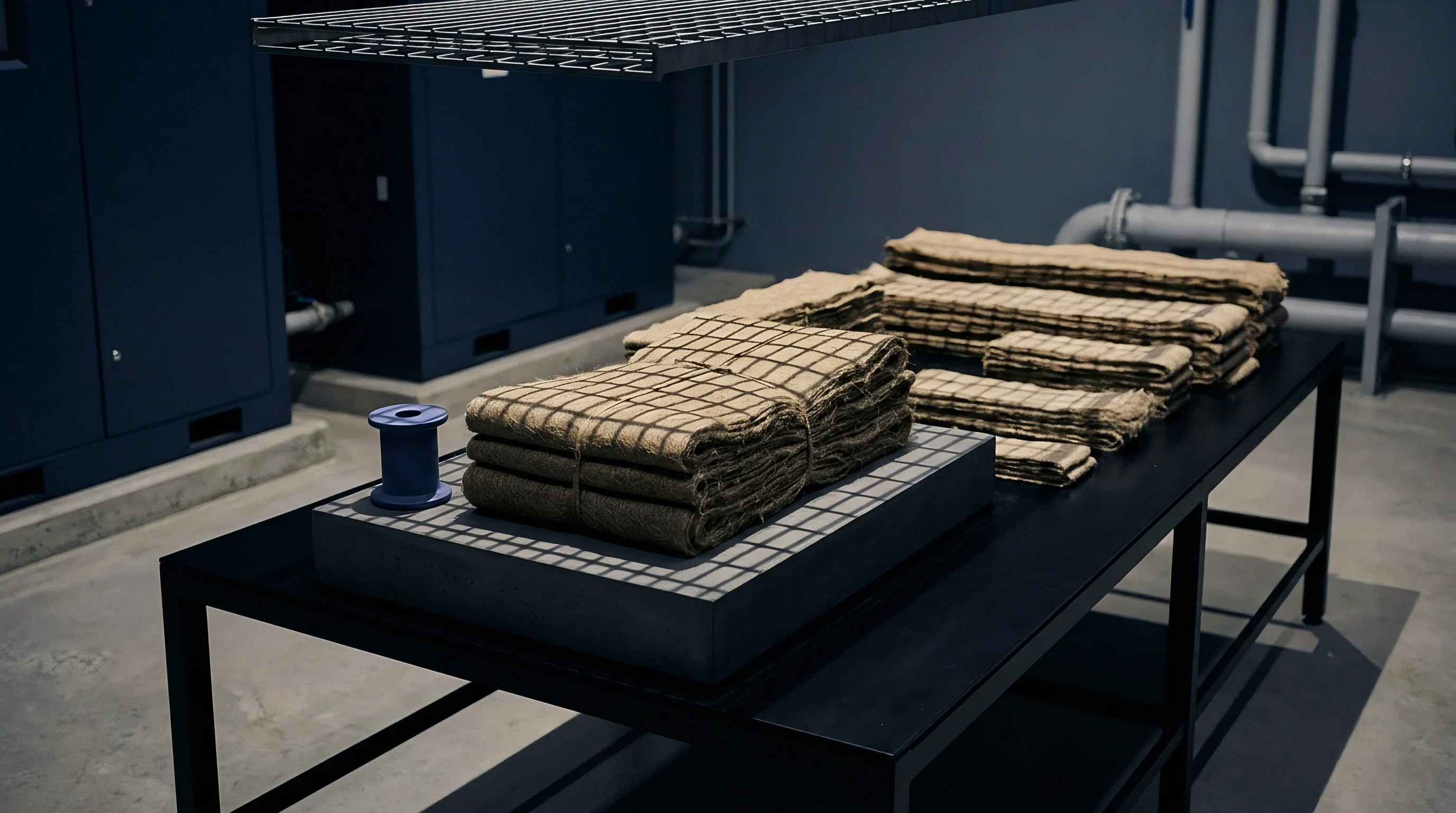
Width Calculations across Variable Flax Densities
Determining repeat dimensions across different yarn counts demands balancing the cover factor against the jacquard hook allocation. Fine 50 Nm wet-spun linen requires higher warp setts to achieve stable cloth structure, whereas coarse 10 Nm dry-spun linen operates at open densities that expand the physical repeat width per hook bank.
| Total Head Capacity | Allocated Pattern Hooks | On-Loom Warp Sett (ends/cm) | Finished Warp Sett (ends/cm) | Finished Repeat Width (cm) | Repeats on 140 cm Cloth |
|---|---|---|---|---|---|
| 1,440 Hooks | 1,344 Hooks | 20.0 | 21.8 | 61.65 | 2.27 |
| 2,688 Hooks | 2,560 Hooks | 28.0 | 30.5 | 83.93 | 1.66 |
| 3,072 Hooks | 2,880 Hooks | 36.0 | 39.2 | 73.47 | 1.90 |
| 6,144 Hooks | 5,760 Hooks | 44.0 | 47.8 | 120.50 | 1.16 |
| 11,520 Hooks | 10,800 Hooks | 52.0 | 56.5 | 191.15 | 0.73 |
Multiple-end drafting provides an alternative mechanism for adjusting weight without altering hook count. In double-end drafting, each harness cord lifts two warp ends acting in unison. A 1,440-hook machine controlling two ends per hook effectively guides 2,880 warp ends across the pattern repeat.
The structural resolution drops by half, but the cloth achieves double the warp density without demanding a larger jacquard head.
Fine yarns packed tightly shrink less in width while opening more in length during wet finishing.


Draft
Pattern structures dictate how many mechanical hooks directly form the visible motif versus auxiliary functions. Electronic jacquard heads must operate edge tucking motions, independent catch selvedges, and false twist Leno binders. Reserving 64 hooks for each selvedge on a 2,688-hook machine leaves exactly 2,560 active hooks for the cloth body.
Overlooking selvedge hook deductions forces designers to crop the artwork after card cutting.
Casting out hooks solves mismatches between available machine capacity and the targeted repeat width. When a cloth design specifies 2,400 ends per repeat on a 2,688-hook harness tie, the loom tuner casts out 288 hooks evenly across the jacquard controller. Dropped hooks run empty.
Heald wires track vertically.

Will Fine Sett Alterations Force Harness Re-Tie?
Altering the warp density beyond a ten percent margin disrupts the alignment between the comber board and the reed. If the reed sett is lowered significantly while keeping the original dense comber board layout, harness cords flare outward at extreme angles. This friction causes rapid heald cord abrasion and uneven shed heights across the pattern repeat.
Casting out creates dead zones in the harness array that require systematic management to protect mechanical components.
- Excessive cord angle deflection accelerates heald wire eyelet cutting against adjacent linen warps.
- Asymmetric knife loading distorts the level lift of the jacquard head, causing mispicks on high-speed rapier insertions.
- Comber board overcrowding generates static charges that trap flax lint inside guide perforations.
- Uneven return spring fatigue produces sluggish shed closing on cast-out rows across the pattern repeats.
Uneven harness cord angles exceeding twelve degrees from vertical accelerate eyelet friction and cause mispicks in fine linen sheds.
Mill technicians frequently claim that any hook capacity can accommodate any repeat width through digital casting out, ignoring the mechanical friction and lost loom efficiency that follow when more than fifteen percent of the harness remains idle.

Matrix
Modern electronic jacquard heads operate in modular arrays ranging from compact 1,440-hook units up to high-density installations carrying 24,576 hooks over a single loom chassis. Sizing the correct machine capacity requires matching the total cloth warp count to an integer multiple of the design hooks plus selvedge allocations. When repeat calculations result in fractional repeats across the reed width, the design will not align at the cloth borders.
Assume a project specifies a pure linen damask table runner with a finished width of 50 centimetres and a pattern repeat width of 25 centimetres. The construction uses 28 Nm wet-spun flax yarn at a finished sett of 36 ends per centimetre. The total warp ends in the cloth body equal 50 multiplied by 36, yielding 1,800 ends.
Two complete repeats across the width require 900 active ends per pattern repeat. Adding 32 selvedge ends on each side brings the total warp count to 1,864 ends. A 2,688-hook machine tied for two repeats can assign 900 hooks to each repeat, casting out 444 body hooks per repeat division.
The standard procedure for establishing jacquard hook requirements walks through seven distinct mechanical checkpoints:
- Target finished cloth width determination establishes the physical boundaries of the usable textile web inside the selvedge lines.
- Finished warp density specification fixes the ends per centimetre required to meet weight and cover requirements.
- Total body ends calculation multiplies finished width by finished warp sett.
- Linear repeat width selection defines the exact horizontal dimension of the artwork unit.
- Required hooks per repeat calculation multiplies the on-loom repeat width by the on-loom warp sett.
- Harness repetition factor resolution divides the total body ends by the ends per pattern repeat, rounding to the nearest whole integer.
- Total machine capacity verification sums active repeat hooks, cast-out allowances, and dedicated selvedge hooks against available commercial jacquard head sizes.
| Nominal Machine Size | Standard Body Hooks | Dedicated Selvedge Hooks | Max Repeats (at 30 ends/cm, 150 cm Reed) | Max Repeat Width (Single Repeat) |
|---|---|---|---|---|
| 1,440 Hooks | 1,344 Hooks | 96 Hooks | 3 Repeats (448 Hooks / 14.9 cm) | 44.8 cm |
| 2,688 Hooks | 2,560 Hooks | 128 Hooks | 2 Repeats (1,280 Hooks / 42.6 cm) | 85.3 cm |
| 6,144 Hooks | 5,952 Hooks | 192 Hooks | 4 Repeats (1,488 Hooks / 49.6 cm) | 198.4 cm |
| 11,520 Hooks | 11,264 Hooks | 256 Hooks | 2 Repeats (5,632 Hooks / 187.7 cm) | 375.4 cm |
| 24,576 Hooks | 24,000 Hooks | 576 Hooks | 1 Repeat (Full Width Panel) | 800.0 cm |
Warp tension rises rapidly. Static charges build friction. Loom speed drops.
The calculation settles capacity.
The unresolved question is how dynamic thermal expansion inside high-speed electronic solenoids shifts knife lifting clearances over continuous twenty-four-hour production runs.
Ledger
Purchasing jacquard loom capacity is an expenditure of loom hours rather than linear metres. Electronic jacquard heads operating 11,520 or 24,576 hooks carry high capital amortization rates and demand slower loom operating speeds. A rapier loom running a simple 1,440-hook jacquard operates reliably at 550 picks per minute, whereas the same loom base carrying a 12,288-hook gantry runs at 380 picks per minute to prevent excessive harness cord whip and end breaks in delicate linen warps.
Casting out excessive hooks directly inflates the landed cost per metre. If a buyer commissions a 1,600-hook pattern repeat on a loom equipped with a 3,072-hook harness tied for a single repeat, 1,472 hooks sit completely idle. The buyer pays the capital depreciation and power overhead for a 3,000-hook machine while receiving the visual output of a 1,600-hook construction.
Extra hooks demand capital. Production margins disappear.
Standard supply agreements stipulate that casting out in excess of twenty percent of total harness capacity incurs a fifteen percent surcharge on quoted loom-hour rates.
Harness re-tying charges represent a substantial upfront tooling barrier. Pulling down an existing jacquard harness, punching a new comber board, lacing thousands of individual harness cords, and leveling every heald eyelet consumes between 60 and 120 skilled labor hours. On premium wide-width linen damask looms, harness re-tie fees range from 2,500 to 6,000 dollars.
Sourcing specialists amortize this fixed preparation charge across minimum warp lengths of 3,000 to 5,000 metres to prevent initial sampling costs from overwhelming piece prices.
Lead times for jacquard capacity depend on beam allocation and seasonal order density in specialized mills. When a custom harness configuration is demanded, the shed scheduler must book an open frame for harness building weeks prior to beam mounting. Verifying the exact hook-to-sett mathematics before issuing the purchase order confirms that the desired repeat width runs on existing mill harness ties without triggering costly mechanical rebuilds.