Calculating Invoice Adjustments from Laboratory Oven Drying Mass Reports
Oven-drying reports adjust invoice totals by establishing true dry mass and applying standard 12 percent regain, preventing payment for absorbed transport water.


Tare

Invoice Mass versus Conditioned Weight Discrepancies
Commercial flax contracts settle on legal clean conditioned weight rather than dispatch scale tickets. A shipping docket for twenty metric tonnes of dew-retted scutched long line flax at 13.5 percent moisture content carries 540 kilograms of water above the standard commercial regain. Settling on gross scale weight means paying the full line price of five euros and forty cents per kilogram for that excess water.
Across multi-year supply contracts, that discrepancy erodes hackling room margins into direct inventory write-downs.
Bast fibres absorb and release moisture readily during maritime transport and storage. Their cell walls ~ crystalline cellulose microfibrils in a pectin and hemicellulose matrix ~ bind water through hydroxyl hydrogen bonds. Relative humidity shifts between 50 percent and 85 percent along shipping routes can swing container weights by over four percent without changing the amount of usable fibre.
Oven-drying test reports offer the only reliable way to adjust invoices for these ambient swings.
Commercial invoice settlements convert gross container mass to oven-dry weight before adding the contract moisture regain.
Settlement requires converting delivered weight to oven-dry weight, then adding the agreed commercial regain percentage. ISO 6741-1 defines commercial mass for textile trading, and ISO 6741-2 sets the drying protocol at 105 degrees Celsius. Once a laboratory certifies the sample dry mass, the commercial desk applies the wet-to-dry ratio across the entire consignment.
Skipping this step inflates raw material costs by hundreds of euros per metric tonne of finished yarn.
Ignoring lab drying sheets means paying for transit humidity as if it were fibre. A damp scutching or combed top lot reads heavy on the weighbridge but leaves sliver weights short during initial drawing passes. Count drift shows up at the first gill box whenever incoming dry mass falls short of the invoice weight.
Correcting the bill before processing prevents downstream accounting mismatches.
Under standard European trading rules, invoices are reduced whenever certified moisture exceeds twelve percent, while moisture levels below twelve percent allow the seller to apply a corresponding surcharge.


Regain
Standard Commercial Regains across Bast Grades
Moisture regain is the mass of water absorbed by bone-dry fibre, expressed as a percentage of its oven-dry weight. Commercial regain is a contractually fixed value agreed by trade federations to keep international pricing consistent. Moisture content differs by calculating water weight as a fraction of total wet mass.
Confusing the two introduces errors that regularly exceed one percent of a lot’s total value.
Legal regain figures vary with processing state and chemical purity. Raw dew-retted scutched flax retains lignified middle lamellae and non-cellulosic impurities, giving it a higher equilibrium regain than scoured roving or bleached sliver. ISO 6741 assigns a 12.00 percent standard regain to raw flax line and scutched tow, while wet-spun yarns, combed slivers, and chemically retted stocks carry their own specific constants.
| Fibre Classification | Processing State | Standard Regain Percentage | Non-Fibrous Allowance Percentage | Governing Standard Reference |
|---|---|---|---|---|
| Scutched Long Line Flax | Raw dew-retted unhackled stricks | 12.00 | 0.00 | ISO 6741-4 |
| Scutched Flax Tow | Unbroken coarse shive-rich byproduct | 12.00 | 0.00 | ISO 6741-4 |
| Combed Flax Top | Hackled combed sliver, oiled | 12.00 | 1.50 | ISO 6741-4 |
| Wet-Spun Flax Yarn | Boiled grey package yarn | 12.00 | 0.00 | ISO 6741-4 |
| Dry-Spun Tow Yarn | Raw coarse yarn on cones | 12.00 | 0.00 | ISO 6741-4 |
| Cottonised Flax Staple | Enzyme-degummed short blend fibre | 8.50 | 0.00 | Commercial Convention |
Processing additives also change commercial weight calculations. Combed tops are treated with lubricants and anti-static emulsions to reduce breakage during pinning. ISO 6741-4 includes an extraction allowance for these added oils, ensuring that commercial mass calculations account for dry fibre, standard regain, and allowed oil so mills do not pay raw flax rates for processing additives.
Raw scutched line flax commands a standard moisture regain of twelve percent under international trading contracts.
Applying raw flax regain rates to degummed cottonised flax distorts invoice balances. Removing amorphous hemicelluloses during degumming lowers the fibre’s moisture capacity, making cottonised staple behave more like raw cotton. Charging a 12.00 percent regain on cottonised fibre that reaches equilibrium at 8.50 percent adds three and a half percent in unpaid mass.
Handheld moisture meters use electrical resistance and mostly measure outer bale layers, leaving internal core moisture unknown until core samples are pulled for lab testing.
Chamber

Drying Protocol Mechanics and Specimen Sampling
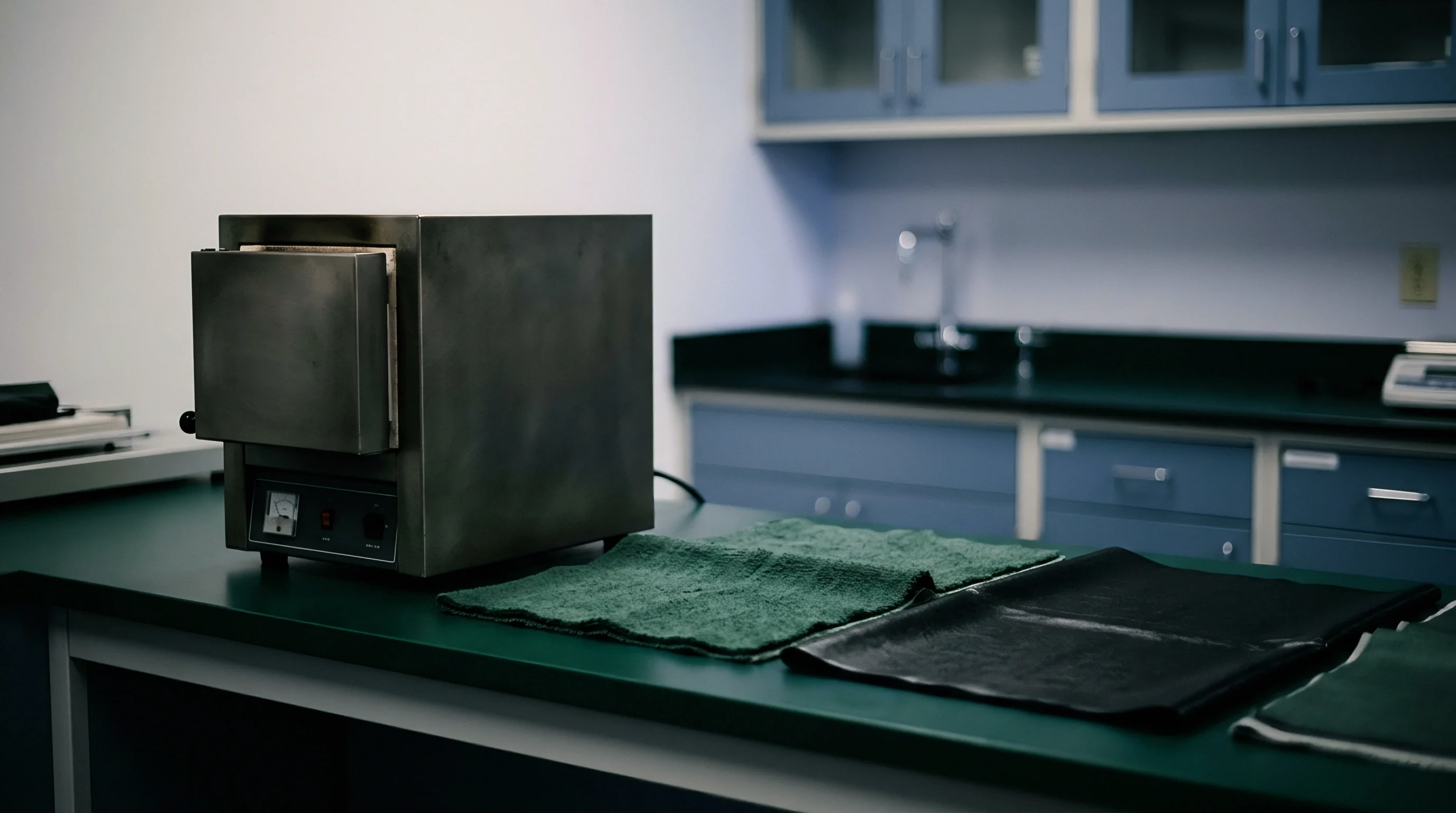
Accurate commercial mass relies on strict testing controls. ISO 6741-2 specifies ventilated ovens with forced air circulation and internal balances so samples can be weighed without leaving the heated chamber. Technicians hold samples at 105 degrees Celsius, plus or minus 2 degrees, driving off free and bound water until consecutive weighings stabilize.
Test reports list two key values: received sample mass (m) and oven-dry mass (m-zero). Constant mass is reached when weighings taken fifteen minutes apart vary by less than 0.05 percent. If oven temperatures spike past 110 degrees Celsius, volatile non-cellulosic compounds and structural polymers begin to degrade, artificially exaggerating the dry loss.
- Core sample extraction uses hollow mechanical drills driving through bale skins to harvest cylindrical cores from fifty percent of consignment packages.
- Airtight sample preservation prevents moisture exchange between the extraction dock and testing benches using hermetically sealed polyethylene containers.
- Initial weighing precision captures baseline sample weight on four-decimal balances immediately upon removal from storage vessels.
- Thermal dwell regulation maintains the desiccation chamber at 105 degrees Celsius for four hours prior to initiating comparative balance cycles.
- Desiccator jar stabilization protects hot specimens from ambient re-absorption when chamber configurations require external weighing protocols.
Proper sampling dictates whether an invoice claim holds up. Pulling handfuls from bale surfaces gives misleading results, as outer layers dry out during transit while inner cores remain damp. Technicians drill radial cores deep into the bale interior.
For a twenty-tonne shipment, ISO 1130 sampling standards require fifty core samples taken randomly across bales.
The test report records gross shipment weight, tare weight, initial sample wet weight, and final dry weight. The dry mass fraction is m-zero divided by m. When running multiple samples, the lab averages the results and retests if individual ratios differ by more than 0.3 percent.
Rigorous weighing protects both sides during settlement.
Ambient humidity absorbed through damaged container seals is sometimes treated as natural equilibrium to be absorbed without price adjustment.
Calculus
Mathematical Derivations for Mass Invoicing
Invoice adjustments isolate pure dry fibre weight before calculating legal commercial mass. Gross delivered weight is marked as M-gross and packaging tare as M-tare, leaving net weight as M-net. Lab tests provide sample wet mass (m) and sample dry mass (m-zero).
Total oven-dry mass (M-zero) is calculated by multiplying net delivered weight by the dry fraction.
The standard formula for legal clean commercial mass, designated CM, integrates the contract moisture regain R, expressed as a decimal or percentage:
CM = M-zero (1 + (R / 100))
Expressing M-zero through the laboratory specimen ratio restructures the operational calculation:
CM = (M-gross – M-tare) (m-zero / m) (1 + (R / 100))
The invoice adjustment value, designated Delta-M, represents the difference between legal commercial mass and net invoiced mass. When Delta-M is negative, the buyer issues a debit note for the missing fibre mass. When Delta-M is positive, the seller issues a supplementary invoice for delivered surplus substance.
Delta-M = CM – M-net
Consider a practical contract construction involving a 22,000-kilogram delivery of French dew-retted scutched line flax grade 3/4. The agreed purchase price stands at 5.20 euros per kilogram, FOB Antwerp, with an agreed commercial regain R of 12.00 percent. The invoice bills net delivery weight of 21,800 kilograms after deducting 200 kilograms of container pallets and baling wire tare.
The independent laboratory conditioning certificate arrives with the following bench data:
- Specimen wet mass sits at exactly 542.40 grams upon unsealing laboratory test canisters.
- Specimen dry mass reaches constant weight at 468.20 grams inside the ventilated drying chamber.
- Calculated dry mass fraction records as 0.8632, representing a dry yield ratio of 86.32 percent.
- Certified moisture content records at 13.68 percent, reflecting elevated transport humidity.
The mill calculates whole-consignment oven-dry mass:
M-zero = 21,800 kg (468.20 g / 542.40 g) = 21,800 kg 0.863199 = 18,817.74 kg
The legal commercial mass is determined by applying the 12.00 percent contract regain:
CM = 18,817.74 kg (1 + 0.12) = 21,075.87 kg
The mass adjustment is calculated by comparing commercial mass to received net mass:
Delta-M = 21,075.87 kg – 21,800.00 kg = -724.13 kg
The buyer issues a formal debit note against the original invoice value:
Financial Debit = 724.13 kg 5.20 euros/kg = 3,765.48 euros
The contract settlement adjusts the financial transaction downward by 3,765.48 euros. If the commercial desk settled against scale weights, the spinning mill would book 724.13 kilograms of non-existent dry fibre, distorting spinning yield statistics across drawing, roving, and ring spinning frames.
Ignoring oven-dry lab adjustments on high-moisture consignments distorts unit production costs by artificially inflating raw fibre mass, leading to immediate yarn cost miscalculations.

Dispute
Should Buyers Absorb Transit Moisture Shifts?
Moisture disputes are a frequent point of friction between European scutchers and Asian linen mills. Ocean transit taking four to six weeks exposes containers to high humidity, particularly through tropical lanes. If seals leak or vents clog, internal air saturates.
Shipments loaded at ten percent moisture often dock at fourteen percent without gaining any actual fibre substance.
Two conflicting positions emerge during arbitration. One view holds that fibre dispatched from European baling halls meets standard moisture tolerances, making transit exposure an unassigned transport risk. The counter position maintains that purchase contracts specify delivered conditioned weight, meaning buyers cannot absorb freight, duties, and processing losses on transit moisture.
International contract terms resolve the conflict by defining where commercial weight liability transfers.
| Actual Laboratory Moisture Content | Specimen Dry Fraction | Calculated Commercial Mass at 12 Percent Regain | Weight Adjustment Against 20,000 kg Scale Net | Financial Settlement Adjustment at 5.50 Euros per kg |
|---|---|---|---|---|
| 9.00 Percent | 0.9100 | 20,384 kg | +384 kg | +2,112.00 Euros |
| 10.71 Percent | 0.8929 | 20,000 kg | 0 kg | 0.00 Euros |
| 12.00 Percent | 0.8800 | 19,712 kg | -288 kg | -1,584.00 Euros |
| 13.50 Percent | 0.8650 | 19,376 kg | -624 kg | -3,432.00 Euros |
| 15.00 Percent | 0.8500 | 19,040 kg | -960 kg | -5,280.00 Euros |
| Calculations based on 20,000 kg net invoice mass at 5.50 euros per kg. Zero-adjustment equilibrium occurs at 10.71 percent moisture content, which corresponds to exactly 12.00 percent moisture regain. | ||||
The table shows that equilibrium occurs at 10.71 percent moisture content rather than 12.00 percent. A lot testing at 12.00 percent moisture content actually short-delivers commercial mass, generating a 1,584.00 euro debit on a twenty-tonne shipment. This happens because moisture regain measures water relative to dry mass, while moisture content measures water relative to total wet mass.
Failing to distinguish between the two leads to direct financial losses.
Contractual commercial settlements achieve parity only when laboratory moisture content equals ten point seven one percent.
When moisture exceeds fourteen percent on long voyages, structural damage compounds the financial loss. Warm, humid container conditions encourage fungal growth, activating native spores that feed on residual pectins and hemicelluloses. This degrades the cellulose, leaving brown streaks and retting odours upon opening.
Bundle tenacity can drop from thirty centinewtons per tex down to eighteen, making the fibre unsuitable for high-speed wet spinning.
Whether humidity degrades polymer chains before moisture testing takes place remains a disputed issue in maritime arbitration claims.
Audit

Reconciliation Workflows for Mill Accounts
Commercial finance departments must reconcile laboratory moisture certificates against purchase ledgers before releasing final supplier payments. The settlement workflow follows five distinct steps, moving from arrival through testing to ledger adjustment. Skipping any step risks paying for non-existent material.
- Container gross mass verification on certified weighbridges immediately upon entry to the mill terminal.
- Core sampling executed by certified independent technicians within twenty-four hours of container destuffing.
- Specimen desiccation under ISO 6741-2 thermal controls to isolate constant dry matter fractions.
- Commercial mass recalculation using contract moisture regain values and non-fibrous extraction deductions.
- Transmission of audited adjustment sheets and commercial debit notes prior to letter of credit maturity.
Letters of credit for imported bast fibres should specify independent commercial mass certificates as required payout documents. When contracts allow payment against simple bill of lading weights, buyers lose financial protection. Requiring certified commercial mass documentation ensures banking channels process calculations automatically before funds clear.
Accounting must reconcile final commercial mass with spinning floor intake records. If a mill receives 20,000 kilograms of physical bales but lab testing establishes a commercial mass of 19,200 kilograms, the actual cost per kilogram of raw material entering processing rises. That change directly impacts unit production costs per hundred metres of finished woven linen.
The final yarn cost per metre reflects the landed commercial mass of the lot, accounting for every decimal adjustment surfaced by the desiccation ovens.