Reconciling Mill Hackling Yield Discrepancies and Tow Co-Product Allocations inside Mass Balance Dossiers
Reconciling hackling yield requires continuous mass balance records matching physical sliver, tow, and extraction waste to incoming scutched flax lot certificates.


Comb
Mechanical hackling separates scutched flax line fibre from hackled tow, combing out cortical debris, shive, and short tangled fragments. The process runs across graduated pin beds with steel needles mounted on moving leather or rubber sheets. Input fibre arrives with varying moisture levels, uneven pectin breakdown from field retting, and irregular root-to-tip alignment.
Combing yields two distinct products: dressed line sliver destined for wet spinning rings, and hackled tow diverted into dry spinning, carded blends, non-woven insulation, or paper.
Discrepancies in hackling mass balance surface when physical yields diverge from the figures recorded in chain-of-custody files. European Flax scheme rules governed by the Alliance for European Flax-Linen and Hemp specify certified chain of custody criteria through transaction certificates and inventory accounting. When a spinner or combing mill processes scutched long flax into hackled sliver, mass conversion is never unity.
Material is lost to moisture evaporation, dust extraction, and dropped shive, while tow absorbs the secondary fraction. If a mill receives 10,000 kilograms of certified scutched scutched scutched scutched flax under an incoming transaction certificate, it cannot output 10,000 kilograms of dressed line.
Under standard conditioning at sixty-five percent relative humidity and twenty degrees Celsius, commercial moisture regain for scutched flax fibre settles at twelve percent.
Auditors reviewing mass balance records check whether the physical ratio between hackled line sliver and hackled tow stays within mechanical tolerances. Normal hackling yields fifty-five to sixty-five percent dressed long line fibre, while hackled tow accounts for thirty to thirty-five percent of the incoming gross mass. The remaining five to eight percent is processing waste: dust, sub-spinnable fibrils, and unseparated shive cast out below the combs.
A ledger claiming a seventy-five percent long line yield from typical Western European dew-retted or water-retted straw points to distorted accounting. Any buyer accepting that figure on paper takes on direct verification risk.
The distortion grows when mills allocate co-products by monetary value instead of physical mass. Under certified chain-of-custody protocols, mass balance requires strict mass conservation. If lower-value hackled tow moves out of the run with certified status, that volume cannot stay credited to the long line sliver ledger.
Chinese processing mills importing French or Belgian scutched flax frequently record divergent ratios on internal workshop sheets compared to outward transaction declarations. In practice, the mill’s raw hackling logs show the true fractionation before yarn spinning commences.

Pin
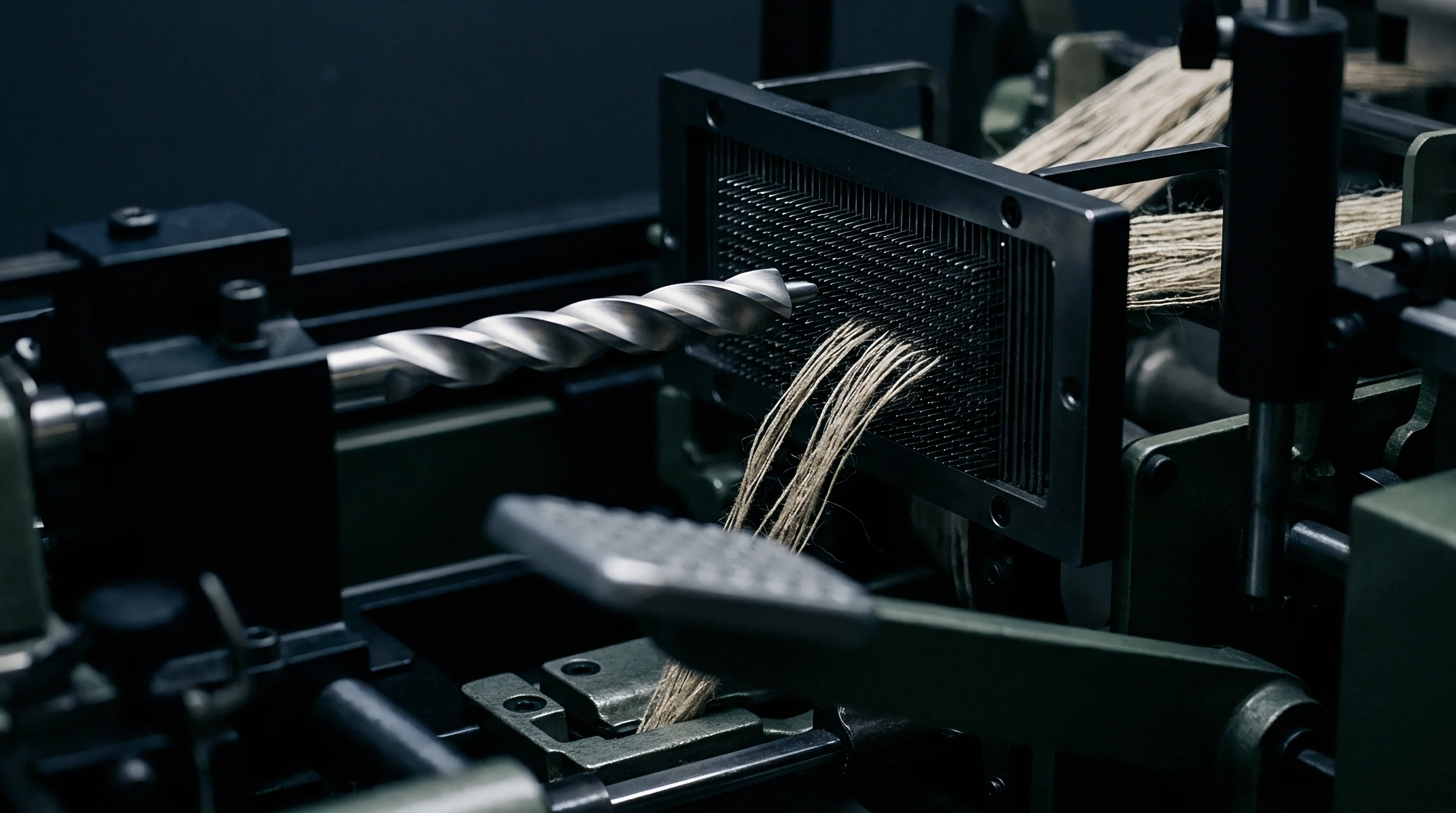
Hackler pin fields establish the boundary between line and tow fractions. Intersecting gill bars carry mechanical pins that penetrate flax stricks clamped in traveling carriage channels. Coarse pins open the bundle during early passes, while fine pins split composite bundles down to individual technical fibres in the final cycles.
Pin density, penetration depth, and carriage descent speed directly control the balance of line sliver to hackled tow.
Heavier pin setups accelerate the breakdown of median bundles into tow fragments. Raising pin density from two pins per centimeter to six pins per centimeter on finishing heads strips more short fibers out of the strick center. That expands tow volume with cleaner, spinnable fiber suitable for high-count tow yarns.
Conversely, lighter pinning preserves gross line weight but leaves more shive in the sliver. The mill balances downstream yarn break rates against combing extraction volumes.
| Process Stage | Pin Density Range | Operating Mass Allocation | Moisture Regain Window | Primary Byproduct Type |
|---|---|---|---|---|
| Initial Head Opening | 0.8 to 1.5 pins/cm | 10% to 14% gross mass | 10.5% to 12.0% dry basis | Coarse root tow, shive |
| Intermediate Combing | 2.0 to 4.5 pins/cm | 12% to 16% gross mass | 11.0% to 12.5% dry basis | Medium hackled tow |
| Finishing Splitting | 5.0 to 9.0 pins/cm | 6% to 9% gross mass | 11.5% to 13.0% dry basis | Fine hackled tow, noils |
| Terminal Line Take-off | Continuous sliver belt | 55% to 65% net mass | 11.8% to 12.2% dry basis | Aspirator micro-dust |
Moisture levels in the hackling hall directly affect needle performance. Flax bundles with moisture regain below nine percent turn brittle and fracture prematurely under pin impact, driving transverse fiber rupture. The broken fragments fall into waste boxes below, raising the hackled tow share and cutting long line yields by up to eight percentage points.
Plants operating without strict relative humidity controls see these yields drift between day and night shifts.
Weighbridge tickets show incoming bale weight, but floor scales record the actual split at the delivery table. When the combined weight of hackled sliver cans and baled tow misses the tare-adjusted intake weight by more than two percent, fiber has gone unaccounted for. That gap indicates systemic inventory inflation in the certified mass balance records.
Where combing losses are attributed to unseasonal atmospheric dryness degrading strick cohesion and dropping fiber into collection chambers, inventory reconciliation treats the gap as unaccounted diversion.


Shift

Allocating Certified Volumes between Parallel Streams
Downstream allocation divides the pedigree of incoming fiber across distinct supply chains. Hackled line sliver sells at a premium, supplying fine wet-spun yarns from Ne 26 to Ne 60 counts destined for luxury apparel and sheetings. Hackled tow sits in a lower pricing tier, fed into carding and dry-spinning frames for heavier Ne 6 to Ne 14 counts.
The economic incentive is to assign all certified credentials from the raw flax to the high-value line sliver while treating the tow fraction as conventional waste.
Mass balance standards under ISO 14021 and certified chain-of-custody rules prohibit one-sided volume shifts. Every derived fraction must reflect its physical or proportional share in the mass ledger. Processing ten metric tons of European Flax scutched long fiber yields roughly six tons of line sliver, 3.3 tons of tow, and 700 kilograms of non-recoverable dust and shive.
Entering nine tons of certified line sliver in a spinning ledger from that single certificate is fraudulent.
- Transaction verification matches certified scutched flax intake weights directly against incoming customs entry dockets, single administrative documents, and issuing certifier lot identifiers.
- Hackler run segregation establishes batch production borders, locking raw bale lot numbers to dedicated combing lines with scheduled scale checks before and after machine runs.
- Co-product classification categorizes secondary outputs by fiber length and purity, assigning discrete internal stock-keeping units to root tow, median tow, and terminal comb collections.
- Ledger balance reconciliation subtracts documented processing tare, volatile regain shifts, and unrecoverable fly dust from total inputs before releasing downstream certificate allotments.
Tracking origin credits across multi-product mills requires strict documentation. Running certified Western European flax alongside uncertified East European or Egyptian scutched fiber introduces immediate contamination risks. Warehouse sorting protocols determine whether lots remain physically segregated or whether the plant relies solely on administrative bookkeeping credits.
Scheme rules disqualify mass balance dossiers when output allocations exceed physical recovery ceilings verified by third-party mill engineering benchmarks.
Failing to track tow co-products leaves unmonitored certified volume in the plant. Unscrupulous operators exploit this by selling the tow twice: once as certified tow under parallel declarations, and again by rolling its unused certified mass credits back into line sliver balances. That generates phantom certified yarn capacity without buying corresponding volumes of certified scutched straw.
Auditors unmask this pattern by comparing input and output ratios across the mill’s entire spinning ledger.
Discrepancies grow when the secondary stream undergoes chemical refining or cottonization. Once cleaned tow is blended with lyocell, cotton, or recycled polyester, physical traceability ends. The mass balance file remains the sole instrument preventing duplicate liquidation of green premiums across divergent product departments.

Flaw

Physical Audit Points on the Factory Floor
Auditing a spinning facility requires matching physical material movements against ledger entries. In the laydown area, inspectors verify bale tags and batch staging. Scutched bundles must retain scutching mill labels matching commercial invoices and scope certificates.
Discrepancies emerge when bale ties carry handwritten tags replacing original mill markings, pointing to batch re-sorting or uncertified lot substitution.
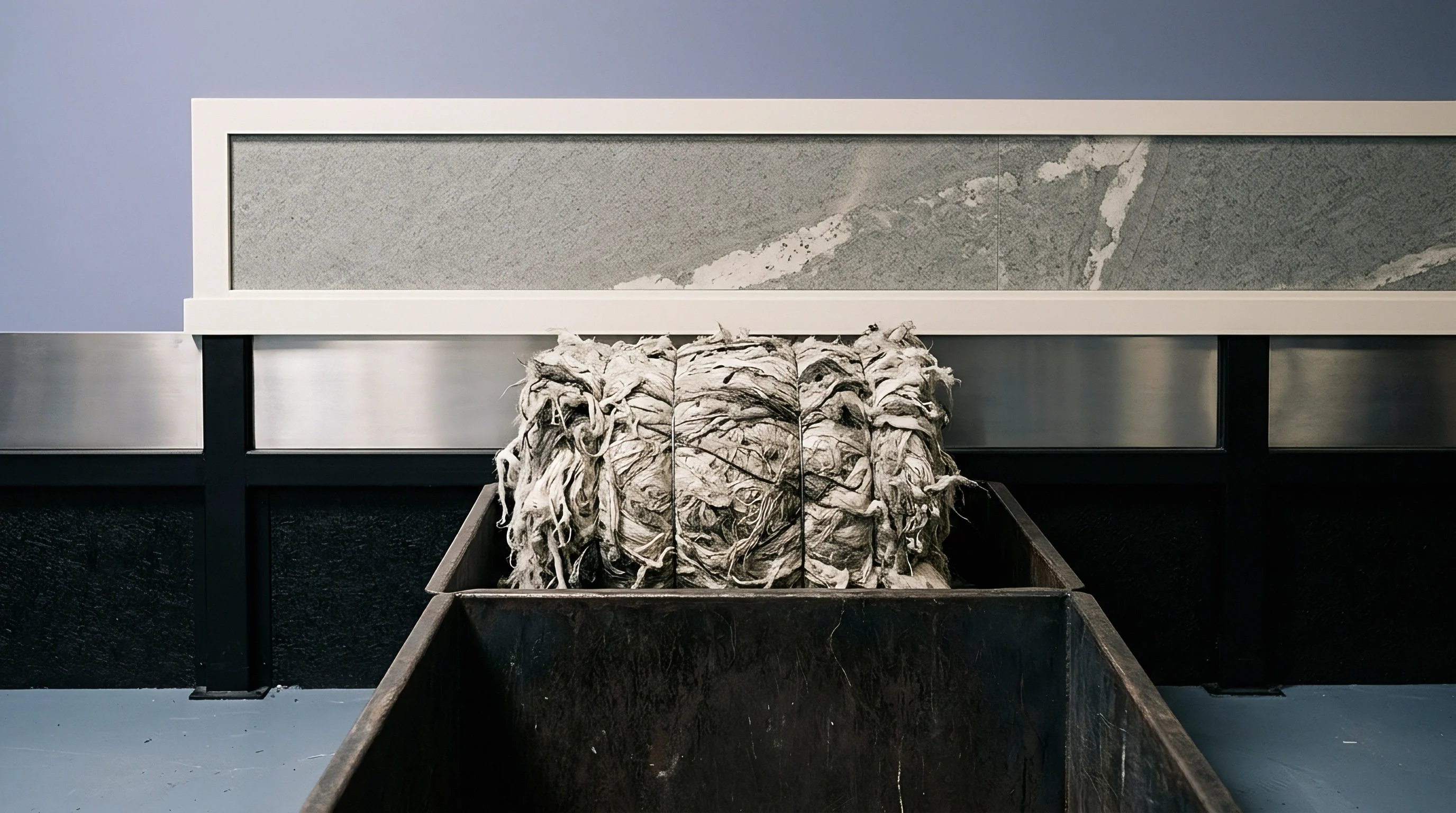
The collection boxes beneath hackling combs supply vital evidence during an unannounced inspection. Shive content, fiber length distributions, and dust compaction rates indicate actual processing parameters. If the mill ledger declares a nominal five percent processing waste, but extraction bins under the needles are emptied four times per shift without being weighed, the scrap share is intentionally understated.
Underreporting waste artificially elevates the declared yield of marketable fiber.
The calculation framework for mass balance verification rests on conservative mass conservation equations. Consider a standard industrial production run processing forty metric tons of dew-retted French flax:
- Gross input raw fiber weighs 40,000 kilograms with an initial recorded moisture content of 13.2 percent across 400 pressed bales.
- Hackled line sliver output accounts for 23,600 kilograms of coiled sliver delivered into numbered pressing cans at 11.8 percent moisture regain.
- Secondary hackled tow output yields 12,800 kilograms of baled comb waste collected across coarse, medium, and fine filtration points.
- Recorded operational dust and shive accounts for 2,100 kilograms extracted through pneumatic vacuum ducting into external cyclone bins.
- Unaccounted process loss amounts to 1,500 kilograms, representing volatile moisture dry-out during room circulation and uncollected floor drop.
The resulting mass balance reconciliation formula evaluates whether the recovery falls within established operational bounds:
Reconciliation Recovery = (Line Sliver Weight + Tow Weight + Measured Waste) / Gross Input Weight
Applying the production figures: (23,600 kg + 12,800 kg + 2,100 kg) / 40,000 kg = 38,500 kg / 40,000 kg = 0.9625, or 96.25 percent recovery. The missing 3.75 percent represents environmental moisture loss and diffuse fibril emissions. If the mill attempts to allocate 100 percent of the original 40,000 kilograms to commercial products without deducting this 1,500-kilogram operational disappearance, the mass balance file contains illegitimate volume allocations.
Inspectors review calibration records for platform scales at the hackler exit table. Calibration stickers on platform scales must show current dates from accredited metrology bodies. Weighing drift of two percent on a high-throughput line compounds into tens of metric tons of phantom inventory over a quarterly accounting cycle.

Toll
How Do Discrepancies Alter Landed Fabric Cost?
Yield variations directly distort fabric cost calculations and origin compliance liabilities. Long line flax carries an input raw material price ranging between 4.50 and 6.00 euros per kilogram for high-grade French or Belgian scutched fiber. When hackling conversions drop from an assumed sixty-two percent to a realized fifty-four percent, the net raw material cost per kilogram of spun yarn climbs steeply.
The price difference between certified hackled line sliver and uncertified tow creates arbitrage avenues. Certified line yarn sells at a surcharge of 1.20 to 2.20 euros per kilogram over uncertified counterparts in global markets. When a mill offsets internal combing yield losses by shifting uncertified long flax into certified processing streams, the customer pays the certification premium for unverified fiber.
The financial hazard shifts down the supply chain to the brand placing the finished textile on consumer markets.
| Model Metric | Baseline Operation | Suppressed Line Yield | Aggressive Line Yield |
|---|---|---|---|
| Scutched Flax Input Cost | 5.20 EUR/kg | 5.20 EUR/kg | 5.20 EUR/kg |
| Hackling Line Yield | 62.0% | 54.0% | 68.0% |
| Tow Byproduct Credit | 0.80 EUR/kg (at 30%) | 1.01 EUR/kg (at 38%) | 0.64 EUR/kg (at 24%) |
| Net Raw Cost per kg Sliver | 7.10 EUR/kg | 7.76 EUR/kg | 6.71 EUR/kg |
| Cost Spread vs Baseline | 0.00 EUR/kg | +0.66 EUR/kg | -0.39 EUR/kg |
Downstream tariff classifications under Harmonized System rules add customs exposure to yield fraud. Under Chapter 53 of the Harmonized Tariff Schedule, flax processing stages dictate non-preferential origin criteria. Scutched flax enters under HS heading 5301.21, while hackled flax line sliver imports under HS heading 5301.29.
Tow and flax waste fall under HS heading 5301.30. Fabricating yields to disguise raw material origin triggers tariff evasion penalties when customs authorities audit consignment declarations against production plant capacity records.
A contract clause stating that supplier production waste figures must not exceed verified mill engineering baselines protects buyers from synthetic volume inflation.
Testing laboratories cannot differentiate certified Western European flax from uncertified Russian, Belarusian, or Chinese domestic flax via standard chemical assays. Stable isotope ratio mass spectrometry can narrow geographical provenance, yet natural environmental variability limits fine-scale discrimination. Traceability rests entirely on documentary reconciliation.
When mass balance records fail an audit, the textile importer faces regulatory seizure under regional trade compliance laws enforcing provenance declarations.
The financial toll lands when retail garments face customs detention or forced consumer recalls. If customs enforcement teams flag discrepancy margins exceeding five percent between import declarations and mill processing capacities, preferential origin status collapses. The importer must then pay retroactive customs duties alongside administrative penalties.
A flawed combing ledger converts an assumed trade asset into an uninsurable customs liability.

Mesh
Industrial integration binds the spinner, the weaver, and the compliance officer into an unbroken operational link. Chain of custody documentation fails when treated as a retroactive reporting exercise rather than a daily shop-floor procedure. Reconciling mill hackling yield discrepancies requires setting standard operating procedures before unbaling a single ton of scutched fiber.
Precise mass tracking preserves origin integrity across borders.
Buyers protecting supply chain provenance install verification protocols directly into purchase contracts. These terms specify physical mass reconciliations across every manufacturing transformation. Requiring batch-level hackling logbooks alongside standard transaction certificates stops volume manipulation before yarn spins.
Mills that provide granular weighbridge receipts, comb tare calibrations, and waste cyclone dump records establish defensible audit profiles that withstand trade scrutiny.