Flax Fibre Yield Audit Protocols in Wet Spinning
Verify certified flax wet spinning yields by measuring dry mass balances across hackling, autoclave scouring, and trough flumes to catch volume inflation.

Intake
Scutched long flax reaches spinning mills in tied stricks packed inside compressed bales that carry gross dispatch weights and shipping marks. Receiving docks check that physical tally against the transport bill of lading and producer dispatch notes. Bales arrive with uneven moisture absorbed during retting in European fields, scutching, and container transit.
Under trading rules established by the Confédération Européenne du Lin et du Chanvre, now the Alliance for European Flax-Linen and Hemp, the official moisture regain of flax fibre is set at 12.0 percent of dry mass. When raw bales arrive at 14.5 percent moisture, water weight inflates the delivered gross scale reading, requiring auditors to establish dry matter content as soon as the steel banding wires are severed.
Traceability breaks down at the warehouse threshold if bale tags detach in transit and dock crews stack bales before cross-checking individual lot numbers against European Flax transaction certificates. Each transaction certificate specifies the certified farming cooperative, the scutching facility, the net kilogram mass, and the delivery lot sequence. When a Chinese wet spinning mill receives forty metric tons of scutched line flax, every bale tag must match the electronic delivery docket.
Mill personnel core-sample twenty random bales per delivery container, testing for residual shive content, average strick length, and actual water regain under ISO 6741-1 oven-drying procedures.
Under European Flax chain of custody regulations, uncertified line flax processed through shared hackling gills forfeits the right to carry transaction certificates.
Discrepancies across Scutched Bale Moisture
Commercial invoices record dispatch weights adjusted to standard moisture allowances. Certified invoice mass equals the absolute dry weight of the sampled flax multiplied by 1.12. If incoming bales show an actual moisture content of 9.5 percent after storage in dry conditions, the physical gross weight drops below the invoice face value without any loss of dry fibre substance.
Lots carrying container condensation artificially elevate the scale weight instead. Auditors verify weighbridge calibration certificates and check moisture meter calibration logs once a month.
Inbound inspection records reveal documentation vulnerabilities that void certified lineage before processing begins:
- Uncertified lot co-mingling occurs when warehouse forklift drivers place non-certified Russian or domestic Chinese scutched flax on the same floor grid as certified French line flax.
- Missing scutching lot codes on bale wraps prevent cross-referencing against the Alliance database, forcing third-party auditors to downgrade the material to conventional status.
- Gross weight variances exceeding 1.5 percent between shipping papers and mill weighbridge receipts indicate unrecorded sample removal or moisture migration.
- Water damage rotting inside bale cores degrades lignin bonds prematurely, producing excessive micro-dust and fiber breakage during initial handling.

Segregation Controls in Mill Warehousing
Physical separation of certified European Flax inventory prevents contamination with uncertified domestic stocks. Segregated floor pens demarcated with high-visibility floor paint hold identified lots. Auditors examine the physical bin cards alongside the digital Enterprise Resource Planning ledger.
Comb
Hackling machines separate disordered, short fibres from parallel long flax bundles using graduating pinned gill pins. Stricks of scutched flax hang from travelling clamps that present the root end, then the tip, to revolving sheets of fine steel needles that extract short tow, strip residual woody core shives, align the long fibres into a parallel ribbon, and divide coarse strands into finer filaments. The long line flax emerging from the delivery end forms a continuous hackled sliver on the spreadboard.
Unsorted hackling tow diverted to open-end rotors carries far less commercial value than the line roving sent to the wet spinning troughs.
A standard long flax consignment at 12.0 percent commercial regain yields between 44 and 52 percent hackled line fibre across automated gill pins.
Dew-retted European flax yields between 44 and 52 percent hackled line sliver under ambient conditions maintained at 20 degrees Celsius and 65 percent relative humidity. The remaining mass splits into hackling tow, coarse root ends, shive trash, and fly waste. Dry air in the hackling hall embrittles the fibre, shaving three to five percentage points off line yield and increasing low-value tow.
Auditors match the total mass of scutched flax fed into the hackling line against the cumulative weight of hackled sliver cans, tow rolls, and dust extraction bins.

What Yield Loss Occurs during Hackling?
Mechanized hackling yields long line fibre alongside short hackling tow. Hackling tow represents the largest mass diversion, claiming 38 to 44 percent of the raw scutched input. Coarse shive dust and broken woody particles vacuumed through cyclone filters account for 4 to 8 percent.
Unrecoverable micro-dust settled on machine frames constitutes another 1.0 to 1.5 percent. Dew-retting inconsistency directly shifts this split. Under-retted straw resists splitting, creating high pin resistance that breaks valuable long strands into tow.
Over-retted straw suffers from microbial degradation of the cellulose walls, causing line flax to fracture into waste dust.
| Processing Stage | Output Stream | Nominal Mass Fraction (%) | Permissible Variance Band (%) | Fibre Classification |
|---|---|---|---|---|
| Hackling | Hackled Line Sliver | 48.5 | 44.0 to 52.0 | Long Line Fibre |
| Hackling | Machine Hackling Tow | 41.0 | 38.0 to 44.0 | Short Staple Tow |
| Hackling | Shive Trash and Cyclone Dust | 6.5 | 4.5 to 8.5 | Solid Waste |
| Hackling | Moisture Loss / Fly Waste | 4.0 | 2.5 to 5.5 | Evaporative / Unrecoverable |
| Spreadboard Drawing | Drawn Line Sliver | 96.5 | 95.0 to 98.0 | Intermediate Sliver |
| Spreadboard Drawing | Roller Lap and Sliver Waste | 2.0 | 1.0 to 3.0 | Reworkable Waste |
| Spreadboard Drawing | Suction Pneumafil | 1.5 | 0.8 to 2.2 | Non-Reworkable Waste |
Following mechanical hackling, the spreadboard converts overlapping stricks into a unified sliver. Subsequent drawing frames double and draft multiple slivers to improve longitudinal count uniformity. Across three to four drawing passages, faller bars fitted with dense needle rows govern inter-fibre slippage.
Drafting waste stays below 3.5 percent when draft ratios are matched to average fibre staple length.
Auditors execute a five-step physical yield audit across the comb room floor:
- Tare all empty sliver cans, tow collection bins, and cyclone waste bags using a mobile calibrated floor scale.
- Weigh the designated batch of scutched flax bales and verify moisture percentage using an oven-dry baseline instrument.
- Lock the machine input feed and monitor the full hackling run until the feed table runs completely dry.
- Weigh every filled sliver can, tow package, shive bin, and dust filter collector immediately upon batch termination.
- Calculate mass reconciliation by subtracting total recovered mass from initial bale weight to isolate moisture shifts.
Auditors regularly discover unaccounted line sliver weight increases caused by unregulated steam humidifiers positioned directly above delivery rollers. The moisture level rises, hiding mechanical fiber loss behind added water weight. Whether this yield inflation stems from uncalibrated humidity controls or intentional yield manipulation remains an open operational question.

Rove
Drawing slivers pass through flyer frames to receive a low protective twist before being wound onto perforated bobbins. This roving carries just enough tensile strength to hold together through wet processing. Roving bobbins then move to chemical boil houses or pressurized autoclaves, where scouring in caustic soda strips natural waxes and loosens pectinous intercellular matter, softening the middle lamella that bonds technical fibre bundles into composite strands.
Boiling rove in dilute sodium hydroxide, soda ash, and surfactant solutions dissolves hemicelluloses, pectins, and natural flax fats. Weight loss during roving treatment runs between 6.5 and 10.5 percent on a dry mass basis. Mill technicians adjust liquor strength according to target yarn counts.
Coarse yarns intended for upholstery retain more pectin to withstand mechanical abrasion, whereas fine warp yarns for luxury apparel undergo intensive boiling to let individual fibrils divide cleanly during ring drafting.
Mass Loss during Chemical Pretreatment
Scouring chemistry alters the yield ledger permanently. Untreated flax roving contains roughly 75 to 80 percent cellulose, 12 to 15 percent hemicellulose and pectins, 3 to 4 percent lignin, and 2 percent waxes. Boiling roves at 95 degrees Celsius removes soluble sugars and waxes, leaving behind purified cellulose.
The audit protocol measures rove weight before and after chemical treatment, adjusting both values to zero percent moisture.
| Pretreatment Chemistry | Bath Temperature (Celsius) | Duration (Minutes) | Dry Weight Loss (%) | Residual Pectin Content (%) |
|---|---|---|---|---|
| Hot Water Only (Mild) | 85 | 60 | 2.8 | 8.4 |
| Soda Ash 3 g/L | 95 | 90 | 6.2 | 4.1 |
| Caustic Soda 4 g/L | 95 | 120 | 9.8 | 1.8 |
| Caustic Soda 8 g/L (Bleach Prep) | 100 | 150 | 12.4 | 0.9 |
| Pretreatment liquor ratio fixed at 1:10; all mass losses calculated on an absolute dry basis against unboiled rove. | ||||
Why Do Mass Balances Diverge Post Wetting?
Leached non-cellulosic solids stay suspended in treatment baths, evading standard catch-box measurements. When spinning mills compute yield simply by weighing rove bobbins before and after boiling, they frequently miscalculate yarn recovery. Wet bobbins hold up to 140 percent water relative to dry fiber mass.
Unless the mill runs complete oven drying cycles on test bobbins, moisture fluctuations obscure true yield losses.
Worked Mass Balance for Line Flax
A representative audit case illustrates the yield trail across an entire processing lot. Take a certified delivery lot of 10,000 kilograms of scutched European line flax entering a wet spinning facility at an audited moisture content of 12.0 percent. The absolute dry matter equals 8,928.6 kilograms.
Hackling produces 4,850 kilograms of hackled line sliver at standard regain, 4,100 kilograms of tow, 650 kilograms of shive waste, and 400 kilograms of evaporative loss. The mechanical line yield registers at 48.50 percent.
The 4,850 kilograms of line sliver enter the drawing and roving frames. Drawing and roving generation yields 4,680 kilograms of finished roving, generating 97 kilograms of reworkable sliver waste and 73 kilograms of non-reworkable fly waste. The roving yield stands at 96.49 percent relative to hackled sliver input.
The cumulative yield from scutched bale to roving reaches 46.80 percent.
These 4,680 kilograms of roving undergo alkaline autoclave boiling. Chemical extraction dissolves 8.20 percent of dry substance. The dry fibre mass drops from 4,178.6 kilograms to 3,835.9 kilograms.
Expressed at standard 12.0 percent regain, the post-boil roving yield equals 4,296.2 kilograms. The cumulative line yield at the autoclave exit drops to 42.96 percent of the original raw bale delivery. Dry fiber mass balances remain unchanged regardless of how wet bobbins become during processing.

Basin
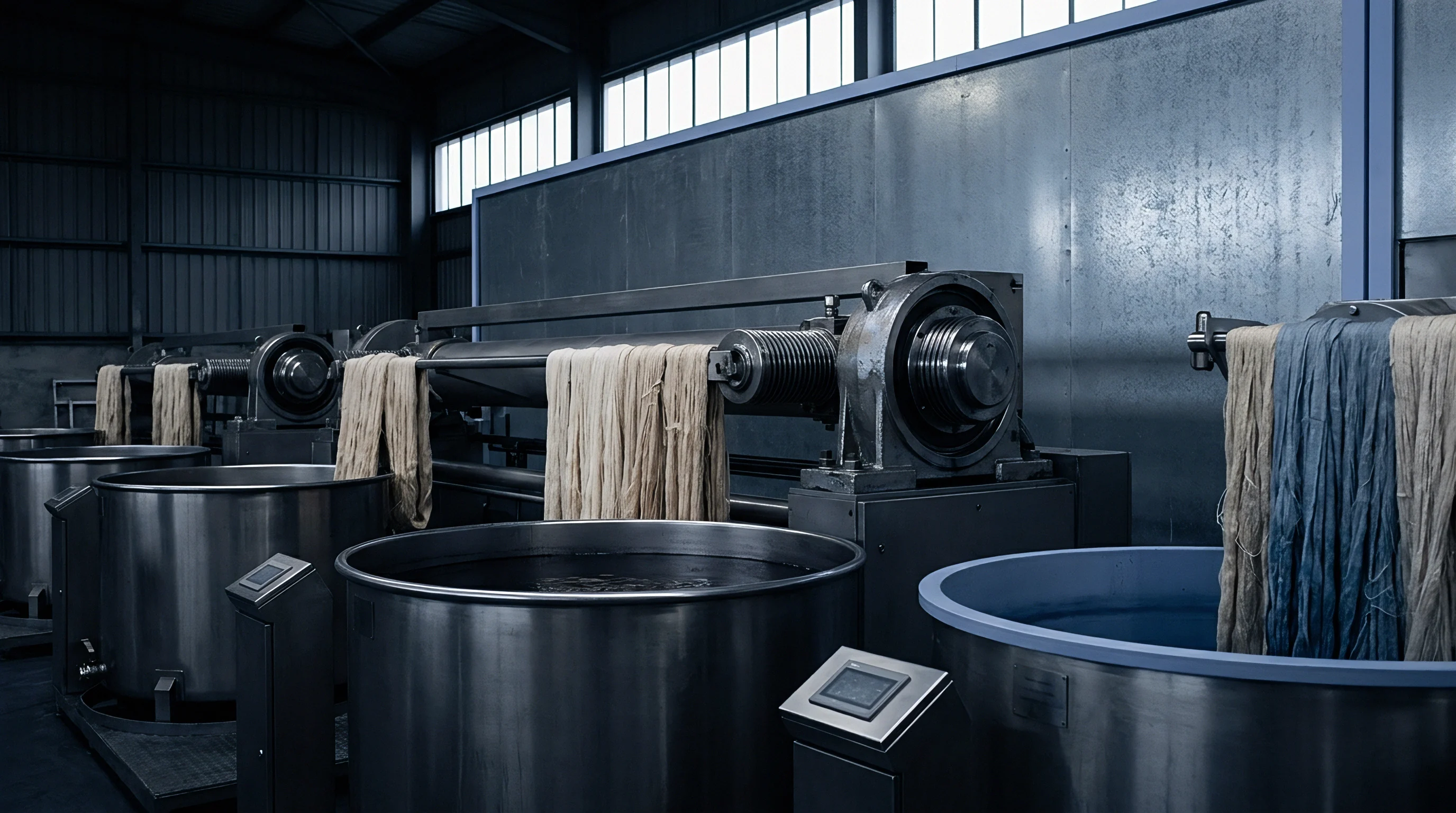
Trough immersion softens the inter-cellular pectins binding elementary flax fibrils immediately prior to drafting on the spinning frame. Wet spinning ring frames feed boiled roving through a stainless-steel water trough heated between 50 and 70 degrees Celsius. Hot water softens remaining gums, allowing fibrils to slide past one another under the drafting rollers.
High draft ratios draw the rove down to fine yarn counts like English wet spun 40s or 60s Lea (NeL). Dissolved organic solids continually enrich the trough water.
Coarser yarn counts leave greater pectin mass intact through drafting basins than fine counts subjected to extended immersion.
When yarn snaps between the front drafting roller and the ring traveler, continuous delivery dumps the roving straight into the water collection flume, where operators trap the waste in filtration troughs. Flume waste cannot return to the long line spinning stream. Mills squeeze, dry, and sell this wet-basin waste as low-grade tow for non-woven insulation or paper pulp.
Auditors verify that operators do not reintroduce wet flume waste into drawing slivers, because short tangled fibers ruin yarn tensile strength.

Spindle Waste and Flume Effluent Losses
Spinning ring frames generate three distinct waste fractions: pneumafil suction waste, wet flume scrap, and traveler ring waste. Pneumafil tubes capture dry roving breaks above the water line, generating roughly 1.5 to 2.5 percent recyclable waste. Submerged breaks generate 2.0 to 4.0 percent wet flume scrap.
Dissolved organic bath extraction accounts for 1.5 to 3.0 percent of total mass, discharging directly into the wastewater stream. Effluent chemical oxygen demand spikes when basins drain without water recycling.

Audit Checkpoints for Wet Processing Floors
Tracing mass reconciliation at the ring spinning frame demands strict scrutiny of floor-level collection practices:
- Pneumafil collection box weighing isolates clean dry roving breaks before moisture contamination alters tare measurements.
- Basin drain effluent sampling measures dissolved total organic carbon to quantify invisible chemical mass losses.
- Bobbin doff count verification cross-checks total spindle runtime against automatic ring frame yardage counters.
- Wet waste pan drying protocols confirm that floor workers bake flume residues to standard moisture regain prior to scrap weigh-ins.
Yarn packages winding onto perforated plastic tubes move to drying ovens or radio-frequency dryers. Wet spun linen holds 30 to 40 percent moisture upon leaving the spinning ring traveler. Over-drying below 8 percent causes irreversible cellulose crystallization, rendering yarn brittle during winding.
Under-drying leaves excessive water that breeds mold inside export cartons. Inaccurate yield records distort raw material costs across spinning lots, masking floor inefficiencies and causing unexpected losses on fixed-price yarn supply contracts.
Tariff
Customs clearance documentation establishes the commercial classification of incoming scutched fibre and outgoing yarns across international borders. European Flax certified fibre entering China arrives under Harmonized System code 5301.21 for scutched flax or 5301.29 for hackled line flax. Outgoing linen yarn clears under code 5306.10 for single unbleached yarn or 5306.20 for multiple or bleached yarn.
Sourcing executives paying proof premiums expect rigorous yield balances to defend preferential origin and certified fiber claims before import enforcement authorities.
| Yield Performance Tier | Cumulative Scutched-to-Yarn Yield (%) | Raw Fibre Input Per Kg Yarn (Kg) | Fibre Surcharge (USD/Kg Yarn) | Landed Cost (USD/Kg Yarn) |
|---|---|---|---|---|
| Upper Benchmark | 42.5 | 2.35 | 1.88 | 14.25 |
| Nominal Average | 38.0 | 2.63 | 2.10 | 15.80 |
| Substandard Operation | 33.5 | 2.99 | 2.39 | 17.65 |

Customs Valuation and Provenance Chain Breaks
Shifting transformation steps between European farms and Asian wet spinning rings challenges trade origin compliance. A mill buying European Flax must supply valid transaction certificates for every individual yarn invoice. A standard mill audit reconciliation matches the raw kilograms of certified 5301.21 fiber against the net exported kilograms of 5306.10 yarn using the proven cumulative yield factor.
If a mill claims an impossible 65 percent scutched-to-yarn yield to stretch certified inventory over conventional volume, trade authorities reject the provenance claim.
When buyers detect yield discrepancies, contracts deploy standard remedial language. Under the standard provenance warranty clause, any failure to reconcile spinning lot mass balances within a five percent tolerance of certified raw material input shifts all audit inspection fees, customs reclassification duties, and commercial provenance penalties onto the spinning mill.