Establishing Isotopic Baseline Discrepancies in Cross-Border Yarn Transfers under Non-Preferential Origin Scrutiny
Cross-border linen yarn audits fail when wet spinning process water shifts cellulosic oxygen baselines away from declared European scutching field data.


Dock
Customs authorities at destination container terminals routinely isolate cross-border yarn shipments when declared non-preferential country assignments clash with physical isotope test results. Consignments arrive with commercial invoices specifying French or Belgian flax origin, yet laboratory profiles reveal chemical discrepancies accumulated during intermediate processing. Under non-preferential rules of origin governed by the Union Customs Code or United States 19 CFR Part 102, origin attaches where the substantial transformation occurs.
For pure linen yarn classified under Harmonized System heading 5306, spinning serves as the legal qualification gate. When a spinner in Jiangsu or Zhejiang draws European scutched flax line into wet-spun roving, the physical commodity undergoes transformation, yet customs inspectors question whether the raw fibre originated in the declared European growing catchments. Stable isotope ratio analysis measures isotopic variants across carbon, nitrogen, oxygen, hydrogen, and strontium to evaluate whether the biological matter matches reference databases for Western European agricultural basins.
The enforcement challenge crystallizes at the container yard. Customs laboratories extract specimen skeins directly from inbound pallets, bypassing paper records to test the cellulosic core. Inspectors pull samples across multiple packaging layers to counter superficial tampering.
An importer holding a certificate of origin issued by a regional chamber of commerce discovers that documentation alone provides zero immunity against an isotopic hold. If measured oxygen-18 or strontium-87 values diverge from reference boundaries established for Normandy or Flanders, customs authorities initiate investigations for false origin declaration, anti-dumping duty circumvention, or forced-labour compliance violations.
Detention notices issue automatically when yarn core cellulose diverges by more than 1.8 per mil in oxygen-18 from the reference regional mean.
Commercial clearance protocols demand an immediate procedural response from the buyer. Importers manage strict administrative deadlines to challenge detention orders before goods face seizure or bonded return:
- Notice Logging secures the port detention manifest within five calendar days to freeze demurrage penalty accruals.
- Sample Splitting authorizes an independent accredited laboratory to receive duplicate yarn cones from the detained lot.
- Chain File Assembly compiles raw scutcher weighbridge certificates, European Flax transaction sheets, and bill of lading transfers.
- Isotopic Re-Extraction isolates unbleached flax fibres from the core yarn bundle to strip out sizing resins and spinning oils.
When a laboratory flags a shipment, failure to resolve baseline discrepancies triggers reclassification, compounding penalty tariffs, and commercial rejection by downstream retail buyers demanding verifiable provenance dossiers.


Soil
Regional geochemical signatures transfer directly into growing flax stalks through rain absorption and mineral uptake across the vegetative cycle. Bast fibres harvested across coastal France, Belgium, and the Netherlands absorb rainwater influenced by Atlantic weather fronts, producing distinct light isotope enrichment. In contrast, continental growing zones across inland China, Egypt, or Central Asia exhibit enriched oxygen-18 and depleted hydrogen-2 profiles driven by higher evapotranspiration and inland moisture trajectories.
The strontium-87 to strontium-86 ratio reflects the underlying geological age of the bedrock, passing through groundwater directly into the vascular tissue of the flax stem without biological fractionation. These soil signatures define the baseline isotope map against which customs enforcement assays every yarn sample.

Can Stable Isotopes Distinguish Blended Bast Fibres?
Laboratory mass spectrometers isolate pure cellulose from yarn bundles to measure atomic weight ratios. When spinners adulterate European line flax with regional tow or domestic cotton, the composite isotope signature shifts away from the authentic baseline. Carbon-13 values reflect photosynthesis pathways and water-stress conditions, distinguishing maritime European crops from arid interior harvests.
The test method separates structural cellulose from hemicellulose and lignin, which eliminates confounding signals from surface contamination. A blend containing twenty percent uncertified regional fibre pulls the bulk isotope ratio beyond the allowable statistical baseline window of two standard deviations.
Natural isotopic variation across regional river basins never exceeds the statistical boundaries set by maritime rainfall regimes.
The analytical parameters established in cross-border testing depend on isotopic metrics that reflect distinct environmental mechanisms.
| Isotopic Metric | Raw Western European Baseline | Wet-Spun European Yarn In Jiangsu | Domestic Asian Flax Baseline | Analytical Variance Driver |
|---|---|---|---|---|
| delta 18O Cellulose (per mil) | +28.5 to +31.2 | +23.1 to +26.8 | +22.0 to +25.5 | Spinning bath exchange and evaporation |
| delta 13C Cellulose (per mil) | -27.8 to -25.5 | -27.5 to -25.2 | -25.0 to -22.8 | Stomatal conductance and rainfall |
| 87Sr/86Sr Ratio | 0.7085 to 0.7105 | 0.7086 to 0.7104 | 0.7115 to 0.7138 | Geological bedrock age and soil weathering |
| delta 15N Bulk (per mil) | +1.8 to +4.2 | +2.0 to +4.5 | +5.5 to +8.2 | Synthetic versus organic nitrogen fertilization |
| delta 2H Non-Exchangeable (per mil) | -65.0 to -52.0 | -88.0 to -74.0 | -95.0 to -80.0 | Precipitation latitude and process water |
Consider a commercial baseline figure of +29.8 per mil for oxygen-18 in genuine Normandy flax straw. This baseline rests on a five-year empirical testing dataset collected between 2018 and 2023 across eighty distinct growing cooperatives. The boundary holds true under normal maritime precipitation patterns.
Severe regional drought shifts this baseline upward toward +32.5 per mil, demonstrating how extreme seasonal microclimates modify biological baselines. A sourcing auditor evaluates meteorological records for the designated crop year before finalizing an origin challenge. Raw agricultural variations establish the foundation of the analytical dossier, creating boundaries that processors cannot alter without deliberate chemical manipulation.
Regional precipitation patterns determine isotopic boundaries across all bast fibre harvests.


Vat
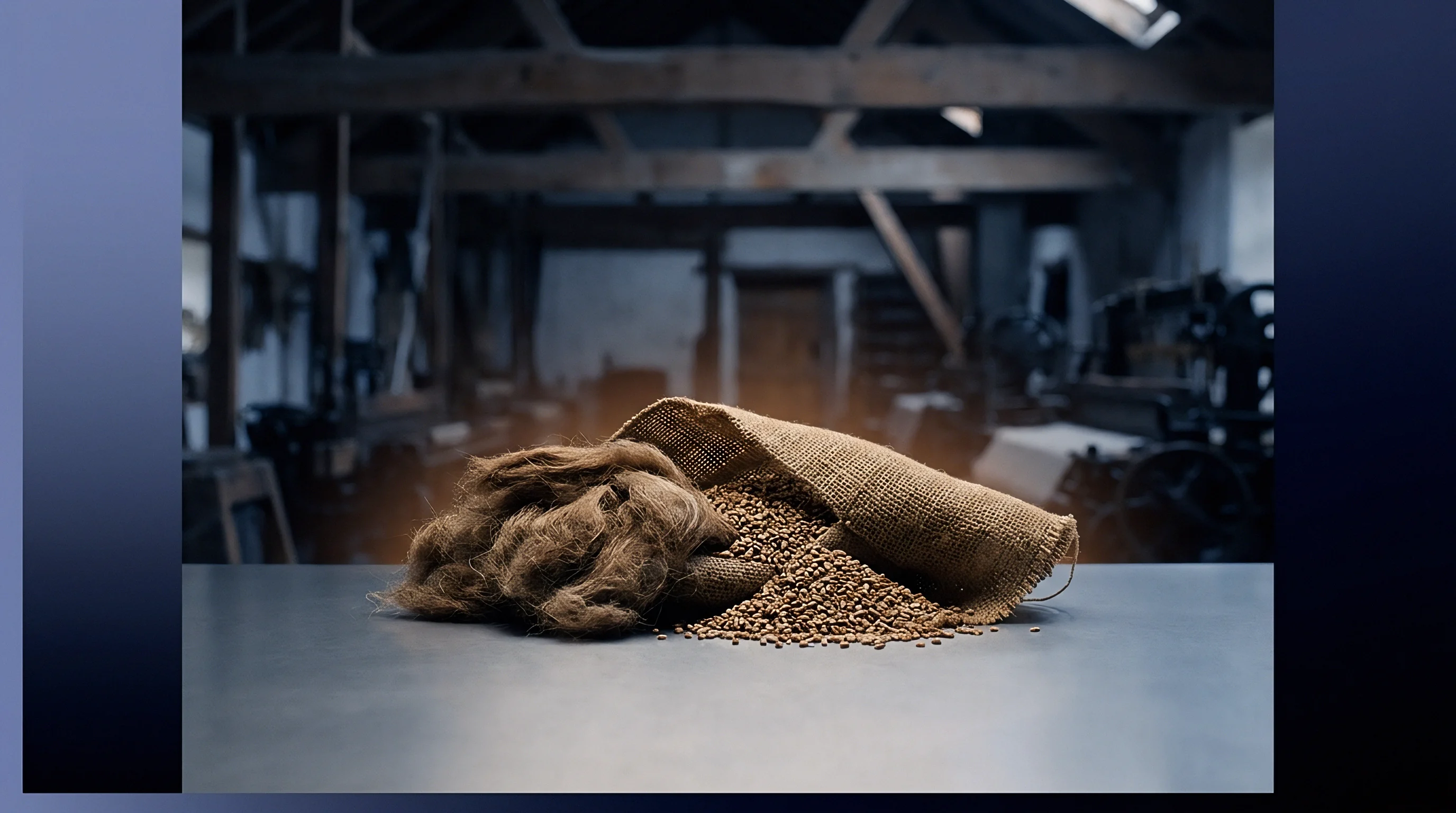
Industrial spinning operations immerse dry line flax into heated chemical baths to soften natural pectins before drafting. Wet spinning introduces process water directly into the cell walls of the roving. Chinese wet spinning mills rely on municipal river networks or deep well groundwater from the Yangtze River basin, which carries an oxygen-18 signature between -7.5 and -9.0 per mil, in contrast to European surface water sitting between -4.5 and -6.0 per mil.
During boiling and drafting at sixty degrees Celsius, hydroxyl groups within amorphous cellulose exchange hydrogen and oxygen atoms with the process bath, introducing local groundwater signatures. The final yarn shows a shifted oxygen and hydrogen isotope profile that customs algorithms misinterpret as domestic Chinese flax fibre.
Do Process Waters Shift Oxygen Baseline Ratios?
Groundwater pumped into Chinese wet-spinning troughs carries distinct regional deuterium signatures. The exchange phenomenon occurs within the outer hydroxyl bonds of the cellulosic chains during prolonged immersion. While carbon-13 and strontium-87 remain locked into the crystalline cellulose backbone, oxygen-18 values drift downward by 4.0 to 5.5 per mil and hydrogen isotopes exchange rapidly during industrial scouring and drafting.
The processing mill adds chemical softening agents, sizing compounds, and spinning emulsions, which further obscure the biological baseline. Provenance underwriters audit the chemical constituents of the spin bath to document precisely how the physical transformation altered the finished commodity.
Isotopic drift during hot water drafting shifts finished cellulosic oxygen ratios without altering the core strontium bedrock signature.
Industrial contamination mechanisms obscure raw fibre baselines across five operational wet-processing stages:
- Roving Boiling exchanges twenty percent of accessible cellulosic hydroxyl oxygen atoms with local borehole process water.
- Acid Rinsing introduces mineral sulfur and chlorine contaminants that interfere with mass spectrometer combustion chambers.
- Spin Finish Emulsion coats the exterior fibre boundary with synthetic petroleum lubricants enriched in fossil carbon-12.
- Bobbin Drying accelerates kinetic fractionation, causing lighter water molecules to evaporate and concentrating heavy isotopes along yarn surfaces.
While strontium ratios resist chemical processing and scutching leaves cellulose intact, bleaching baths and spin finishes alter oxygen and carbon profiles, leaving behind measurable isotopic marks from local process water.

Crate
Bale-to-cone traceability demands physical records linking inbound scutched bundles to outbound packed cartons. A documented chain of custody tracks individual lot numbers through intermediate blending and spinning stages. In typical operations, a Jiangsu mill imports forty tonnes of certified European scutched line flax under HS heading 5301.
The factory blends the long line with twenty percent domestic flax tow to lower raw material expenditure while retaining an export origin declaration for the resulting yarn under HS 5306. Mass-balance reconciliation exposes the fraud: the weighbridge receipt, the bale tag registry, and the spinning yield sheet must match total kilograms spun within an operational waste tolerance of eight percent.
When customs investigators audit a suspected consignment, cross-border documentation fails if transaction certificates do not align with physical pallet manifests. Importers construct an unbroken documentary file before shipping containers across customs frontiers:
- Scutcher Delivery Certificates establish the European cultivation lot, grower registration code, and physical bale tare weights.
- Maritime Ocean Bills verify uninterrupted transit from Antwerp or Le Havre directly to Shanghai or Ningbo container ports.
- Spinning Workshop Allocation Records track the batch routing of imported bale tags to individual carding and ring-spinning frames.
- Process Water Assay Reports document the local tap or well oxygen-18 and deuterium levels in the spinning mill bath.
Commercial margins depend on accurate customs valuation and tariff mitigation. Sourcing managers face substantial exposure when consignments are flagged for origin irregularities.
| Origin Claim Type | Declared HS Subheading | Retesting Cost Per Container | Detention Surcharge Rate | Margin Write-Down Per Kilo |
|---|---|---|---|---|
| Pure European Wet-Spun Line | 5306.10.00 | $1,850 | $140 per day | $2.40 |
| Blended European Tow / Asian Line | 5306.20.00 | $2,100 | $185 per day | $4.15 |
| Uncertified Asian Domestic Wet-Spun | 5306.10.90 | $1,600 | $120 per day | $5.80 |
| Scoured and Bleached Flax Roving | 5301.30.00 | $1,950 | $160 per day | $3.10 |
Commercial contracts allocate legal liability through origin warranty clauses. Sourcing agreements require precise legal text: “Seller warrants that all delivered yarn derives exclusively from raw European flax straw cultivated in certified zones, and shall indemnify Buyer against all customs duties, penalties, and testing fees arising from isotopic discrepancies exceeding standard baseline tolerances.” This language shifts testing and detention financial liabilities back to the manufacturer.

Tariff
Customs valuation shifts abruptly when enforcement officers reclassify yarn entries following an isotopic mismatch. Under United States rules governing Section 301 tariffs, textile goods containing Chinese origin materials face punitive ad valorem rates reaching twenty-five percent. If an entry declared as French origin yarn spun in an intermediate country is reassessed as Chinese domestic flax, customs liquidates the entry with back duties, compound interest, and civil fraud penalties.
Non-preferential rules of origin demand that the importer demonstrate substantial transformation. For bast yarns, the mechanical action of spinning raw flax fibre constitutes origin conferral under standard origin rules, but trade remedies targeted at raw fiber origin bypass spinning transformation thresholds, exposing the importer once wet processing washes out original provenance indicators.
One specific figure in active regulatory use is the 0.7090 strontium-87 to strontium-86 baseline floor for Western European soils. This figure derives from a 2021 geological isotope survey examining eighty-four soil and flax stem samples across Normandy and coastal Belgium. The threshold relies upon the absence of older granite or gneiss mineral structures within the local topsoil.
The baseline would shift higher if flax cultivation expanded south into the older Hercynian crystalline basement zones of the Massif Central. A buyer facing customs scrutiny evaluates regional geological maps to verify whether cultivation plots border atypical bedrock structures.
Regulatory models assume that process water exchanges exactly thirty-two percent of cellulosic oxygen atoms across every commercial wet-spinning frame configuration, though operating temperatures, flyer speeds, and yarn counts alter the kinetics of exchange between bath liquor and roving core. Sourcing managers handle this scientific uncertainty by requiring spinners to archive one-litre samples of process water alongside corresponding greige yarn cones from every production run.
Industrial testing facilities evaluate cellulosic materials alongside mineral fertilizers, creating an analytical intersection between agronomic soil science, heavy machinery mechanics, and international customs law. When forensic laboratories test bast fibres, their spectrometers read the physical residue of rain, rock, and chemical drafting baths. The commercial outcome turns on whether technical auditors can distinguish the biological signature of European fields from the chemical footprint left by Chinese process vats.