Resolving Discrepancies between Laboratory Fiber Quantitative Analysis and Customs Non Preferential Origin Thresholds
Aligning chemical fiber dissolution data with customs non-preferential origin thresholds requires adjusting dry lab ratios for moisture regain and mass loss.


Assay
Quantitative Chemical Dissolution Procedures
Standard laboratory testing separates mixed textile fibers through selective solvent extraction. Under ISO 1833-11, sulfuric acid at 75 percent by mass dissolves cotton, viscose, or rayon while leaving insoluble flax cellulose behind. ASTM D629 instead uses zinc chloride and formic acid solutions to separate cellulosics from synthetic fibers.
Once isolated, the residue is dried at 105 degrees Celsius to a constant weight, giving technicians the baseline dry mass ratio. That calculation turns entirely on whether the solvent fully penetrates tight yarn twists and dense weaves; any soluble fiber left unextracted artificially inflates the measured bast fiber percentage.
Correction factors adjust for the slight mass lost during solvent baths. Standard ISO methods assign empirical d-factors to offset insoluble fiber degradation from acid reagents. Raw, unbleached flax contains lignified structures that react differently to acid than fully scoured linen does.
If reagents leach out residual pectin and hemicellulose, the remaining residue understates the original raw fiber input. Testing houses therefore multiply the raw insoluble weight by standard solubility coefficients before issuing a certificate of analysis.
ISO 1833-11 assigns a d-factor correction of 1.02 to insoluble flax residues after sulfuric acid treatment at 20 degrees Celsius to compensate for non-cellulosic mass loss.

Analytical Limits in Microscopic Fiber Counting
Microscopic examination under ISO 20705 is used when reagents fail to separate structurally similar plant cellulosics. Distinguishing flax from hemp or treated cotton involves counting fiber cross-sections under polarized light, evaluating lumen diameter, cell wall thickness, and transverse dislocation marks across at least 1000 fibers. Manual counting carries far wider variance than gravimetric dissolution; a microscopic count typically has a 95 percent confidence interval of plus or minus 2.5 percentage points.
For that reason, borderline declarations fall back on gravimetric solvent methods whenever a standardized protocol exists.
Mismatched reagents during separation distort component ratios, quickly compromising customs declarations.
Transformation
Non Preferential Substantial Transformation Rules
Customs authorities base non-preferential origin on defined processing stages and minimum composition thresholds. Under Annex 22-01 of the Union Customs Code, pure flax fabric imported under Harmonized System heading 5309 from non-member states requires weaving alongside yarn spinning or designated finishing. United States Customs and Border Protection applies 19 CFR 102.21, conferring origin to the single country where the fabric was woven.
Where intermediate work spans multiple territories, value-added percentage rules take over. Tariff headings split woven linen along a sharp 85 percent threshold: fabric containing 85.0 percent or more flax by weight falls under HS subheadings 5309.11 or 5309.19, whereas goods with less than 85.0 percent fall into subheadings 5309.21 or 5309.29.
Those threshold boundaries carry real financial weight. Entering fabric under HS 5309.19 rather than HS 5309.29 triggers distinct tariff rates across most national schedules. Origin verification hinges on whether the material matches the exact statutory definition of the entry heading.
A fractional deviation in fiber content reclassifies the goods, altering both the duty assessment and the required country-of-origin marking.
| Customs Jurisdiction | Primary Origin Criterion | Composition Threshold | Mandatory Proof Document |
|---|---|---|---|
| European Union | Weaving combined with yarn spinning or finishing | 85.0% flax for category pure designation | Supplier declaration and mill production logs |
| United States | Country of fabric weaving (19 CFR 102.21) | 85.0% flax by weight for heading 5309.19 | Entry summary and commercial invoice specification |
| China Customs | Two-stage substantial transformation rule | 85.0% main fiber content weight threshold | Certificate of origin and fiber assay report |

Blend Percentages and Tariff Shift Triggers
A consignment declared as 85.5 percent flax and 14.5 percent cotton claims entry under pure linen provisions. If laboratory analysis finds 84.2 percent flax instead, the shipment misses the threshold, and the origin analysis defaults to mixed-fiber tariff shift rules. That physical shortfall forces reclassification regardless of what the mill records say, leaving the importer facing administrative reassessment when lab numbers contradict the entry paperwork.
Analytical target misses often conflict with natural moisture absorption variations across raw bast fiber batches rather than actual processing errors.


Drift

Moisture Regain Corrections and Dry Weight Calculation
Raw oven-dry mass values do not represent commercial fiber composition. ISO 1833-1 requires applying official commercial moisture regain allowances to oven-dry weights before calculating final percentages. Flax has an official regain allowance of 12.0 percent; raw cotton is set at 8.5 percent, viscose at 13.0 percent, and polyester at 1.5 percent.
Working directly from unadjusted dry weights understates the share of high-regain bast fibers against low-regain synthetics.
In an oven-dry sample yielding 83.0 grams of insoluble flax and 17.0 grams of soluble polyester, the raw ratio reads as 83.0 percent flax. Factoring in official regain allowances shifts that balance. With the 12.0 percent allowance, flax mass rises to 92.96 grams.
Polyester, at a 1.5 percent regain factor, moves to 17.255 grams, bringing total commercial mass to 110.215 grams. That recalculation yields an adjusted flax fraction of 84.34 percent. Skipping the regain adjustment introduces a 1.34 percentage point error, enough to push a borderline blend beneath a customs cutoff.
Standard ISO 1833-1 dictates solvent extraction with petroleum ether prior to acid dissolution, without which non-cellulosic sizing agents artificially inflate the insoluble linen fraction by up to 2 percent.

Chemical Degradation Factors and Matrix Interferences
Residual processing additives distort gravimetric figures. Sizing agents, starches, paraffin waxes, and finishing resins contribute measurable dry mass to greige or finished goods. Bypassing pre-treatment extractions leaves these non-cellulosic compounds in the insoluble residue, skewing the bast fiber calculation upward.
- Unextracted Sizing Agents leave starch and polyvinyl alcohol coatings in the insoluble residue, inflating bast fiber readings by up to 2.5 percent.
- Lignin Retention Variances in dew-rotted flax alter chemical dissolution rates in acid reagents, causing inconsistent d-factor calculations.
- Over Bleaching Degradation lowers the degree of polymerization in flax cellulose, causing more fiber to dissolve during acid separation.
- Elastane Solvating Residuals foul solvent systems, depositing gummy polymer residue on scoured filter frits.
- Thermal Moisture Loss from aggressive oven drying changes subsequent regain uptake in heavily dyed bast fibers.
The point at which hemicellulose loss from aggressive bleaching shifts a fabric’s measured ratio across tariff brackets remains a point of friction among testing laboratories.


Proof

Borderline Composition Scenarios in Customs Classification
Disputes intensify when laboratory assays skirt statutory boundaries. Entry filings based strictly on vendor fiber specs face routine verification at port, where customs authorities test samples against declared Harmonized System headings. Any gap between mill test sheets and customs laboratory findings triggers reclassification, back-duty claims, and audit scrutiny.
Quantitative Margin Analysis for Non Preferential Origin
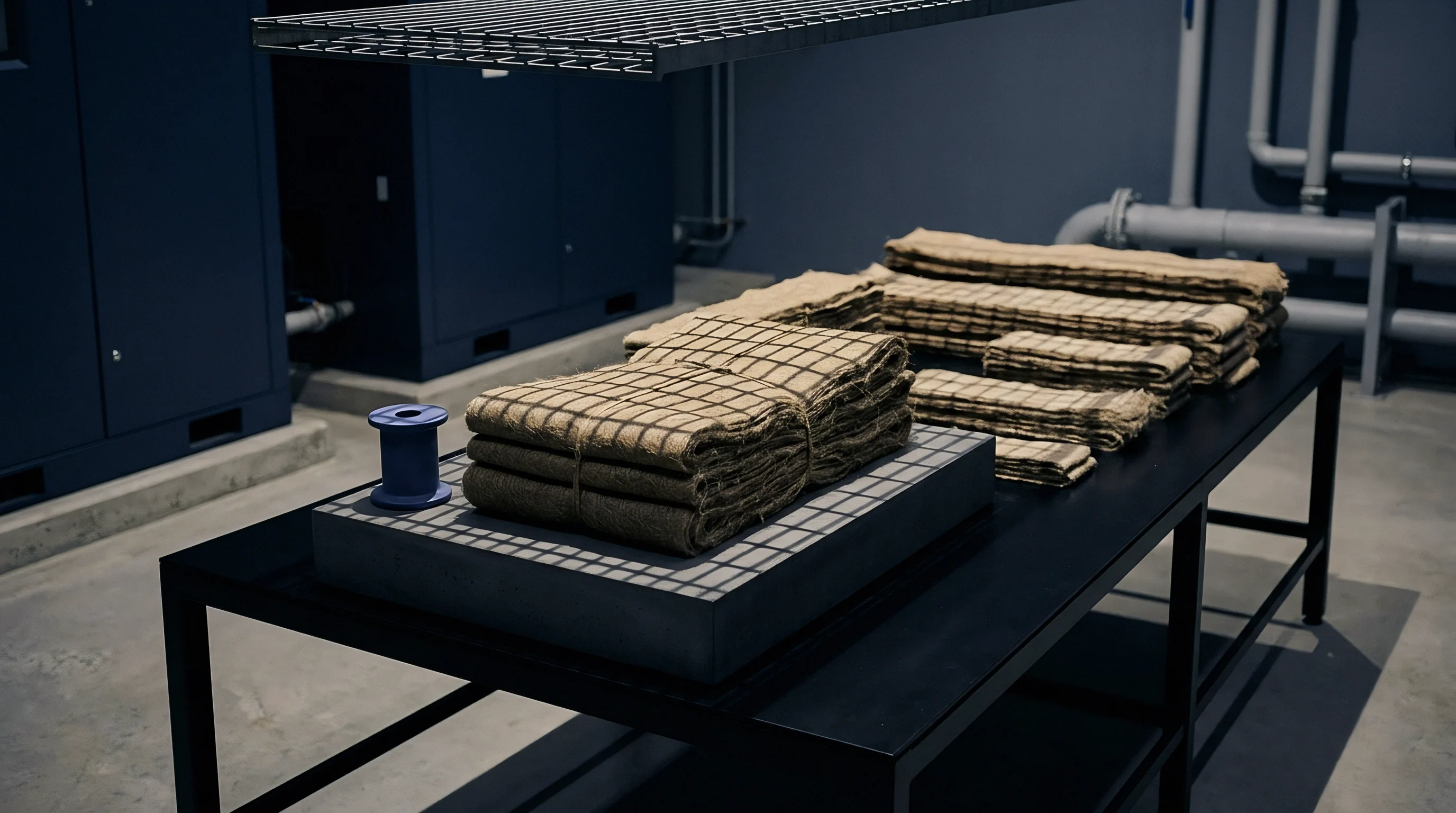
Standard laboratory adjustments demonstrate how calculated values shift under scrutiny. Take an imported lot of woven greige fabric declared as 85.5 percent flax and 14.5 percent cotton under HS subheading 5309.11. Port authorities pull samples and run solvent extraction under ISO 1833-11 using 75 percent sulfuric acid.
From a 100.00-gram dry specimen, the lab recovers 83.20 grams of insoluble flax residue and 16.80 grams of dissolved cotton. Unadjusted, the dry ratio stands at 83.20 percent flax. Applying the standard d-factor of 1.02 to account for slight flax dissolution in acid yields a corrected dry flax mass of 84.864 grams.
With the corrected total dry mass reaching 101.664 grams, the corrected dry flax content adjusts to 83.47 percent.
Next come commercial moisture regains. Multiplying the corrected dry flax weight of 84.864 grams by 1.120 gives a commercial flax mass of 95.048 grams. Multiplying the dry cotton weight of 16.80 grams by 1.085 produces 18.228 grams of commercial cotton.
Total commercial mass is 113.276 grams. Dividing 95.048 grams by 113.276 grams establishes a commercial composition of 83.91 percent flax and 16.09 percent cotton.
| Processing Stage | Flax Component (g) | Cotton Component (g) | Flax Percentage (%) | Customs Threshold Impact |
|---|---|---|---|---|
| Raw Oven-Dry Mass | 83.200 | 16.800 | 83.20% | Fails pure linen tariff threshold |
| Acid d-Factor Adjusted (1.02) | 84.864 | 16.800 | 83.47% | Fails pure linen tariff threshold |
| Commercial Regain Adjusted | 95.048 | 18.228 | 83.91% | Fails 85.0% threshold (HS 5309.29) |
Because the adjusted test result of 83.91 percent falls short of the statutory 85.0 percent threshold, the shipment moves from HS 5309.11 to HS 5309.29. The importer incurs a 4.5 percent duty rate increase while facing misdeclaration inquiries.

What Analytical Margin Triggers Origin Reclassification?
Whether a laboratory finding legally displaces an entry declaration depends on measurement uncertainty. ISO 5725 outlines reproducibility limits between independent testing facilities, and standard fiber methods recognize reproducibility tolerances between plus or minus 1.0 to 1.5 percentage points. If a customs lab finds 84.2 percent flax against an 85.0 percent declaration, that gap sits within normal testing error.
Importers routinely challenge reclassifications by showing that the declared blend falls inside the laboratory’s expanded uncertainty window, backing the claim with spinning mill batch records to substantiate initial fiber inputs.
Section 4 of the Standard Cotton and Linen Purchase Warranties specifies that commercial regain adjustments calculated under ISO 1833-1 supersedes raw oven-dry laboratory outputs in all origin classification disputes.


Dock

Customs Sampling Protocols at Port of Entry
Border enforcement teams conduct sampling under ISO 2859-1 acceptance procedures, cutting full-width swatches across randomly selected crates and rolls. The swatches are divided into duplicate specimens, sealed in moisture-proof containers, and sent to accredited customs laboratories. The primary specimen goes to testing, while the secondary sample remains held under seal for appeal.
Reconciling Mill Mass Balance with Import Sample Results
Resolving a border testing discrepancy requires reconstructing raw material inputs from mill production records. Scutcher yield reports, spinning blend sheets, and weighbridge receipts document the original batch proportions before wet finishing altered fiber weights.
- Obtain certified mill weighbridge tickets matching raw flax straw deliveries to specific yarn lot numbers.
- Extract scutching and combing loss records to calculate long-fiber to short-tow ratios used during spinning.
- Audit spinning-room sliver blend logs to confirm draw-frame fiber proportions before twisting.
- Collect loom-state weigh tickets to establish original greige construction parameters prior to wet finishing.
- Compile scouring and bleaching mass balance reports showing measured hemicellulose loss percentages.
- Submit independent ISO 17025 test certificates run on retain samples taken directly from the production lot.
A mill log reflecting flax tow usage without matching scutching waste records indicates unrecorded short-fiber additions that distort lab composition tests.
During customs audits, bale tags from raw fiber lots carry more evidentiary weight than finished fabric test reports.


Liability

Contractual Origin Warranties and Laboratory Defense Dossiers
Sourcing contracts must protect buyers against the financial fallout of blend variations. Specifications require overseas mills to guarantee composition thresholds on a dry-regain-adjusted basis, backing that warranty with indemnities covering back-duties, demurrage, and legal fees if mislabeled fiber blends trigger customs reclassification. Agreements also require mills to hold dual-tested retain samples for two years following shipment.

Administrative Appeals and Binding Origin Decisions
Challenging an adverse tariff assessment follows defined administrative channels. Within the European Union, importers submit Binding Origin Information applications to secure advance rulings on specific blend formulations. In the United States, importers request formal Binding Rulings under 19 CFR Part 177.
Presenting a technical dossier with mill mass balance records, d-factor adjustments, and spinning logs gives customs legal divisions the documentation needed to overturn port-level rejections.
Technical Dossier Completeness expedites administrative reviews by providing full analytical transparency up front.
Mill Batch Traceability connects finished roll serial numbers directly to verified raw bast fiber receipts.
Regain Verification Metrics demonstrate that laboratory calculations incorporated correct commercial moisture allowances.
Reagent Solubility Records confirm that chemical testing accounted for baseline fiber degradation factors.
Filing dual-tested retain samples alongside spinning logs provides the documentary foundation required to resolve laboratory variances before customs authorities issue formal penalties.