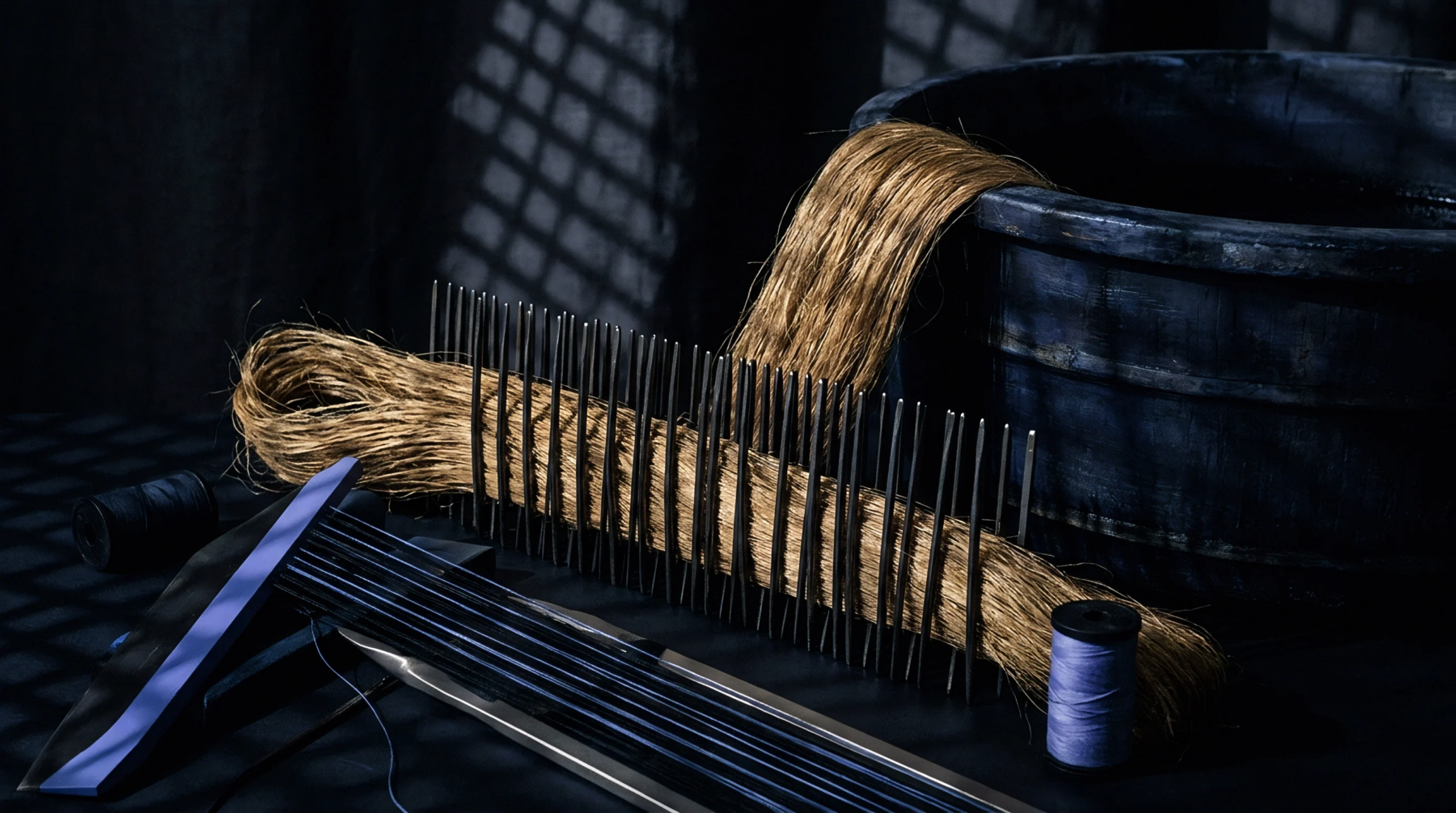
Mechanical Variance
Irregular tension variations within the drawing zone of a spinning frame represent a common mechanical disruption in staple yarn manufacturing. This drafting force instability occurs when the friction between overlapping fibres undergoes rapid and unpredictable changes during attenuation. When the force needed to draw the fibres fluctuates, the rollers lose precise control over individual strand movement.
Such behavior is common in flax wet spinning, where the presence of surface moisture alters the surface traction of the bundles. These irregular shifts create localized clusters of unattenuated material.
Process Influence
Attenuation of the fibre strand becomes irregular when these tension spikes exceed the tensile limit of the weakest sections. The resulting yarn exhibits severe mass variation, showing alternating thick and thin places that degrade the mechanical strength of the finished fabric. When mill operators detect drafting force instability, they often adjust the roller spacing or modify the water temperature to alter the cohesion of the flax bundle.
This intervention stabilizes the yarn diameter before winding.
Control Boundary
Lubrication viscosity restricts the effectiveness of mechanical drafting adjustments below a certain linear speed. High-speed drawing creates a hydrodynamic regime where water cannot disperse quickly enough, forcing a reduction in throughput to maintain uniformity. Spun yarn properties are therefore bounded by this physical interaction between roller pressure and moisture content.