Boundary Layer Hydrodynamics and Mass Transfer Rates in Flax Roving Swelling
Hydynamic boundary layer reduction in wet-spinning troughs accelerates core hydration, stabilizing swelling and lowering yarn count CV percent.

Boundary
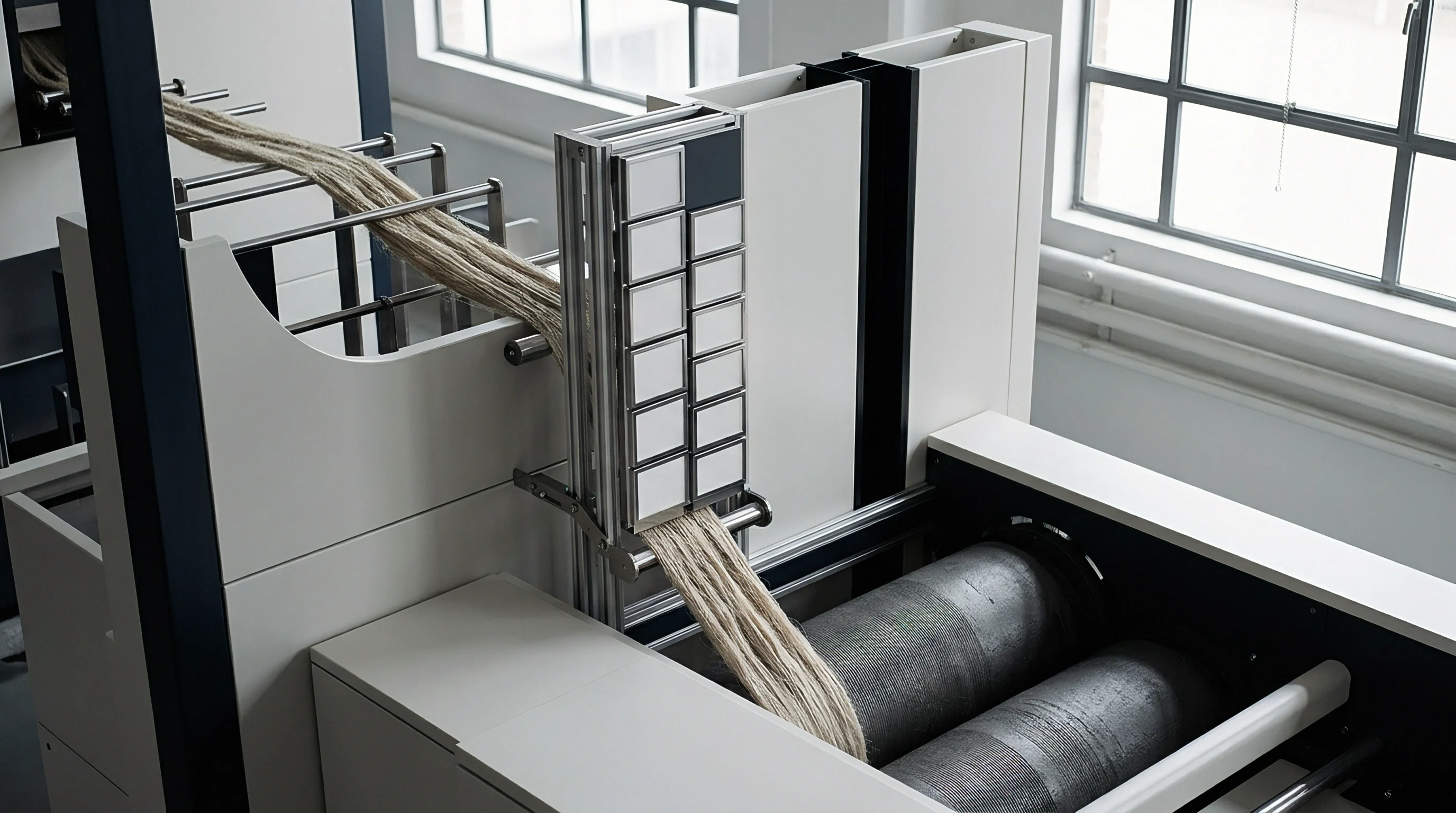
As a flax roving strand moves submerged through liquid media, a hydrodynamic boundary layer forms around the cylindrical bundle. At the roving wall, fluid velocity drops to zero, leaving a stagnant viscous film where chemical reagents and water molecules must migrate by molecular diffusion alone. Mass transfer across this sheath dictates how quickly pectins soften and cell walls hydrate.
In industrial wet spinning troughs running at linear speeds between 12 and 30 metres per minute, local boundary layers range from 45 to 110 micrometres depending on bath temperature and liquor viscosity.
Static baths delay liquid penetration. Laminar fluid motion across the moving strand keeps the Sherwood number low, holding mass transport back until turbulence or micro-mixing breaks open the viscous film. For a 0.8-millimetre diameter roving in a 60-degree Celsius aqueous bath, the Reynolds number generally stays below 150, keeping flow within the laminar regime.
Increasing fluid shear thins this boundary layer, driving water faster into the inter-fiber pore network.
Overall mass transfer efficiency hinges on the balance between convective transport in the bulk liquid and diffusive transport across the boundary film. At typical wet-spinning temperatures, the Schmidt number for dilute aqueous solutions ranges from 250 to 400. Raising trough temperatures from 20 to 70 degrees Celsius lowers liquid viscosity enough to boost water’s diffusion coefficient by a factor of 2.8 while shrinking boundary layer thickness by 32 percent.
Hydrodynamic calculations highlight how strongly mass transfer coefficients respond to bath velocity and fluid density. Higher coefficients shorten the immersion length required before drafting.
| Fluid Velocity (m/min) | Bath Temp (°C) | Kinematic Viscosity (m²/s × 10⁻⁶) | Boundary Thickness (µm) | Sherwood Number | Mass Transfer Coeff (m/s × 10⁻⁵) |
|---|---|---|---|---|---|
| 12.0 | 20.0 | 1.004 | 108.5 | 4.12 | 0.82 |
| 12.0 | 60.0 | 0.475 | 74.6 | 6.85 | 2.14 |
| 22.0 | 60.0 | 0.475 | 55.1 | 9.28 | 2.90 |
| 30.0 | 70.0 | 0.413 | 44.8 | 11.45 | 3.88 |
A ten percent reduction in trough boundary layer thickness increases initial core liquid pickup by sixteen percent at standard line-flax delivery speeds.
When fluid velocity lags behind roving speed, dry bundle cores pass straight into the drafting nip, shearing fibers and snapping the line.
Kinetics
Once liquid breaches the outer fiber perimeter, mass transfer inside the flax roving shifts from convective boundary transport to capillary and intra-fiber diffusion through radial pores. Primary cell walls contain amorphous pectins, hemicellulose matrices, and crystalline cellulose microfibrils. As hydrophilic polymers absorb water, the calcium-pectate gel binding technical fibers into bundles begins to relax.
Initial radial liquid uptake follows Fickian diffusion kinetics, but shifts toward non-Fickian, relaxation-controlled transport as swelling stresses alter the internal pore structure.
Along the length of elementary fibers, fluid moves axially through lumen channels and inter-fiber spaces via capillary action. Cross-sectional radial transport faces much higher resistance because high-twist roving packs the fibers tightly together. Twist levels between 35 and 65 turns per metre squeeze inter-fiber channels, reducing effective pore radii from 12 micrometres down below 1.8 micrometres.
While smaller pores raise capillary pressure, they drastically cut liquid permeability under Darcy’s law.
- Fluid Bypass Channeling preferential liquor migration along the outer bundle perimeter leaves core fibers dry and unplasticized during rapid trough transit.
- Pectin Dissolution Delays short dwell times in heated baths prevent the thermal hydrolysis of inter-cellular pectins needed for smooth drafting.
- Solvent Depletion Gradients rapid absorption at the roving surface strips chemical reagents from the inner boundary layer.
- Air Entrapment Pockets air locked inside hydrophobic dry lumens forms gas cushions that block radial liquid penetration into technical fibers.
Diffusion kinetics determine how long roving must stay in the trough before entering the drafting rollers. Under ISO 6741 conditioning protocols, laboratory measurements place effective diffusion coefficients for water in un-swollen line flax between 1.2 × 10⁻¹¹ m²/s and 4.5 × 10⁻¹¹ m²/s at 50 degrees Celsius. Adding mild alkali to raise bath pH to 8.5 triggers ion-exchange reactions in pectin carboxyl groups, increasing the swelling kinetic rate constant by 40 percent.
Standard purchasing contracts specifying wet-spun line flax require moisture equilibrium verification across the complete roving package cross-section before drafting trial approval.
The precise point where swelling stress relaxation overrides microfibrillar orientation in long-staple bast fibers remains a subject of debate among fluid dynamicists and fiber chemists.
Swell
As water enters the cell wall matrix, microfibrils spread apart in a distinctly anisotropic pattern. Axial elongation stays between 0.5 and 1.2 percent, while radial expansion enlarges elementary fiber cross-sectional areas by 25 to 45 percent. This uneven swelling alters roving packing density, closing up internal voids and building lateral contact pressure between fibers in the bundle core.
Where Does Radial Resistance Peak during Wet Drafting?
Peak radial resistance occurs right at the transition zone between the trough exit and the first drafting nip. As fibers swell radially, inter-fiber friction rises from 0.22 in dry technical fibers to 0.58 when fully saturated. Under alkaline conditions, pectin swelling and radial expansion squeeze liquid out of internal pores back into the boundary layer, generating a counter-flux that opposes incoming liquid mass transfer.
| Fiber Grade | Mean Staple Length (mm) | Dry Count (Nm) | Radial Swelling (%) | Water Pickup (% wt) | Drafting Force Peak (N) |
|---|---|---|---|---|---|
| Water-Retted Line Flax | 750 | 2.8 | 38.5 | 115.0 | 14.2 |
| Dew-Retted Line Flax | 680 | 2.6 | 31.2 | 98.0 | 18.6 |
| Hackled Tow Flax | 250 | 1.8 | 26.4 | 84.0 | 22.1 |
| Enzyme-Treated Line | 720 | 3.1 | 42.0 | 128.0 | 11.8 |
Once pectin softening is complete, higher swelling ratios reduce required drafting forces. Uniform cell wall hydration lubricates microfibrillar sliding, allowing elementary fibers to slip past each other smoothly under drafting tensors. Uneven radial swelling, by contrast, causes draft resistance spikes that yield slubs and thick spots in the yarn.
Fully saturated flax fibers exhibit maximum radial volumetric expansion within ninety seconds of liquid immersion under ambient temperature conditions.
A roving bundle swollen to saturation requires half the mechanical drafting force of an unevenly wetted strand.
Flume
Managing wet-spinning hydrodynamics requires tight control over bath geometry, recirculation, and temperature distribution to keep boundary layer conditions consistent. Fluid velocity must match or slightly exceed roving speed to eliminate stagnant zones along the path. Submerged guide pins disrupt boundary layer growth by flexing the strand, displacing interstitial fluid and forcing convective transfer directly into the core.
- Run incoming dry roving through steam pre-conditioning chambers to evacuate trapped core gases.
- Enter the main wetting trough at a controlled 15-degree immersion angle to minimize surface wave formation.
- Guide the strand over submerged ceramic break-pins to strip the hydrodynamic boundary layer mechanically.
- Pass through counter-current liquor flow channels operating at 65 degrees Celsius with surfactant dosing.
- Deliver saturated roving directly into the drafting nip under zero axial tension loss.
Adding surfactants lowers bath surface tension from 72.8 mN/m to below 35.0 mN/m, accelerating penetration through hydrophobic wax coatings on the fiber surface. Ultrasonic transducers operating at 40 kHz generate micro-cavitation bubbles that collapse against the strand; these cavitation shockwaves tear away stagnant boundary layers and raise mass transfer coefficients by over 200 percent without damaging delicate cell walls.
Immersion trough fluid replacement rates must sustain counter-current flow configurations to prevent pectin accumulation from altering bath viscosity.
Raw flax retting variations can override bath boundary layer dynamics, driving yarn count variations on wet-spinning frames.

Variance
Inconsistent mass transfer and uneven swelling show up directly as linear density variations in finished yarn. Dry core zones slip at the nip rollers, producing unattenuated slubs alongside thin sections where over-hydrated fibers draft too early. Measuring count variation (CV%) on Uster equipment confirms how directly mass transfer boundary stability correlates with yarn unevenness.
Audit protocols require strict verification of roving immersion history and mass transfer parameters during qualification runs.
- Boundary Layer Thickness Standard minimum liquor recirculation velocity must maintain boundary layer thickness below 60 micrometres across all frame positions.
- Swelling Ratio Compliance core-to-sheath hydration differential across sampled roving strands cannot exceed 5.0 percent prior to drafting.
- Bath Viscosity Limits total dissolved solids and dissolved pectins in the trough liquid must stay below 1.2 percent by weight to preserve mass transfer rates.
- Thermal Profile Control temperature gradients along the length of the wet-spinning trough must remain within plus or minus 1.0 degree Celsius.
End breakage rates during wet spinning rise exponentially when dry cores push mass transfer below critical thresholds. Every broken end requires manual piecing, adding yarn defects, labor costs, and lost frame efficiency.
ISO 2060 yarn linear density testing mandates conditioning wet-spun samples to standard moisture regain prior to commercial weight and count determination.
Under Clause 8.2 of standard linen yarn purchase agreements, a count coefficient of variation above 11.5 percent across a ten-bobbin test lot gives the buyer absolute right of rejection.
Valuation
Boundary layer optimization and mass transfer control dictate the economics of high-count linen spinning. Inadequate roving hydration forces frames to run at reduced delivery speeds, taking a heavy toll on capacity. Pushing frame speeds from 18 to 28 metres per minute while keeping yarn count CV% stable requires active boundary layer stripping through forced recirculation and precise chemical control.
Capital spent upgrading trough hydrodynamics yields immediate returns by lowering end breaks per 1,000 spindle hours and cutting hackling waste. Uniform swelling also allows mills to spin finer, higher-value yarn from cheaper raw fiber.
| Process Configuration | Max Frame Speed (m/min) | End Breaks / 1000 Spindle Hr | Spinnable Count Limit (Nm) | Waste Rate (%) | Yarn Cost per Metre ($) |
|---|---|---|---|---|---|
| Standard Static Trough | 14.0 | 42.0 | 26.0 | 8.5 | 0.082 |
| Heated Recirculating Trough | 20.0 | 22.0 | 39.0 | 5.2 | 0.061 |
| Ultrasonic Boundary Stripped | 28.0 | 11.0 | 50.0 | 3.1 | 0.046 |
| Enzyme Assisted Recirculation | 25.0 | 14.0 | 56.0 | 2.8 | 0.042 |
Faster mass transfer cuts drying oven residence times and downstream fuel oil consumption. Mill calculations show that every one percent reduction in spinning frame waste lowers finished fabric production costs by 0.012 Euros per square metre at standard weaving densities. Liquid boundary control remains central to operating a profitable wet-spinning mill.