Standard Usable Cuttable Width Verification Protocols under ISO Conditioning Frameworks
Usable cuttable width must be verified on tensionless cloth relaxed under ISO 139 conditions using ISO 22198, excluding pin marks, selvages, and edge distortion.

Flank
Loom width exceeds finished width by the sum of reed contraction, wet processing shrinkage, and selvage drop combined. While a mill invoice bills for gross width between the outer tenter pin marks, the cutting room programs lay-planning software strictly to the usable cuttable width bounded inside drop stitches, pin punctures, and edge distortion. ISO 22198 establishes the mechanical method for separating total cloth width from the usable width clear of selvages.
Without reconciling the purchase order to that distinction, delivered yardage will fall short of marker requirements.
Gross width spans the full woven web perpendicular to the warp axis, measured between the outermost edge threads. Usable cuttable width covers only the internal breadth with uniform sett, consistent pick density, even surface finish, and no mechanical hold-down damage. On high-speed air-jet and rapier sheds weaving apparel-weight bast fibers, tuck-in units or leno catch cords secure the outer 5 to 20 millimeters.
These edges carry double yarn densities or auxiliary binding threads, creating local ridges and crimp variations that deflect spreading blades and stall automated cutters.
The commercial width stated on a finished roll label represents gross physical expanse and routinely exceeds cuttable breadth by four to eight percent.
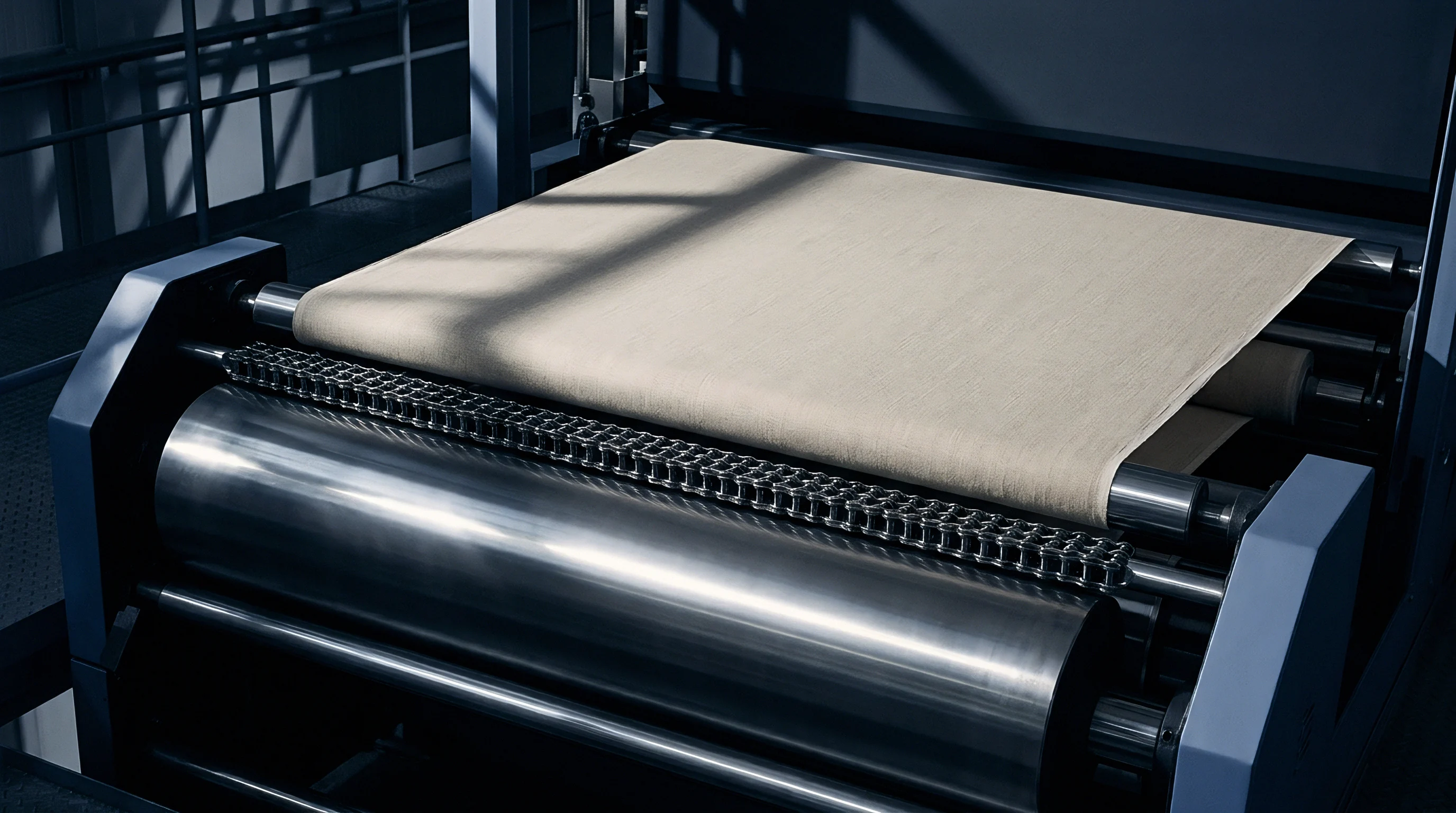
Processing concentrates mechanical wear along this boundary strip. Stenter frames use pinned chains or heavy clamps to carry wet fabric through drying and heat-setting chambers, leaving punctured craters and tension rings across 12 to 25 millimeters of each flank. Overdriving the cross-direction feed to stretch the roll profile pulls the fabric adjacent to the pin marks into sharp lateral tension, which later relaxes unevenly.
Yarn spacing throughout this border stays unstable, and any marker laid over it causes cut-part distortion during assembly.
Procurement teams avoid marker starvation by writing cuttable limits into purchase specifications. A standard data sheet cites both minimum gross width and guaranteed minimum usable cuttable width at specified atmospheric conditions. A finished roll measuring 152 centimeters edge to edge frequently yields no more than 142 centimeters of usable cutting aperture.
If the pattern room builds markers to the 152-centimeter figure, cutting blades run directly into pin holes and selvage cords, ruining nested components and generating costly yardage deficits.


Air
Lignocellulosic fibers gain and lose moisture readily with fluctuations in ambient relative humidity and temperature. Flax filaments contain amorphous cellulose, hemicellulose, and natural pectins packed with accessible hydroxyl groups that bind atmospheric water molecules through direct hydrogen bonds. Moisture uptake swells the transverse diameter of flax fibers by 20 to 30 percent, whereas axial elongation stays under 2 percent.
This structural anisotropy shifts cloth dimensions along the loom and through finishing whenever humidity changes.
Fiber swelling forces the woven matrix to readjust. As yarn cross-sections expand, warp and weft push against each other at every interlacing point, increasing crimp amplitude in plain weave bast constructions. Each thread follows a steeper path around adjacent ends or picks, shrinking the fabric in both directions while raising areal mass per square meter.
A roll inspected in an unheated warehouse during dry winter conditions registers an artificially broad width; shipped into a humid garment plant, the cloth takes up moisture and contracts across the cuttable field by several centimeters.

Atmospheric Equilibration Dynamics
ISO 139 defines the standard atmosphere for textile conditioning and physical testing at 20.0 degrees Celsius (plus or minus 2.0 degrees Celsius) and 65.0 percent relative humidity (plus or minus 4.0 percent). For tropical regions recognized under the standard, the baseline shifts to 27.0 degrees Celsius at 65.0 percent relative humidity. To obtain repeatable measurements, the woven structure must reach equilibrium moisture content through the entire core of the roll before testing.
Reaching that equilibrium requires specific roll preparation. Fabric wound under industrial tension traps internal stress and seals out ambient air. Bast cloth must be completely unwound and laid tensionless in loose folds or racked horizontally on conditioning frames for at least 24 hours.
Verification is gravimetric: successive weighings at two-hour intervals must show less than 0.25 percent variance. Measuring leader fabric straight off a delivery truck yields unusable data.
| Relative Humidity Band | Equilibrium Moisture Regain (%) | Transverse Swell Coefficient | Width Contraction from Dry Baseline (%) | Areal Weight Adjustment (g/m²) |
|---|---|---|---|---|
| 45% RH (Dry Storage) | 7.2 | 1.00 | 0.00 | 185 |
| 65% RH (ISO Standard) | 12.0 | 1.08 | -1.85 | 196 |
| 85% RH (Tropical Marine) | 17.4 | 1.17 | -3.40 | 209 |
| Values reflect a 100 percent wet-spun flax 1/1 plain weave construction, nominal specification 190 g/m² at ISO standard atmospheric equilibrium. | ||||
Hysteresis further complicates this thermodynamic relationship. Flax reaching 65 percent relative humidity via desorptive drying retains more moisture than a bundle brought to that level by absorbing moisture from a dry state. Desorption leaves the yarns more swollen, holding the fabric narrower across the width, whereas absorption yields lower regain and a broader, flatter profile.
Resolving commercial disputes requires thorough preconditioning in dry air at 30 to 35 percent relative humidity before final equilibration, eliminating the effect of prior moisture history.
Bypassing environmental controls exposes the buyer to direct production risk. When rolls ship from a dry maritime zone into a humid manufacturing basin, unconditioned cutting releases latent contraction stresses inside the cut plies. Panels cut true from green, unconditioned yardage shrink on the cutting tables before assembly begins, producing fit defects across production runs, breaching manufacturing tolerances, and forcing full lot rejections.

Gauge
Physical measurement protocols require rigid bench procedures to keep operator handling from altering the cloth. ISO 22198 requires supporting the fabric on a smooth, flat horizontal surface wider than the broadest specimen under test. The layout must be completely relaxed, letting the roll yardage lie free of longitudinal pull from motorized let-offs or dragging selvages.
Calibrated steel rules, verified against national metrology standards and graduated to 1 millimeter, serve as the reference instrument.
Automated scanning systems offer a production-line alternative to manual rules. These frames use multi-camera laser triangulation heads or overhead transverse optical arrays to track fabric boundaries across continuous running webs. Operating at line speeds up to 40 meters per minute, optical sensors calculate width fluctuations continuously and catch localized neck-downs that spot checks miss.
High-frequency digital logs also flag cyclic narrowing caused by worn tenter clips or misaligned drive rollers.
Edge boundary determination represents the primary operational variable. Inspectors distinguish between physical edge, pin limits, and clear cuttable field:
- Gross Expanse Boundary measures between extreme outermost woven boundaries, including fringed leno ends, waste catch threads, and protruding loops.
- Pin Line Demarcation marks the innermost perimeter of mechanical penetrations, tears, clip scorch marks, and stenter chain indentations.
- Uniform Structure Boundary defines the outermost longitudinal lines displaying specified warp yarn spacing, regular pick insertion angles, and standard cloth thickness.
- Usable Cuttable Boundary sits two centimeters inboard from the innermost defective surface element, providing automated cutting tables a reliable clearance channel.
A defined sampling schedule governs physical verification across volume shipments. ISO 22198 specifies measurement intervals along the piece and excludes the first 5 meters at either roll end. A 30-meter roll requires 5 evenly spaced width readings across its length; rolls over 100 meters require at least 10 equidistant checks.
The arithmetic mean of these points establishes the declared width. A single reading falling below the contracted minimum triggers lot quarantine.
Single-point spot checks fail legal validation under ISO 22198 because finishing tension oscillates down the roll length.
Inspectors record each measurement to determine both mean cuttable width and standard deviation across the delivery. Mapping cross-width profiles isolates crowning ~ where uneven stenter drying tensions leave the center of the web slacker and narrower than the flanks. Skew and bow distortions narrow the usable zone further whenever weft yarns cross warp lines away from a clean 90-degree angle.
Discrepancies often prompt arguments that narrow readings stem from measuring without tension, on the theory that winding pull straightens out crimp to achieve nominal width. Contract law dismisses that reasoning when technical purchase specifications cite ISO 22198. The standard defines width strictly as an unstressed, tensionless measurement taken on fully relaxed cloth resting on an inert horizontal surface.
Crimp
Woven geometry governs how external width shifts during wet finishing and subsequent mechanical relaxation. Cover factor formulas quantify yarn packing density: warp cover factor is ends per centimeter multiplied by the square root of yarn count in tex, divided by 100, with weft cover factor calculated identically from picks per centimeter. Total cover factor represents combined yarn coverage up to the jam limit, where adjacent threads lock together and prevent further structural compaction.
Flax yarns show low shear compliance and irregular surface profiles compared to synthetic filaments. As weft yarns interlace with warp ends, crimp distributes between both systems according to Peirce cloth geometry models. Running a loom under high warp let-off tension holds warp ends taut while weft threads bend around them, yielding high weft crimp and low warp crimp.
Once the greige cloth leaves the loom take-up roll, internal stresses seek equilibrium, triggering spontaneous contraction across the web width.
Finishing operations alter these crimp distributions permanently. Scouring strips out natural waxes and pectins, which increases fiber-to-fiber friction, while bleaching and piece-dyeing subject the web to vigorous liquor movement and longitudinal transport pull. Stenter drying draws the warp taut, driving weft crimp higher and pulling selvages inward.
Unless the finisher applies correct overfeed rates, the set cloth retains substantial latent contraction forces.
Construction Geometry Comparison
Different weaves retain width differently under identical wet finishing conditions. A plain weave interlaces at every thread, generating internal friction that resists lateral deformation but demands generous loom reed allowances. A 2/1 twill reduces interlacing frequency; its longer yarn floats pack closer under finishing pressure.
Jacquard damasks alternate between warp-dominant satin and weft-dominant sateen areas, setting up localized crimp imbalances that create uneven width retraction across complex patterns.
| Cloth Construction | Warp Yarn Count (Nm) | Weft Yarn Count (Nm) | Loom Reed Width (cm) | Finished Usable Width (cm) | Total Width Loss (%) |
|---|---|---|---|---|---|
| 1/1 Plain Tabby Sheeting | 26 | 26 | 172 | 142 | 17.4 |
| 2/1 Warp-Face Twill | 39/2 | 26 | 168 | 144 | 14.3 |
| 4-End Broken Twill (Sateen) | 39 | 39 | 165 | 145 | 12.1 |
| 5-End Jacquard Table Linen | 44 | 36 | 178 | 140 | 21.3 |
Sizing the reed to yield a specified cuttable width depends on denting density and total contraction rates. Reed width is finished width divided by one minus the total contraction percentage, factoring in both loom drop-off and aqueous finishing loss. For dense 1/1 plain weave linen, total transverse contraction frequently nears 18 percent.
Weaving on a 160-centimeter reed bed cannot reliably yield 145 centimeters of cuttable plain weave.
Weave architecture sets an upper bound on finished width. High cover factors approaching maximum packing density leave little room for yarn redistribution. When an over-dense bast construction enters wet processing, swollen weft yarns force warp threads into steep crimp excursions, pulling the flanks inward.
The fabric loses cuttable width, taking on a boardy, unyielding hand along the edges while cutting yields drop.
Cutting layouts fail when crimp balance varies across the web. If weft crimp differs between the flanks and the center, panels cut across those zones distort unevenly during steam pressing. That differential relaxation skews garment parts, showing up as twisted seams, curved plackets, and uneven hems.


Drift
Width drifts predictably along the length of a production run. Industrial weaving sheds process warp beams carrying 1,000 to 3,000 running meters, over which warp tension varies as the beam diameter shrinks from 800 millimeters down to the bare barrel. Electronic let-offs compensate for the change, but mechanical hysteresis, loom stops, and humidity variations across the shed cause continual micro-shifts in tension that translate into measurable width variations down the piece.
Finishing plants add to this drift through fluctuating line speeds and inconsistent nip pressures. Continuous washing, open-width scouring, and drying pull the wet web lengthwise. If brake tension spikes at an unroll stand, the fabric stretches axially and narrows across its full width.
Yardage run through clean squeeze rollers early in the morning responds differently from fabric run late at night through fouled equipment or unevenly heated chambers.

Tracking Longitudinal Variances
Verifying dimensional compliance requires identifying three distinct physical width categories across lot deliveries:
- Roll Head Width identifies dimensions captured precisely five meters inboard from the outer lead seam, reflecting unroll stabilization.
- Roll Midpoint Width captures dimensions verified across the geometric center of the packaged bolt, representing sustained running equilibrium.
- Roll Tail Width denotes the final cuttable dimensions recorded five meters prior to the core tube splice, exposing tail-end tension drops.
Discrepancies among these three checkpoints show the level of process control. In a well-run finishing facility, width drift between head and tail stays within plus or minus 1 percent of nominal width. Poor control yields hourglassing or a steady taper, where the cloth narrows by 3 to 5 centimeters from the outer wrap to the core.
Markers nested strictly to head-end measurements will spill past the usable boundary midway through the roll.
Acceptance quality limits govern these deviations. Technical inspection protocols mandate that 80 percent of captured verification points must land within the contracted nominal width range. Not a single verified point across an entire production lot may dip below the contracted absolute cuttable floor.
A delivery displaying an average width of 144 centimeters against a 140-centimeter contract fails legal acceptance if a five-meter pocket midway through the bolt narrows to 138 centimeters due to localized stenter slippage.
Inspection protocols allow no tolerance for unannounced roll tapering. When five consecutive rolls from a multi-thousand-meter dye lot narrow steadily toward the core tube, receiving teams halt processing across the entire delivery. That pattern points to uncorrected mechanical drag through the continuous wash range ~ a structural defect that steam finishing cannot rectify.


Cost
Loom hours govern weaving economics. Weaving machines operate within fixed width limits; running 140 centimeters of cuttable cloth on a 190-centimeter air-jet loom ties up capacity that could produce a wider, more profitable fabric. For garment manufacturers, fabric pricing reflects yarn inputs, warp preparation, loom operating rates, and achievable marker efficiency.
Purchasing narrow cloth wastes production capacity by driving up marker scrap across every cut panel.
Consider the underlying conversion costs. An apparel program requires 100,000 running meters of finished 100 percent flax fabric, nominal 190 g/m² plain weave, using Nm 26 wet-spun yarn in warp and weft. Garment markers require an exact usable cuttable width of 142 centimeters.
A modern positive rapier loom runs at 420 picks per minute at 85 percent efficiency on a construction requiring 20 picks per centimeter.
Weaving output equals picks per minute multiplied by 60 minutes, multiplied by efficiency, divided by picks per centimeter multiplied by 100 centimeters per meter. Under those parameters, the loom produces 10.71 meters of greige cloth per operating hour, requiring 9,337 loom hours to deliver 100,000 meters. At a billing rate of 14.50 USD per loom hour, base weaving conversion costs reach 135,386 USD, or 1.35 USD per greige meter.

Market Utilization Consequences?
Deficits in cuttable width carry sharp financial penalties. If poor stenter control narrows usable width from 142 centimeters to 137 centimeters, nesting efficiency drops across the lay. In trouser and jacket manufacturing, every lost centimeter of usable marker width reduces fabric utilization by roughly 0.75 percent; a five-centimeter loss cuts marker yield by 3.75 percent.
A 3.75 percent yield loss across a 100,000-meter cut plan requires 3,750 additional meters of cloth to produce the same garment run. At a landed cost of 5.80 USD per finished meter, the width shortage adds 21,750 USD in raw material costs alone, before accounting for trim scrap disposal and the extra labor of laying additional markers across automated cutting tables.
Contractual width remedies remain enforceable only when procurement dossiers define verification exclusively within relaxed, conditioned states under ISO standards.
Narrow yardage is frequently defended on the basis of gross edge-to-edge dimensions or ambient receiving dock humidity. Vague purchase orders leave the buyer absorbing marker scrap losses. Conversely, contracts specifying ISO 22198 verification under ISO 139 standard conditions ~ with explicit exclusions for selvages, pin holes, and edge distortion ~ give the buyer clear grounds to reject non-compliant rolls or back-charge the mill for lost yardage.

Remedy
Commercial agreements need clear technical criteria to translate laboratory standards into legal protection. An enforceable contract bypasses colloquial terminology to define width structurally: usable cuttable width must explicitly exclude leno edges, false selvages, pin-wheel punctures, clip marks, and irregular sett zones from billable yardage. The specification should cite ISO 22198 as the sole adjudicating test standard, governed by ISO 139 preconditioning protocols.
Specifying explicit tolerance bands reconciles mill operating tolerances with cutting room needs. A standard contract names a nominal cuttable width (such as 142 centimeters) paired with an absolute cuttable floor (such as 140 centimeters), requiring the average roll width to equal or exceed the nominal figure across 95 percent of the delivery. Any roll showing width below the absolute floor for more than two continuous linear meters is rejected for replacement at the supplier’s expense.
Clear dispute protocols prevent protracted arguments over conflicting inspection logs. The contract should designate an independent, ISO 17025 accredited laboratory as the binding arbiter. The buyer receives a 14-day window following delivery to complete receiving audits and submit claims.
If measurements conflict, independent technicians pull randomized roll samples directly from quarantine for 24-hour desorptive preconditioning and ISO 22198 verification, with all testing fees, handling charges, and bonded freight assessed to the non-prevailing party.
Price adjustments provide financial protection when cloth remains marginally usable. If delivered cuttable width falls between the nominal target and the absolute floor, the buyer may accept the yardage against an automatic invoice debit. The debit reflects actual marker loss: the percentage gap between nominal width and verified cuttable width applies as a direct deduction against the linear meter price, covering marker yield losses and compensating the cutting room for extra lay planning.
Section 8.2 of the International Federation of Sourcing Agreements Master Textile Contract incorporates these terms directly into the purchase order: Usable cuttable width shall be determined in full accordance with ISO 22198 following complete relaxation and equilibration under ISO 139 standard atmosphere, excluding all selvages, pin marks, and edge distortion; deliveries failing to meet the guaranteed cuttable floor entitle the buyer to immediate rejection or proportional value adjustments against outstanding balances.