Quantifying Mechanical Warp Stop Rates Derived from Sizing Encapsulation Deficiencies and Splice Slip
Size film encapsulation under 85 percent and splice tensile strength below 85 percent of parent yarn trigger exponential mechanical warp stops on high-speed looms.
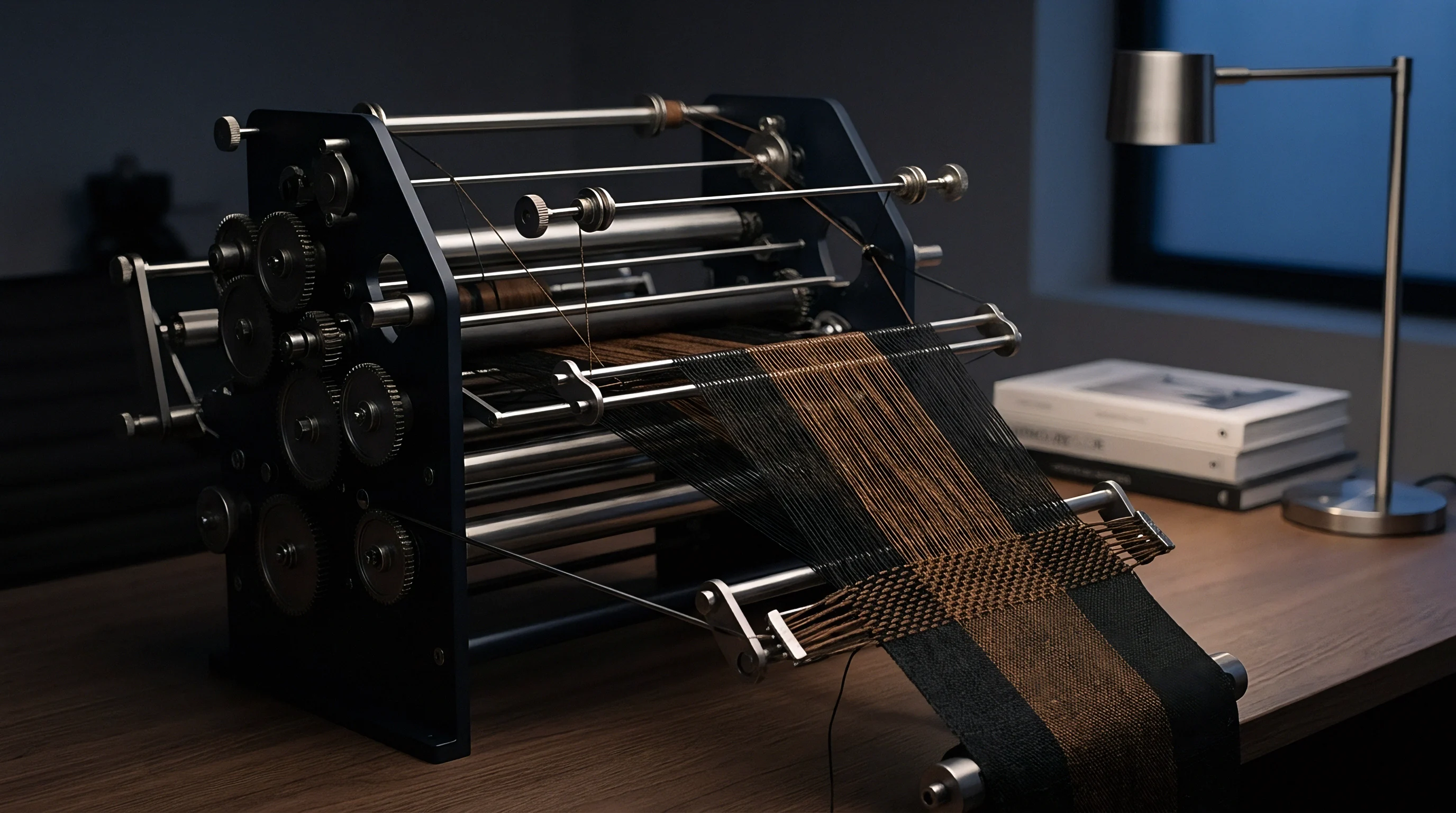
Knot
Mechanical warp stops during high-speed weaving stem mainly from localized structural failures in individual single end yarns. Air-jet looms operating at 800 to 1200 picks per minute subject warp strands to severe cyclic tension peaks, heald wire abrasion, drop wire friction, and reed beat-up impact. If warp preparation processes fail to supply continuous tensile integrity, shedding motion separates fragile filaments, creates cling, or pulls splices apart.
Stop motion droppers fall immediately upon tension collapse, triggering automatic loom braking to avoid severe structural defects in the greige cloth.
A failed splice represents a direct mechanical breakdown of the yarn joining interface. Modern automated winders use pneumatic or mechanical splicing to join yarn packages into continuous warp lengths without physical knots, which produce bulky profiles that catch on dropper eyes and reed wires. Pneumatic splices rely on air turbulence to untwist, intermingle, and retwist fiber ends into a smooth profile.
Encapsulation deficiencies severely compromise this spliced region. When size liquor fails to penetrate the air-entangled fiber matrix, internal friction remains low, allowing cyclic tension peaks to untwist fiber ends and cause joint slippage under dynamic load.
Dynamic tension fluctuations during the shedding cycle place peak stresses on warp ends precisely when the heald frames achieve maximum lift. Fine count cotton yarns, ring-spun or rotor-spun, undergo elongation cycles that exceed five percent strain. Spliced zones lack the continuous parallel structure of parent yarn.
If the tensile modulus of the splice falls below eighty percent of the parent strand, elastic deformation concentrates inside the join zone. The splice elongates plastically, loosens its mechanical interlock, and slips apart under beat-up strain.
The sequence of mechanical breakdown within an un-encapsulated splice joint follows a distinct progressive path during weaving operations.
- Dynamic shed opening stretches the spliced region beyond its elastic yield limit.
- Unanchored outer tail fibers pull out from the intermingled core bundle.
- Drop wire contact creates localized friction, fraying the destabilized splice neck.
- Reinterlacing tail fibers tangle around neighboring warp ends, creating a double-end bridge.
- Beat-up impact forces the tangled bridge against the reed, shearing the weakened splice joint completely.
Dropper drop times range between fifteen and twenty-five milliseconds following a complete strand severance. Loom stopping distance depends on main drive brake torque and machine velocity. A delayed brake response permits the severed warp tail to re-enter the shed, creating double ends, floats, or loose warp end defects.
Mechanical stop rate monitoring provides the primary diagnostic baseline for evaluating warp prep quality. Tail slipping inside pneumatic splices accounts for over forty percent of unforced mechanical warp stops in fine count cotton constructions.
Ignoring splice geometry and joint cohesion increases loom downtime while generating persistent point deductions on the inspection frame.
Film
Sizing encapsulation forms a protective polymeric shell around the outer surface of the yarn bundle while anchoring internal fibers through controlled chemical core penetration. Polyvinyl alcohol, modified starches, carboxymethyl cellulose, and synthetic acrylic binders comprise the core chemical formulations. Penetration depth must reach fifteen to twenty-five percent of the yarn cross-sectional radius to secure internal fibers.
Encapsulation depth must form a uniform exterior film measuring one to three micrometers in thickness. A thin or incomplete size film exposes raw surface fibers to continuous metallic contact during shedding.
| Encapsulation Rating | Size Film Thickness (µm) | Core Penetration (%) | Abrasion Cycles to Break | Expected Stop Rate (Stops/10⁵ End-Metres) |
|---|---|---|---|---|
| Deficient Coating | 0.2 to 0.6 | Below 10.0 | 1,200 to 2,100 | 8.5 to 14.0 |
| Sub-Optimal Film | 0.7 to 1.1 | 10.0 to 14.9 | 2,200 to 3,800 | 4.0 to 8.4 |
| Target Specification | 1.2 to 2.5 | 15.0 to 25.0 | 4,000 to 6,500 | 0.8 to 3.9 |
| Excessive Crust | Above 2.8 | Above 28.0 | 2,500 to 3,200 | 5.2 to 9.0 |
Size pick-up percentage directly dictates total binder volume present on the yarn, balancing dry binder weight against dry yarn mass. A pick-up level falling below eight percent by weight fails to form a continuous polymer film over protruding surface hair. This lack of coating leaves individual fiber loops exposed to catch on drop wires, heald eyes, and adjacent warp strands.
The resulting mechanical interlock forms fuzz balls that migrate down the yarn strand until blocking the heald eye, causing sudden tension spikes and end breakages.
Adhesion failure between size film and fiber surfaces increases hairiness by three hundred percent before the warp strand reaches the reed.
Deficient encapsulation manifests through distinct chemical and physical failure modes across the warp sheet.
- Brittle Film Shearing occurs when low plasticizer ratios cause hard size coats to flake off under dynamic bending stresses inside the heald wire.
- Insufficient Penetration leaves the core fiber bundle unanchored, allowing inner fibers to slide past each other under cyclic warp loading.
- Uneven Size Take-Up creates alternating long zones of under-sized and over-sized yarn across the beam width during drying cylinder contact.
- Hydrophobic Film Repulsion happens when wax residues on raw cotton fibers prevent uniform wetting by aqueous size liquor formulations.
Over-sizing creates equally destructive mechanical conditions on high-speed looms. A heavy size coat exceeding eighteen percent total pick-up turns the yarn bundle into a rigid rod, as bending stiffness increases exponentially with film thickness. Rigid yarn strands resist natural shedding deformation, increasing tension at the harness frames.
Micro-cracks develop in the thick size crust as yarn passes around the whip roll, propagating rapidly toward the core until the film delaminates. Delaminated size flakes gather inside the drop wire box, causing electrical short circuits and false mechanical warp stops.
Chemical additives cannot cure poor yarn winding quality; raw yarn irregularity always overrides binder chemistry on the loom floor.
Wear
Abrasion wear inside the weaving shed acts as an unrelenting mechanical filter on deficient sizing. Each warp end contacts three distinct steel surfaces during every shedding cycle: the drop wire eye, the heald wire eye, and the reed dent wire. A loom operating at 1000 picks per minute exposes every millimeter of yarn in the shedding zone to thousands of sliding frictional cycles.
Unprotected yarns suffer immediate surface hairiness escalation as friction shears away weak surface fibers, generating fiber dust that accumulates on the stop motion bank.
Drop wire friction represents the first mechanical wear point on the warp path, where droppers exert constant vertical gravitational force on individual strands. Stainless steel drop wire eyes develop microscopic surface grooves after thousands of running hours, continuously scrubbing the passing yarn. Sizing encapsulation must withstand this continuous sliding friction without peeling or shedding polymeric dust.
When size coats flake off at the drop wire stage, raw cotton fibers protrude immediately.
Heald wire eyes introduce bidirectional lateral flexural wear. Harness frames move up and down, forcing the yarn strand to angle sharply twice per pick. The friction angle increases as shed height expands; higher shed openings clear jet nozzles cleanly but double the abrasive shear stress imposed on the sizing film.
Sizing binders must maintain elastic flexibility under these high-frequency bending movements, as fragile size formulations fracture at the heald eye and expose bare spots on the yarn core.
Contractual specifications require size loss under standardized dry abrasion testing to remain strictly under twelve percent total film weight.
The reed dent wire delivers the final mechanical impact during beat-up. Dense reed counts compress warp strands laterally inside narrow dent spaces, while air-jet beat-up forces the newly inserted pick against the cloth fell, dragging dent wires over the warp surface under peak tension. Spliced regions passing through dent spaces experience intense lateral compression combined with axial sliding friction.
Splice tails with poor encapsulation peel back under dent friction, opening the splice joint core.
Monitoring shed-floor wear patterns requires systematic verification steps before committing production beams to high-speed sheds.
- Dropper Eye Inspection using magnification optics identifies grooved or burred metal contact surfaces across active drop motion banks.
- Size Dust Collection Analysis quantifies the exact grams of polymeric debris falling beneath the heald frames per million picks.
- Surface Hairiness Profiling measures long fiber counts before whip roll entry and immediately following heald wire passage.
- Splice Abrasion Resistance Testing subjects spliced samples to twenty thousand strokes on a benchtop thread abrasion tester.
Dust accumulation under the harness motion directly indicates size film failure, warning floor supervisors of impending warp stop spikes before efficiency metrics drop.
Equation
Quantifying mechanical warp stop rates derived from sizing deficiencies and splice slip requires deterministic and probabilistic modeling. Total warp stop rate per hour per loom integrates multiple yarn, chemical, and loom mechanical parameters, expressing frequency as stops per one hundred thousand end-metres traversed.
The mathematical relationship governing overall warp stop rate combines baseline yarn break frequency, encapsulation deficiency factors, and splice displacement probability:
S_total = S_yarn + ( K_encap (1 – E_ratio) N_abrasion ) + ( P_splice N_splices )
Where S_total equals total predicted warp stops per 10^5 end-metres. S_yarn defines the intrinsic yarn weakness break rate based on raw tenacity distribution. K_encap represents an empirical loom shedding aggression constant.
E_ratio expresses the sizing encapsulation ratio, defined as film-covered perimeter over total strand perimeter. N_abrasion accounts for cumulative friction cycles per loom meter. P_splice measures the statistical probability of splice slip under dynamic tension.
N_splices indicates the total count of splices present per 10^5 meters of warp yarn.
| Variable | Parameter Description | Target Range | Critical Failure Limit |
|---|---|---|---|
| E_ratio | Encapsulation Film Coverage Ratio | 0.85 to 0.98 | Below 0.70 |
| P_splice | Splice Slip Probability Factor | 0.001 to 0.005 | Above 0.025 |
| K_encap | Loom Shedding Mechanical Aggression | 1.2 to 1.8 | Above 2.5 |
| S_yarn | Intrinsic Raw Yarn Weak Spot Frequency | 0.2 to 0.5 | Above 1.2 |
The splice slip probability factor depends inversely on internal frictional shear strength generated within the spliced zone. Yarn structural geometry dictates that splice pull-out occurs when peak warp load exceeds total internal friction force. Sizing penetration increases this internal frictional force by gluing inner fiber cores together.
Why Do Micro Slices of Spliced Regions Displace under High Air Jet Beat up Tension?
Dynamic tension spikes occurring during beat-up exceed average standing warp tension by three hundred percent. When a spliced segment passes through the drop wires and heald eyes, cyclic bending loosens outer binder film locks. If internal size liquor penetration sits below ten percent, core fibers lack adhesive resin locks.
The high tension pulse stretches the un-anchored parent fibers, causing micro-slippage across the splice lap zone. Micro-displacement accumulates over fifty to one hundred beat-up cycles until total joint integrity collapses, pulling the splice apart completely.
Quantified stop rate models establish that dropping size encapsulation coverage below seventy percent increases total loom stop rates exponentially rather than linearly.
Calculating the precise contribution of splice slip to overall stops requires analyzing stop motion location logs. Modern loom monitoring systems track exact stop positions along the warp length: splice slip stops cluster tightly between the heald frame bank and the cloth fell, whereas encapsulation failure stops occur diffusely across the entire length from whip roll to reed. Statistical regression isolates the primary driver, guiding targeted corrections in warping or sizing departments.
Model limits expand when processing blended fibers, where synthetic hydrophobic fiber blends redistribute internal size liquor stresses during thermal setting.

Metric
Verification of size encapsulation and splice reliability demands rigorous standardized laboratory procedures before mounting beams on high-speed looms. Laboratory diagnostic metrics prevent costly shed-level trials by identifying deficient sizing chemistry or worn splicer chambers early. ISO standards govern mass determination, tensile properties, and abrasion resistance across prepared warp beams.
Size pick-up extraction testing validates total applied binder weight. ASTM D2257 procedures outline solvent extraction protocols to measure removable materials from yarn sheets. A desizing wash cycle using enzymatic baths removes applied starches, while alcohol baths extract synthetic polymers like PVA.
Comparative dry weight analysis before and after desizing establishes absolute size mass percentages. Deviations exceeding plus or minus one percent from target specifications trigger immediate sizing box recalibration.
| Property Measured | Standard Designation | Sample Size | Acceptance Threshold |
|---|---|---|---|
| Yarn Tensile Strength & Elongation | ISO 2062 / ASTM D2256 | 50 individual strands | Tenacity drop below 5% of target |
| Warp Abrasion Resistance | ISO 5587 / ASTM D3886 | 20 warp lengths | Minimum 3,500 wear cycles |
| Splice Joint Retained Strength | ISO 2062 | 30 spliced samples | 85% of parent yarn tenacity |
| Sizing Mass Percentage | ISO 7211-3 / ASTM D2257 | 10 gram warp section | Target pick-up within ±1.0% |
Cross-sectional microscopic analysis provides visual proof of sizing encapsulation quality. Technicians embed sized warp strands in acrylic resin blocks, slicing ultra-thin cross-sections using a microtome. Chemical staining agents react with size polymers, highlighting binder distribution under optical or scanning electron microscopes.
Encapsulation depth, core penetration percentage, and film cross-sectional uniformity receive direct digital measurement across hundreds of sample ends.
Microscopic cross-sectional analysis remains the definitive analytical court for validating binder penetration depth across fine yarn counts.
Splice quality verification requires single-strand tensile testing on automatic strength testers. Automated testers pull hundreds of spliced samples to destruction at controlled strain rates. Retained splice strength must average eighty-five percent or higher relative to unspliced parent yarn.
Elastic elongation at break must maintain ninety percent of parent yarn values. Retained splice strength values falling below eighty percent predict high splice slip rates inside the loom shed.
Sourcing documentation must present verifiable laboratory test data before warp approval.
- Certified Desize Analysis Reports confirming exact size pick-up percentages across left, center, and right beam sections.
- Cross-Section Microscopy Dossiers displaying stained film distribution maps and measured core penetration depth metrics.
- Splice Tenacity Distributions providing Weibull modulus statistics for single-strand tensile breaks across minimum one hundred sample joins.
- Dry Abrasion Endurance Logs recording average cycles to failure on standardized thread-to-thread wear testers.
Master supply agreements mandate full mill credit for greige rolls produced from warp beams failing standardized retained splice strength thresholds.

Loss
Warp stops directly convert loom time into unrecoverable financial losses. Modern high-speed weaving sheds generate profit based strictly on loom hours booked at target efficiency thresholds. Air-jet looms running at 1000 picks per minute produce roughly sixty meters of standard plain cloth per hour.
Every mechanical stop halts production instantly, requiring manual weaver intervention to find the broken end, clear the shed, draw the strand through drop wire and heald eye, re-thread the reed, and restart the loom. Average stop repair time ranges from one to three minutes depending on weaver floor loading.
Quantifying financial loss requires mapping stop frequency directly against shed efficiency metrics. A warp stop rate rising from 1.5 stops per 10^5 end-metres to 6.0 stops per 10^5 end-metres causes severe efficiency degradation. At high stop frequencies, weaver allocation limits collapse: one weaver managing twenty looms under low stop rates cannot maintain machine assignment schedules when stop rates quadruple.
Loom idle time escalates exponentially as machines sit waiting for weaver intervention, driving overall shed efficiency down from ninety-two percent to below seventy-five percent.
| Stop Rate Baseline (Stops/10⁵ End-Metres) | Loom Efficiency (%) | Net Output (Metres/Loom-Hour) | Defect Penalty (Points/100 m²) | Landed Cost Increase ($/Metre) |
|---|---|---|---|---|
| 0.8 to 1.5 (Optimal) | 93.5 | 56.1 | 12 to 18 | Base Line |
| 1.6 to 3.5 (Elevated) | 88.0 | 52.8 | 22 to 30 | +$0.14 |
| 3.6 to 6.0 (Severe) | 78.5 | 47.1 | 38 to 55 | +$0.38 |
| Above 6.0 (Critical Failure) | 62.0 | 37.2 | Above 70 | +$0.82 |
Quality downgrades multiply financial losses through ASTM D5430 four-point inspection penalty systems. Warp stops leave distinct visual faults in finished greige cloth ~ starting marks, loose ends, double ends, and reed marks appear precise to the stop location. Mechanical stops caused by splice slip often create small floats or broken pick intersections before the stop motion halts the main drive, while spliced tails dragging adjacent threads produce distorted picks.
Accumulating defect points above twenty-eight points per one hundred square meters downgrades first-quality cloth to second-quality stock, forcing twenty to forty percent price discounts on commercial markets.
Consider a practical commercial scenario involving a fifty thousand meter production run of 120 gsm cotton plain poplin woven on air-jet machinery. Target loom speed operates at 950 picks per minute across a 190-centimeter reed width, with total warp ends set at 6,800. At an optimal stop rate of 1.2 stops per 10^5 end-metres, the shed books 892 total loom hours to complete the order, achieving 92.5 percent running efficiency and yielding a landed cloth cost of $2.10 per finished meter.
If sizing encapsulation fails and splice slip drives the stop rate to 7.2 stops per 10^5 end-metres, required loom hours jump to 1,228 hours due to continuous machine idle time. Total loom-hour capacity charges expand by $6,048 at a baseline shed rate of $18.00 per loom hour. Additional inspection point penalties trigger a second-quality downgrade on fifteen percent of total yardage, adding $11,250 in direct market value loss.
The resulting total financial loss increases net finished cloth cost by $0.35 per meter, completely destroying operating profit margins across the order.
Calculating the true cost of un-encapsulated warp yarn shifts capital allocation focus directly back to sizing box chemistry and winding room maintenance budgets. Sizing costs represent less than five percent of total greige manufacturing expense. Sacrificing size liquor quality or lowering size pick-up targets saves pennies in chemicals while throwing away thousands of dollars in lost loom capacity and degraded product quality.
Production managers track size encapsulation depth and splice retained strength as critical financial risk indicators, securing high-speed loom efficiency before committing warp beams to the shed floor.