Jacquard Linen Loom Capacity Allocation and Minimums
Locking jacquard linen capacity requires booking minimum warp beam lengths of 1,200 metres and balancing pick densities to protect low-elasticity flax yarns.
Harness
Electronic Jacquard Capacities and Loom Allocation
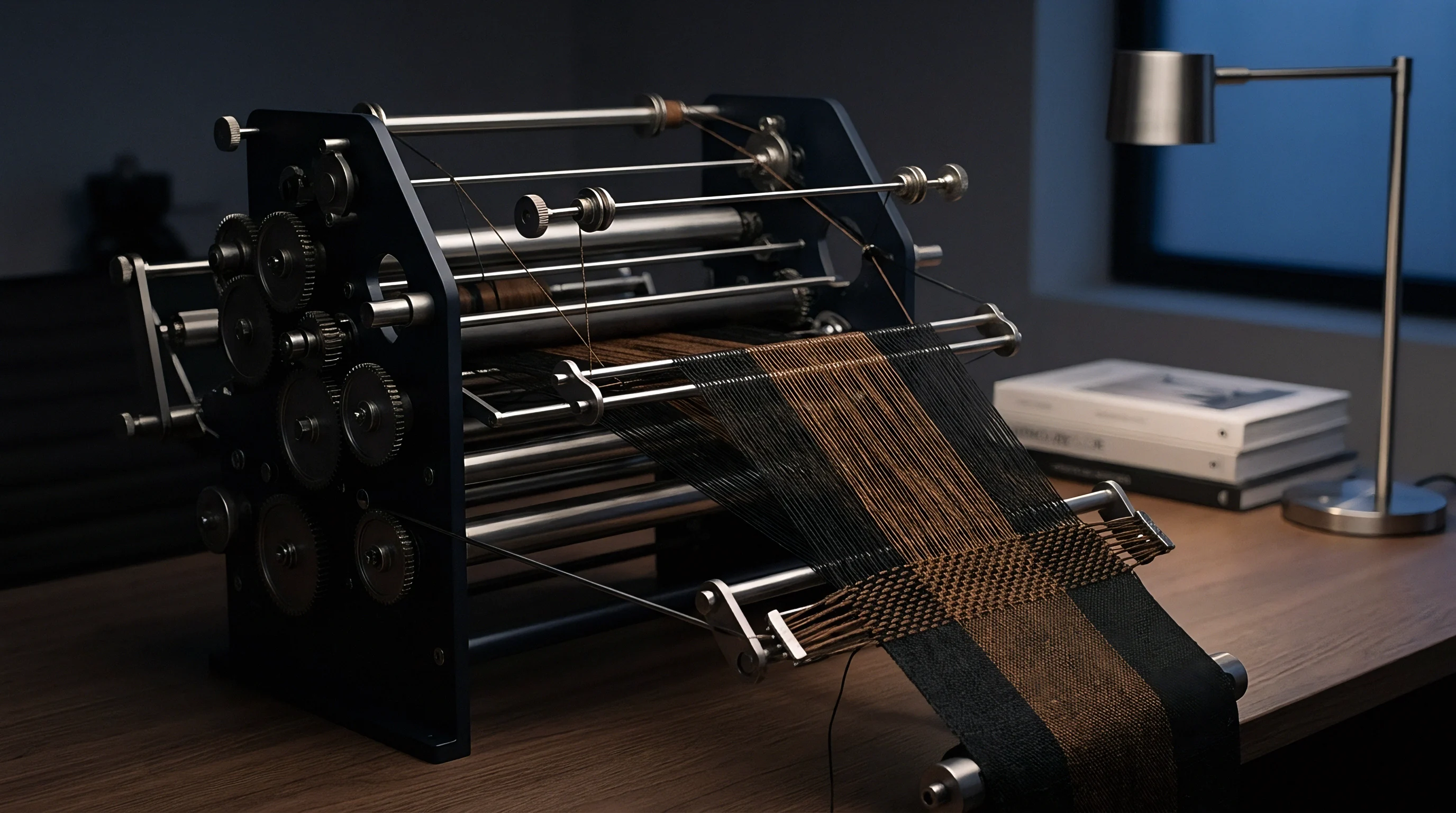
Booking jacquard linen production comes down to the physical geometry of the machine and its harness cords well before yarn touches the loom. Mills weaving pure flax jacquards run high-capacity electronic heads ~ typically Staubli SX or LX models ~ mounted over rigid rapier frames like the Picanol Optimax-i or Itemax R9500. Flax has minimal stretch: break elongation rarely tops 2.5 to 3.0 percent for dry-spun yarns, and drops to 1.8 to 2.2 percent for wet-spun tow or line fibres.
Because the fibre cannot absorb sudden dynamic shocks through elastic stretch, shedding runs at 2,688, 5,120, or 10,240 hooks, kept to conservative speeds. Shed managers peg rapier speeds between 240 and 380 picks per minute on pure linen, whereas the same frames run polyester filament at upwards of 600 picks per minute. The lower speed simply keeps the yarn intact.
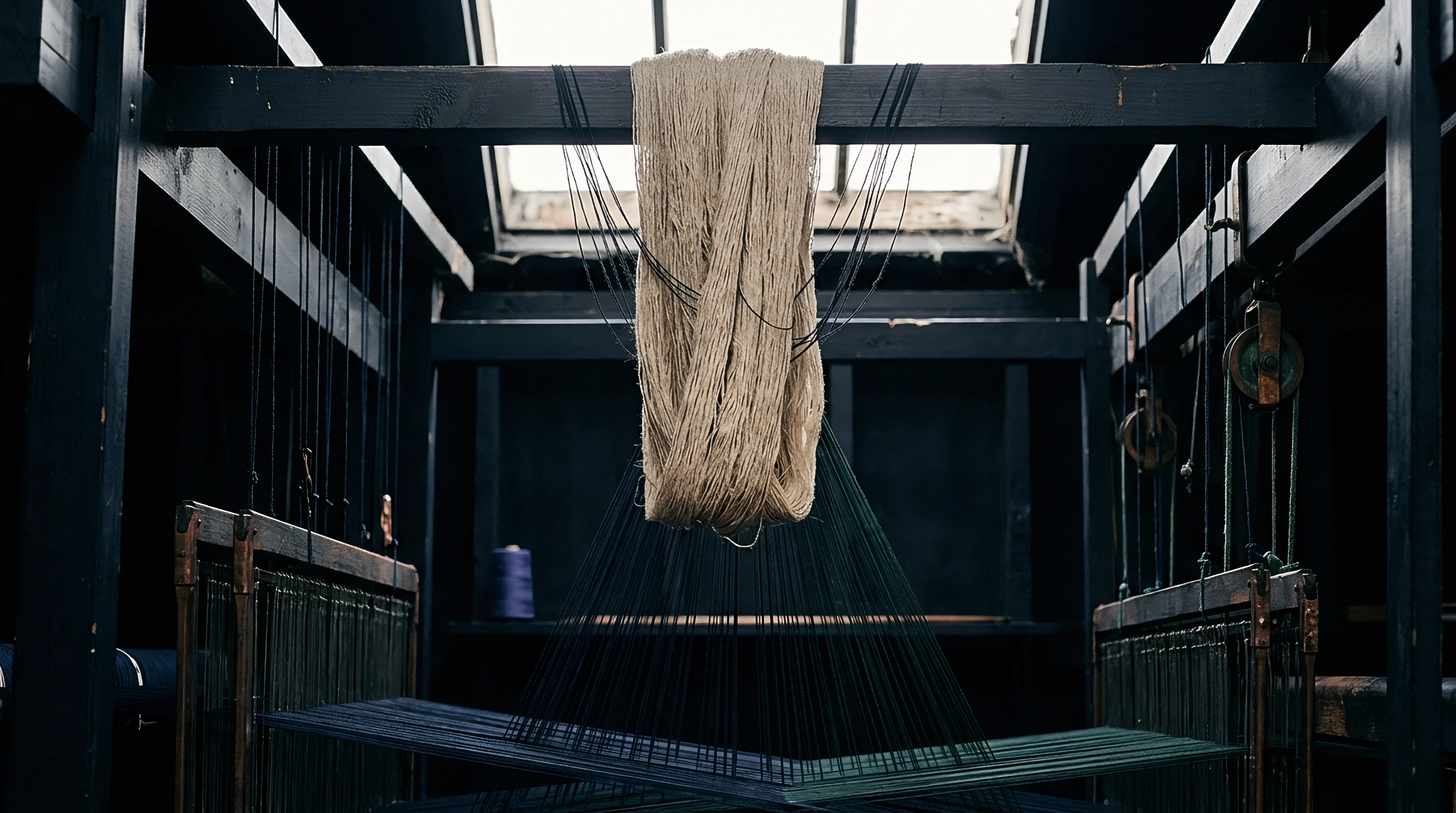
Capacity allocation is dictated by the harness tie-up, which fixes how many times a given pattern repeat recurs across the reed width. Harness cords run down from the electronic knives through the comber board, terminating at the mail eyes that control individual warp ends. For linen, ties are arranged straight or in point repeats calculated for specific reed densities.
A 5,120-hook setup running table linen generally devotes 4,800 working hooks to pattern formation, keeping 320 hooks aside for internal selvedges, false selvedges, and catch cords. At 24 ends per centimetre over an unbleached greige reed width of 200 centimetres, the layout consumes exactly 4,800 working ends ~ a single full-width pattern repeat. If an order calls for upholstery weight at 48 ends per centimetre over the same width, the mill has to re-harness, run a two-repeat tie across 9,600 working ends on a doubled comber board, or thread two hooks per mail eye.
Re-harnessing burns 40 to 80 man-hours of skilled drafting and levelling. Sourcing desks hit firm minimum run rules because sheds will not take pattern structures that clash with the standing harness tie on an active machine.
Tension spikes during shed opening snap low-elasticity flax yarns whenever shedding angles exceed twenty-six degrees.
When loom hours tighten during the peak European production window between January and May, mills filter contracts strictly by hook efficiency. Managers turn away pattern widths that leave more than ten percent of the hooks idle. Operating an active harness with wide dead zones across the comber board creates uneven friction against the return spring assembly, producing chronic warp tension bands across the reed.

Tack
Sizing Formulations and Yarn Mechanical Properties
Flax warps will not survive the continuous rubbing of harness cords, neighbouring ends, and rapier tapes without a chemical size. Unlike cotton, with its uniform tubular cellulose structure, linen consists of bundled ultimate fibres glued together by middle lamellae of pectin, lignin, and hemicellulose. These bundles fray quickly under cyclic friction.
The resulting hairiness makes adjacent warp ends cling together inside the shed, triggering mispicks, warp stops, and stitching defects.
To withstand that abrasion, wet-spun line warps are dressed with modified starches, carboxymethyl cellulose (CMC), and polyvinyl alcohol (PVA), along with lubricating waxes. Dry solids add-on for a 26 Nm (38.5 tex) pure linen warp normally runs between 6.0 and 9.5 percent by weight. Over-sized flax turns brittle and shatters under the impact of the rapier; under-sized yarn rubs up into slubs that wedge in the reed dents.
In practice, warping efficiency and sizing speeds dictate the opening cost base of the entire yardage lot.
| Yarn Count (Nm / Tex) | Spinning Route | Tensile Strength (cN/tex) | Elongation at Break (%) | Target Size Add-On (%) | Loom Warp Stops per 100,000 Picks |
|---|---|---|---|---|---|
| 14 Nm (71.4 tex) | Wet-Spun Tow | 14.5 to 17.0 | 1.8 to 2.2 | 5.5 to 7.0 | 3.5 to 6.0 |
| 26 Nm (38.5 tex) | Wet-Spun Line | 18.0 to 22.5 | 2.0 to 2.5 | 7.0 to 8.5 | 1.8 to 3.2 |
| 39 Nm (25.6 tex) | Wet-Spun Line | 21.0 to 26.0 | 2.2 to 2.7 | 8.0 to 9.5 | 2.2 to 4.5 |
| 50 Nm (20.0 tex) | Wet-Spun Line | 23.5 to 28.0 | 2.4 to 2.9 | 9.0 to 11.0 | 4.0 to 7.5 |
Beaming takes place on sectional warping frames kept between 150 and 300 metres per minute. Creel tension units rely on active disc compensators to prevent pull differences between outer and inner bobbins; tension variations across the warp bands show up as banded defects in the greige that cannot be washed or finished out. When a beam is warped, it holds the full yarn allocation for the entire scheduled weaving run.
Once that beam is wound, the warp specification of every cut off that machine is set.
Weaving depends heavily on ambient conditions in the shed. Pure flax needs steady humidity to stay supple under shedding tension: relative humidity must sit between 65 and 75 percent at 20 to 24 degrees Celsius. If an air-handling failure drops relative humidity below 60 percent, warp breakages triple within ninety minutes, and the shed usually shuts down until conditions recover.
Incomplete desizing shows up later during scouring, bleaching, or dyeing. Residual PVA films act as resists, leaving cloudy streaks across piece-dyed goods that fail ASTM D5430 four-point audits.
Draw
Structural Cover Factor and Weave Interlacing Friction
Linen jacquard work requires balancing graphic pattern clarity against practical cloth stability. Flax has essentially no crimp recovery. In plain weaves or tight twills, the yarn diameter fixes the absolute limit of thread density before beat-up begins to jam the fell.
Designers calculate cover using fractional cloth geometry; jamming sets in as combined warp and weft cover approaches theoretical maximums, roughly 28 to 30 under the metric formula:
Warp Cover Factor equals ends per centimetre multiplied by the square root of warp tex divided by 10. Weft Cover Factor equals picks per centimetre multiplied by the square root of weft tex divided by 10. Total cover equals the sum of warp and weft cover minus their product divided by 28.
Jacquards carry varying float lengths across a single repeat. Grounds often use plain weave or 1/1 ribs to lock the structure together, while figures rely on satin, sateen, or twill floats across five or seven ends to bring out the lustre of the line fibres. Longer floats lower interlacing friction, letting the reed pack higher pick counts into the fell.
But an abrupt shift from a five-end satin float field into a plain ground causes beat-up resistance to jump sharply; the reed pushes hard against the plain sectors, producing scalloped fell lines and reed deflection streaks across the width.
Under ASTM D5430, four or more broken ends within a single running metre penalise the roll by four full defect points.
Flax yarns have irregular cross-sections and natural slubs. In dense setts, these variations cause adjacent threads to abrade each other during every pick cycle. A high-density damask illustrates where these mechanical limits sit:
- Ground construction combines a 39 Nm (25.6 tex) wet-spun line warp at 36 ends per centimetre with a 36 Nm (27.8 tex) wet-spun line weft at 32 picks per centimetre, operating on an eight-end warp satin interlacing for high surface lustre.
- Figure areas drop interlacing points into an eight-end weft sateen structure, maintaining uniform yarn consumption across all harness sectors to avoid warp baggy bands.
- Selvedge reinforcement runs a minimum 24 ends of double-drawn plain weave on dedicated auxiliary harness cords, holding the outer edges stable against the high lateral contraction forces of the linen filling yarn.
- Fell-of-cloth displacement is held under 1.2 millimetres during beat-up cycles by running symmetrical shedding geometries on the electronic jacquard head.
Failing to balance float transitions across bordering panels leads to heavy cockling during wet processing, leaving the yardage unusable for high-end upholstery or apparel.

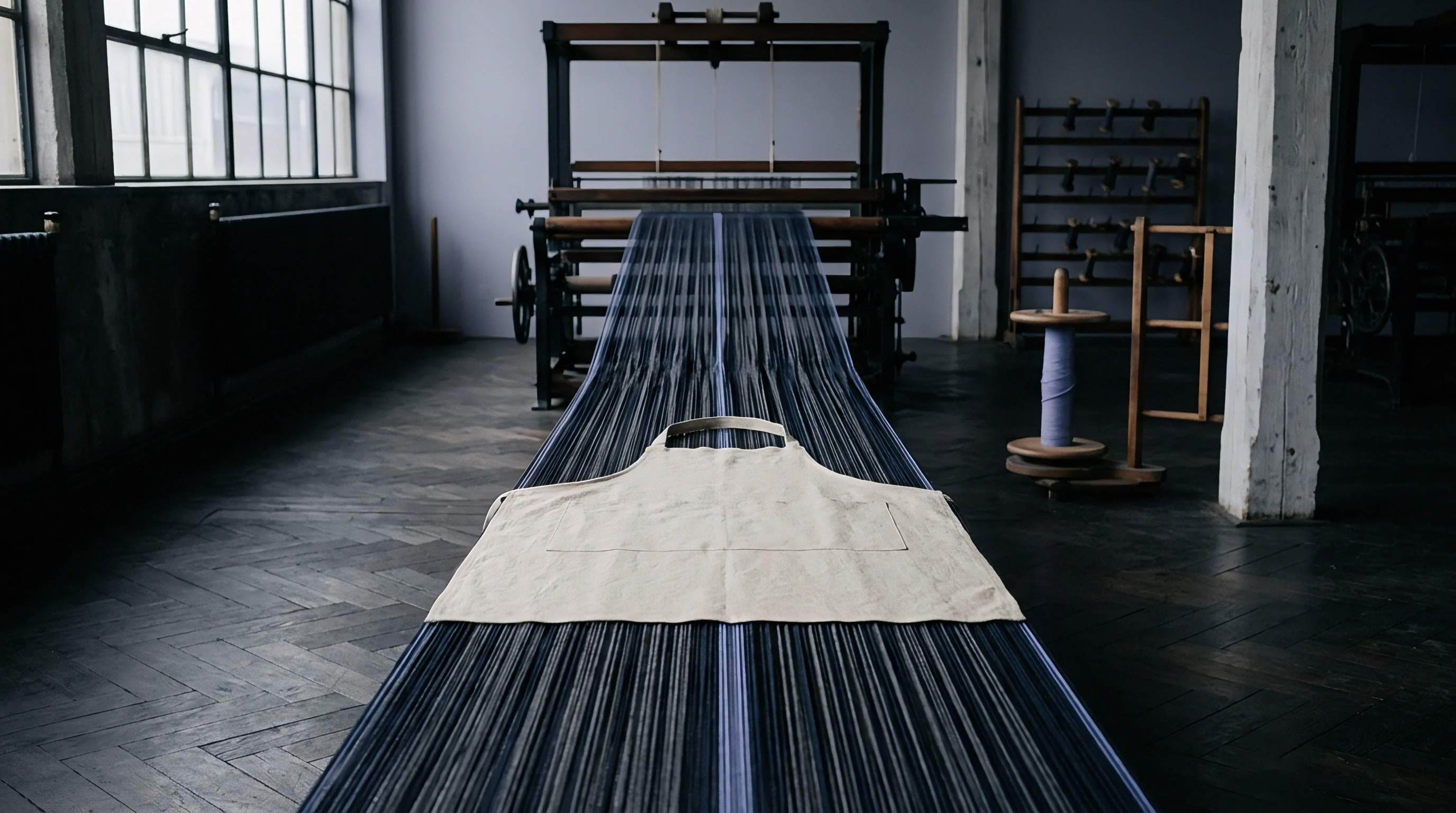
Intake

Minimum Order Quantities Driven by Beam Length
The primary commercial hurdle in jacquard linen is the minimum beam length. Mounting a short sample run of a few dozen metres on an industrial rapier loom makes no economic sense. Preparation involves several separate machines: creel, sectional warper, size box, drying cylinders, and loom beam winder.
Every pass generates waste yarn and takes up equipment that could otherwise be running bulk yardage.
To justify putting a warp up, European and Chinese mills set minimum beam lengths between 1,200 and 3,000 metres. Sectional warping loses 30 to 60 metres of yarn during leasing, sizing tie-in, and looming before the harness knotting frame is even reached. At the loom, knotting an existing jacquard harness to a fresh warp beam with an automatic head (Knotex or Uster topmatic) takes two to four hours on a 5,120-end machine, assuming no ends cross or break.
Drawing an entirely new warp through empty drop wires, heddles, and reed dents stretches that setup past thirty hours.
| Production Order Length (Metres) | Warp Beam Allocation Status | Loom Efficiency Factor (%) | Loom-Hour Burden per Metre | Greige Production Surcharge (%) |
|---|---|---|---|---|
| 300 | Split Beam / Sampling Creel | 45 to 55 | 0.38 Hours | 140 to 180 |
| 600 | Short Warp Run | 60 to 68 | 0.26 Hours | 65 to 90 |
| 1,200 | Standard Mill Minimum Beam | 72 to 78 | 0.20 Hours | 20 to 35 |
| 3,000 | Full Standard Industrial Beam | 80 to 86 | 0.17 Hours | Base Price (0.0) |
| 6,000 | Double Beam / Tandem Production | 84 to 88 | 0.16 Hours | -4 to -8 |
Buyers often try to work around minimum warp requirements by ordering multiple colorways on one common warp ~ a setup known as warp sharing. The mill knots a single natural or bleached white 3,000-metre beam through the jacquard harness, and the customer divides the yardage across different fillings, swapping weft color, count, or blend every 300 to 500 metres. That solves the beam volume hurdle, but it creates headaches on the floor.
Swapping filling yarns requires resetting rapier tensions, accumulator brakes, and pick counts at every change. Any shift in weft thickness moves the beat-up line, requiring mechanical adjustments at the electronic take-up to prevent starting marks and density banding.
The cost penalties for sub-minimum yardage are direct. Buying 300 metres of a custom jacquard design means absorbing the setup, sizing, beam preparation, and harness labour over a tiny volume, easily doubling or tripling the square-metre price compared to baseline industrial rates.
Mills routinely decline orders below standard beam minimums; shed schedules during peak season leave no room for short warps that tie up machine capacity for negligible pick counts.

Shift

How Does Pick Insertion Speed Impact Production Schedules?
Loom hours are the base unit of the weaving shed. Fabric is scheduled, costed, and booked by machine time before it is ever translated into running metres. The pick insertion rate determines how long a contract sits on a jacquard frame, and the relationship between pick density, running speed, and lead time is purely mechanical.
Take an 180-centimetre finished width furnishing fabric: 196 centimetres wide in the reed, a 26 Nm wet-spun line warp at 28 ends per centimetre, and an 18 Nm tow flax filling at 22 picks per centimetre, woven on a 220-centimetre rapier with an electronic head. Running linen weft through rapier grippers forces insertion speeds down to roughly 280 picks per minute to avoid snapping the yarn during the transfer in the middle of the shed. Actual efficiency ~ factoring in warp stops, bobbin swaps, weft breaks, and shift changes ~ averages about 78 percent over three shifts (24 hours).
At 280 picks per minute and 78 percent efficiency, the loom inserts 218.4 picks per operational minute, or 13,104 picks per hour. At 22 picks per centimetre (2,200 picks per linear metre), the machine yields 5.95 running metres of greige fabric per loom-hour. A 2,400-metre run takes 403.36 active loom-hours.
Running around the clock, that order ties up 16.8 calendar days of machine capacity on a single loom, before accounting for beam tying or pre-production sign-offs.
Every increase of two picks per centimetre on a heavy linen jacquard adds ten to fifteen percent directly to machine occupation time.
If the buyer bumps the weft density from 22 to 28 picks per centimetre to make the pattern more opaque, daily output drops from 142.8 metres to 112.2 metres. The machine footprint stretches from 16.8 days to 21.4 days. That unexpected week of loom time backs up subsequent orders, leaving the mill to either decline the change or push back later delivery dates.
The problem worsens when running heavy jacquards through humid summer months without proper climate control, where break rates can drag operational efficiency below 60 percent.
Underestimating loom-hour demand quickly ripples through supply chains. Cut-and-sew operations and home textile finishers sit idle waiting for yardage delayed by excessive shed stops.

Grading
Defect Classification and Physical Inspection Protocols
Inspection happens right after cloth comes off the loom take-up, run over illuminated perch tables at 10 to 15 metres per minute. The standard grading benchmark for commercial jacquard runs is the ASTM D5430 Four-Point System. Because linen naturally contains slubs, tow flecks, and uneven yarn diameters, inspectors have to separate inherent fibre character from true structural faults.
ASTM D5430 assigns demerit points based on defect length:
- Minor defects up to three inches in length receive a penalty of one point, covering small weft slubs, isolated loose picks, or tiny oil spits from the harness pulleys.
- Defects exceeding three inches up to six inches earn two points, covering localized warp floats, harness double-picks, or small starting marks.
- Defects exceeding six inches up to nine inches are assessed three points, covering elongated reed marks, heavy foreign fibres, or broken selvedges that disrupt cloth tracking.
- Defects exceeding nine inches in length receive the maximum four-point penalty, covering massive warp breakouts, continuous pattern dropouts, or long mispicks that traverse the fabric body.
No single linear metre can accumulate more than four points, regardless of how many defects it contains. Point totals per 100 square metres follow the standard formula: total demerit points multiplied by 10,000, divided by the product of inspected metres and width in centimetres. First-quality jacquard linen typically requires scores below 20 to 28 points per 100 square metres for upholstery, and 15 to 18 points for apparel or sheeting.
Higher counts give the buyer contractual grounds to reject the lot.
Physical testing on finished goods verifies that preparation and bleaching have not degraded the fibre. Standard specs require ISO 13934-1 strip testing for breaking force and elongation, alongside ISO 13937-2 trouser tear testing. Bleached jacquards testing below 350 Newtons warp tensile strength or 280 Newtons weft tensile strength under ISO 13934-1 will fail quickly from seam slippage under commercial washing.
Without ASTM D5430 metrics explicitly written into the supply contract, mills default to internal grading standards that routinely pass off mispicks as acceptable natural flax texture.

Claim

Commercial Terms and Capacity Reservation Contracts
Reserving jacquard capacity requires contract terms that cleanly separate machine booking costs from yarn and finishing expenses. Across European and Asian textile regions, spinning, warping, and weaving operate on entirely different scheduling lead times. A forward reservation agreement locks down loom time weeks before designs are finalised.
Agreements need to detail harness setup charges, pattern digitisation, sample approvals, and cancellation terms. Digitising artwork into electronic jacquard EP files involves point-by-point interlacing mapping to maintain cloth balance across float transitions. Card charges generally run between 200 and 800 euros per pattern file, depending on repeat size and hook count.
If an order is cancelled after the warp is sized and mounted, standard industry terms hold the buyer liable for the yarn on the beam, the prep and sizing costs, and a daily downtime fee tied to the scheduled loom hours.
| Cost Component | Basis of Calculation | Typical Cost Contribution (%) | Liability Trigger Point |
|---|---|---|---|
| Flax Warp & Weft Raw Yarn | Weight in kg based on tex count and waste | 45 to 55 | Commitment of yarn spinning or dye lot |
| Warping & Chemical Sizing | Linear metres warped on beam | 8 to 12 | Mounting yarn packages on creel |
| Jacquard Harness & CAD Setup | Fixed fee per pattern repeat structure | 3 to 6 | Generation of master jacquard file |
| Weaving Loom-Hour Conversion | Picks per cm / loom operational speed | 20 to 28 | First pick inserted on production machine |
| Wet Finishing & Inspection | Linear metres scoured, softened, graded | 10 to 14 | Greige cloth delivered to finishing range |
Procurement agreements protect buyers through defined delivery dates tied to liquidated damages. When reserving capacity during periods of heavy flax market volatility, contracts should anchor yarn prices to indexed spot quotes for dry- and wet-spun fibre. Indexing keeps mills from pausing production when raw flax prices spike halfway through a contract run.
A typical clause addressing short-run allocations reads: If the final order quantity confirmed by the buyer falls below the minimum warp allocation specified in Schedule A, the buyer shall pay the documented setup, sizing, and drawing-in costs, and the mill shall retain the remaining beam length for its own stock or clear the harness without further claim on production capacity.