Grounding Warp Stop Baselines in Ring Spun Linen Weaving
Grounding linen warp stop baselines requires linking wet-spun sizing encapsulation and asymmetric shed geometry to hold stops between 2.0 and 4.0 per 100k picks.


Tension
Loom stop logs in wet-spun and dry-spun bast weaving highlight a rigid mechanical boundary where yarn hairiness and low cyclic work-to-break intersect with mechanical shedding. Running 100 percent ring spun linen warps under controlled air-jet conditions yields between 1.8 and 4.2 stops per hundred thousand picks, whereas rapier frames carrying identical lea counts average between 3.5 and 8.0 stops per hundred thousand picks. That contrasts with conventional carded or combed ring spun cotton, where modern sheds operate around 0.5 to 1.2 stops per hundred thousand picks.
Linen yarn consists of high-crystallinity native cellulose bundles cemented by calcium pectate and hemicellulose; its filament aggregate exhibits an ultimate elongation at break rarely exceeding 2.0 to 2.8 percent in the grey state, leaving virtually no dynamic cushion for shed-opening peaks or cyclical heddle friction.
Setting baseline stop targets in purchase specifications poses a practical dilemma. Demanding an ungrounded target of 1.0 warp stops per hundred thousand picks forces a mill to overload sizing formulas with heavy synthetic film-formers or drop loom speeds below 350 picks per minute ~ raising desizing chemistry costs while cutting output. Accepting loose baselines above 10 stops per hundred thousand picks, on the other hand, degrades greige piece goods through starting marks, set marks, and localized warp tension distortions.
Single-end peak dynamic tension during linen shedding must stay below thirty-five percent of mean breaking load to avoid exponential structural cleavage at yarn slub interfaces.
Every stop in a high-speed linen shed leaves a physical mark on the fabric. When the loom halts for a broken warp end, residual beam relaxation causes the cloth fell to creep back. Modern electronic let-off and take-up drives try to compensate with pre-programmed pick-finding reverse sequences, but flax bundles respond nonlinearly to viscoelastic stress relaxation compared with synthetic polymers or crimped animal fibers.
The resulting fell shift causes pick density variations across adjacent centimeters, creating visual bands that fail four-point grading under ASTM D5430.
Setting realistic stop limits requires distinguishing pure tensile failure from entanglement breaks driven by projecting bast fibrils. Ring spinning dry flax bundles produces high surface hairiness with stiff fibers that fail to tuck into the core matrix. Wet spinning softens the pectins in warm water during drafting, yielding a smoother, tighter yarn structure with minimal surface fuzz.
Sizing helps bridge the gap, though size penetration remains notoriously uneven due to dense bundle lumens and residual shive particles. A buyer reviewing a mill quotation must judge stop records against the specific yarn processing route and shed geometry.
This operational compromise directly impacts loom allocation. While an operator in a standard rapier shed manages twenty to thirty looms on cotton poplin or filament polyester, transitioning to ring spun wet-spun linen warps of metric count Nm 39 (lea 23 or 256 dtex) reduces that assignment to eight to twelve looms per weaver. High break frequencies require frequent manual intervention, pulling draw-in hands and battery tenders into constant piecing and pushing labor overhead directly into per-meter fabric pricing.
Cleavage
Bast fiber breakage follows fracture mechanics governed by the separation of elementary cell walls rather than the scission of individual cellulose molecular chains. Flax fibers exist as ultimate cells 15 to 40 millimeters long and 12 to 25 micrometers in diameter, bonded by an inter-cellular pectinous middle lamella. Mechanical drafting during ring spinning acts on these bundles.
Dry spinning leaves bundle separation coarse, producing irregular thick-and-thin cross-sections where twist does not distribute evenly. Stress concentrates at the narrowest diameter nodes and around kink bands or dislocation nodes created during mechanical decortication and scutching.
Dislocation Nodes and Mechanical Degradation
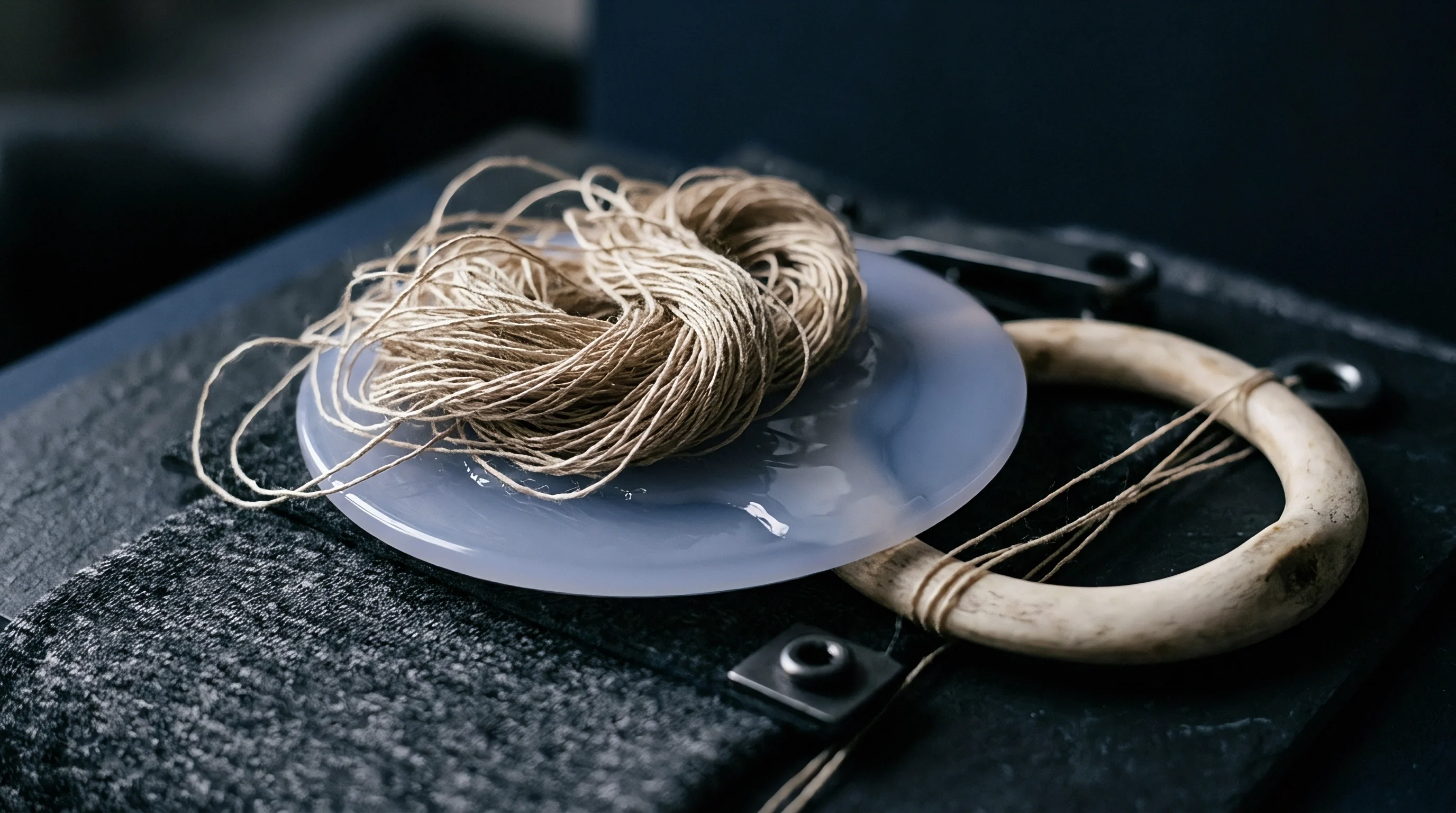
Decortication rollers crush the woody core of flax straw, leaving transverse fissure defects along ultimate fiber walls. Under repeated tension cycles on the loom, these dislocation regions develop micro-cracks. As warp yarn passes through drop wires, heddle eyes, and reed dents, it suffers severe flexural fatigue and multi-axial abrasion.
The friction coefficient between unsized dry-spun linen and steel heddles ranges from 0.38 to 0.48, compared with 0.22 for equivalent continuous filament viscose.
Cyclic work-to-break values capture this structural vulnerability. Standard ring spun cotton absorbs 5.0 to 7.5 centinewtons per tex of elastic energy before undergoing permanent plastic deformation. Wet-spun linen yarns reach only 2.0 to 3.2 centinewtons per tex, while dry-spun linen drops to a fragile 1.2 to 1.8 centinewtons per tex.
Warp preparation counters this weakness by applying sizing agents designed to encapsulate the yarn matrix rather than just coat its exterior.
Abrasion occurs mostly during shed transitions. As harness frames move in opposite directions, adjacent hairy ends rub together in the cross region behind the heddles. This friction peels back elementary flax fibers, balling them into fluff balls or pills.
When these clusters drift forward, they jam at the narrow heddle eye aperture. The blocked yarn experiences a sharp spike in dynamic tension that exceeds the ultimate tensile strength of the single end, shearing the yarn behind the frame.
| Yarn Type | Tenacity (cN/tex) | Elongation at Break (%) | Work-to-Break (mJ/tex) | Friction Coefficient (Steel) |
|---|---|---|---|---|
| Wet-Spun Linen (Nm 39) | 24.0 ~ 28.5 | 2.1 ~ 2.6 | 2.4 ~ 3.1 | 0.31 ~ 0.35 |
| Dry-Spun Linen (Nm 18) | 14.5 ~ 18.0 | 1.6 ~ 2.1 | 1.3 ~ 1.9 | 0.39 ~ 0.46 |
| Bleached Flax Roving (Nm 26) | 19.0 ~ 23.0 | 1.8 ~ 2.3 | 1.8 ~ 2.5 | 0.33 ~ 0.38 |
| Ring Spun Combed Cotton (Ne 30) | 18.5 ~ 22.0 | 5.8 ~ 7.2 | 5.8 ~ 7.6 | 0.22 ~ 0.26 |
| Continuous Filament Viscose (167 dtex) | 22.0 ~ 26.0 | 18.0 ~ 22.0 | 18.5 ~ 24.0 | 0.19 ~ 0.23 |
Reed velocity and beat-up forces further compound the fracture sequence. At beat-up, the cloth fell is driven forward against warp tension. In dense plain weave (tabby) constructions, warp ends undergo sharp crimp exchanges around rigid filling yarns.
Lacking elastic stretch, flax requires immediate longitudinal yarn delivery from the back beam. If the electronic let-off out-of-sync with sley motion, peak dynamic tension can easily double the static baseline, snapping abraded nodal zones along the reed line.
Attributing high shedding failures to the natural character variations of unrefined plant fibers often conceals poor hackling, over-retted stock, or inadequate sizing formulations.
Harness
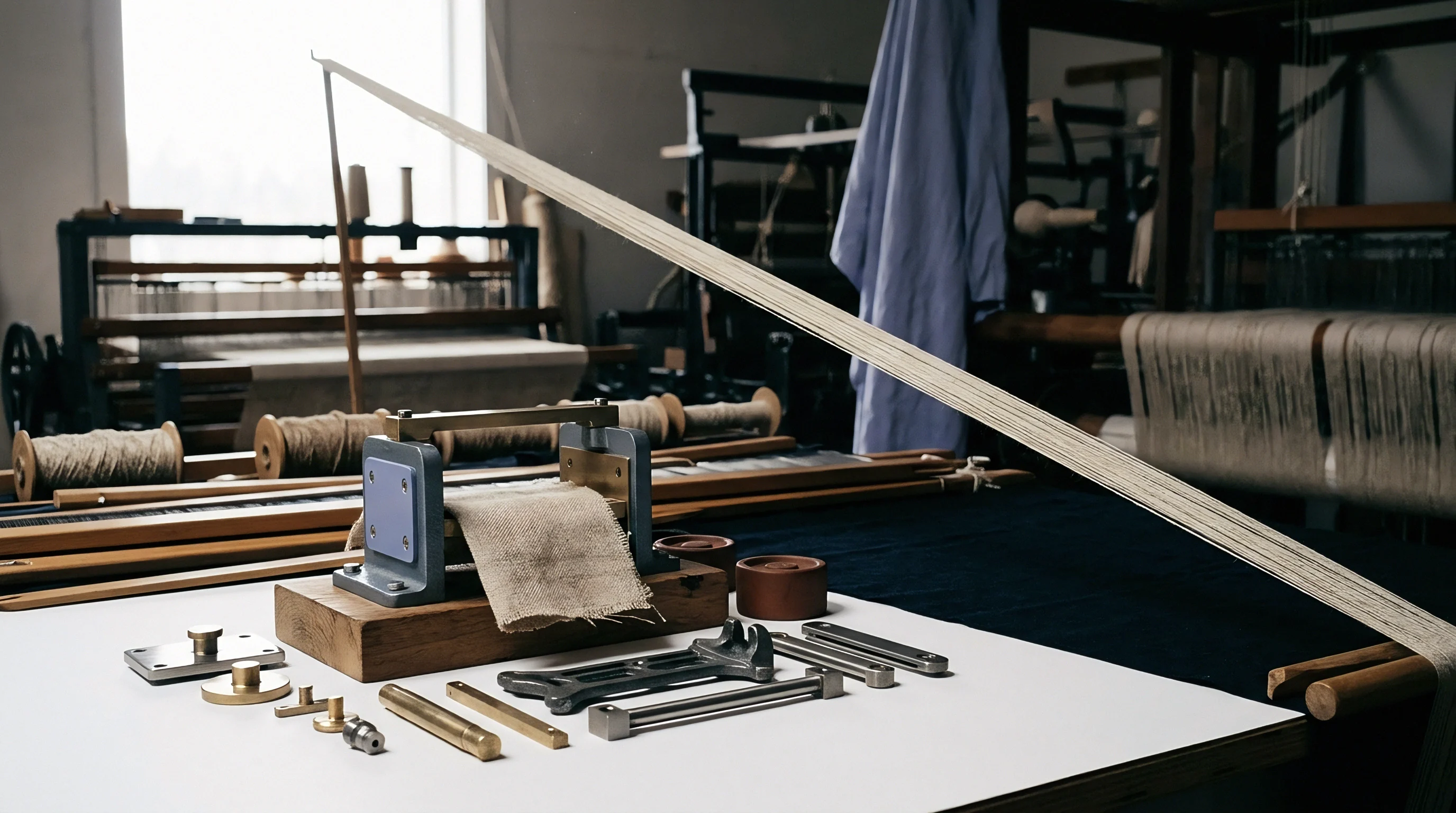
Loom motion dictates how stress spreads across the warp sheet during insertion. Harness kinematics, shed geometry, drop wire selection, and reed execution determine whether a linen warp runs cleanly or suffers continuous stops. The warp line cannot remain flat: while a symmetric shed subjects upper and lower sheets to uniform elongation, linen requires an asymmetric shed line to balance dynamic beat-up tension between open and crossed sheds.
Shed height involves a strict technical compromise. A larger shed provides clearance for insertion elements, preventing rapier or projectile collisions with warp ends, but raising the harnesses increases tensile strain on each flax yarn. On a 190 cm reed width machine running plain weave wet-spun linen, a shed opening angle of 24 to 26 degrees avoids filling interference while holding single-end elongation under 1.2 percent.
Harness dwell timing requires equal care: holding dwell past 120 degrees of mainshaft rotation creates high static strain, fatiguing fiber bundles across the heddle eye radius.
Drop wire mass in bast warp processing must not exceed 0.7 grams per unit for counts finer than lea 30, preventing mechanical yarn cutting under vibration.
Drop wire selection dictates both detection accuracy and yarn wear. Heavy wires accelerate surface fuzzing as they ride against vibrating warp ends during shedding. For Nm 26 to Nm 39 wet-spun yarns, electro-mechanical drop wires weighing 0.85 to 1.1 grams balance reliable stop triggering with low surface abrasion.
Light wires risk false stops from yarn flutter, while overly heavy wires saw through brittle dry-spun linen within a few thousand picks.
Harness frame configuration and heddle design govern frictional heating and yarn clearance. Standard duplex heddles fail to provide enough lateral space for hairy linen yarns. Mandatory adjustments for ring spun flax runs include:
- Heddle eye specification requires polished oval inserted-wire or hardened stainless steel flat mail eyes measuring at least 5.5 mm by 1.2 mm to allow slub clearance.
- Frame staggering arrangement delays harness movement across consecutive shafts by 2 to 4 degrees of mainshaft rotation, reducing inter-yarn friction at shed crossover.
- Reed dent execution calls for DLC-coated or mirror-polished stainless steel dents with a 50 to 55 percent air space ratio to eliminate lateral binding at beat-up.
- Drop box distribution spreads the warp sheet across four to six drop wire rails rather than two, tripling linear spacing between adjacent drop pins.
Back rest roller height dictates the shock wave generated when the sley strikes the fell. Elevating the back rest roller above the horizontal harness plane creates a tension differential between upper and lower sheds at crossover. The slacker sheet lets warp ends shift laterally to clear filling slubs without snagging.
Adding a sprung, damped oscillating back rest absorbs the impact wave at beat-up, protecting brittle bast fibers against sharp tension spikes.
Ignoring these adjustments elevates stop rates enough to compromise shed throughput and cloth quality. Running harnesses on standard cotton timing diagrams causes broken picks and heddle-induced knots to multiply across the fabric.


Draft
Structural cloth design dictates the workload placed on the warp during weaving. The construction draughtsman calculates how fabric weight, ends and picks per centimeter, weave structure, and crimp interact with yarn properties. Mechanical stress on a loom stems less from nominal fabric weight than from friction generated within the warp sheet by pick density and shedding crossings.
Interlacing frequency directly drives yarn stress: plain weave requires the highest crossing density per unit area, putting the warp through the most demanding harness cycle.
Do Structural Crossings Predict Warp Breaks?
Cover factor calculations highlight the physical constraints of weaving ring spun bast fibers. Using Peirce’s formula modified for linen, warp cover factor K1 and filling cover factor K2 combine to quantify total fabric tightness. Flax yarns exhibit higher bulk density and lower packing factors than cotton because of their flat, polygonal bundle geometry.
For a standard 150 g/m² plain weave shirting, wet-spun Nm 39 yarns set at 21 ends/cm and 19 picks/cm yield a warp cover factor of 10.6 and a filling cover factor of 9.6, giving a combined metric cover factor of 18.2.
At these settings, plain weave hits the practical limits of bast weaving. Because every warp end alternates position on every pick, friction inside the heddles and reed stays very high. Switching the construction to a 2/1 twill or 2/2 basket weave reduces crossing frequency by 33 to 50 percent for the same yarn count.
Lowering harness friction allows higher pick densities or lower stop rates; a 2/1 twill structure accommodates warp cover factors up to 13.5 while matching the stop rates of a less dense plain weave.
| Construction | Warp Count | Sett (Ends/cm) | Pick Sett (Picks/cm) | Cover Factor (Total) | Baselines (Stops/100k Picks) |
|---|---|---|---|---|---|
| Plain Weave (1/1) | Nm 39 | 21.0 | 19.0 | 18.2 | 2.4 ~ 3.8 |
| Warp-Rib (2/2) | Nm 39 | 24.0 | 18.0 | 18.5 | 2.1 ~ 3.2 |
| Twill (2/1) | Nm 39 | 26.0 | 20.0 | 20.1 | 1.9 ~ 2.9 |
| Four-End Satin (1/3) | Nm 39 | 28.0 | 21.0 | 21.4 | 1.5 ~ 2.4 |
| Plain Heavy (1/1) | Nm 18 | 14.0 | 12.0 | 17.8 | 4.5 ~ 7.2 |
Crimp distribution determines the take-up allowance required on the warp beam. Flax shows negligible crimp recovery through desizing and scouring. When unbalanced weaves drive warp crimp to 8.0 percent while filling crimp stays under 2.0 percent, warp ends bend sharply over every pick, straining the outer fiber walls of the bundle.
Specifying a tight tabby weave with raw, unboiled grey flax causes trouble: high-modulus unrefined pectins keep the yarn from flattening at crossover points, creating heavy reed resistance and frequent machine knock-offs.
Drafting patterns with staggered harness lifts mitigates these disruptions. In jacquard damasks, positioning large floats next to fine ground weave creates loose warp ends adjacent to tight, high-tension bands. The slack ends vibrate into neighboring threads to create friction entanglements, while high-tension ends snap during beat-up.
Spreading structural floats evenly across the repeat maintains uniform tension along the back rest roller and stabilizes stop rates.
Every extra crossing per centimeter imposes a direct physical strain on ring spun flax yarn. Pushing cover factors past twenty in plain weaves causes break frequencies to rise sharply.


Sizing
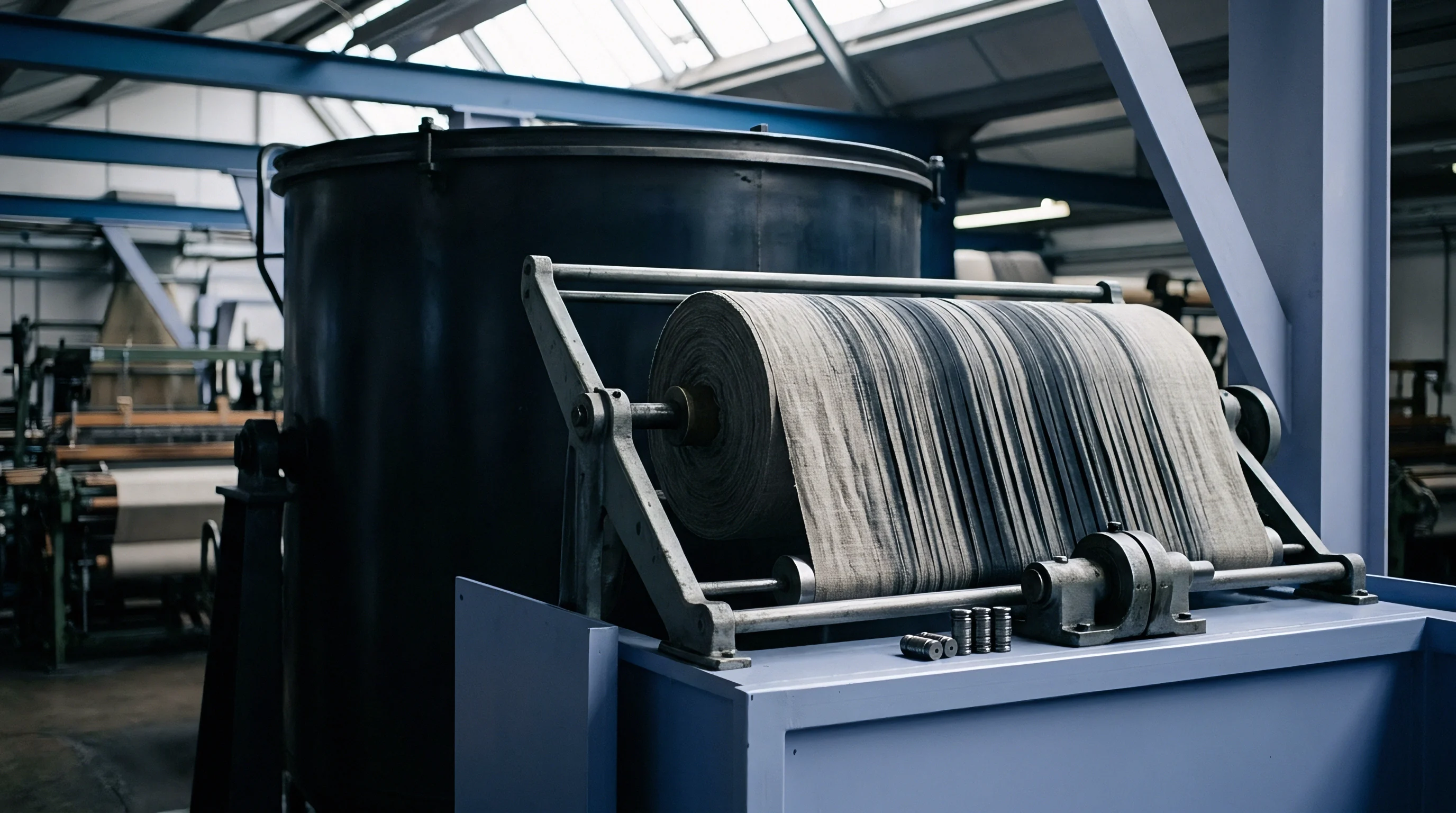
Warp preparation sets the baseline stop rate for any ring spun bast yarn. No amount of loom tuning or harness staging makes up for an improperly sized linen warp. While synthetic filaments and fine combed cotton run well with light sizing, linen requires thorough encapsulation.
Flax absorbs aqueous sizing quickly into its porous structure. Over-sizing yields stiff, brittle yarn that cracks as the shed opens; under-sizing leaves surface hair exposed to friction and rub-offs.
Chemical Formulations and Penetration Control
Modern linen sizing combines modified starches with polyvinyl alcohol (PVA) and acrylic copolymers. High-fluidity potato and oxidized corn starches provide bulk encapsulation, while medium-hydrolysis PVA (87 to 89 percent) contributes film toughness and flexibility. Flexible size film is essential over a brittle flax substrate; formulas relying solely on natural potato starch without plasticizers crack when flexed over drop wires.
Target size pick-up sits between 7.0 and 11.0 percent dry solids for wet-spun yarns from Nm 26 to Nm 39. Coarser dry-spun yarns (Nm 10 to Nm 18) require 10.0 to 14.0 percent add-on to lock loose surface fibers into the core. Size should penetrate the outer 20 to 30 percent of the yarn cross-section while keeping the core supple; fully saturated yarns behave like rigid rods and snap under cyclic bending fatigue.
The size box squeeze roller pressure must be adjusted to hold wet pick-up between one hundred and one hundred fifteen percent, preventing gummy surface buildup.
Sizing ring spun flax calls for controlled multi-zone cylinder drying. Direct contact with overheated cylinder faces bakes starch films, inducing micro-crystallization and loss of elasticity. Standard sizing protocols follow these steps:
- Pre-wetting the warp sheet in a water bath at 60 to 70 degrees Celsius extracts soluble residues and swells outer cell walls before size application.
- Size box temperature must remain at 82 to 86 degrees Celsius to prevent viscosity drift and maintain consistent penetration depth.
- Squeeze roll hardness must calibrate to 65 to 70 Shore A durometer for even liquor expression across the full box width.
- Cylinder drying must use graduated temperature stages from 65 to 110 then down to 80 degrees Celsius to prevent starch film caramelization.
- Moisture regain at headstock delivery must measure between 7.0 and 8.5 percent to keep native cell pectins pliable.
Over-drying frequently causes major weaving disruptions. Drying warps below 5.0 percent residual moisture desiccates inter-cellular pectins, causing yarn dusting and brittle breaks at the drop wires. Re-moisturizing warps with rotary disk atomizers at the headstock restores necessary bundle flexibility before high-speed shedding.
The weaving shed climate must support this moisture target. Bast weaving requires 68 to 74 percent relative humidity at 20 to 22 degrees Celsius. If air washers fail and relative humidity drops below 60 percent, warp break frequencies on identical sized beams can double within forty minutes.
Under-sizing causes rapid fuzz accumulation behind the harness shafts, forcing weavers to spend shift time clearing fiber balls and creating defects that degrade greige fabric value.

Rate
Loom speed determines the strain rate applied to flax fibers. Bast yarns are strain-rate sensitive: higher deformation speeds slightly increase apparent tensile strength but cause sharp drops in work-to-break and ultimate elongation. This forces a trade-off between operating speed and warp stop frequency.
Modern rapier looms that run continuous filaments or fine cotton at 650 to 800 picks per minute must drop to 350 to 450 picks per minute on 100 percent ring spun linen.

Loom Type and Insertion Kinetics
Rapier machines dominate bast weaving because of gentle weft insertion, though rapier kinematics impose considerable lateral friction on warp yarns as the shed closes. Air-jet looms insert weft without solid elements in the shed, avoiding guide-tooth contact with the bottom sheet, but the air blast requires wide, clear shed openings. Higher harness strokes stretch brittle flax to its limit, so air-jet weaving demands high-grade wet-spun yarn with minimal hairiness to avoid weft snarls.
Stop rates directly dictate loom efficiency. Downtime per warp stop on modern linen looms averages 1.2 to 2.5 minutes, covering stop detection, automatic pick-finding, manual piecing, drawing through heddle and reed, and restarting. A loom running at 400 picks per minute executes 24,000 picks per hour.
At 4.0 stops per hundred thousand picks, it averages 0.96 stops per hour ~ losing roughly 2.0 minutes of runtime and maintaining operating efficiency above 95 percent.
If poor sizing or brittle yarn raises the stop rate to 12.0 per hundred thousand picks, stops jump to 2.88 per hour. Lost time rises to 4.5 to 7.0 minutes per hour, dropping efficiency below 88 percent and turning profitable capacity into a loss.
| Loom Technology | Picks Per Minute (Max) | Effective RPM (Linen) | Nominal Stops/100k | Expected Shed Efficiency |
|---|---|---|---|---|
| Positive Rapier (Rigid) | 380 | 280 ~ 320 | 4.5 ~ 8.5 | 86 ~ 90% |
| Negative Rapier (Flexible) | 700 | 380 ~ 460 | 2.8 ~ 4.8 | 91 ~ 95% |
| Air-Jet (Profile Reed) | 1000 | 550 ~ 680 | 1.8 ~ 3.5 | 93 ~ 96% |
| Projectile Loom | 420 | 320 ~ 360 | 3.2 ~ 5.5 | 89 ~ 93% |
Weaver assignments tie these efficiency limits directly to floor economics. Managing twenty high-speed looms, an operator can handle a shed average of 1.5 stops per machine hour. If machines average 3.0 or 4.0 stops per hour, queue times ~ the minutes a stopped loom sits waiting for attention ~ exceed actual repair times, accelerating capacity loss across the shed.
Loom builders often cite speed figures based on smooth, high-tenacity synthetics. Sourcing teams basing schedules on catalog speeds quickly learn that the flax warp dictates operating velocity, not the main motor.

Ledger
Cloth is bought in loom hours and sold in running meters. Technical managers and sourcing teams must translate ends, picks, sizing solids, and stop baselines into procurement balance sheet figures. High break frequencies erode margins through increased labor costs, lower equipment utilization, higher desizing utility expenses, and value markdowns from stop marks.
Worked Cost Breakdown of Shed Disruption
Evaluating the commercial impact of elevated stop rates requires examining a sample 10,000-meter production run of standard plain weave linen apparel fabric under clear operational assumptions:
- Fabric specification uses Nm 39 wet-spun ring spun linen in warp and filling at 20 ends/cm and 18 picks/cm, with an on-loom width of 165 cm yielding 148 cm finished width.
- Machine capacity parameters assume negative rapier frames running at 420 picks per minute, with shed operating costs billed at twenty-two dollars per active loom hour (excluding raw yarn).
- Order pickage volume totals 18,000,000 machine picks to produce 10,000 linear meters of greige cloth.
- Downtime repair assumptions budget 1.8 minutes per stop for pick-finding, manual knotting, re-drawing, and restart.
At an optimized baseline of 2.5 stops per hundred thousand picks, the order generates 450 warp stops. Repair downtime totals 810 minutes (13.5 loom hours). Running time at 420 picks per minute requires 714.3 loom hours, bringing total shed allocation to 727.8 loom hours.
Total loom cost comes to $16,011.60, or $1.60 per woven meter.
If poor sizing or low-grade roving drives the stop rate to 8.0 per hundred thousand picks, breaks increase to 1,440. Downtime reaches 2,592 minutes (43.2 loom hours), pushing total booked time to 757.5 loom hours. At twenty-two dollars per loom hour, conversion costs rise to $16,665.00 ~ an extra $653.40 in direct waste.
The loss of nearly thirty loom operating hours delays subsequent delivery schedules and finishing slots.
Direct downtime charges are only part of the penalty. Further loss occurs at inspection under ASTM D5430 four-point grading. A warp stop leaving a visible starting mark receives a three- or four-point penalty.
Accumulating over 28 points per 100 square meters degrades a fine wet-spun shirting roll from first- to second-quality, forcing price markdowns of 25 to 40 percent.
Standard purchase contracts protect buyers by formalizing stop baselines in procurement terms. Sourcing specifications often include a clause stating: If greige production exceeds an average of 4.5 warp stops per one hundred thousand picks over any rolling ten-thousand-meter production block, the buyer reserves the right to cancel remaining loom allocations, require re-sizing of unslashed yarn lots at the mill’s expense, or debit conversion fees by an amount equal to documented loom downtime hours.
When high stop rates reduce output and trigger defect penalties, settling accounts becomes difficult. Commercial disputes usually resolve through disputed debit notes or price concessions that strain long-term supplier relationships.