Pneumatic Yarn Splice Microstructure and Tensile Mechanics
Pneumatic yarn splices in linen warp must balance wrapper coil friction and splice diameter to prevent abrasive fatigue failure during high-speed loom shedding.
Cavity
Compressed air enters the mixing block through cross-drilled channels angled between forty-five and sixty degrees relative to the yarn path. The pneumatic blast expands into a hardened steel chamber, generating a dual-vortex airflow that strips the initial twist from two overlapping yarn ends before intermingling their constituent fibers. In wet processing of bast fibers, pressurized fluid mist atomizes directly inside the chamber volume to plasticize pectin binders and lower the flexural rigidity of coarse flax bundles.
Dry chambers lose loose fiber. High-speed cameras record boundary layer velocities exceeding three hundred meters per second at supply pressures of six bar, creating violent turbulent shears that disperse outer fibrils around the yarn axis. The resulting joint relies entirely on mechanical inter-fiber friction generated by geometric entanglement rather than chemical adhesion.
Pneumatic splicing cycles execute within a tight temporal window spanning two hundred to five hundred milliseconds on modern automatic winding stations. The sequence divides into distinct operational stages: yarn clamping, mechanical cutting, pneumatic untwisting, pneumatic retwisting, and final tensioned release. Variations in chamber volume and inlet nozzle diameter dictate the mass throughput of air, directly shifting the vortex swirl ratio.
When winding dry-spun linen yarns of forty lea or coarser, standard cylindrical chambers fail to produce sufficient lateral fiber migration. Triangular and asymmetrical cross-section blocks force transverse circulation, driving the stiffer bast fibrils across the yarn centerline.
- Yarn clamping sequence establishes static positioning across the cutting anvils to prevent premature slip under tension.
- Pneumatic untwisting blast opens the twist structure over a designated overlap length without severing parent strand fibrils.
- Fluid injection pulse introduces micro-droplets of water at five bar to soften inter-cellular pectin films on exposed flax.
- Retwisting swirl cycle rotates the mingled fiber ends in the opposite direction, wrapping exterior fibrils over the joint.
- Evacuation draw stroke pulls excess loose fiber tails into the waste collector before the winder resumes package rotation.
Air velocity reaches supersonic speed. Chamber geometry dictates how efficiently shockwaves dissipate along the fiber axis without inducing tensile rupture in brittle staple fibers. Bast fibers exhibit low ultimate elongation compared to synthetic filaments or cotton, causing fiber shattering when untwisting blast pressures exceed six and a half bar.
Technicians adjust the pneumatic valve dwell time to prevent over-stripping of the yarn ends. Excessive exposure to high-velocity vortices generates localized fiber loss, reducing the linear density of the spliced zone below eighty percent of the parent strand.
| Yarn Type And Count | Chamber Geometry | Air Blast Pressure (bar) | Pulse Duration (ms) | Water Mist Volume (microliters) |
|---|---|---|---|---|
| 100% Wet-Spun Flax 26 Nm | V-Profile Triangular | 6.2 | 380 | 12 |
| 100% Dry-Spun Flax 14 Nm | Dual-Slot Asymmetric | 6.8 | 460 | 22 |
| Flax Cotton Intimate Mix 30 Nm | Cylindrical Dual-Port | 5.5 | 290 | 0 |
| 100% Combed Cotton 40 Ne | Symmetric Prismatic | 4.8 | 220 | 0 |
Yarn suppliers frequently excuse low tenacity by claiming that high chamber pressures blow away the essential flax gums during the splicing cycle.
Morphology
Microscopic inspection reveals three structural zones across the longitudinal profile of a pneumatic splice: the central intermingled region, the flanking wrapping zones, and the terminal tail tapers. In ring-spun yarns, the original helical twist disappears entirely within the central twenty millimeters of the joint. In its place sits an unoriented, felted assembly of longitudinal load-bearing fibers locked into position by circumferential wrapper fibers.
These wrapper fibers migrate from the exterior of the untwisted ends, driven inward and outward by the turbulent vortex to form tight binding coils. Spliced zones in flax yarns display irregular packing density because individual bast bundles resist transverse deformation.
Coarse fiber bundles slip through loose wraps when vortex intensity drops below threshold.
Splice diameter sets reed resistance. The cross-sectional profile of an acceptable pneumatic splice exhibits an increase in diameter of ten to thirty percent over the nominal parent yarn. Values exceeding forty percent create severe friction points inside the loom drop wires and heddle eyes.
Cross-sectional scanning electron microscopy demonstrates that while the parent yarn possesses a circular or oval geometry with uniform twist angle, the central spliced zone assumes an irregular, compressed polygon shape with voids between poorly flexible flax ultimates. Packing factor drops from 0.65 in the parent ring-spun yarn to roughly 0.48 in the spliced segment.
- Tail fiber protrusion creates brush-like clusters that catch adjacent ends during shed opening cycles.
- Insufficiency of wrapper coils permits early axial slip of load-bearing fibers under moderate tensile loads.
- Excessive localized bulk chokes yarn clearances inside reed dents, abrading neighboring warp ends.
- Corkscrew structural bias induces torque imbalance, causing localized snarls during package unwinding.
Tail length determines whether the joint passes cleanly through warp preparation stages. If the tail ends terminate abruptly without structural integration, loose ends lift from the yarn body under yarn-guide friction. Modern splicing blocks incorporate secondary trimming blades that taper the tail fibers across four to six millimeters.
Wet splicing compacts flax bundles. The added moisture causes localized swelling of the cellulosic walls, which increases transverse contact area and locks wrapper turns into place before drying stabilizes the joint.
A firm splice maintains diameter parity with the parent strand across the entire joined length.

Expense
Loom stop rates drive the conversion cost of grey cloth. When an automatic winder produces defective splices that fail during warping or shedding, the financial loss extends beyond yarn waste into idle machine hours and manual mending labor. Operating a modern air-jet or rapier loom shed costs between twenty-two and thirty-eight dollars per machine hour depending on regional power tariffs, depreciation schedules, and overhead allocation.
A single warp break on an eight-hundred-pick-per-minute machine idling for three minutes consumes valuable capacity, reducing total yardage output and disrupting planned beam runout schedules.
Why Do Splice Failures Inflate Shed Costs?
Production deficits multiply when weak joints snap simultaneously across multiple adjacent ends during high-tension shed beat-up. A warp break frequency exceeding 1.5 stops per one hundred thousand picks forces an operator to oversee fewer machines, pushing direct labor costs upward. In high-density linen plain structures, a single broken warp end creates a visible defect across several centimeters of greige cloth before the warp stop motion brings the sley to a standstill.
Greige mending adds direct expense. Mending rooms charge per defect fixed, eroding the commercial margin on finished piece goods.
Warp break rates above two stops per hundred thousand picks double standard shed labor allocation.
Winding speed balances package quality against pneumatic splice integrity. High-speed winders running at twelve hundred meters per minute cycle the splicing mechanism thousands of times per shift. Reducing splicing cycle time by one hundred milliseconds increases winding throughput by two percent, yet cutting air pulse duration risks incomplete entanglement on bast fibers.
The economic optimum favors longer splice cycle times and higher air consumption to secure joint reliability in warp preparation.
| Splice Failure Rate (%) | Warp Stops Per 100k Picks | Loom Efficiency (%) | Shed Cost Per Linear Metre (USD) | Greige Mending Cost Per 100 Metres (USD) |
|---|---|---|---|---|
| 0.5 | 0.8 | 92.4 | 1.84 | 14.20 |
| 1.2 | 1.4 | 88.6 | 1.96 | 28.50 |
| 2.5 | 2.6 | 81.2 | 2.24 | 58.00 |
| 4.0 | 4.1 | 72.5 | 2.62 | 104.00 |
| Assumptions: 190 cm width, plain structure, 22 ends/cm, 18 picks/cm, 750 picks/min, 30 USD per loom hour base operating rate. | ||||
Tolerating inadequate splice parameters drops loom efficiency below acceptable commercial thresholds, converting planned operating profits into unrecoverable shed overhead charges.
Traction
Tensile mechanics of spliced staple yarns diverge sharply from continuous parent yarn behavior. When axial tension applies to a pneumatic splice, tensile loads transfer across the discontinuous parent ends through inter-fiber shear. The outer wrapper fibers exert radial inward pressure, generating normal forces across the central load-bearing fibers.
According to Amontons’ frictional laws modified for fibrous assemblies, the total frictional resistance resisting axial pullout equals the product of the inter-fiber friction coefficient and the cumulative normal force generated by wrapper coils. Static strength misses fatigue life. Linen fibers possess a low transverse compliance and an irregular, polygonal cross-section, limiting intimate contact area unless high radial pressure flattens outer surface ridges.
Tensile testing under ISO 2062 reveals that standard dry pneumatic splices achieve between sixty-five and seventy-five percent of parent yarn breaking tenacity. Wet pneumatic splices achieve eighty to ninety percent tenacity retention. Wet splices gain frictional grip.
Capillary forces and localized pectin softening allow wrapper fibers to bed deeply into the core strand, increasing the real contact area. Elongation-to-break across the spliced segment drops significantly compared to the parent strand. Parent wet-spun flax yarn exhibits roughly 2.8 percent elongation at break, whereas the spliced zone ruptures at 1.8 to 2.1 percent strain.
This loss of elasticity creates a structural notch effect under sudden dynamic loading.
The failure mode shifts depending on wrapper coil density and fiber overlap length. In splices with insufficient length or low air pressure, failure occurs exclusively by fiber slip, where the opposing parent yarn ends slide apart without fiber breakage. Spliced fibers pull out intact, exhibiting clean, unruptured tips under optical magnification.
Conversely, when wrapper coils generate normal forces exceeding the individual tensile strength of the fibers, the failure mode transitions to pure tensile rupture. High normal forces lock the fibers in place, causing them to fracture progressively from the outer periphery inward. In commercial flax processing, the ideal splice exhibits a hybrid failure mode: forty percent fiber breakage combined with sixty percent controlled frictional slippage.
Single-end tensile testers report ninety percent retention on specimens that unravel under five cyclic load repetitions.
Short tails pull through cleanly. Tension cycles break loose tails. Experimental trials indicate that gauge length selection on tensile testers masks localized splice weaknesses.
A standard five-hundred-millimeter test gauge averages the extension of parent yarn over a long span, concealing the brittle behavior of a thirty-millimeter splice zone. Testing at short gauge lengths of fifty millimeters isolates the splice, exposing severe reductions in work-to-break values. Work-to-break represents the area under the force-elongation curve, which governs whether a spliced end survives sudden shed changes.
The exact quantitative relationship between moisture content, fiber surface wax distribution, and the resulting normal pressure generated by wrapper coils remains an open question across diverse bast fiber crops.
Fatigue
Dynamic stresses inside a weaving shed exert cyclic tension, multi-directional flexing, and aggressive surface abrasion simultaneously. A warp end passes through the drop wire, heddle eye, and reed blade, experiencing up to ten thousand cyclic tension peaks before emerging into the woven cloth. Peak tensions reach 0.8 to 1.4 centinewtons per tex during shedding motions, well below the static breaking tenacity of a pneumatic splice.
Cyclic extension unseats spliced joints. Spliced warp ends break primarily from cyclic fatigue and heddle abrasion rather than single catastrophic peak overloads.
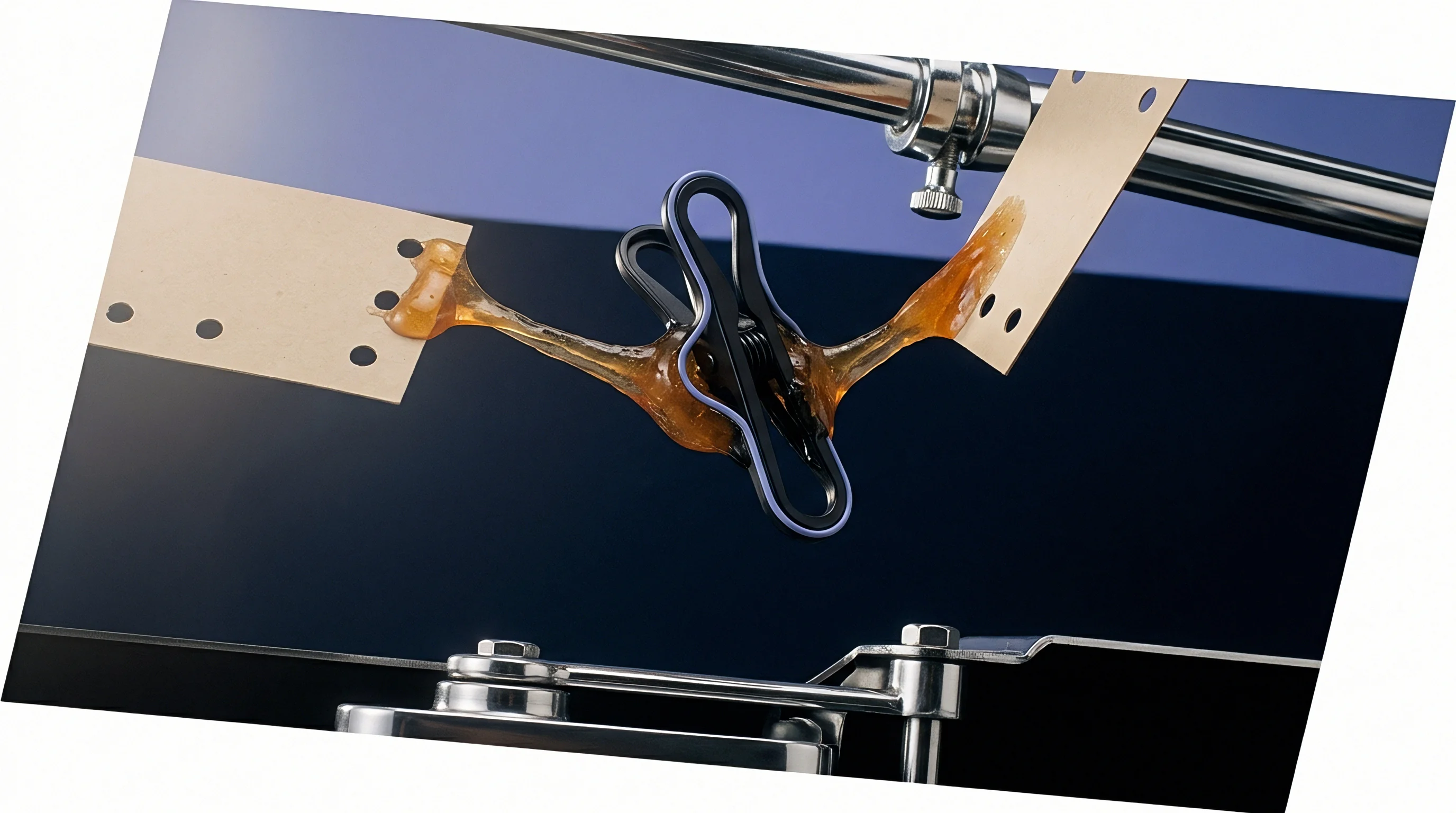
Which Yarn Preparation Parameter Governs Weavability?
Sizing add-on percentage controls the mechanical survival of pneumatic splices during loom operation. Unsized flax splices unravel rapidly under the aggressive backwards-and-forwards rubbing action of heddle eyes. The metallic eye abrades the outer wrapper fibers, severing the microscopic coils that maintain radial pressure on the core.
Once wrapper continuity breaks, the unoriented central fibers slide apart under standard warp sheet tension. Applying a high-film-strength modified potato starch or polyvinyl alcohol size formulation glues wrapper coils securely to the yarn core, raising fatigue life by three hundred percent.
Reed abrasion destroys weak joints. Splicing geometry governs beam efficiency. As the reed beats each pick into the cloth fell, adjacent warp ends rub against one another inside the reed dent.
Splices with elevated diameters experience severe abrasive contact, causing fibril peeling that leads to giant fiber balls behind the reed. Uncut fibers foul the shed. Warp breaks stop the loom.
Automatic testing using dynamic stress testers demonstrates that splices surviving five thousand cycles at two percent static extension experience rapid degradation if the surface hairiness index exceeds normal tolerances.
ASTM D5430 inspection protocols penalize visible warp breaks as severe defects that degrade cloth value from first to second quality.
A specific purchase contract clause stipulating a minimum spliced tenacity retention of eighty percent combined with a maximum diameter increase of twenty-five percent shifts operational liability back to the spinning mill, forcing strict control over chamber maintenance and winder calibration.