Active Warp Tension Control for Linen Weaving Mills
Active closed-loop warp tension control suppresses shedding strain spikes in wet-spun linen, lowering warp breaks and driving loom speed from 320 to 480 PPM.

Hysteresis
Wet-spun flax yarn combines a steep initial modulus with minimal ultimate elongation, generating severe stress spikes under cyclic mechanical loads. Its highly crystalline cellulosic structure aligns tightly along the fiber axis. Typical wet-spun yarns exhibit a tensile modulus between 18 to 30 GPa, while breaking strain stays constrained between 1.5% and 2.2%.
Unlike cotton or synthetic staple yarns, bast fibers provide virtually no elastic buffer, meaning small geometric changes during shedding translate directly into sharp strain differentials across the warp sheet.
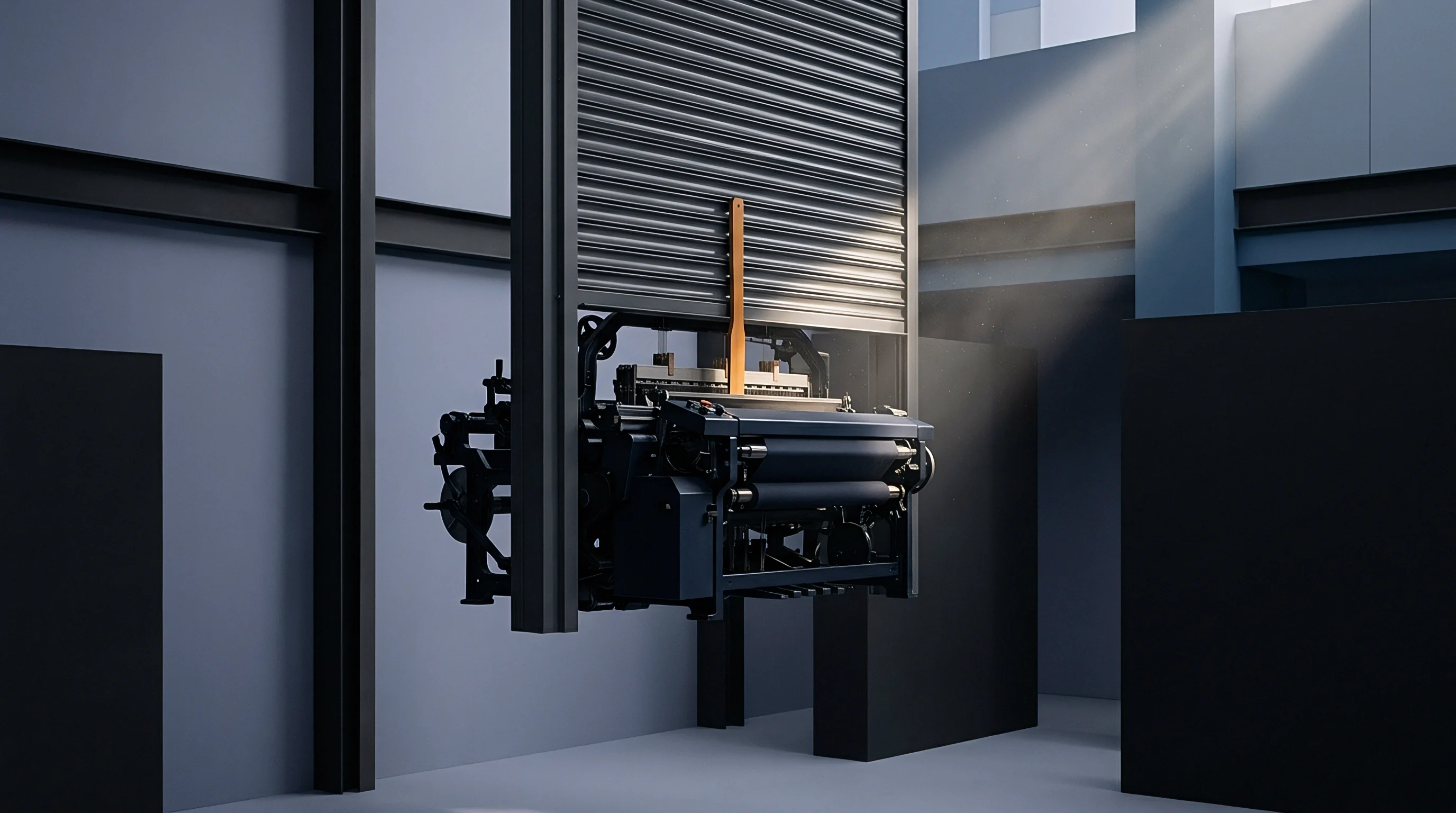
Static mechanical let-off systems rely on friction bands or deadweight lever arms that react only after cumulative tension shifts alter the backrest roller’s position over multiple loom revolutions. At speeds exceeding 400 picks per minute, shedding takes place within a 40 to 60 millisecond window. Passive mechanical brakes fail to accelerate or decelerate the heavy yarn package fast enough to handle these instantaneous load shifts.
Consequently, peak loads during heald frame clearance frequently surpass the yield point of single-spun yarns, driving inter-fiber slippage in the yarn core or causing direct tensile failure.
Stiff bast fibers absorb shedding strain through internal cell wall deformation rather than linear elongation.
Cyclic loading during shedding progressively degrades structural nodes within the flax fiber. Without instantaneous tension control, repeated stretching and relaxation lead to mechanical fatigue. Uncompensated tension spikes force micro-slubs through heddle eyes and reed dents under heavy lateral pressure, causing localized fiber shearing and high friction.
Passive let-off mechanisms allow warp tension to swing by more than 40% above set baseline levels during shedding, accelerating end breaks and creating uneven pick density across the woven greige cloth.
| Yarn Construction | Tenacity (cN/tex) | Elongation at Break (%) | Elastic Modulus (GPa) | Peak Shedding Load (N/end) |
|---|---|---|---|---|
| Wet-Spun 100% Linen 26 Nm (38.5 tex) | 32.5 | 1.85 | 22.4 | 2.45 |
| Wet-Spun 100% Linen 40 Nm (25.0 tex) | 34.1 | 1.70 | 24.8 | 1.92 |
| Wet-Spun 100% Linen 60 Nm (16.7 tex) | 36.8 | 1.55 | 28.2 | 1.38 |
| Dry-Spun 100% Linen 14 Nm (71.4 tex) | 19.2 | 2.40 | 14.1 | 3.85 |
Heavy sizing add-on levels alone cannot absorb peak shedding strains without active motor-driven let-off control.

Beam
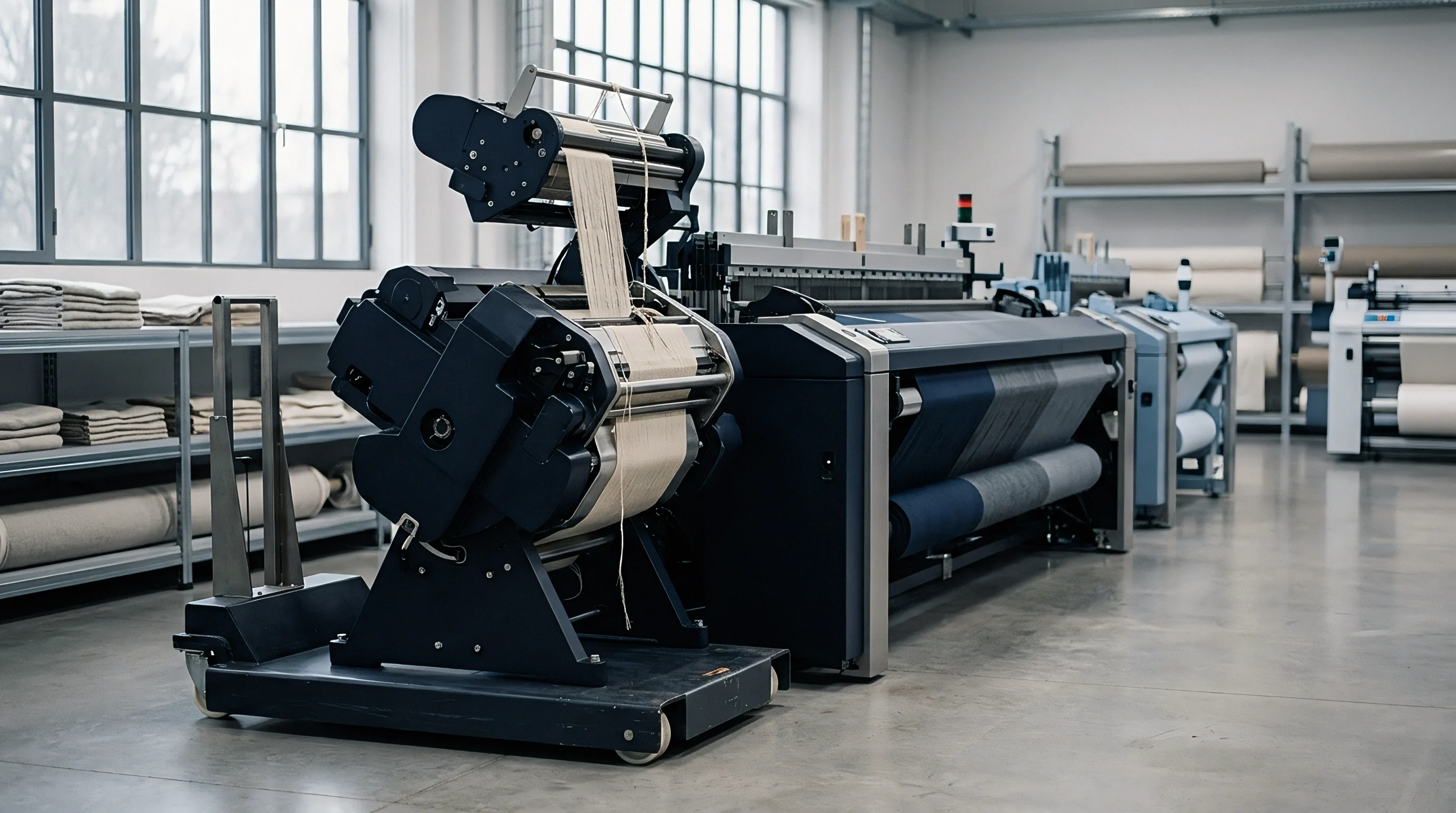
Regulating yarn delivery continuously requires combining real-time sensor feedback with direct-drive actuation. Modern electronic let-off architectures replace friction pads with brushless AC servo motors coupled to the yarn beam through high-precision planetary gear reducers. Load cells under the backrest roller mounting blocks sample total warp sheet tension at rates between 200 Hz and 1000 Hz, while a signal processor filters out loom frame vibration to isolate the true tension vector from the yarn sheet.
Beam diameter shrinks continuously as weaving progresses from a 1000 millimetre flange diameter down to the bare 219 millimetre steel barrel. To maintain constant linear yarn speed, the controller must steadily increase drive shaft angular velocity matching the rate of beam radius decay. A closed-loop algorithm calculates target rotational velocity using encoder feedback from the main loom shaft alongside load cell readings, adjusting torque delivery within milliseconds.
- Calibrate load cell transducers using calibrated deadweights attached across the full working width of the backrest roller.
- Map the optical shaft encoder position to the main loom shaft zero reference point at back center.
- Enter yarn count and raw material modulus parameters into the central terminal interface.
- Perform dynamic zero-point balancing with the warp sheet under full operational static tension.
- Set feedforward compensation gain parameters based on active heald frame lift height and shed opening angle.
The mechanical coupling between the servo motor and the flange must display zero backlash. High-torque planetary gearboxes with torsional rigidity ratings above 110 Nm/arcmin prevent positional drift during high-speed shed closures. When heald frames move to create shed clearance, the system calculates geometric path extension and modulates motor speed to avoid overstressing fine wet-spun singles.
Specifications adhering to ISO 7211 clause 5 require target pick density verification under standardized off-loom tension conditions to prevent shrinkage penalties.
The effectiveness of an electronic let-off mechanism hinges on calibration accuracy. If sensors are zeroed without accounting for the backrest assembly’s tare weight, the controller applies flawed baseline torque, causing off-loom pick density to drift. Ultimately, stable warp delivery depends more on real-time encoder synchronization than on static brake calibration.


Compensation
Warp path length varies dynamically as heald frames move, creating strain peaks that coincide with pick insertion and beat-up. In a 1/1 plain weave, half the ends lift while the other half drop, resulting in symmetric geometric extension. Twill, satin, and complex jacquard weaves create asymmetric warp consumption, where uneven lift ratios drive severe tension imbalances across individual heald shafts.
Without active dynamic compensation, ends on high-lift shafts suffer localized over-stretching.
Which Dynamic Tension Setpoints Mitigate Shedding Stops on Dense Linen Damasks?
Setting peak tension limits on complex jacquard structures requires matching shedding lift profiles to yarn elongation limits. Dense table linen damasks running 30 ends per centimetre with wet-spun 40 Nm linen warps generate high beat-up resistance. Static backrests force the reed to push incoming picks against an unyielding yarn sheet, causing reed marks, yarn skinning, and heddle eye abrasion.
To prevent this, active backrest assemblies use motor-driven or torsion-bar-assisted oscillating whip rolls synchronized with main shaft rotation.
During shed opening, active whip rolls move forward toward the heald frames, releasing linear warp length into the shedding zone to absorb peak tension spikes. As the shed closes and the reed advances for beat-up, the whip roll swings backward, restoring the tension needed to hold the cloth fell firm against the reed stroke. This dynamic stroke control limits peak shedding loads to within 12% of baseline static tension, protecting low-twist wet-spun yarns from structural failure.
| Weave Construction | Ends/cm | Picks/cm | Static Baseline Tension (N/end) | Peak Passive Tension (N/end) | Peak Active Tension (N/end) | Whip Roll Stroke (mm) |
|---|---|---|---|---|---|---|
| Plain Weave 1/1 (Huckaback Towel) | 22.0 | 18.0 | 0.42 | 1.85 | 0.62 | 6.5 |
| Twill 2/2 (Heavy Apparel Linen) | 28.0 | 24.0 | 0.38 | 1.62 | 0.54 | 5.2 |
| Satin 5 (Fine Bedding Linen) | 36.0 | 30.0 | 0.32 | 1.45 | 0.44 | 4.0 |
| Jacquard Damask (Tableware) | 30.0 | 26.0 | 0.45 | 2.10 | 0.68 | 8.5 |
On a 220 centimetre reed width loom weaving a jacquard damask with 6,600 ends of 40 Nm wet-spun linen (25 tex), setting static tension to 0.45 N per end creates a baseline warp sheet tension of 2,970 N. During shed opening, heald lift adds 8.5 millimetres to the geometric path over the 450 millimetre distance between backrest and fell. Given an elastic modulus of 24.8 GPa, that uncompensated 8.5 millimetre extension creates an instantaneous strain increment of 1.88% ~ exceeding the yarn’s 1.70% elongation limit and breaking multiple warp ends across the beam.
At 480 picks per minute on a 220 centimetre reed width, active whip roll displacement must match 8.5 millimetres of linear yarn travel within a two-millisecond window.
Engaging an active backrest driven by a direct servo motor allows the whip roll to advance 7.8 millimetres during peak shed lift. This displacement absorbs 91.7% of the geometric extension, keeping dynamic strain down to 0.15% and total end tension at 0.68 N. Peak loads remain safely below the yarn break threshold, sustaining continuous weaving at 500 picks per minute without structural fiber damage. Whether high-frequency motor-driven backrests can eliminate micro-structural fatigue in ultra-fine 80 Nm wet-spun linen warps above 600 picks per minute remains an open question.

Defect
Fabric quality in woven linen relies directly on tension stability through loom stops, shed reversals, and beat-up impacts. When a loom stops for a filling break or bobbin change, the warp remains under high static tension. Under prolonged static load, bast fibers exhibit viscoelastic stress relaxation: linear tension decays while the machine sits idle, allowing the cloth fell to drift backward toward the backrest roller.
When the loom restarts, the initial beat-up stroke strikes a displaced fell, leaving a dense pick band or an open crack mark in the greige fabric. Modern active warp controllers run automatic stop-mark prevention routines: upon stopping, the servo motor shifts the warp beam forward or backward based on dwell time, keeping the cloth fell aligned with the reed line.
- Idle fell relaxation occurs when prolonged downtime causes flax yarns to lose elastic memory, shifting the cloth position relative to the reed impact line.
- Beat-up displacement thin places emerge if the let-off motor fails to adjust position instantly during the first pick after restarting.
- Micro-slub shear rupture happens when an uncompensated tension spike forces a yarn thick spot through reed wires without sufficient clearance.
- Asymmetrical selvage snap results from uneven tension distribution between the ground warp structure and reinforced catch cords.
Structural defects reduce commercial value under international inspection protocols. High peak tension causes reed marks by forcing warp ends to bundle inside dent spaces instead of spreading evenly across the fabric plane. Lower baseline settings made possible by active tension control allow flax yarns to settle naturally into uniform spacing during beat-up.
Linen fabrics inspected under four-point quality systems incur major point penalties when starting marks exceed two pick spacings.
Break rates dictate weaving efficiency. Uncontrolled tension spikes can push single-end breaks above 5 per 100,000 picks, causing frequent loom stops and leaving manual repair tails in the greige fabric. Active closed-loop control drops end breaks below 1.0 per 100,000 picks on wet-spun linen warps.
Under standard purchasing contracts with ASTM D5430 class A limits, allowable point deductions drop from 40 to 28 per 100 square metres when active let-off logs confirm no uncompensated stops occurred.

Economics
Weaving efficiency and loom output dictate the final unit cost of finished linen. Because high-speed rapier looms involve substantial capital investment and hourly overhead, running stiff, low-elongation linen warps on passive mechanical let-off systems forces mills to cap machine speeds at 280 ~ 320 picks per minute to control breakage. Installing closed-loop active warp control allows those same looms to run reliably at 480 ~ 520 picks per minute while improving overall efficiency.
Repairing a single broken warp end takes an operator an average of 2.5 minutes to thread through the heddle eye and reed dent before restarting the loom. At 4.8 breaks per 100,000 picks on a 220 cm loom running at 320 PPM, downtime accounts for over 12% of shift time, significantly cutting net production output.
- Encoder resolution verification requires checking that the let-off motor positioning sensor delivers at least 2048 pulses per main shaft revolution for rapid feedback response.
- Backrest dynamic response bandwidth must match maximum operating pick rates without introducing mechanical harmonic resonance into the yarn sheet.
- Idle relaxation compensation routines should be fully programmable within the main loom controller to allow customized time-decay torque curves.
- Load cell temperature stability must maintain measurement precision within plus or minus one percent across ambient weaving shed temperature shifts.
A production comparison illustrates the financial impact across a 20,000 linear metre order of 240 g/m² plain linen fabric (22 ends/cm, 18 picks/cm, 220 cm reed width). Shed A operates rapier looms with passive mechanical let-off, while Shed B uses rapiers equipped with closed-loop active let-off and motor-driven whip rolls. Both facilities run at an operating cost of $28.50 per loom hour.
Shed A operates at 320 PPM with a net efficiency of 74%, producing 12.64 linear metres per hour. Completing the 20,000 metre order takes 1,582 loom hours, totaling $45,087 in machine capacity cost, or $2.25 per linear metre. High warp breakage leads to 960 total machine stops, driving up yarn waste and repair labor.
Shed B operates at 480 PPM with an active-control net efficiency of 89%, achieving 22.78 linear metres per hour. The order finishes in 878 loom hours, dropping machine capacity expenditure to $25,023, or $1.25 per linear metre. Active tension control reduces direct manufacturing cost by $1.00 per finished metre, saving $20,064 on this single run.
By contrast, running high-density linen warps on passive let-off systems increases repair labor and cuts quarterly shed revenue by tens of thousands of dollars per machine bank.