Mechanical Decortication Parameters for Retted Flax Processing Lines
Optimize breaker roll pressure and scutching drum clearances across retted straw moisture bands to isolate long flax fibres and retain origin certifications.

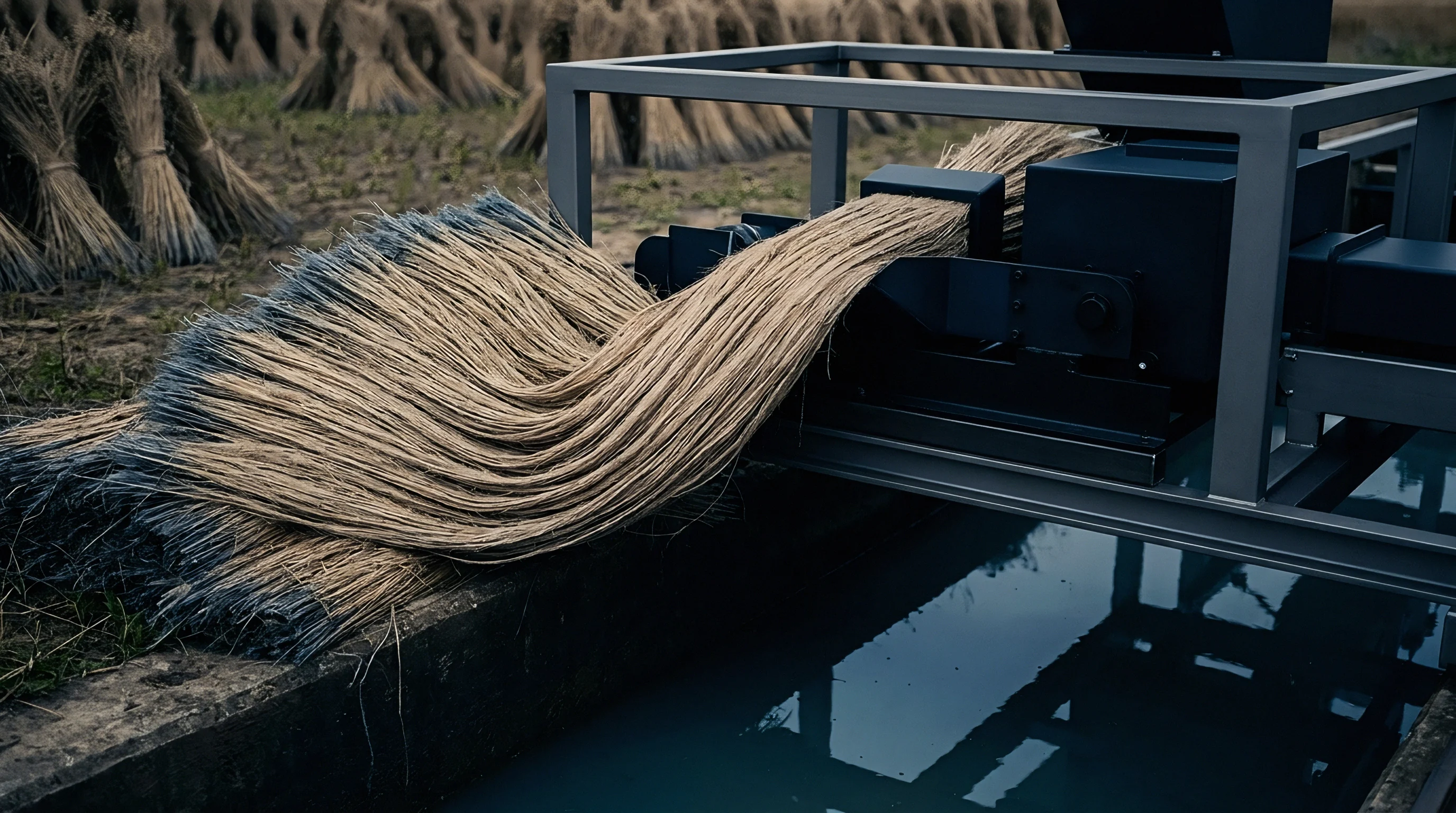
Brake
Incoming dew-retted flax straw arrives at the decortication facility in round or square bales compressed to densities between 130 and 160 kilograms per cubic metre. Unloading conveyors feed the unwound straw layer onto a spreading table where oscillating divider fingers align stalks parallel to the machine throughput axis. Stalk alignment fixes the mechanical orientation before the first fluted rollers crush the stem.
Misaligned stalks cross the roller nips obliquely, creating transverse shear stresses that rupture technical fibres into irregular tow fragments instead of maintaining continuous bast ribbons.
Feed tables regulate linear velocity between 25 and 45 metres per minute, matching the intake rate of the breaker unit. Roller pairs with conjugate fluting profiles engage the stalk bed under regulated pneumatic or hydraulic downforce. Modern breaker assemblies run between four and eight pairs of fluted rollers, alternating coarse and fine pitches to gradate mechanical deflection.
The initial pair features flute depths near 18 millimetres with pitches of 32 millimetres to crack the woody core cylinder without crushing external cortical tissue.
A stalk moisture level exceeding 12 percent at the first breaker pair increases required roller downforce by 35 percent to shatter identical core volumes.
Pith shatters under repeated shear.
Downforce settings vary across retting degrees and moisture contents. Stems rets to an optimal Fried rating of 3.5 to 4.0 yield woody cores that fracture cleanly under linear roll pressures between 12 and 18 decanewtons per centimetre. Under-retted material retains strong pectin bonds along the middle lamella, demanding roll pressures above 24 decanewtons per centimetre to achieve comparable shive detachment.
Excessive compression fractures the cellulosic cell walls of the bast bundles, depressing subsequent spinning yarn tenacity. Crushed stems drop loose xylem.
- Rotary bale unwinding pulls continuous stem sheets from the periphery inward while avoiding internal mass collapse that disrupts continuous layer density.
- Reciprocating comb spreading parallelizes tangled stalks along the conveyance direction, eliminating transverse stem overlaps before entry nips engage.
- Coarse flute pre-cracking flexes the woody shive core at wide tooth intervals, creating primary longitudinal fracture fissures along the xylem tissue.
- Fine flute crimping applies high-frequency transverse shear deflections, dislodging fractured shive fragments from the adhering bast sheath.
Moisture content inside the decortication bay dictates the brittle-to-ductile transition of both bast bundles and inner xylem tissue. Processing lines running straw below 8 percent moisture lose long line recovery because brittle fibre bundles snap inside roller teeth. Processing lines running straw above 13 percent moisture fail to shatter the flexible green shive, carrying woody fragments forward into downstream scutching turbines where damp core particles stick to wet pectins.
Ambient relative humidity inside the breaking hall requires continuous control between 55 and 65 percent at 20 degrees Celsius. Bale weights shift with humidity.
Pneumatic exhaust hoods mounted beneath each roller pair pull detached woody particles downward into negative-pressure ducting. Linear air velocities inside these collection plenums operate between 22 and 26 metres per second to prevent shive settling and blockage. Clean separation at the breaker zone reduces the cleaning burden placed on turbine beaters by up to 40 percent.
| Retting Class | Moisture Regain (%) | Roll Downforce (daN/cm) | Flute Pitch (mm) | Flute Depth (mm) | Throughput (m/min) |
|---|---|---|---|---|---|
| Under-retted (Fried 2.0-2.5) | 10.0 – 11.5 | 22 – 26 | 24 | 14 | 26 – 30 |
| Standard Dew-retted (Fried 3.5-4.0) | 9.0 – 11.0 | 14 – 18 | 28 | 16 | 35 – 42 |
| Over-retted (Fried 4.5-5.0) | 8.5 – 10.0 | 10 – 12 | 32 | 18 | 40 – 48 |
| Industrial High-Moisture | 12.5 – 14.0 | 24 – 28 | 20 | 12 | 22 – 26 |
Improper breaker roller flute engagements produce crushed, fibrillated stem sections that fold instead of passing cleanly, jamming downstream transfers and triggering immediate line stoppages.
Drum
Scutching units receive crimped stems from the breaker train via clamping belts that grip the root ends while rotating beaters strip shive from stalk tips. The mechanical assembly uses pairs of counter-rotating cylindrical drums fitted with longitudinal beater blades. Stripping actions depend entirely on the clearance gap between blade tips and the stationary curved grid bars enclosing the lower drum perimeter.
Drum diameters on European industrial decorticators measure between 900 and 1200 millimetres, running peripheral tip speeds between 12 and 18 metres per second.
Grid bar geometry controls shive expulsion while retaining technical bundles within the beating envelope. Clearance between drum blade edges and grid profiles narrows progressively along the drum length, starting at 14 millimetres near the feed intake and tapering to 4 millimetres at the discharge terminal. Beater blades strike the suspended flax fringe tangentially, flexing bundles sharply over the rounded grid edges.
Flexion cracks the remaining parenchymal bonds, allowing centrifugal force to eject woody core particles through the grid slots into under-floor collection augers.
High velocity fractures long bundles.
Drums operate in series across two distinct operations. The first turbine scutches the tip portion of the stalks while rubberized conveyor belts clamp root ends under continuous pressure. An inversion transfer zone then unclamps the processed tips and re-grips them to expose untouched root sections to the second turbine.
Clamping pressures along these transfer bands maintain minimum values of 0.4 megapascals. Lower clamping pressures allow stalk slippage under the violent impact of beater knives, pulling long line fibres into the shive collection hopper as scutching tow. Damp bundles resist turbine knives.
Centrifugal air movement generated by rotating drums creates internal aerodynamic turbulence that alters stalk presentation. Stationary baffles and secondary suction chambers direct air currents outward through the grid spaces, stabilizing the flax fringe against erratic fluttering. Unstable fringe movement causes bundle ends to wrap around rotating drum shafts, creating frictional heat that degrades bast cell structures.
A change in blade-to-grid spacing of two millimetres alters residual shive content in scutched flax by more than three percentage points.
Turbine blade edges require precise maintenance to prevent mechanical damage. Rounding of blade striking faces beyond a radius of 1.5 millimetres converts sharp impact detachment into abrasive scuffing that shreds long bast bundles into low-value short fibre. Operators redress beater edges every 200 operating hours to maintain designed shearing profiles.
- Excessive blade tip velocity exceeds bundle tensile limits, shearing long line flax into short scutching tow within the first turbine stage.
- Clogged grid slots trap expelled shive fragments inside the beating perimeter, grinding abrasive woody debris back into bast ribbons.
- Insufficient clamping retention force permits stalks to pull free from transport belts, dumping unprocessed stem segments into the lower augers.
- Blade profile erosion blunts striking edges and drags bundles across grid bars without generating sufficient acceleration to dislodge adhering cortex.
Unretted bark clings to fibre.
Turbine rotational velocities link electronically to the linear throughput rate of the clamping conveyors. A decortication line operating at 40 metres per minute throughput drives turbine shafts at 240 revolutions per minute to deliver an impact frequency of 16 strikes per linear centimetre of stalk. Increasing line velocity without a proportional rise in drum rotational speed reduces impact frequency, leaving high concentrations of shive adhered to the bast ribbon.
Mill supervisors explain high shive counts by arguing that incoming straw bales arrived too damp for the scheduled processing speed.

Yield
Mass distribution across industrial decortication balances stalk components against mechanical losses. Raw retted flax straw input separates into long line scutched flax, scutching tow, shive, and particulate dust. Long line yield forms the primary economic return of the operation, consisting of parallel, unbroken bast fibre bundles measuring between 600 and 900 millimetres in length.
Standard French, Belgian, and Dutch dew-retted crops yield between 18 and 24 percent long line fibre under stable machine settings.
Scutching tow comprises tangled, shortened bast fibres extracted by turbine grids and under-drum collection vents. Tow mass fractions run between 8 and 14 percent of incoming straw weight. Shive represents the largest physical fraction, generating between 50 and 55 percent of total output mass.
Particulate dust, cuticle wax flakes, and moisture evaporation account for the remaining 10 to 15 percent balance. A decortication line running 3000 kilograms of raw straw per hour yields 600 kilograms of long line scutched flax, 330 kilograms of tow, 1560 kilograms of shive, and 510 kilograms of combined dust and moisture loss.
Scutching yields dictate mill margins.
Moisture loss during mechanical processing shifts final weight accounting. High-velocity airflow generated by turbine beaters combined with pneumatic dust extraction accelerates moisture loss, reducing material regain from 11 percent at the intake table to 8.5 percent at the output sorting conveyor. Water loss accounts for 2.5 to 3.0 percent of total incoming batch mass, mimicking physical waste in gross balance sheets unless measured with calibrated drying ovens.
Clean harl demands stable clearances.
Dry straw pulverizes into tow.
Tenacity and fineness assessments confirm mechanical gentleness along the line. Technical fibre bundles exiting the second turbine maintain tenacity values between 45 and 55 centinewtons per tex when breaking rollers operate without excessive nip downforce. Over-pressing at the breaker table reduces bundle tenacity below 38 centinewtons per tex by introducing micro-fractures into individual ultimate cells.
Fineness metrics follow decortication intensity, as progressive shive removal splits coarse technical bundles from initial widths of 120 micrometres down to spinning-grade ribbons measuring 30 to 50 micrometres.
| Feed Moisture (%) | Retting Quality (Fried) | Long Line Yield (%) | Scutching Tow (%) | Shive Output (%) | Moisture Loss (%) |
|---|---|---|---|---|---|
| 9.0 | 3.8 | 23.2 | 9.8 | 53.6 | 2.8 |
| 11.5 | 3.8 | 21.5 | 10.4 | 54.1 | 3.1 |
| 13.5 | 3.2 | 17.1 | 13.6 | 55.8 | 1.9 |
| 8.0 | 4.5 | 18.4 | 14.8 | 51.2 | 3.9 |
Decortication lines operating in inland drying climates lose substantial bast flexibility during midday shifts. Engineering teams continue to debate whether post-breaker misting manifolds re-hydrate bundle cuticles effectively or merely generate localized surface wetting that clogs turbine grid bars during subsequent stripping.
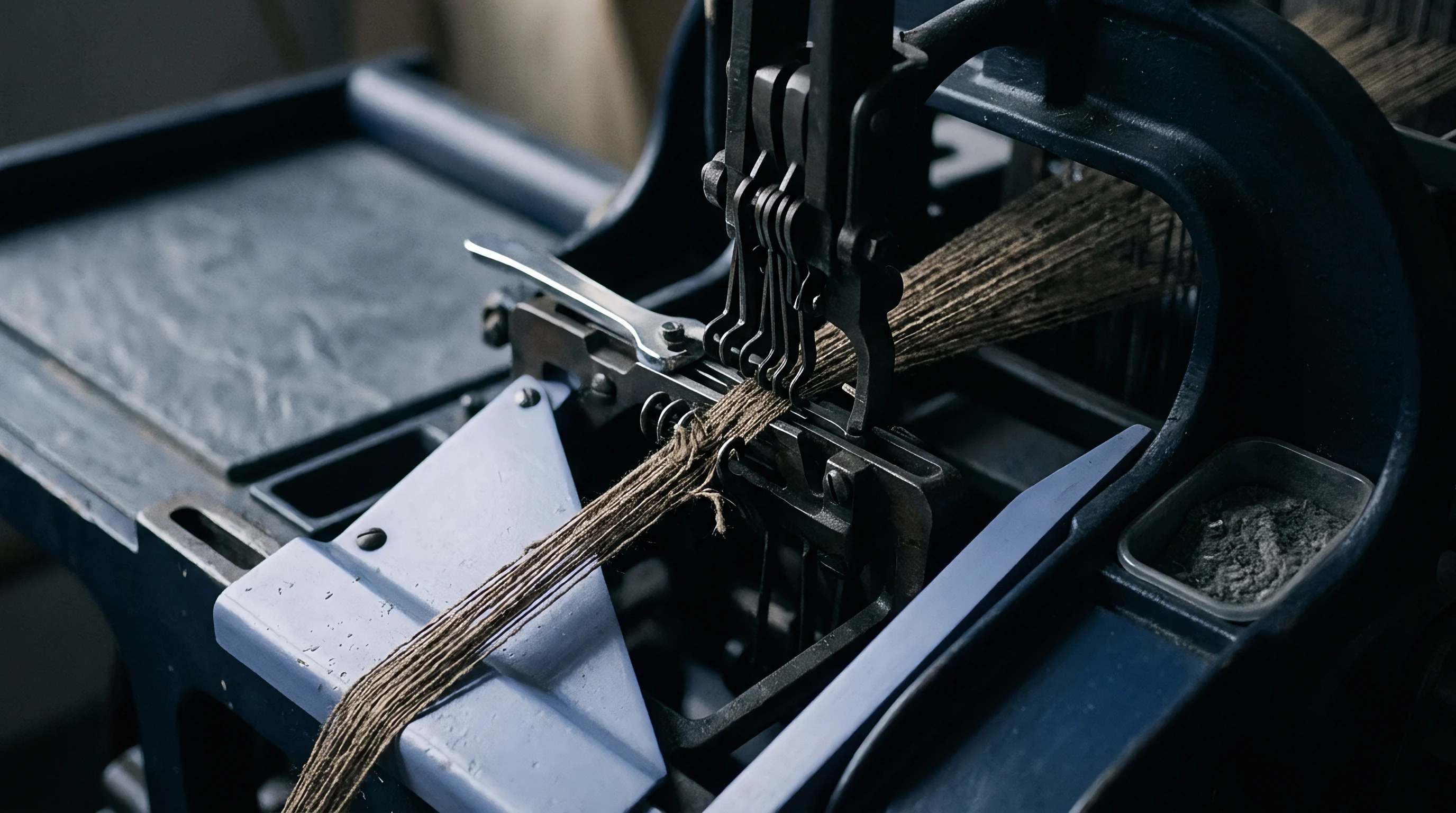
Custody
European Flax certifications issued by the Alliance for European Flax-Linen and Hemp track raw material movements from certified grower fields to individual decortication lots. Decorticators act as primary transformation units under ISO 17065 custody frameworks, converting bulk agricultural straw into numbered industrial fiber bales. Scutching mills operating inside France, Belgium, and the Netherlands maintain dual registration, holding both production certificates and chain-of-custody transaction accounts.
Incoming straw deliveries enter mill registries with weighbridge tickets recording grower registration numbers, field plot cadastral identifiers, straw variety, harvest year, and baling moisture readings. Bales from different agricultural parcels undergo physical segregation inside covered storage barns. Processing protocols restrict blending across distinct grower lots during decortication runs to ensure pure parcel batching.
Field records validate port filings.
Mass-balance calculations balance incoming straw weights against outgoing baled inventory. Auditors reconcile raw straw inputs with scutched long fibre, tow, and commercial shive sales receipts using conversion factors established for specific harvest years. European Flax audits reject mass-balance reconciliations showing long line extraction rates exceeding 26 percent of gross straw mass, treating excess figures as evidence of undeclared non-certified straw blending.
A mill losing lot separation between raw storage and the feed table forfeits European Flax transaction certificate eligibility for the entire decortication shift.
Cross-border processing routes involving toll-scutching or yarn spinning in offshore facilities introduce strict documentary hurdles. Chinese mills importing raw scutched long line from Western Europe for spinning into linen yarn operate under secondary transaction certificates. The transaction document traces back to the specific European scutcher certificate number, naming the gross weight, net fibre mass, harvest year, and individual bale serial bands.
Spinners blending European certified line flax with non-certified Chinese or Egyptian flax forfeit Masters of Linen qualification and face non-preferential origin reclassification under destination customs reviews.
- Field delivery logging links straw bale RFID tags directly to national agricultural parcel numbers and grower European Flax scope certificates.
- Intake moisture testing establishes dry-basis lot mass, setting baseline figures for downstream scutching yield reconciliation formulas.
- Batch execution tracking records the exact start time, stop time, line parameters, and machine clean-down routines between parcel changes.
- Bale press serialization attaches tamper-evident barcode tags to finished long line bales, embedding grower identity and decortication lot numbers.
Contractual agreements incorporate European Flax Standard Section 4.2 to hold decortication facilities legally liable for origin misrepresentation, compelling suppliers to pay full commercial indemnities if uncertified fiber dilutes certified parcel runs.
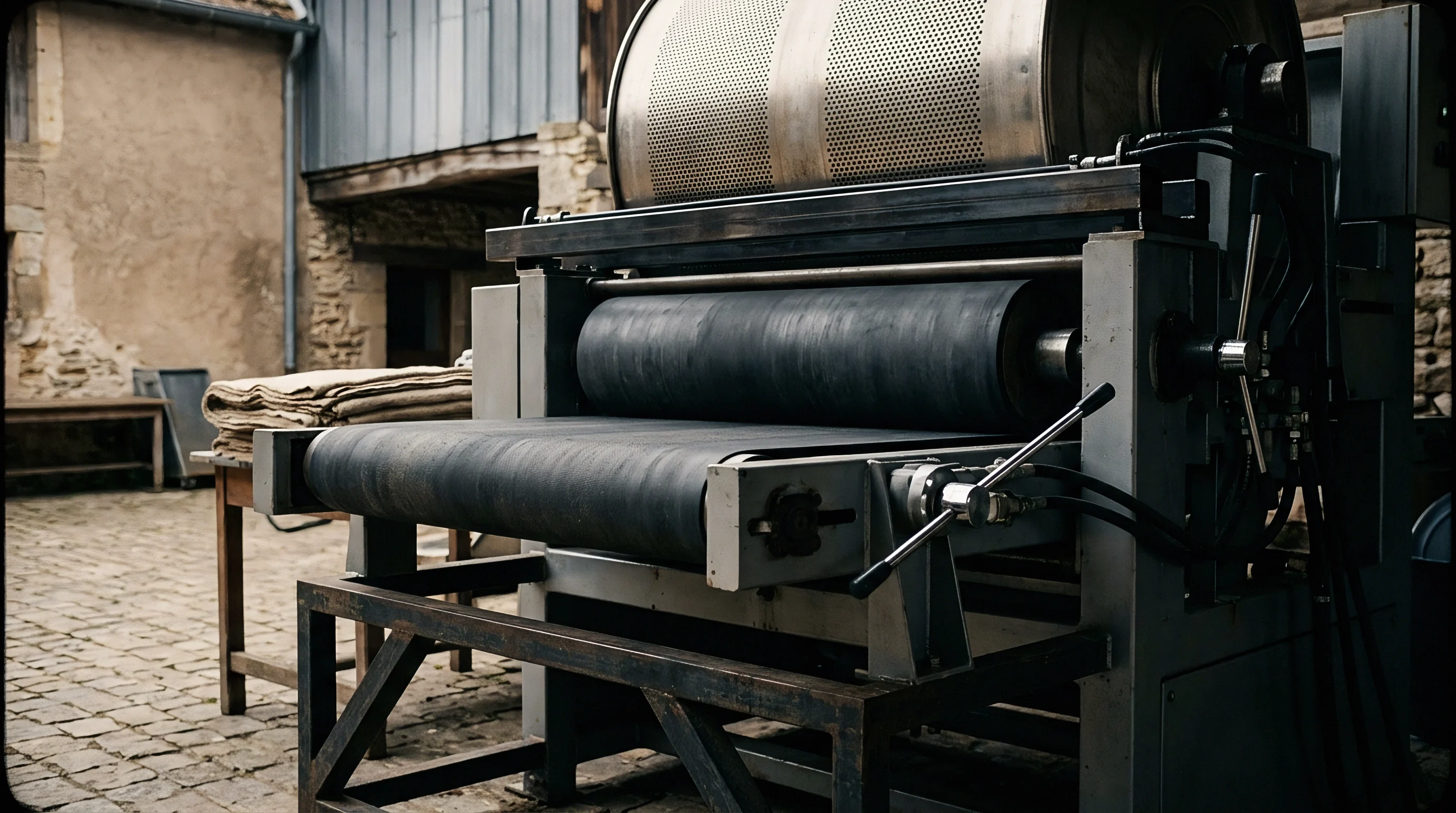
Grade
Finished long line flax exiting the scutching line undergoes manual and optical evaluation on inspection tables before bundling and pressing. Grading technicians assign commercial quality tiers based on residual shive percentage, fibre fineness, bundle cleanliness, color uniformity, and mechanical strength. Standard European grades differentiate between wet-spinning qualities, suitable for fine apparel yarns between wet metrics Nm 26 and Nm 60, and dry-spinning grades destined for coarse home furnishings or technical twines.
Residual shive content serves as the primary mechanical defect metric directly governed by decortication precision. High-grade scutched flax contains less than 1.5 percent residual shive by weight. Commercial lots displaying shive fractions between 2.0 and 3.5 percent incur contractual price penalties ranging from 0.30 to 0.75 euros per kilogram against the agreed base price.
Lots exceeding 4.0 percent shive fail wet-spinning acceptance specifications and face mandatory re-cleaning through secondary hackling passes or re-direction into low-value tow categories.
Fiber bundle divisibility confirms successful separation of bast ribbons without cortical gum residue. Over-decorticated flax displays excessive surface peeling and split tip fibers, generating high waste percentages during downstream mill hackling and comber sorting. Under-decorticated flax maintains hard, ribbon-like bundle groupings that resist chemical penetration during wet-spinning roving preparation.
| Quality Grade | Max Shive (%) | Fibre Fineness (tex) | Tenacity (cN/tex) | Target Yarn Count | Price Adjustment |
|---|---|---|---|---|---|
| Tier 1 (Superior Line) | 1.2 | 1.8 – 2.4 | > 50 | Nm 39 – Nm 60 | +5% Base Premium |
| Tier 2 (Standard Line) | 1.8 | 2.5 – 3.2 | 44 – 50 | Nm 26 – Nm 36 | Base Contract Rate |
| Tier 3 (Coarse Line) | 3.0 | 3.3 – 4.5 | 38 – 43 | Nm 10 – Nm 24 | -0.45 EUR/kg Penalty |
| Tier 4 (Defective/Rework) | > 4.0 | > 4.5 | < 38 | Dry-Spun / Nonwoven | Rejection / Downgrade |
Scutched flax showing uniform pale blond to silver-grey coloration indicates consistent field retting and dry decortication conditions. Dark brown streaks or blackened bundle bases reveal over-retted, mold-damaged straw that degrades during turbine impact, generating excessive fly waste throughout the spinning room. Clean bundles free of woody shive slide smoothly between the fingers with a dry, cool feel that experienced mill sorters recognize across every delivery.