Weibull Distribution Parameters in Single Yarn Strength Testing
Weibull shape and scale parameters quantify single yarn tail failure rates, governing high-speed weaving warp break frequencies and yarn acceptance limits.


Tenacity
Tensile fracture in a single spun yarn stems from localized microstructural weaknesses rather than a uniform load spread across every fiber. Gaussian distributions assume strength varies symmetrically around an arithmetic mean breaking force. Because linear textile strands break at their single weakest cross-section, symmetrical average metrics give a misleading picture for production planning.
Weibull distribution analysis models this vulnerability by treating the strand as a chain of mechanically linked elements; survival at a given tensile stress requires every individual sub-element to withstand that load without failing.

Mathematical Structure of Tensile Failure Distributions
The two-parameter Weibull cumulative distribution function calculates the failure probability for a single yarn strand loaded to a specific breaking tenacity. In this formulation, sigma represents the applied breaking tenacity measured in centinewtons per tex, sigma zero denotes the scale parameter or characteristic strength, and m represents the shape parameter, also termed the Weibull modulus.
F(sigma) = 1 – exp( – ( sigma / sigma_0 )^m )
The scale parameter sigma zero corresponds to the tenacity level where exactly 63.2 percent of test specimens fail. The shape parameter m dictates the breadth of the strength distribution. Higher m values indicate narrow strength variations and superior structural uniformity along the yarn axis.
Lower m values signal broad dispersion driven by localized physical defects. Standard ring-spun cotton yarns typically yield shape parameters between 8 and 12. Synthetic continuous filament yarns achieve shape parameters ranging from 20 to 35 due to controlled extrusion and drawing conditions.
Calculating mean breaking tenacity from Weibull parameters relies on the upper gamma function, reflecting how tensile failure follows the single weakest element.
Mean Tenacity = sigma_0 Gamma( 1 + 1 / m )
The coefficient of variation correlates directly with the shape parameter. An approximate relationship links the coefficient of variation percentage to the Weibull shape parameter m through an inverse exponential function.
CV% ≈ 100 m^( -0.92 )
When the shape parameter equals 10, the coefficient of variation lands near 12 percent. A drop in m to 6 elevates the coefficient of variation to roughly 19 percent, expanding the low-tenacity tail where weaving failures originate.
A high Weibull shape parameter reflects microstructural uniformity across fiber bundles rather than maximum absolute tensile capacity.

Three-Parameter Model Mechanics and Threshold Stress
The three-parameter Weibull model introduces a location parameter, sigma u, representing a minimum strength threshold below which tensile failure cannot occur. The cumulative failure density incorporates this lower boundary directly into the exponent.
F(sigma) = 1 – exp( – ( ( sigma – sigma_u ) / sigma_0 )^m )
Textile yarn testing rarely justifies extracting a non-zero location parameter. Extreme structural defects like thick slubs, missing roving splices, or severe thin places can break a strand under negligible loads during unwinding or shedding. Setting the location parameter to zero provides a conservative baseline for high-speed weaving calculations and accounts for catastrophic fiber slip caused by localized missing twist.
Linear regression models applied to median rank probabilities frequently fail to detect zero-strength anomalies. Tensile testing software that forces a three-parameter fit without sufficient low-tenacity sample points risks overestimating minimum yarn resistance. Relying on an unverified location parameter obscures critical defects that cause immediate warp breaks on air-jet looms.
The two-parameter model maintains mathematical stability across varying specimen batch sizes while accounting for tail rupture risks that standard deviation conceals. Evaluating yarn lots with two-parameter Weibull metrics isolates the shape parameter as the primary indicator of spinning consistency and structural reliability.
Focusing parameter extraction entirely on the lower cumulative tail provides the numerical foundation needed to forecast shed performance.


Flaw
Structural variations along a spun strand create local stress concentrations that determine total specimen breaking force. Fiber orientation, staple length distribution, twist variation, and cross-sectional fiber count govern the local linear density of short staple yarns. A reduction in fiber count inside a thin place decreases the cross-sectional area available to share applied tension.
Frictional slip between staple fibers dominates rupture behavior in low-twist zones, while fiber fracture occurs in high-twist zones. These shifting microstructural failure mechanisms create the dispersion captured by the Weibull shape parameter.

Gauge Length Effects and Weakest Link Scaling
Evaluating single yarn strength requires specifying the physical length under tension. As gauge length increases, the volume of yarn under stress expands proportionally, raising the statistical probability that a severe flaw will fall within the test zone and lowering the measured tensile capacity.
Weibull weakest link theory quantifies this length dependency through an exact scaling law. For two test specimen lengths, L1 and L2, with corresponding characteristic strengths, sigma 1 and sigma 2, the strength ratio relates inversely to the length ratio raised to the power of one over the shape parameter m.
sigma_1 / sigma_2 = ( L_2 / L_1 )^( 1 / m )
Testing yarn at a 50 millimeter gauge length yields a higher mean breaking tenacity than testing at the standard ISO 2062 length of 500 millimeters, largely because short specimens miss critical weak points. When the shape parameter m is low, scaling to longer test lengths produces sharp drops in measured mean strength; higher m values keep laboratory bench figures much closer to actual long-length shed performance.
| Spinning Architecture | Yarn Count (tex) | Shape Parameter (m) | Scale Parameter (cN/tex) | Measured CV (%) | Length Scaling Ratio (50mm/500mm) |
|---|---|---|---|---|---|
| Ring-Spun Combed Cotton | 15 | 11.4 | 18.6 | 10.2 | 1.22 |
| Ring-Spun Carded Cotton | 20 | 8.7 | 14.8 | 13.1 | 1.30 |
| Rotor Open-End Cotton | 20 | 13.2 | 12.1 | 8.9 | 1.19 |
| Air-Jet Vortex Viscose | 12 | 15.8 | 16.3 | 7.4 | 1.15 |
| Fully Drawn Polyester Filament | 16 | 28.5 | 38.2 | 4.1 | 1.08 |
Rotor open-end yarns display higher shape parameters than carded ring-spun yarns despite possessing lower absolute mean tenacity. Wrap fibers in open-end structures generate a uniform external wrapper that distributes tension evenly across short lengths. Ring spinning preserves long fiber strength, yielding higher peak tenacity alongside wider distribution spread.
Increasing specimen gauge length from 100 mm to 500 mm under ISO 2062 reduces measured mean breaking tenacity by 14 percent in combed cotton ring-spun yarns.

Defect Classification and Distribution Tail Distortion
Disruptions in spun yarn structure distort the lower tail of the Weibull failure probability density curve. Evaluating yarn reliability requires separating background variation from structural yarn faults.
- Thick Place Accumulation localizes twist reduction immediately adjacent to slub zones, triggering fiber slip under sudden peak tension loads.
- Thin Place Depletion reduces the local cross-sectional fiber count below sixty percent of mean values, creating isolated low-tenacity failure sites.
- Pneumatic Splicer Failure generates localized non-periodic strength losses where joint strength falls below seventy percent of parent yarn tenacity.
- Combing Preparation Defect leaves short staple clusters unaligned, lowering internal friction within localized drafting zones during ring spinning.
Combing eliminates short floating staple fibers, while high twist increases inter-fiber frictional lock. Structural flaws create a bimodal failure distribution when low-tenacity outliers populate the tail region. Fitting a conventional linear regression across the entire dataset smooths over these critical weak points, distorting shape parameter extraction.
Failing to isolate tail defects during statistical fitting understates how often low-load yarn ruptures will occur during warping and weaving.

Estimation
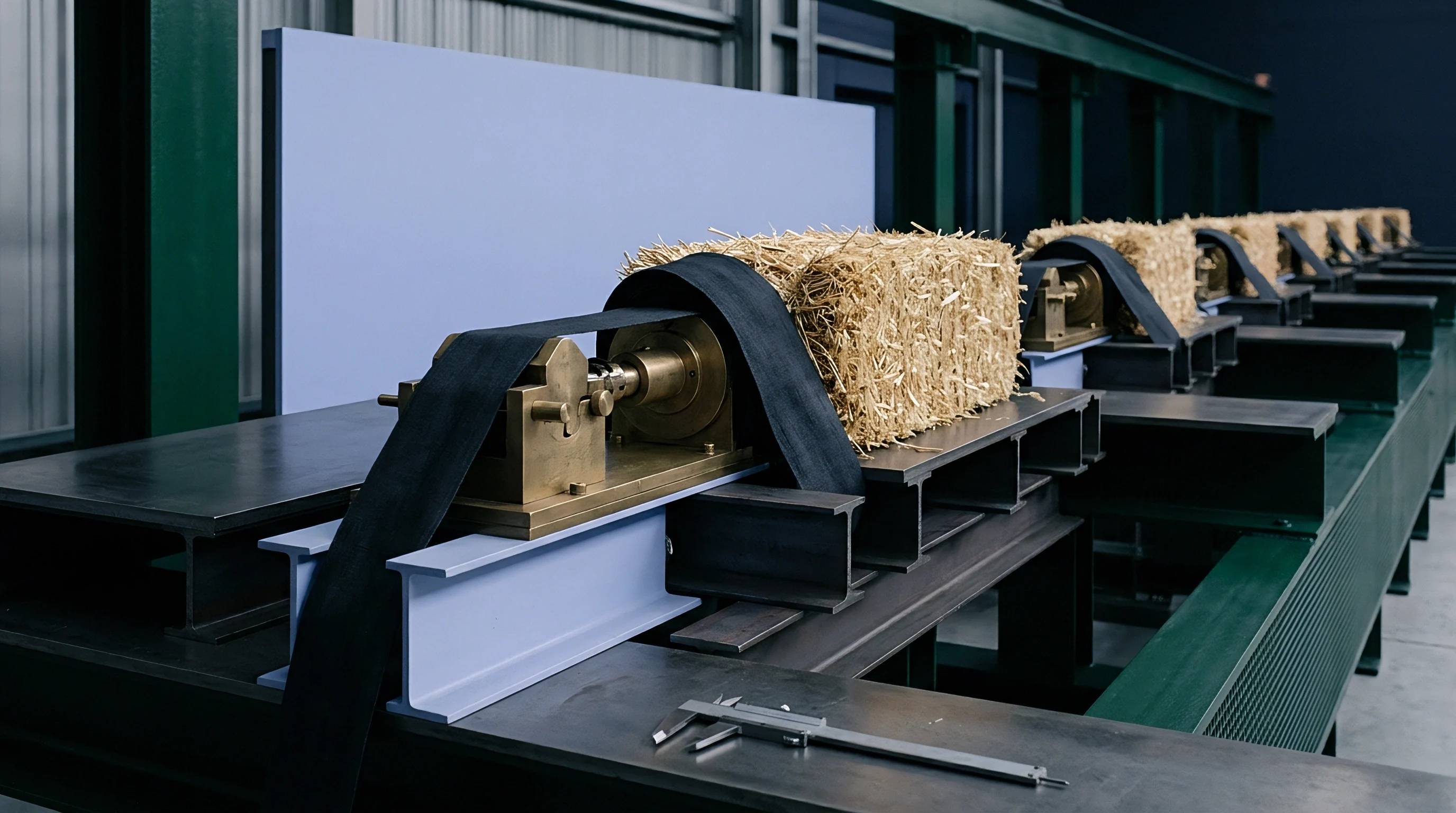
Extracting Weibull statistical parameters from single yarn tensile datasets demands standard test execution under standardized jaw separation rates. ISO 2062 prescribes testing single yarns at constant rates of extension using automated tensile instruments equipped with pneumatic clamps. Testing fifty individual specimens per yarn package provides a baseline for mean tenacity, but determining the shape parameter m with narrow confidence intervals requires expanded specimen counts, as sample size controls estimation error.
What Sample Size Stabilizes Shape Parameter Extraction?
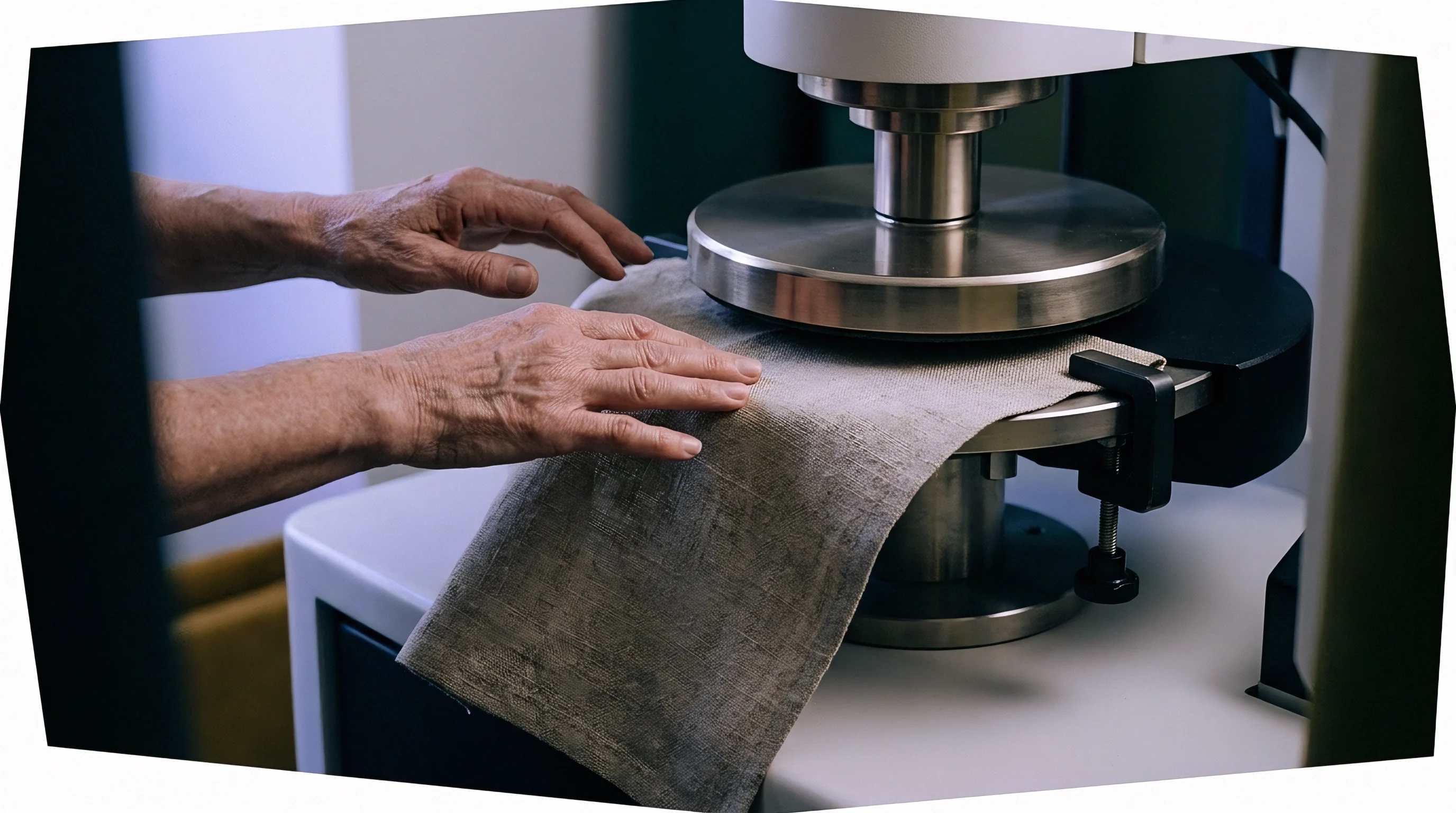
Calculating the Weibull shape parameter from small specimen sets introduces substantial statistical bias. Tensile testing programs using twenty specimens yield shape parameter estimates with ninety-five percent confidence intervals spanning plus or minus twenty-five percent of the true population parameter. Expanding the test lot to two hundred specimens contracts this error window to under seven percent.
| Specimen Count (N) | Extracted Shape Parameter (m) | Shape Lower Bound | Shape Upper Bound | Extracted Scale (cN/tex) | Scale Error Band (cN/tex) |
|---|---|---|---|---|---|
| 20 | 11.2 | 7.8 | 14.6 | 15.2 | ±1.15 |
| 50 | 10.4 | 8.6 | 12.2 | 15.1 | ±0.68 |
| 100 | 10.1 | 9.0 | 11.2 | 15.0 | ±0.46 |
| 200 | 10.0 | 9.3 | 10.7 | 15.0 | ±0.31 |
Maximum Likelihood Estimation delivers superior parameter accuracy compared to Least Squares Linear Regression applied to probability paper transforms. Linear regression assigns equal statistical weight to all rank-ordered specimens, understating the importance of low-tenacity failures sitting in the extreme lower tail. Maximum likelihood algorithms solve non-linear equations iteratively to converge on parameters that optimize the true density function fit.
Maximum likelihood estimation isolates the lower tail far better than linear regression, which consistently underestimates extreme low-tenacity failures.

Algorithmic Workflow for Maximum Likelihood Fitting
Processing tensile test data into reliable Weibull parameters requires systematic data handling to eliminate clamp slippage artifacts.
- Sort raw single yarn breaking force data in ascending numerical order, recording individual specimen breaking tenacity in centinewtons per tex alongside elongation at break.
- Inspect load-elongation curves to identify jaw breaks occurring within 2 millimeters of clamp contact faces, discarding clamp failure points from the primary tensile dataset.
- Assign empirical median rank survival probabilities to ordered specimens using Benard approximation formula i minus 0.3 divided by N plus 0.2.
- Formulate log-likelihood equations incorporating specimen tenacity values and solve for shape parameter m via Newton-Raphson numerical iteration.
- Compute scale parameter sigma zero directly from the converged shape parameter using the arithmetic mean of raised tenacity powers.
- Calculate standard errors for both parameters using the inverted Hessian matrix derived from second-order partial derivatives of the log-likelihood function.
Because clamp failures distort low-tenacity records, dynamic jaw pressure control is needed to prevent strand damage at clamping boundaries during automated high-speed runs.
Yarn spinners frequently attribute low shape parameters to laboratory jaw slippage rather than true structural spinning variability.


Shed
High-speed weaving machinery subjects warp ends to cyclic mechanical stress during harness frame motion and reed beat-up. Modern rapier and air-jet looms operate at insertion rates exceeding 800 picks per minute. Warp strands sustain continuous tension cycles combined with abrasion against dropped wires, heddle eyes, and reed dent blades.
The maximum dynamic tension imposed during heddle shed opening represents the operational stress threshold of the weaving process. If this peak stress intersects the low-tenacity tail of the yarn Weibull distribution, warp end breakage rates escalate instantly.
Translating Tensile Tails to Breakage Rates
Calculating expected warp breakage rates requires integrating the Weibull failure probability density function up to the peak dynamic stress experienced during weaving. Consider a high-speed air-jet loom running a warp sheet of 9,600 ends at 900 picks per minute. The total length of warp yarn passing through the shedding zone per loom hour reaches 259,200 meters.
Tensile stress pulses during harness frame movement generate repeated tension peaks averaging 4.5 centinewtons per tex. Dynamic stress surges during shed closure reach peak values of 7.2 centinewtons per tex.
Assuming a warp yarn lot with a scale parameter of 16.0 centinewtons per tex and a shape parameter of 8.0, the failure probability at peak dynamic stress calculates directly through the cumulative distribution equation.
F( 7.2 ) = 1 – exp( – ( 7.2 / 16.0 )^8.0 ) = 0.00152
This probability equates to 1.52 structural failures per one thousand meters of yarn passing through the high-stress shedding zone. Running 9,600 warp ends under these conditions results in over 390 warp breaks per loom hour, halting production completely ~ and these mechanical stops directly consume billable loom hours.
| Shape Parameter (m) | Calculated Failure Probability F(6.8) | Predicted Stops per 100k Picks | Efficiency Loss (%) | Commercial Classification |
|---|---|---|---|---|
| 6.0 | 0.003421 | 82.1 | 38.5 | Unprocessable Lot |
| 8.0 | 0.000548 | 13.1 | 7.2 | High Downtime Exposure |
| 10.0 | 0.000087 | 2.1 | 1.4 | Standard Commercial Grade |
| 12.0 | 0.000014 | 0.3 | 0.2 | High Efficiency Grade |
| 14.0 | 0.000002 | 0.05 | 0.03 | Premium Shed Reliability |
Shifting the shape parameter from 8.0 to 12.0 reduces predicted warp breakage rates by more than ninety-seven percent under identical peak weaving loads. Air-jet looms demand high modulus uniformity, so elevating yarn structural uniformity protects loom efficiency far more effectively than merely increasing mean breaking tenacity.
Dynamic warp tension peaks that cross the lower three-sigma strength boundary trigger immediate mechanical thread rupture during harness frame crossover.

Sizing Protection and Weak Link Suppression
Polymer sizing agents applied during warp preparation alter the original yarn strength distribution by encapsulating surface fibers and establishing inter-fiber adhesive bonds. Coating the strand seals surface staple ends, while total size pick-up alters tail behavior.
- Film Encapsulation coats outer staple ends, restricting fiber migration and smoothing mechanical friction against heddle eyes.
- Intra-Strand Penetration anchors internal staple fibers, elevating minimum breaking tenacity in localized thin places.
- Segmental Length Binding bridge localized structural flaws, effectively increasing the shape parameter m across short stress zones.
- Elastic Modulus Modification lowers breaking elongation slightly while increasing initial tensile resistance under sudden shed opening loads.
Applying a ten percent dry size pick-up of modified corn starch and polyvinyl alcohol transforms the lower tail of a carded cotton yarn. Post-sizing tensile tests show an increase in shape parameter m from 8.5 to 13.2, suppressing the defect-driven low strength tail. Effective warp sizing converts an erratic single yarn tensile profile into a narrow distribution capable of surviving modern loom shedding dynamics.
How much of the measured sizing benefit stems from true structural defect repair versus temporary surface lubrication remains open to dispute among sizing technicians.


Dossier
Commercial yarn procurement specifications historically rely on mean tenacity and coefficient of variation. Modern high-speed weaving sheds require strict contractual limits on lower tail distribution metrics. A yarn lot displaying acceptable mean tenacity can cause catastrophic loom stoppage rates if the shape parameter falls below production thresholds.
Buying loom hours requires specifying statistical Weibull parameters directly inside supply agreements.

Contractual Parameter Specification Metrics
A rigorous yarn purchasing contract replaces general quality promises with explicit numerical boundaries governing parameter estimation methods and specimen counts. Specifications must state test conditions under ISO 2062 alongside mathematical calculation methods.
Requiring maximum likelihood parameter extraction eliminates disputes over manual regression line fitting on probability paper. Contracts specify minimum allowable shape parameter values alongside baseline scale parameters. A standard delivery dossier for combed cotton warp yarns intended for air-jet insertion mandates a minimum shape parameter m of 10.5 based on a sample size of one hundred single yarn specimens per lot.
Specifying a minimum shape parameter of ten in yarn delivery contracts prevents catastrophic warp stoppage rates on high-speed rapier looms.

Financial Exposure and Rejection Threshold Calculations
A warp stop on a high-speed loom causes immediate financial loss through lost pick insertion, operator intervention time, and fabric starting marks. Warp stop rates exceeding 1.5 stops per loom hour reduce shed efficiency below target thresholds, driving up landed metre costs.
Calculating the financial penalty associated with low shape parameters uses loom-hour operating costs. A weaving shed operating 200 air-jet looms at a fixed machine rate of 28.50 USD per loom hour incurs significant costs when yarn quality drops. A drop in yarn shape parameter from 11.0 to 7.5 increases average warp stops from 0.8 to 4.2 per loom hour.
Total shed output falls by nine percent, generating a direct operational loss of 513.00 USD per shift in unrecovered machine time.
Receiving inspection protocols enforce lot rejection when sample parameter extraction yields values below contractual thresholds. If incoming testing under ISO 2062 reveals a shape parameter below 9.0, the buyer reserves the right to reject the warp lot or charge back loom downtime costs against the yarn spinner invoice. Yarn suppliers accept liability for weaving performance losses when delivered lots fail agreed shape parameter standards.
A standard quality assurance addendum specifies that any yarn batch yielding a Weibull shape parameter below 9.5 across one hundred ISO 2062 single end tests subject to maximum likelihood estimation shall be rejected prior to beam warping.