Flax Fiber Yield Losses during Wet Spinning Attenuation
Wet spinning attenuation loses 5% to 16% dry fiber mass through pectin dissolution and short fiber detachment, requiring bone-dry mass audit reconciliation.
Draft
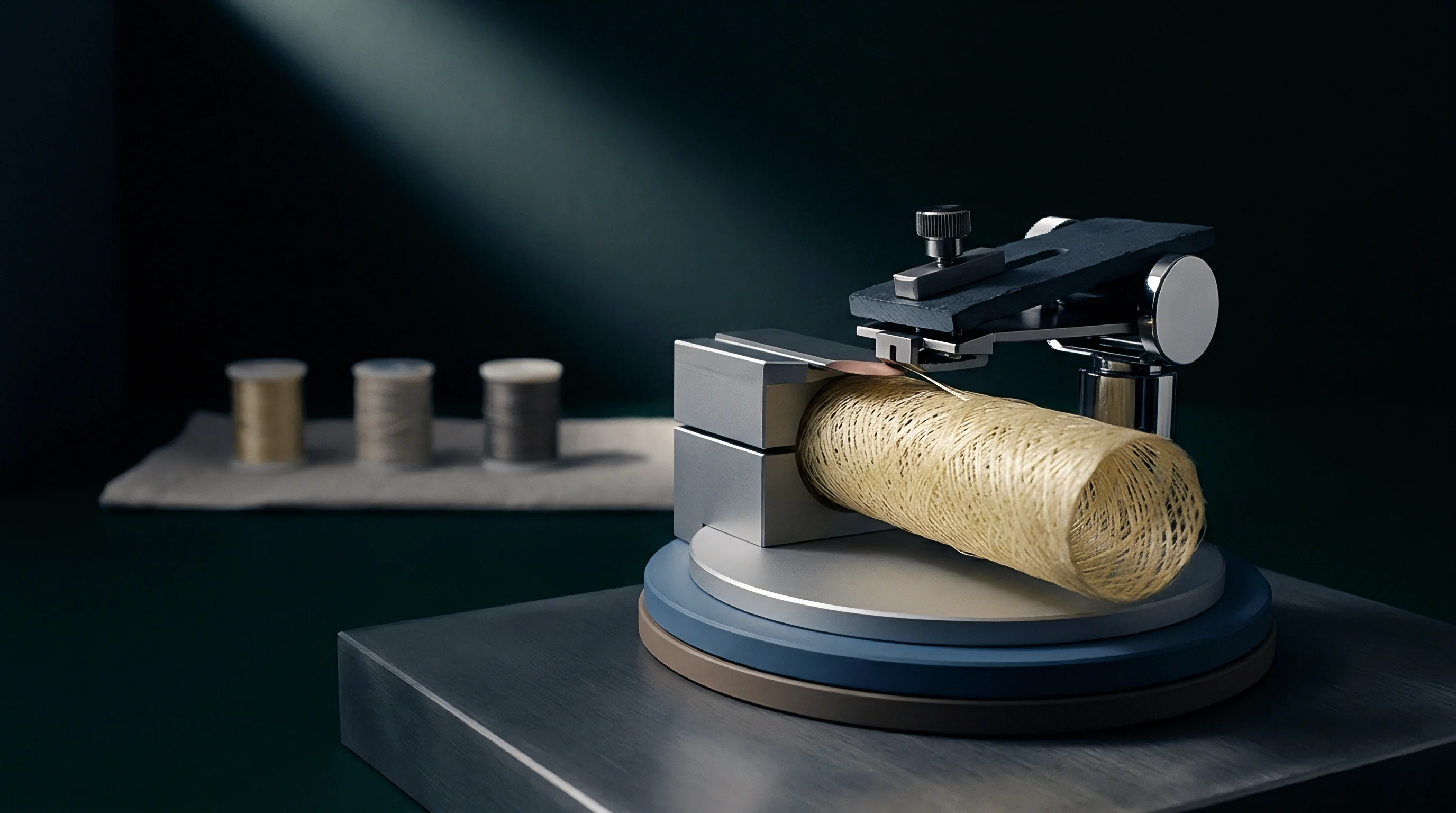
In high-draft wet spinning of long-staple flax, mechanical attenuation relies on softening middle lamella pectins so individual ultimate fibers can slide past one another. Scutched flax roving enters the drafting zone after passing through a hot water trough held between 60°C and 80°C. Back nip rollers hold the swollen roving, feeding it into the drafting gap at a set linear speed. Front nip rollers, turning 10 to 30 times faster than the back rollers, exert the tensile drafting force that pulls the released fiber bundles forward.
The ratio between front and back roller surface speeds gives the mechanical draft ratio, which directly sets the final yarn count in Metric Number (Nm).
Attenuating flax sliver in a wet state works quite differently from dry drafting synthetic or cotton fibers. Technical flax fibers exist as composite bundles held together by a non-cellulosic matrix containing 18% to 28% pectins, hemicelluloses, and lignin. Hot water hydrates this matrix, lowering its glass transition temperature and weakening non-covalent bonds between adjacent ultimate fibers.
As drafting forces pull on the bundle, individual fiber strands slide over each other. If those forces exceed the cohesive strength of the softened matrix, shorter ultimate fibers break away entirely from the main stream. These detached fragments never make it into the yarn core; instead, they wash into the trough or build up on roller aprons as fly and slub waste.
Roller nip pressure sets the limit where smooth fiber slipping turns into wholesale fiber breakage. Front top rollers apply pressure through synthetic rubber aprons, typically at 25 to 40 decanewtons per centimeter of nip length. Excess pressure crushes the swollen bundles, fracturing ultimate cell walls and creating ultra-short cellulosic debris.
Too little pressure lets fibers slip unchecked, introducing drafting waves, thin spots in the yarn, and periodic mass loss where entire unattenuated fiber clumps get pulled into the bath. Irregular linear density in the incoming roving sharpens these dynamics, generating force spikes that snap fiber bundles under peak tension.
| Yarn Count Target (Nm) | Mechanical Draft Ratio | Trough Water Temperature (°C) | Front Nip Pressure (daN/cm) | Mechanical Fiber Loss Range (%) |
|---|---|---|---|---|
| Nm 9.5 (Coarse Dry-Look) | 10.5 to 12.0 | 55 to 62 | 26 to 28 | 1.2 to 1.8 |
| Nm 26.0 (Standard Apparel) | 14.5 to 17.0 | 68 to 72 | 30 to 34 | 2.1 to 3.1 |
| Nm 39.0 (Fine Shirting) | 18.0 to 22.5 | 74 to 78 | 35 to 38 | 3.4 to 4.8 |
| Nm 60.0 (High-Count Sheer) | 24.0 to 28.5 | 80 to 85 | 38 to 42 | 5.2 to 7.1 |
Drafting zone geometry also shapes mass attenuation loss. The distance between back and front roller nips ~ the gauge length ~ must exceed the maximum staple length of the technical fiber bundles to prevent pinching and mass fracture. Long-staple flax roving contains fibers from 200 millimeters up to 500 millimeters long, requiring wide gauge settings.
Across this wide nip gap, shorter ultimate fibers measuring 15 to 30 millimeters carry no mechanical guidance. With no contact against top or bottom aprons, these short fibers float free until water currents clinging to the moving strand sweep them away. This detachment accounts for up to 40 percent of total physical yield loss during high-draft attenuation.
The mechanical draft ratio directly governs short fiber detachment within the gauge gap, driving mass loss higher as yarn fineness targets move above Nm 39.
Roving twist added during frame preparation gives the strand necessary strength during immersion, but it works against clean attenuation in the drafting zone. Metric roving twist factors usually fall between 15 and 25 turns per meter. High twist keeps hot water from penetrating evenly into the core, leaving central pectin layers firm.
When front rollers grab the outer fibers, that unsoftened core resists sliding and breaks under tension, shedding dense fiber knots into the bath. On the flip side, undertwisted roving collapses upon entering the hot bath, shedding continuous fiber webs before reaching the front nip. Balancing roving twist against residence time in the bath is essential to keeping mechanical losses down.
Spindle speeds on modern wet frames run from 6,000 to 10,000 revolutions per minute, inserting final yarn twist through ring and traveler assemblies. Dynamic tension on the wet strand between front nip and traveler generates significant centrifugal force. Water droplets carrying fine cellulosic microfibers spin off the ballooning strand, coating structural guards and collection troughs.
This airborne wet fly creates a steady loss of mass that conventional dry suction cannot easily catch. Mills running older frames without controlled balloon rings report an extra 0.8% to 1.4% dry fiber loss equivalent on fine counts.
Trough layout and fluid dynamics inside the wetting bath also affect how fast fibers wash out. Continuous fresh water feeds maintain temperature and bath purity, but they create turbulence right where roving enters. These turbulent eddies strip loose surface fibers off the swollen strand before drafting even begins.
Adding labyrinth baffles and laminar flow manifolds minimizes local shear, keeping loose fibers attached until the front rollers grip them. Controlling fluid turbulence prevents early fiber loss without slowing down the hydration needed for smooth pectin plasticization.
Uneven retting profiles in imported European Flax roving increase attenuation losses during spinning on European frames. Inconsistent pectin hydrolysis across scutched fiber lots forces higher bath temperatures and draft ratios, doubling short fiber detachment rates.
Trough
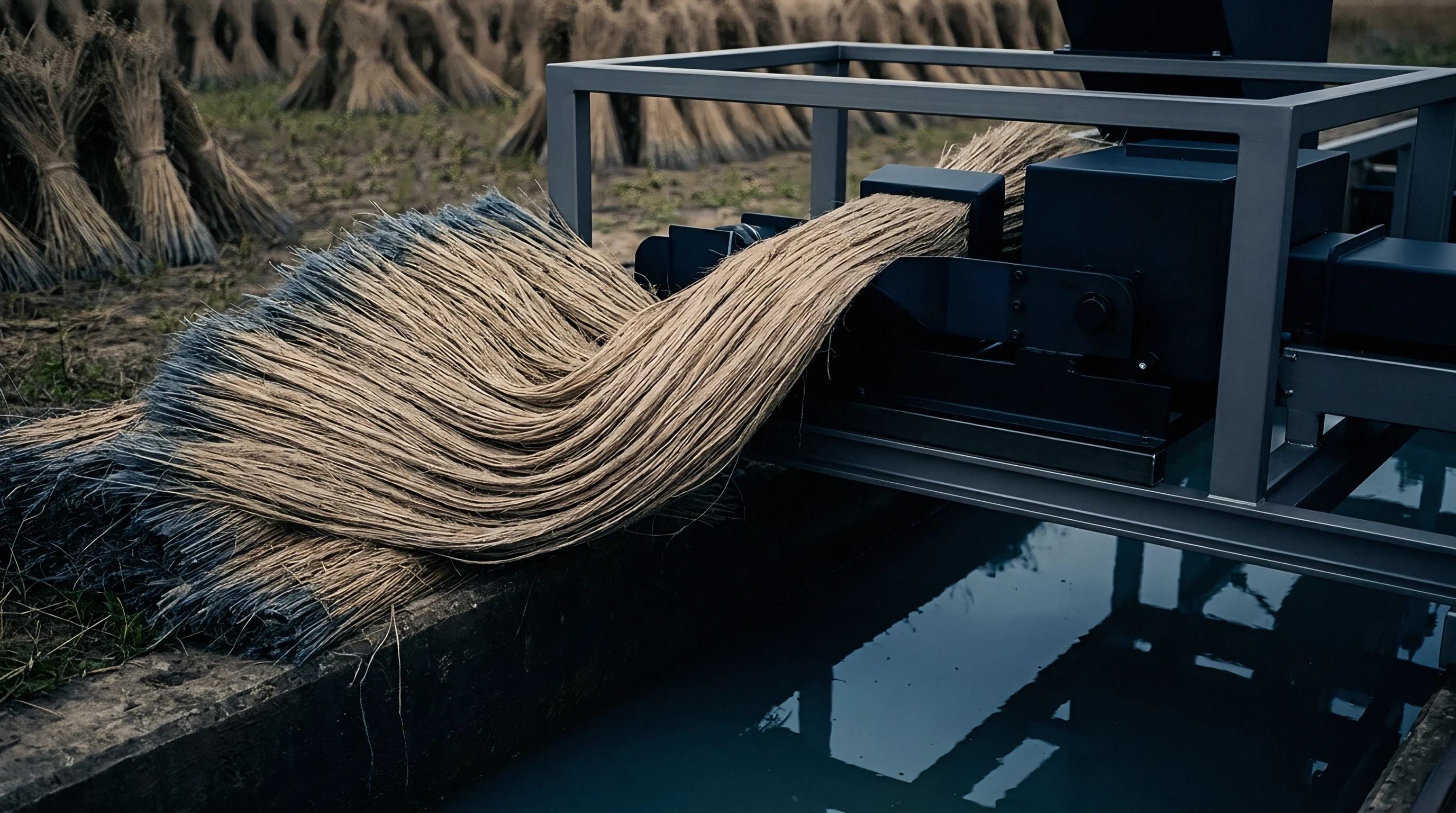
Chemical yield loss in wet spinning occurs in the hot water immersion trough as water-soluble non-cellulosic components leach out of the flax matrix. Raw flax consists of cellulose microfibrils encased in an amorphous matrix of pectins, hemicelluloses, lignin, waxes, and inorganic salts. Hot water dissolves lower-molecular-weight pectin fractions ~ specifically calcium and magnesium pectanates ~ along with soluble hemicellulosic galactans and arabinans.
This chemical extraction is necessary to separate the bundle down to individual ultimates, but it represents a permanent loss of solid dry mass that never makes it onto the finished yarn spool.
Bath temperature acts as the main thermodynamic driver for pectin dissolution kinetics. Below 50°C, pectins soften slowly, requiring longer immersion times that drag down frame production speeds. Pushing trough temperatures above 70°C speeds up the hydrolysis of esterified pectin chains, rapidly lowering matrix viscosity.
However, exposure to water at 80°C to 85°C strips non-target structural hemicelluloses, leaching up to 5.5% of total dry roving mass within just 12 seconds of immersion. Spinners running high thermal setpoints trade chemical dry yield for lower drafting resistance and cleaner yarn surfaces.
Water chemistry inside the trough sets the solubility threshold for native fiber pectins. Soft water low in divalent cations accelerates the dissolution of sodium and potassium pectates, driving up matrix loss. Hard water loaded with dissolved calcium and magnesium triggers ion-exchange reactions along pectin polymer chains, forming insoluble calcium pectate gels on the fiber surface.
Although calcium gel formation preserves overall fiber mass, it increases inter-fiber friction, leading to higher drafting forces, localized slubs, and more end-breaks. Wet spinning operations require tight control of total water hardness, keeping it strictly between 3 and 6 German degrees of hardness (°dH).
| Chemical Constituent | Initial Fiber Dry Weight (%) | Dissolution Loss at 65°C (%) | Dissolution Loss at 82°C (%) | Effluent Stream Destination |
|---|---|---|---|---|
| Water-Soluble Pectins | 4.5 to 6.2 | 2.1 to 3.0 | 3.8 to 5.4 | Biological Wastewater Treatment |
| Hemicellulose (Galactans/Xylans) | 14.0 to 18.5 | 0.8 to 1.2 | 2.2 to 3.6 | Dissolved Organic Carbon Load |
| Lignin & Phenolic Monomers | 2.5 to 5.0 | 0.1 to 0.3 | 0.4 to 0.9 | Sludge Precipitation Tanks |
| Lipid Waxes & Fats | 1.2 to 1.8 | 0.3 to 0.5 | 0.6 to 1.1 | Surface Trough Foam Skimmers |
| Inorganic Minerals (Ash) | 1.0 to 2.2 | 0.7 to 1.5 | 0.9 to 1.9 | Filtrate Dissolved Solids |
Hydrogen ion concentration in the bath influences hydrolytic and enzymatic breakdown of fiber polysaccharides. Fresh water baths supplied with deionized makeup water naturally drop to an acidic pH of 5.2 to 5.8 as organic acids leach from passing roving. Acidic conditions slow further pectin solubilization, but if local bath temperatures exceed 80°C, they can degrade primary cell wall cellulose.
Holding a neutral pH of 6.8 to 7.2 with continuous buffering systems stabilizes hemicellulose structures, capping chemical yield loss within target limits of 2.8% to 3.5% dry mass.
Residence time inside the trough depends directly on linear delivery speed and immersion path length. Standard wet frames use immersion paths between 300 millimeters and 600 millimeters. Running at a delivery speed of 18 meters per minute leaves roving submerged for roughly 1.5 to 2.0 seconds.
High frame speeds shorten residence time, restricting chemical dissolution mostly to outer fiber layers. To compensate on high-speed automated frames, mills add low-foaming non-ionic wetting agents to the trough at 0.5 to 1.5 grams per liter, lowering surface tension and speeding up water penetration into the core.
Water hardness held strictly between 3 and 6 German degrees prevents calcium pectate gel formation while suppressing unnecessary hemicellulose extraction.
Surfactants drop bath surface tension from 72 millinewtons per meter down to 30 millinewtons per meter, allowing immediate liquid penetration into the fiber core. While surfactants cut down mechanical drafting breaks, they also remove lipophilic waxes that protect cell walls. Stripping these surface lipids leaves dried fiber less lubricated, making yarn brittle during winding and doubling abrasion losses during warping.
Sourcing managers have to weigh surfactant dosing against downstream weaving performance and subsequent waxing needs.
Replacing bath liquor continuously keeps dissolved solids from building up and staining top aprons or leaving sticky residues. Spent bath liquid carries high Chemical Oxygen Demand (COD), often exceeding 4,000 milligrams of oxygen per liter in closed-loop systems. Counter-current rinsing systems continuously feed fresh heated water at 1.2 to 2.5 liters per kilogram of yarn, overflowing dirty liquor into drains.
This constant purge maintains a stable concentration of dissolved organic mass, preventing sticky pectin deposits from accumulating on high-speed drafting rollers.
Recirculating trough water with un-extracted organic polymers leads to micro-gel agglomerates that cling to moving strands. When these gels dry behind the spinning frame, they fuse adjacent yarns wrapped on bobbin tubes, causing tension spikes and breaks during automatic winding. Medium-scale operations still struggle to balance effective closed-loop filtration with complete pectin polymer removal without spending too much on thermal energy.
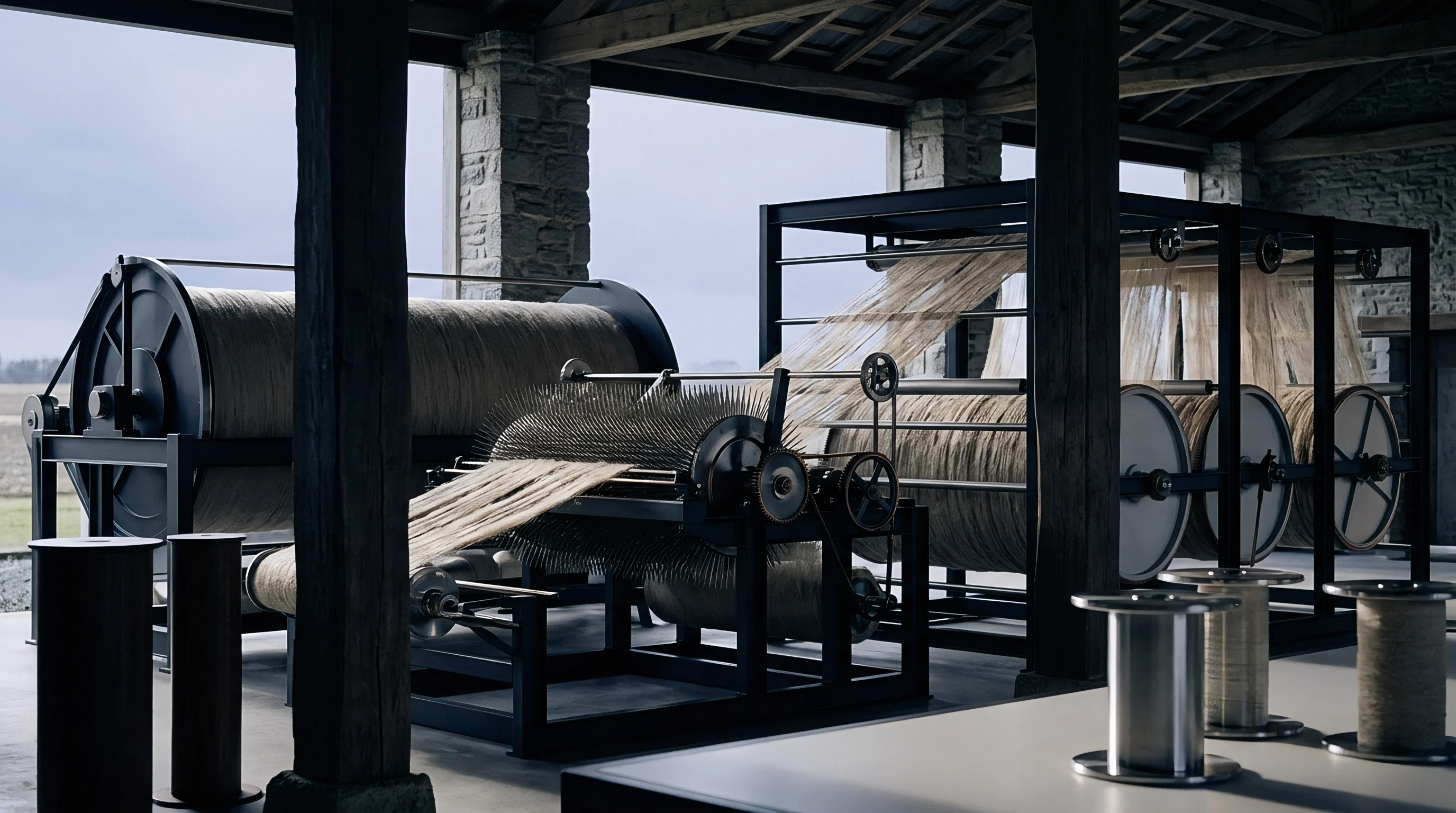
Debris
Solid waste from wet spinning attenuation shows up in two main forms: heavy cellulosic sludge that settles in drafting troughs and light airborne wet fly thrown off by traveler rings. Examining this debris points directly to where attenuation losses occur mechanically. Microscopic analysis shows trough sludge consists mainly of isolated ultimate fibers measuring 10 to 22 millimeters long, broken cortical cells, and middle lamella fragments.
This solid material represents permanent physical yield loss, distinct from dissolved chemical mass.
Sludge generation depends on roving quality, drafting speed, and apron alignment. High-grade long-staple European flax produces 12 to 18 grams of dry solid sludge per kilogram of spun yarn under optimal drafting. Lower-grade tow-blended roving generates 32 to 50 grams per kilogram.
As aprons wear, surface micro-grooves snag short fibers, pulling them out of the attenuation path and dropping them into the lower trough. Regular apron maintenance prevents this accelerated solid waste generation.
Airborne wet fly stems from traveler-yarn friction and centrifugal throw at the spinning balloon. Liquid droplets containing short cellulosic micro-fibrils atomize around the spindle rail. As these droplets evaporate in the mill air, suspended fiber dust settles onto machine frames, guide wires, and floor trenches.
If room relative humidity drops below 65%, wet fly dries quickly in mid-air, forming lint clouds that contaminate nearby spinning positions and clog vacuum nozzles.
Effluent screening removes coarse solids before spent trough water hits primary chemical treatment. Micro-strainers with stainless steel wedge-wire screens (150 to 250 micrometers) capture long fiber fragments, while continuous belt vacuum filters catch fine cellulosic silt. The resulting screen cake contains up to 85% water and must be pressed mechanically to reach a dry solid level suitable for incineration or composting.
The dry weight of this cake is a key input for validating total mill mass balance.
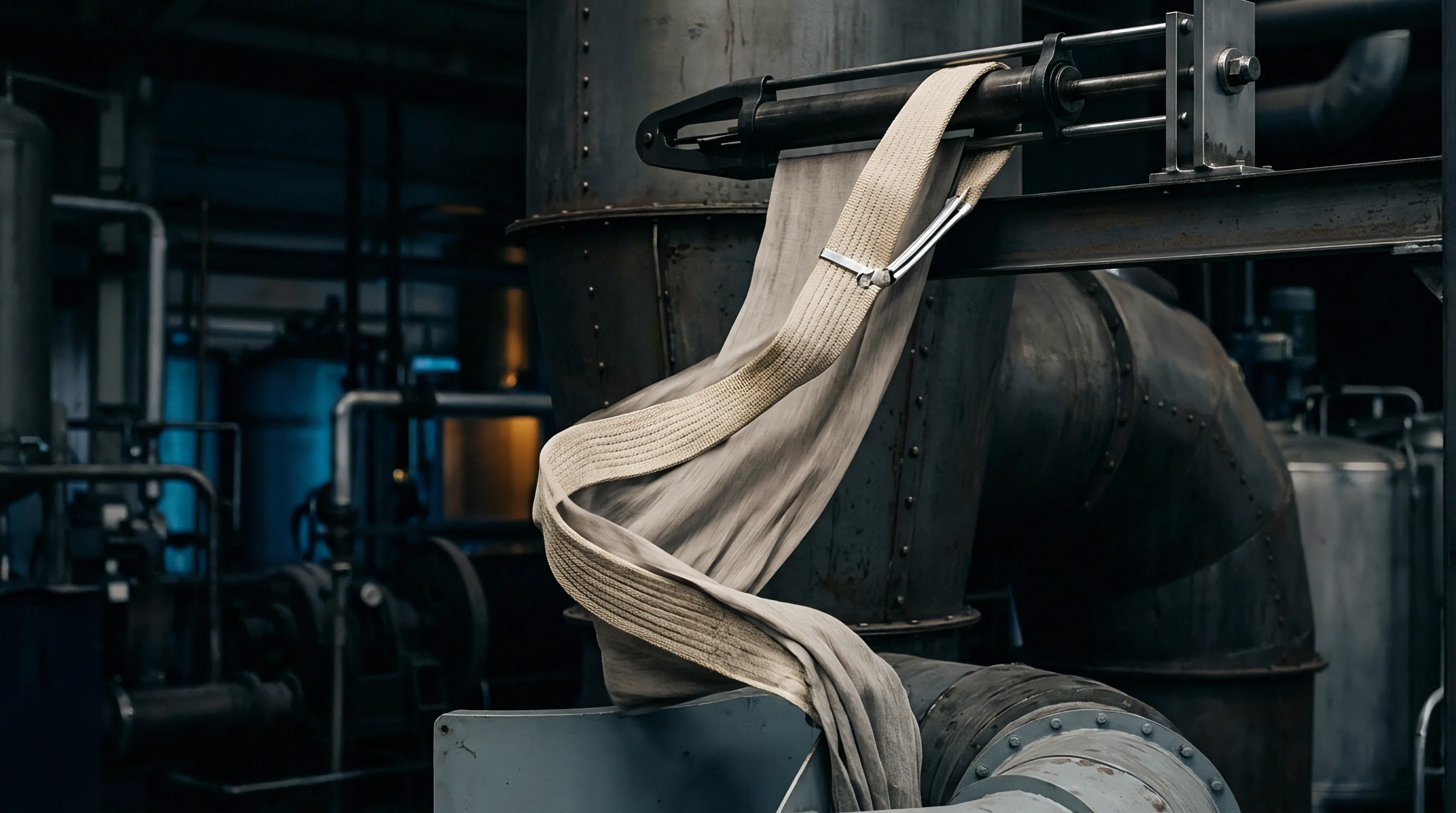
Microstructural Classification of Solid Attenuation Waste
Classifying solid waste by particle morphology gives direct feedback on machine setup errors and fiber defects.
- Cortical Cell Agglomerates point to structural breakdown caused by excessive top nip pressure or degraded synthetic rubber aprons.
- Un-attenuated Roving Fragments indicate localized twist drops in roving packages or slipping back-roller drive belts.
- Isolated Ultimate Fibers signal complete dissolution of middle lamella pectins combined with proper mechanical draft gap alignment.
- Lignosuberin Shive Particles come from incomplete scutching and hackling, leaving rigid wood bark fragments that break under drafting tension.
Automated cleaning systems clear solid debris from drafting zones to protect yarn quality. Oscillating scraper blades wipe lower steel rollers, sweeping wet lint into continuous pneumatic suction ducts. Suction pressures held between 1,200 and 1,800 Pascals carry fiber waste to central cyclones.
If airflow drops below critical speed, damp fiber packs inside manifold elbows, creating plugs that overflow back onto running yarn ends and cause severe slubs.
Solid waste increases non-linearly with higher draft ratios when spinning ultra-fine counts. Pushing draft ratios above 22 to achieve Nm 50 yarn forces short ultimate fibers past their breaking point. Tensile overload fractures individual cell walls, multiplying fine cellulosic fragments suspended in the trough.
Spinners trying to make fine yarns from coarse flax roving face steep solid yield losses that quickly make the run uneconomic.
Water-insoluble shive particles in low-grade roving create stress points during high-speed drafting. Because wood shives cannot absorb water or stretch, they will not attenuate between back and front rollers. As surrounding flax fibers stretch around a rigid shive, local tension spikes, tearing adjacent fibers and dislodging the shive along with a cluster of good ultimate fibers.
Thorough hackling and double-combing of sliver before roving preparation remain the best defense against shive-related debris.
Precise mechanical alignment along the fiber path reduces solid waste across all spinning positions. An alignment error of just 0.5 millimeters between roving guide, immersion rod, and roller nip forces running strands against guide edges, shearing off surface fibers through continuous friction. Accurate mechanical alignment keeps troughs clean and stabilizes yarn mass balance.
Tally
Calculating true yield losses requires balancing dry mass inputs against dry mass outputs across the entire spinning process. Commercial practice relies on bone-dry mass, stripping out variable moisture regain. Raw flax roving enters with an official commercial regain of 12%, while packaged yarn leaves with moisture levels that vary based on drying oven settings and room conditioning.
Mass balance calculations that ignore exact moisture regain yield false loss figures, misleading procurement and hiding physical mill waste.
Total yield loss percentage during wet spinning attenuation is defined as the dry weight of input roving minus the dry weight of clean spun yarn, divided by the dry weight of input roving, multiplied by one hundred. Dry weights require drying representative samples in forced-air laboratory ovens at 105°C ± 2°C until consecutive weighings differ by less than 0.1%. Subtracting tare weights for bobbins, tubes, and packaging ensures recorded weights reflect pure fiber alone.
Mass accounting divides total attenuation yield loss into three components: soluble chemical loss, solid mechanical sludge loss, and unrecoverable airborne loss. Calculations must separate each piece to pinpoint operational inefficiencies. Soluble chemical loss comes from measuring total dissolved solids (TDS) and non-volatile organic content in spent trough purge water.
Solid mechanical loss is determined by weighing dried filter cake from screening plant equipment and pneumatic cyclone collectors.

Yield Loss Equation Framework for Wet Spinning Operations
Quantifying mass distribution across drafting stages requires calculating specific dry fiber metrics at defined operational sampling points.
- Calculate the bone-dry mass of input roving: Mdry_roving = Mwet_roving × Where Mwet_roving is measured initial roving mass and Rroving is tested percentage moisture regain.
- Determine bone-dry mass of output yarn on bobbins: Mdry_yarn = Mwet_yarn × Where Mwet_yarn is measured net yarn mass on bobbins and Ryarn is tested yarn regain percentage.
- Quantify total percentage mass loss across the spinning run: Ltotal (%) = × 100
- Isolate chemical soluble loss percentage via evaporation residue testing: Lchem (%) = × 100 Where Veffluent represents total liters of purged trough water and TDSpurge is dry residue weight per liter.
- Calculate net unrecoverable waste variance: Lunrecoverable (%) = Ltotal − (Lchem + Lsolid_sludge)
Comparing production figures against target yield benchmarks reveals hidden mill losses. A standard 1,000-kilogram dry roving batch spun into Nm 26 apparel yarn yields roughly 910 kilograms of dry yarn ~ a 9.0% total yield loss. In a typical run, chemical dissolution accounts for 3.5% (35 kg), mechanical trough sludge for 2.8% (28 kg), pneumatic lint suction recovers 1.7% (17 kg), and unrecoverable wet fly and floor waste make up the remaining 1.0% (10 kg).
| Loss Component Category | Coarse Yarn Target (Nm 10 to 18) | Medium Yarn Target (Nm 24 to 36) | Fine Yarn Target (Nm 40 to 60) | Primary Measurement Method |
|---|---|---|---|---|
| Soluble Chemical Extraction | 2.2% to 2.8% | 3.0% to 3.8% | 4.2% to 5.8% | ISO 6427 Hot Water Residue Test |
| Solid Trough Sludge | 1.1% to 1.6% | 2.1% to 2.9% | 3.8% to 5.2% | Gravimetric Filter Cake Drying |
| Pneumatic Suction Fly | 0.8% to 1.2% | 1.4% to 1.8% | 2.2% to 3.1% | Cyclone Dust Bag Weighing |
| Unrecoverable Variance | 0.4% to 0.7% | 0.8% to 1.2% | 1.3% to 2.1% | Mass Balance Reconciled Residual |
| Total Cumulative Loss | 4.5% to 6.3% | 7.3% to 9.7% | 11.5% to 16.2% | Bone-Dry In-Out Calculation |
Yield accounting errors frequently trace back to inaccurate tare weights for spinning packages. Plastic bobbin tubes absorb water during hot spinning and steam conditioning, increasing their tare weight by 0.5% to 1.2% over dry weights. If mill systems subtract dry tube tare weights from gross package weights, reported net yarn weights are artificially inflated.
This error masks true yield losses by up to 15 kilograms per ton of spun yarn, hiding actual fiber loss.
Yield calculations must also account for residual non-cellulosic extractives left inside dried yarn. Yarn exiting the frame still contains 1.5% to 2.5% residual pectins and hemicelluloses in its core. If downstream processing includes boiling-off or bleaching before weaving, this residual material dissolves during fabric preparation, causing further weight loss at the dye house.
Sourcing professionals evaluating total conversion efficiency need to track cumulative mass loss from roving all the way to finished greige cloth.
An audit of a Jiangsu spinning facility claiming a suspicious 96.2% dry fiber yield on Nm 39 long-staple yarn showed that re-weighing bobbin tare weights after complete oven drying and adjusting for continuous trough purge rates revealed a true yield of 89.4% ~ exposing an unaccounted 68-kilogram dry fiber deficit per ton masked by uncalibrated package tare allowances.

Dossier
Auditing mill provenance claims requires verifying that incoming certification credentials match output volumes after accounting for attenuation losses. Certified programs like European Flax and Masters of Linen mandate strict mass balance tracking from farm origin through scutching, hackling, roving, and spinning. A mill buying 10,000 kilograms of certified European Flax roving cannot legally sell 10,000 kilograms of certified yarn.
The maximum volume of certified yarn eligible for sale equals certified input fiber minus documented attenuation and process yield losses.
Transaction Certificates (TCs) issued by accredited third-party certification bodies document the weight of certified material moving through the supply chain. When a spinner receives certified roving, the accompanying TC lists both net gross weight and bone-dry weight. To preserve chain of custody under ISO 17065 frameworks, the mill must maintain internal batch ledgers linking specific incoming roving lots through drafting troughs to final yarn packages.
Auditors compare these ledgers against physical production logs.
Discrepancies between certified input mass and declared output mass often point to unapproved blending of non-certified fiber during wet spinning. Unscrupulous operators may top up drafting frames with non-certified tow sliver or low-cost domestic Asian flax to offset attenuation losses, keeping a false 1:1 input-to-output ratio on paper. Auditors spot this by comparing declared yield loss figures against lab tests of trough waste solids and yarn physical properties.
True long-staple attenuation losses leave clear quantitative footprints in waste collection logs.
Documentation Verification Checklist for Spinner Qualification
Validating provenance and yield loss compliance requires auditing physical documents in sequential order across the mill office.
- Scutcher and Hackling Batch Delivery Notes showing raw fiber origin, lot numbers, and bale dry weights entering the roving preparation line.
- Scope Certificates and Transaction Certificates verifying issuing body accreditation, expiry dates, and covered processing stages under European Flax standards.
- Spinning Frame Daily Production Logs recording spindle allocation, yarn count targets, operational speeds, and gross yarn bobbin counts.
- Wastewater Treatment Plant Sludge Manifests quantifying dry filter cake weight removed from wet spinning trough treatment circuits.
- Laboratory Moisture and Regain Test Reports confirming oven-dry weight calculations performed on incoming roving and outgoing yarn lots.
- Outbound Sales Invoices and Matching Transaction Certificates verifying that declared certified yarn weights do not exceed theoretical yields based on input mass.
Chinese wet spinning mills processing European flax fiber operate under distinct non-preferential origin rules and customs documentation standards. Under European Union Regulation 2015/2447, non-preferential origin is conferred upon the country where the last substantial, economically justified processing took place. Spinning raw fiber into yarn constitutes a substantial transformation, granting Chinese origin to yarn spun in Jiangsu from French-grown flax.
However, retaining the commercial right to market the yarn under the European Flax trademark requires maintaining chain-of-custody documentation certified by auditing agencies accredited under ISO 17065.
Audits at Chinese mills involve physical reconciliations of bale stores, roving inventory, and waste disposal records. Inspectors check physical inventory in warehouses, matching lot numbers against declared transaction certificates. Auditors also sample wastewater discharge points to confirm pectin sludge volume aligns with reported spinning losses.
A mill declaring high fiber yields alongside negligible sludge generation fails physical reconciliation, triggering immediate suspension of certification scope.
Contracts between brand buyers and wet spinners should explicitly state acceptable yield loss ranges for given yarn counts. Sourcing agreements ought to require mills to submit certified batch mass reconciliations with every delivery. Setting explicit yield benchmarks prevents mills from inflating yarn weight with heavy wax or excess moisture conditioning to disguise fiber losses incurred during aggressive, un-audited drafting.
When auditing compliance with European Flax scheme rules, certified facilities must present documentation proving mass balance calculations include actual attenuation loss factors for the specific yarn count produced. Under Clause 4.3.2 of the European Flax Standard for Processing, any certificate holder caught issuing Transaction Certificates for yarn volumes exceeding input fiber minus audited process losses faces immediate certificate revocation and financial penalties under supply chain warranty deeds.

Settlement
Commercial contracts for long-staple flax yarn must build attenuation yield loss directly into the baseline pricing structure. Because wet spinning destroys 5% to 16% of dry fiber mass depending on yarn fineness, raw material costs cannot be evaluated on a simple weight-for-weight basis. Spinner quotation formulas include a Fiber Loss Surcharge Factor (FLSF) that scales raw fiber costs up to cover destroyed mass, dissolved solids, and unrecoverable trough sludge.
Failing to audit this surcharge factor allows mills to inflate baseline yarn prices beyond actual yield loss costs.
Landed cost per kilogram of spun flax yarn reflects raw roving costs, conversion costs, attenuation loss surcharges, and certification fees. Standard pricing equations treat the fiber yield loss factor as a distinct multiplier applied directly to baseline fiber costs. Cost models must also account for scrap recovery, where collected mechanical lint and dry filter cake are sold into lower-grade non-woven or coarse tow applications, offsetting a small portion of overall fiber loss expenses.
To calculate the baseline raw material cost per kilogram of finished yarn, the dry roving price is divided by net dry yield. For example, if certified European Flax roving costs $8.50 per kilogram dry weight and audited dry yield for Nm 26 apparel yarn is 91.0% (0.910), the true raw material cost per kilogram of yarn increases to $9.34. If a spinner quotes based on a default 85.0% yield factor (0.850), the calculated raw material cost jumps to $10.00, letting the mill capture an unearned margin of $0.66 per kilogram under the guise of attenuation waste.
| Yarn Fineness Target | Base Roving Cost ($/kg) | Audited Net Yield (%) | Effective Fiber Cost ($/kg) | Conversion Cost ($/kg) | Final Landed Yarn Cost ($/kg) |
|---|---|---|---|---|---|
| Coarse (Nm 14) | $6.20 | 94.5% | $6.56 | $2.80 | $9.36 |
| Medium (Nm 26) | $8.50 | 91.0% | $9.34 | $3.90 | $13.24 |
| Fine (Nm 39) | $11.80 | 86.5% | $13.64 | $5.60 | $19.24 |
| Ultra-Fine (Nm 60) | $16.50 | 81.0% | $20.37 | $8.40 | $28.77 |
Scrap recovery credits offset attenuation expenses by capturing value from solid waste streams. High-grade long-fiber lint collected by pneumatic suction during Nm 26 spinning sells to paper mills or needle-punched insulation makers for $0.80 to $1.20 per kilogram dry weight. Trough sludge and low-grade filter cake carry minimal value and often cost $0.05 to $0.12 per kilogram to dispose of.
Sourcing managers negotiating volume orders should ensure pneumatic lint credits are applied against overall processing cost calculations.
Resolving contractual yield loss disputes relies on standardized laboratory testing of reference bobbin samples. When a buyer identifies weight deficits or suspects uncertified blending, representative bobbins are drawn under ISO 2859-1 sampling plans and sent to an accredited ISO 17025 laboratory. Testing evaluates quantitative cellulose purity, non-cellulosic extractables (ISO 6427), and dry moisture regain.
If results show the spinner inflated yarn weight with excess moisture or wax instead of delivering true fiber mass, contract indemnification clauses trigger rebates covering the weight variance.
Warranty indemnification language must specify clear financial remedies for shortfalls in fiber mass delivery. A standard clause for bulk flax procurement states that if audited net dry fiber weight falls more than 1.5% below certified input mass minus agreed attenuation benchmarks, the seller must credit the buyer for both the missing fiber mass and the proportional certification surcharge paid on un-delivered material. Establishing explicit remedies protects buyers from covert yield loss inflation and maintains chain of custody integrity across supply lines.
The commercial settlement sheet reconciles every kilogram of scutched flax delivered to the frame against the exact meters of conditioned yarn shipped on pallets. When mill ledgers, lab moisture reports, and transaction certificates agree on bone-dry mass, the financial transaction matches physical reality. Best practice requires embedding these audit checks directly into purchase orders before the first roving spool enters the drafting bath.