Modeling Non-Cellulosic Polyuronide Extraction Kinetics Governing Inter-Elementary Flax Fibre Delamination Limits in High-Speed Wet Spinning
Polyuronide extraction kinetics dictate middle lamella shear failure, establishing draft speed ceilings to prevent yarn delamination and mass variation.


Trough
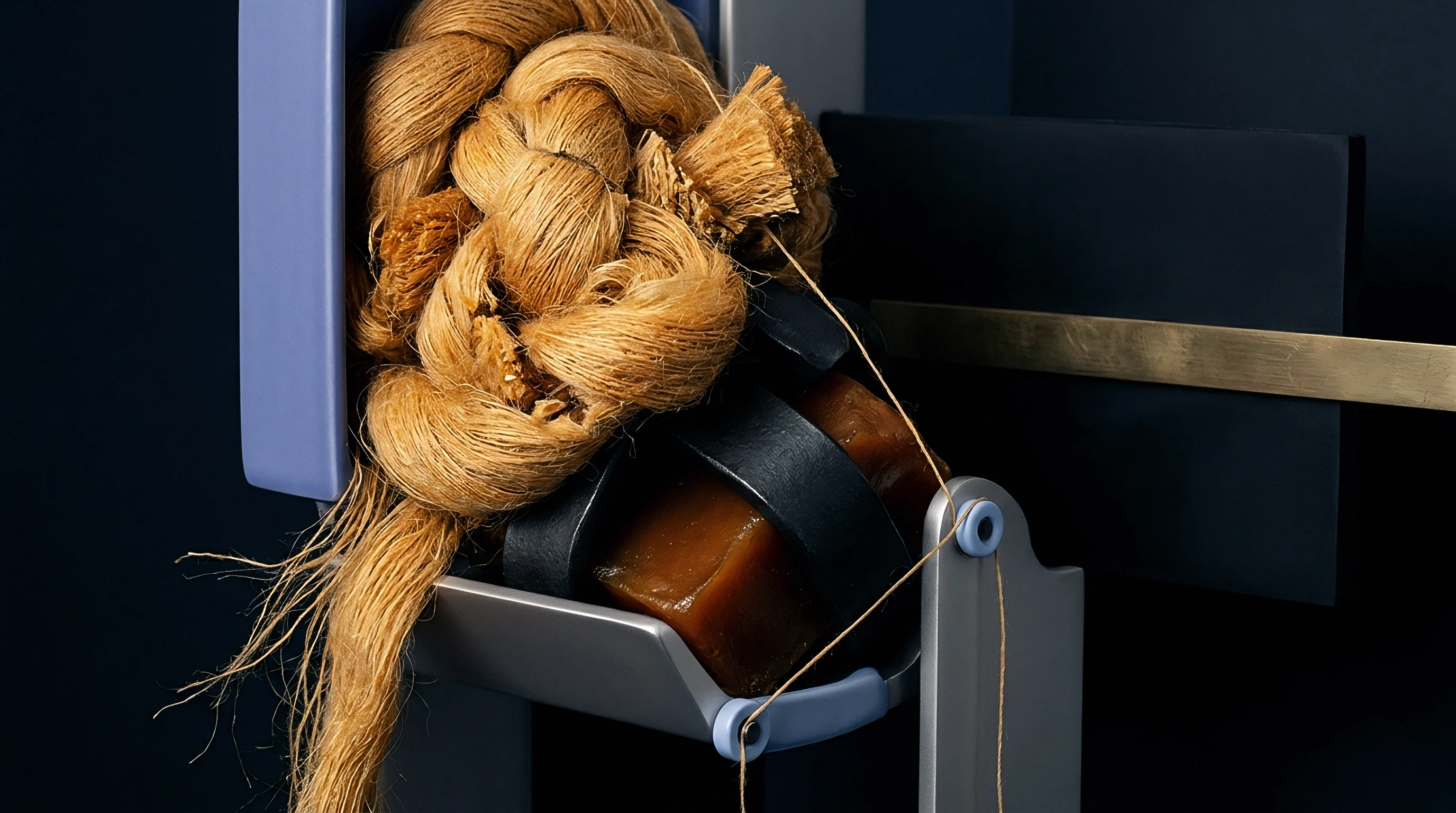
Pectin Depolymerization in Hot Water Conditioning
Delamination speed in high-speed wet spinning depends on how rapidly non-cellulosic polyuronides dissolve out of the flax middle lamella. Unprocessed technical bast bundles arrive at the spinning trough with an intact polygalacturonic acid matrix binding 10 to 40 elementary filaments together. Water held between 60 and 70 degrees Celsius dissolves the water-soluble pectic fractions quickly enough to alter bundle cohesion before the material contacts the drafting rollers.
On industrial frames operating above 25 metres per minute, immersion time drops below 15 seconds. That brief dwell limits heat transfer into coarse bundle cores, peeling the outer sheath while leaving core pectins largely untouched.
The dissociation limit is set by the chemistry of these middle lamella cements. In flax, the lamellae consist of roughly 65 percent homogalacturonan, interspersed with branched rhamnogalacturonan-I segments and neutral arabinan side chains. Divalent calcium ions bridge unesterified carboxyl groups on the galacturonan backbone, forming egg-box junction zones.
Hot water weakens hydrogen bonds among the neutral hemicelluloses, but the ionically cross-linked calcium pectate network stays mostly intact. Plain thermal extraction cannot fully separate elementary fibres without chemical additives or longer retting times.
Water-soluble polyuronide dissolution within a fifteen-second immersion cycle alters the outer bundle boundary without shearing core calcium-pectate bonds.
Above 75 degrees Celsius, protopectin components break down via accelerated beta-elimination alongside ester hydrolysis. The degree of methylesterification in typical dew-retted line flax runs between 45 and 65 percent, leaving the backbone susceptible to chain scission even at neutral pH. This non-enzymatic breakdown thins the middle lamella, dropping the critical shear stress needed to separate elementary fibres from 14 megapascals down to 3 megapascals.
In unbuffered baths, organic acids leached from cortical tissue can pull the liquor down to roughly 4.8 pH. That drop suppresses unesterified polyuronide solubility, which shows up downstream as drafting force swings across the field.
| Immersion Chemistry | Bath Temperature (deg C) | Dwell Time (s) | Polyuronide Extraction Yield (pct) | Residual Esterification (pct) | Bundle Cohesion Force (cN/tex) |
|---|---|---|---|---|---|
| Demineralised Water | 60 | 12.0 | 1.8 | 58.2 | 18.4 |
| Demineralised Water | 75 | 12.0 | 4.1 | 51.3 | 11.2 |
| 0.05 M Sodium Carbonate | 60 | 8.5 | 7.6 | 38.4 | 6.5 |
| 0.05 M Sodium Carbonate | 75 | 8.5 | 12.9 | 22.1 | 2.8 |
| 0.02 M Oxalic Acid / Chelant | 65 | 10.0 | 9.4 | 44.0 | 4.3 |

Alkaline Penetration Dynamics across Technical Bundles
To speed delamination, wet spinning plants dose small amounts of sodium hydroxide or sodium carbonate into the trough. Sodium ions displace calcium bridges in the polyuronide structure, yielding soluble sodium pectate polymers that wash out into the bath. This exchange displays pseudo-first-order displacement mechanics, where the bottleneck shifts from reaction rate to radial diffusion through the bundle matrix.
Mechanical agitation from roving guides running above 30 metres per minute trims the hydrodynamic boundary layer from 45 micrometres to under 8 micrometres.
The radial diffusion coefficient for sodium ions migrating through the intercellular pectin matrix sits near 1.2 multiplied by 10 to the power of minus 10 square metres per second. In coarse technical bundles, densely packed outer filaments shield the interior, setting up a steep extraction gradient: peripheral fibers separate cleanly while the core remains a bound composite. This split state produces localized drafting force spikes right at the nip.
Over-extracting destroys process stability on high-speed lines. Runaway saponification strips the intercellular cement altogether, stranding single elementary fibres before they reach the nip rollers. These unsupported ends break free in the pre-drafting zone and build up as roller wrap.
Spinning mills adjust chemical concentrations, temperature, and line speed to pin residual polyuronide content between 1.5 and 2.5 percent by dry fiber weight. Specifying yarn spun from aggressively leached slivers simply transfers costs to winding, where waste percentages climb.


Shear
Delamination Mechanics in the High-Speed Drafting Zone
Elementary fibres separate mechanically between the back retaining rollers and the front delivery rollers. Flax wet spinning frames run short ratch settings ~ generally 40 to 65 millimetres ~ so short elementary bast fibres, which measure only 20 to 40 millimetres, do not drift uncontrolled through the zone. Splitting must happen while the fibres slide past one another, with the softened middle lamella acting as a shear-thinning fluid binder under tension.
Higher delivery speeds drive up shear strain rates inside the matrix. At yarn speeds past 30 metres per minute, shear rates within the middle lamella exceed 10,000 reciprocal seconds, mechanically rupturing residual crosslinked polyuronides. The stress required to separate them scales inversely with extracted pectin volume.
When too much pectin remains, bundle cohesion stays high, forcing drafting rollers to run higher nip pressures to prevent slippage.
Drafting resistance across the ratch traces a series of peaks and troughs tied to individual bundle cleavage events. As a bundle hits the nip, tension climbs until the middle lamella yields in shear; the bundle splits, releasing elementary fibres that slide across one another until surface interlocks disengage. If polyuronides are under-extracted, failure shifts from lamellar shear to tensile breakage of the elementary fibrils themselves.
That fiber breakage costs 25 to 40 percent of finished yarn tenacity, as fragmented fibrils cannot sustain high loads once twist is inserted.
ISO 2062 single-end tensile measurements establish that yarns produced under middle lamella shear delamination yield forty percent higher tenacity than lots subjected to tensile fibril fragmentation.

Drafting Force Profiles at Elevated Delivery Velocities
Dynamic drafting resistance offers a direct readout of trough extraction performance. Modern wet frames use piezo-electric load cells on the front roller bearings to log drafting force in real time. For properly conditioned line flax, nominal resistance stays between 80 and 140 centinewtons per kilotex.
Coarse slivers carrying excess polyuronide push that resistance above 280 centinewtons per kilotex, inducing roller chatter and heavy mass variance in the yarn.
Frame accelerations compound this resistance unless bath extraction accelerates to match. Moving from 20 to 40 metres per minute cuts trough immersion time in half, reducing extraction yields by roughly 35 percent. This leaves higher-molecular-weight polyuronides behind, thickening the lamella and driving up apparent viscosity.
Front drafting rollers then transfer elevated mechanical strain back down the zone, triggering intermittent stick-slip action.
That uneven drafting generates alternating thick and thin spots, inflating thin-place counts per thousand metres. The drafting assembly fails mechanically as soon as chemical extraction falls behind delivery speed. Keeping delamination stable requires balancing bath chemistry and temperature directly against roller pressure settings.


Kinetics

Rate Equations for Non-Cellulosic Polyuronide Dissolution
Pectin removal in hot water troughs follows a dual-regime first-order kinetic model. Industrial flax bundles contain two main pectic pools: an easily solubilized labile fraction and an insoluble, cross-linked structural fraction. Extraction follows this integrated rate expression:
C(t) = C_rapid (1 – exp(-k_rapid t)) + C_slow (1 – exp(-k_slow t))
Here C(t) is total extracted polyuronide mass at time t, while C_rapid and C_slow represent initial concentrations of the labile and structural domains. The labile pool consists of neutral arabinogalactans and unesterified pectins held by hydrogen bonds and physical tangling. The structural pool contains rhamnogalacturonan segments anchored to cell-wall cellulose through covalent bonds or calcium bridges.
| Bath Temperature (deg C) | Extraction Agent | k_rapid (s^-1) | k_slow (s^-1) | Activation Energy E_a (kJ/mol) | Goodness of Fit R^2 |
|---|---|---|---|---|---|
| 60 | Pure Water | 0.082 | 0.0031 | 42.5 | 0.984 |
| 70 | Pure Water | 0.145 | 0.0064 | 43.1 | 0.988 |
| 80 | Pure Water | 0.248 | 0.0128 | 41.8 | 0.991 |
| 60 | 0.05 M Na2CO3 | 0.210 | 0.0145 | 31.2 | 0.979 |
| 70 | 0.05 M Na2CO3 | 0.380 | 0.0298 | 32.0 | 0.985 |
| 80 | 0.05 M Na2CO3 | 0.620 | 0.0580 | 30.7 | 0.989 |
Both kinetic rate constants follow Arrhenius behavior across normal operating temperatures. Labile extraction carries an activation energy near 42 kilojoules per mole in water, typical of simple hydration and physical dissolution. The structural fraction requires breaking coordination complexes or covalent ester linkages, demanding roughly 78 kilojoules per mole in neutral water.
Adding alkaline salts drops that barrier to about 31 kilojoules per mole, speeding structural breakdown during brief trough passes.
What Governs Middle Lamella Cleavage across Varying Frame Speeds?
Whether fibres delaminate cleanly or snap under tension depends on how drafting transit time balances against trough extraction time. A dimensionless Damkohler number captures this relationship:
Da = k_rapid L_trough / v_roving
In this expression, L_trough is the submerged roving path length in metres, and v_roving is linear roving speed entering the bath. If this extraction index falls below 1.2, too little polyuronide dissolves before mechanical drafting begins. Bundle cohesion stays too high, breaking fibres and overloading the drafting drive.
Roving speed adjustments must therefore track changes in trough conditions.
This model assumes the roving cross-section heats uniformly, but industrial rovings run from 350 to 800 tex, setting up sharp thermal gradients between surface and core. Heat moves through wet cellulosic bundles at a thermal diffusivity of about 1.4 multiplied by 10 to the power of minus 7 square metres per second. In an 800-tex roving running at 35 metres per minute, core temperature stabilizes only after 4.5 seconds of full immersion.
Submersion times shorter than that leave core filaments under-extracted, destabilizing fibre delamination across the strand.


Rupture
Delamination Limits and End Breakage Dynamics
Erratic delamination directly drives end breaks on ring frames. Failures happen when drafting force spikes exceed the tensile limit of the untwisted strand leaving the front delivery nip. At that point, the yarn relies entirely on capillary attraction and lamellar viscosity to hold together until twist is inserted.
If over-extracted, the strand loses cohesion, fails under delivery tension, and breaks at the nip.
Plotting end breaks against roving speed and chemical extraction yield produces a Weibull distribution. Breaks reach a minimum when residual polyuronides in the middle lamella settle between 1.8 and 2.2 percent. Above 3.5 percent, undrafted bundle segments wedge into roller flutes and snap the ends.
Below 1.0 percent, breaks jump tenfold as the fibre mass collapses within the twist triangle. Higher delivery speeds compress this workable operating window.
Stable delamination at speed relies on four main process settings:
- Trough chemical concentration stabilizes extraction rates by replacing lost chelating ions continuously through automated dosing pumps linked directly to bath conductivity meters.
- Roller nip pressure calibration maintains consistent mechanical gripping across the whole drafting zone, compensating for changes in bundle width and hydration swelling.
- Submersion depth control adjusts physical contact duration inside the liquid medium proportionally to fluctuations in frame delivery speed.
- Bath temperature monitoring prevents thermal spikes from inducing non-selective cellulose degradation that impairs finished yarn tenacity.
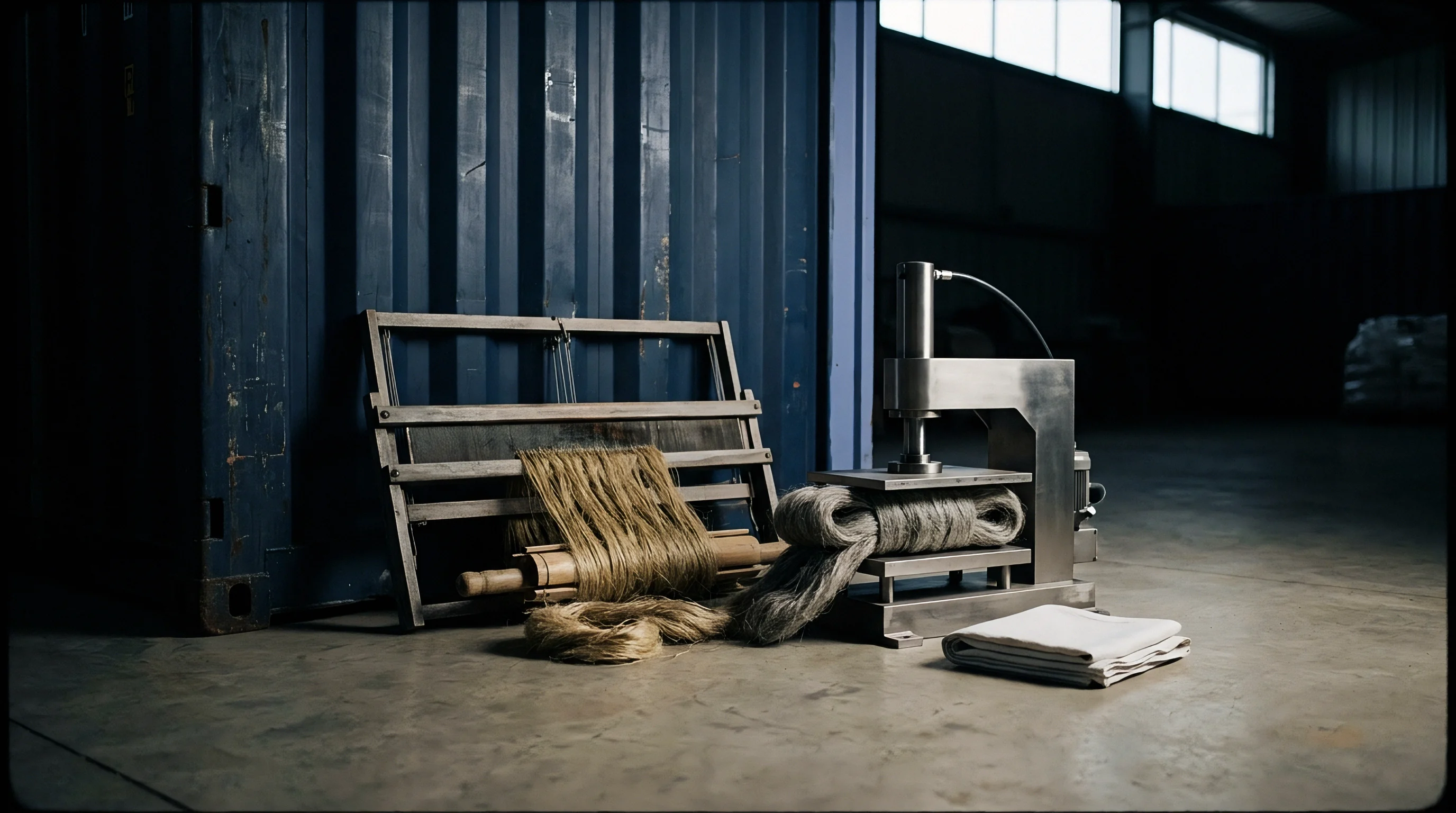
Elementary Fibre Delamination Defect Modes
Under-extraction and uneven leaching leave recognizable structural defects in wet-spun yarn packages. Auditors and classers spot these flaws on finished cones before clearing yarn lots for weaving or knitting.
- Shive encrustation retention occurs when inadequate middle lamella solubilization prevents the detachment of non-fiber cortical fragments, leaving dark woody flecks embedded within the yarn body.
- Coarse bundle slippage faults emerge as local drafting irregularities, generating thick slubs with lengths matching the drafting ratch distance.
- Premature strand starvation generates extreme thin places where hyper-extracted filaments drafted out cleanly without drawing adjacent fibres into the twist triangle.
- Fibrillar peeling hairiness develops when incomplete matrix softening forces elementary fibrils to fracture longitudinally, producing high surface hairiness along the spun thread.
Yarn metrics deteriorate quickly once extraction drifts outside standard operating parameters. The table below records physical properties across wet-spun line flax lots conditioned at different extraction levels.
| Pectin Extraction State | Residual Polyuronide (pct) | Tenacity (cN/tex) | Tenacity CV (pct) | Mass CVm (pct) | Hairiness Index (H) | End Breaks (per 1000 sp/hr) |
|---|---|---|---|---|---|---|
| Severely Under-Extracted | 4.2 | 22.4 | 18.6 | 19.8 | 6.2 | 85 |
| Moderately Under-Extracted | 3.1 | 28.5 | 14.2 | 15.2 | 5.4 | 42 |
| Balanced Extraction | 2.1 | 34.8 | 9.8 | 11.4 | 3.8 | 14 |
| Moderately Over-Extracted | 1.2 | 29.2 | 13.5 | 14.1 | 4.5 | 38 |
| Severely Over-Extracted | 0.6 | 18.1 | 22.4 | 18.5 | 7.8 | 120 |
Hairiness data shows how mechanical shear treats partially softened bundles. Rigid middle lamellae resist bending over drafting rollers, forcing stiff ends to splay outward from the strand core. Proper chemical extraction softens those outer layers, letting fibres tuck smoothly into the yarn structure under ring twist to produce the clean surface characteristic of wet-spun linen.

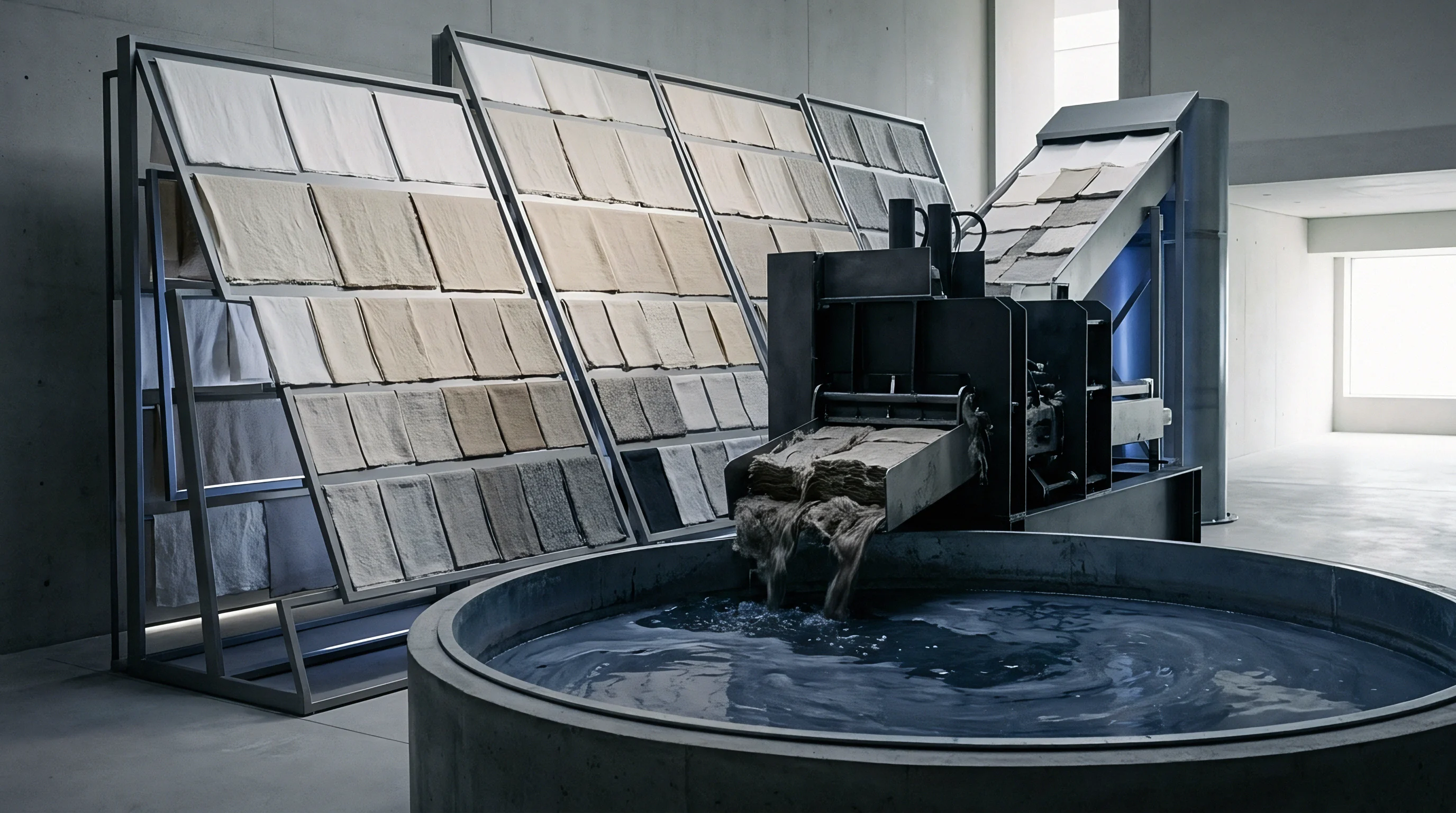
Ledger

Worked Yield and Count Economics under High-Speed Regimes
Applying kinetic data to spinning economics requires tracking dissolved mass against target yarn counts. Leaching non-cellulosic polyuronides strips dry mass straight out of the sliver, with losses typically running between 2.5 and 5.0 percent depending on bath chemistry. A 10-tonne allocation of scutched hackled line flax priced at 8.20 USD per kilogram landed mill-gate, intended for high-speed wet spinning into Nm 60 (16.7 tex) yarn, outlines the cost progression.
With a balanced bath, chemical dissolution accounts for 3.2 percent of mass loss in the trough. Mechanical losses ~ roller wraps, pneumafil suction, and splicing cuts ~ take another 4.5 percent on the frame, leaving a finished yarn yield of 92.3 percent. This pushes the effective raw fibre cost from 8.20 USD to 8.88 USD per kilogram before adding conversion power, chemicals, or direct labour.
In an unmanaged setup running 10 degrees Celsius hot with excess caustic to force frame output, chemical mass loss reaches 6.8 percent through non-selective pectin and hemicellulose stripping. High break frequencies push pneumafil collection from 4.5 to 8.2 percent, dropping net spinning yield to 85.0 percent. Fibre cost climbs to 9.65 USD per finished kilogram ~ an unrecoverable cost increase of 0.77 USD per kilogram, or 7,700 USD lost across a 10-tonne order.
A two-percent drop in spinning yield from aggressive chemical over-extraction increases finished yarn manufacturing cost more than doubling the trough heating energy expenditure.
Count limits track extraction depth directly. Fine counts such as Nm 80 or Nm 100 require fine bundle division, averaging under 3 elementary fibres per cross section. Partial extraction caps production around Nm 39 or Nm 48; drafting beyond that point without adequate softening results in immediate drafting zone failure.
| Target Count (Nm) | Roving Tex | Machine Speed (m/min) | Extraction Mass Loss (pct) | Total Waste (pct) | Finished Yarn Yield (pct) | Fibre Cost / kg Yarn (USD) | Fibre Cost / 100m Cloth (USD) |
|---|---|---|---|---|---|---|---|
| Nm 26 (38.5 tex) | 850 | 38.0 | 2.4 | 5.8 | 91.8 | 8.93 | 5.16 |
| Nm 39 (25.6 tex) | 650 | 32.0 | 2.8 | 6.4 | 90.8 | 9.03 | 3.47 |
| Nm 60 (16.7 tex) | 450 | 25.0 | 3.5 | 7.8 | 88.7 | 9.24 | 2.31 |
| Nm 80 (12.5 tex) | 350 | 18.0 | 4.4 | 10.2 | 85.4 | 9.60 | 1.80 |
| Nm 100 (10.0 tex) | 280 | 12.0 | 5.2 | 14.5 | 80.3 | 10.21 | 1.53 |
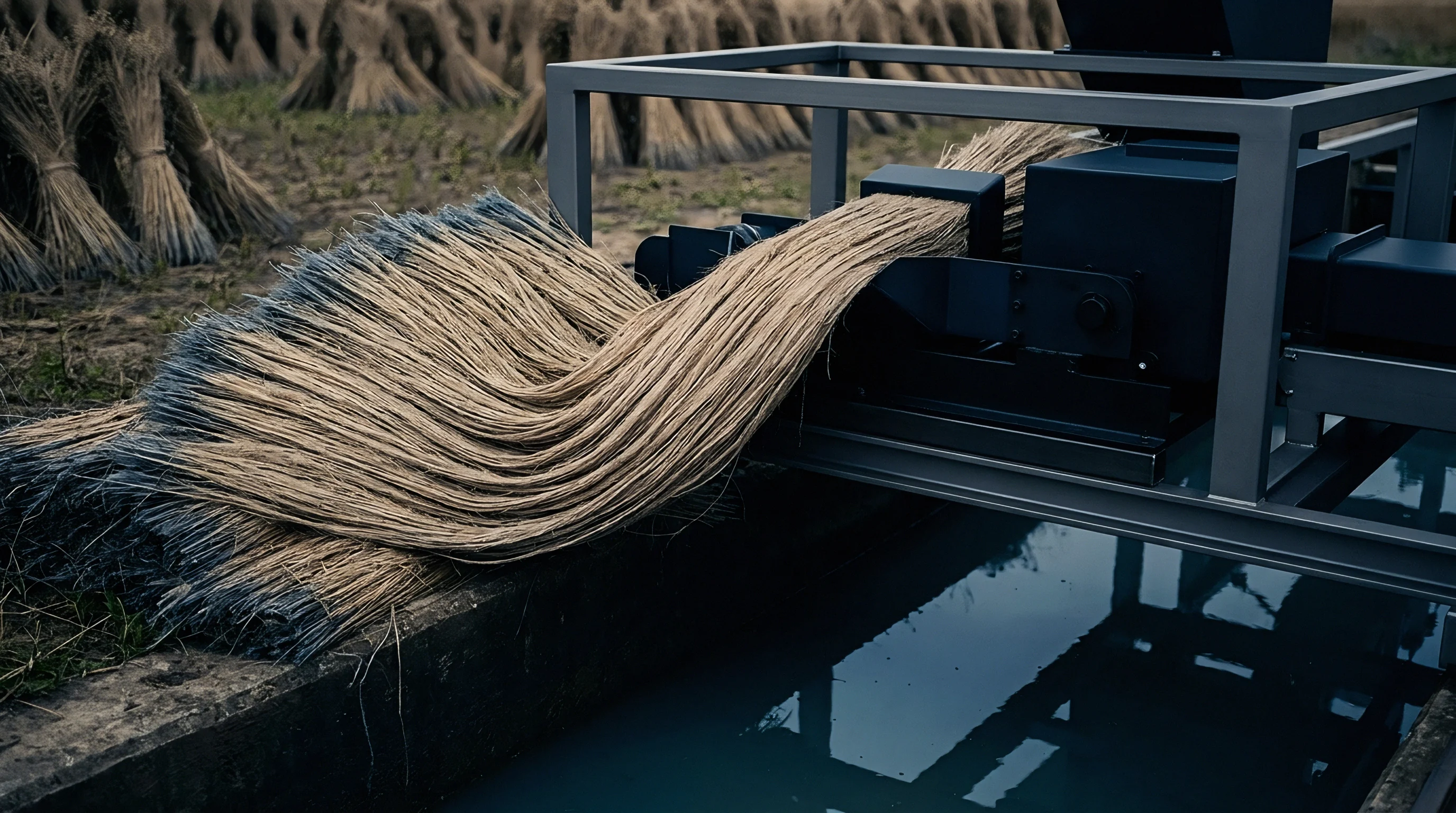
Sourcing Contract Controls for Spinning Specifications
Buyers commissioning custom spinning runs can limit delamination damage by specifying chemical and physical thresholds in procurement contracts. Standard agreements usually check only yarn count, single-end tenacity, and mass evenness, none of which reveal whether fibers were chemically stripped and weakened for wet finishing.
Stricter terms define acceptable residual polyuronide ranges alongside baseline fibril strength. Specs should set limits on residual calcium in finished yarn packages to verify that the lot was not over-scoured. Ash and mineral crosslink assays offer a straightforward, non-destructive way to verify middle lamella history without micro-tensile testing.
Yarns with low tensile strength and high flexural stiffness cause frequent loom stops during sizing and shed opening. When higher frame speeds are presented as harmless to yarn structure, technical audits should verify drafting force logs and bath extraction records directly. Supply contracts can stipulate that if mass CV exceeds 14 percent while residual polyuronides fall below 1.0 percent, the spinning mill assumes responsibility for weaving efficiency losses.
Chemical surfactants are often positioned as an easy fix for elementary fiber division at high frame speeds without altering bath settings. On production audits, running high speeds without adjusting trough parameters shows up as heavy roller-waste accumulation and local thermal scorching across the frames.