Hydrodynamic Shear and Pectin Solubilization during Wet Drafting
Hydrodynamic shear in hot water troughs solubilizes middle lamella pectins, enabling elementary flax fiber attenuation for fine, high-tenacity yarns.
Rheology
Fluid Dynamics inside the Wet Drafting Zone
Water reduces inter-fiber friction. During wet drafting of flax roving, attenuated technical fiber bundles pass through a heated liquid bath immediately prior to the drafting rollers. Fluid motion within the narrow gap between adjacent filaments creates severe hydrodynamic shear forces.
These localized velocity gradients strip away softened intercellular substances that bind individual elementary fibers together. Liquid boundary layers surrounding each bundle experience shear rates exceeding ten thousand reciprocal seconds at commercial production speeds of thirty to fifty meters per minute.
Shear forces pull filaments apart. Physical separation of bast fiber bundles relies on simultaneous thermal softening of intercellular pectins and mechanical drag exerted by the moving liquid. Water molecules penetrate the porous cellular walls of the bundle, swelling the hemicellulose matrix and expanding the distance between cell walls.
As the back and front drafting rollers establish a speed differential defined by the draft ratio, moving water carries dissolved pectins away from the sliding surfaces, preventing immediate re-adhesion of the microfibrils.
| Trough Temperature (°C) | Water Viscosity (mPa·s) | Shear Rate at Draft Nip (s⁻¹) | Pectin Solubilization Rate (g/kg/min) | Fiber Slip Force (N/ktex) |
|---|---|---|---|---|
| 20 | 1.002 | 4,200 | 0.14 | 18.5 |
| 40 | 0.653 | 6,100 | 0.38 | 12.2 |
| 60 | 0.467 | 8,500 | 0.89 | 6.8 |
| 70 | 0.404 | 9,800 | 1.42 | 4.3 |
| 80 | 0.354 | 11,200 | 2.15 | 2.9 |

Velocity Gradients and Viscous Drag Forces
Viscosity drops as temperature rises. Lower fluid viscosity allows rapid penetration into dense roving architecture, decreasing the boundary layer thickness around individual filaments. High liquid drag forces generated at elevated drafting speeds pull individual elementary fibers out of the bundle matrix without causing tensile failure of the cellulosic core.
When fluid velocity matches the drafting roller surface speed, shear stress concentrates at the interface between outer and inner bundle layers, enabling uniform attenuation down to fine yarn counts.
Water trough temperature maintained at 72 degrees Celsius reduces pectin shear resistance by forty percent compared to ambient drafting.
Speed changes fluid drag forces. Cold baths cause yarn slubs. Incorrect adjustment of the liquid level or flow velocity inside the trough leaves un-dissolved pectin pockets between technical fibers.
Thick places in the drafted sliver emerge when intact bundle aggregates resist attenuation, creating yarn count variation that undermines downstream weaving efficiency and lowers the market value of the finished fabric.
Hydrolysis
Polygalacturonate Cleavage and Calcium Chelation Chemistry
Chemical breakdown of middle lamella structures determines the ultimate fineness of wet-spun flax yarns. Pectin exists inside the plant cell wall primarily as insoluble calcium and magnesium pectate complexes, forming a cross-linked gel structure that holds elementary fibers into rigid technical bundles. Dissolution requires the cleavage of ionic bonds holding polygalacturonate chains together, alongside thermal cleavage of ester linkages within the polymeric backbone.
Water acting alone at room temperature cannot break these cross-links, leaving the fibers stiff and resistant to attenuation.
Heat softens the binding gel. Hard water delays pectin removal. Free calcium ions dissolved in the process bath shift the chemical equilibrium toward pectin precipitation, maintaining the rigid gel network despite high thermal energy.
Adding sequestering agents or controlling the bath pH between six and seven accelerates the release of polygalacturonate molecules into solution, lowering the energy required for mechanical attenuation.

Degradation Kinetics of Bast Intercellular Matrices
Clean liquor preserves bundle strength. Solubilized pectin fractions accumulate within the liquid bath during continuous operation, increasing bath viscosity and lowering the concentration gradient required for diffusive extraction. Regular bath turnover prevents re-deposition of dissolved carbohydrates onto attenuated filaments.
Over-retted flax lacks structural core. When chemical hydrolysis proceeds too rapidly or exposure times extend beyond the drafting window, elementary fibers separate entirely, leading to excessive fiber breakage, fly generation, and reduced yarn tenacity.
- Calcium bridge locking retards filament separation by maintaining rigid ionic bonds between adjacent polygalacturonate polymer chains within hard process water.
- Pectin redeposition forms sticky surface films on drafting rollers when dissolved carbohydrate levels in the trough exceed three grams per liter of bath volume.
- Thermal ester cleavage breaks down high-methoxy pectin domains at temperatures exceeding seventy-five degrees Celsius, reducing the structural integrity of technical bundles.
- Acidic hydrolysis drift degrades cellulose crystalline structures whenever process water pH drops below five point two during prolonged thermal exposure.
Suppliers frequently claim that dark yarn discoloration stems entirely from field retting variations rather than bath chemistry accumulation. Process records from spinning floors demonstrate that stagnant trough water containing high concentrations of solubilized pectins and tannins stains the yarn core during drafting, proving that incomplete liquor exchange causes surface staining regardless of raw fiber grade.

Frame

Machinery Configuration for Wet Attenuation
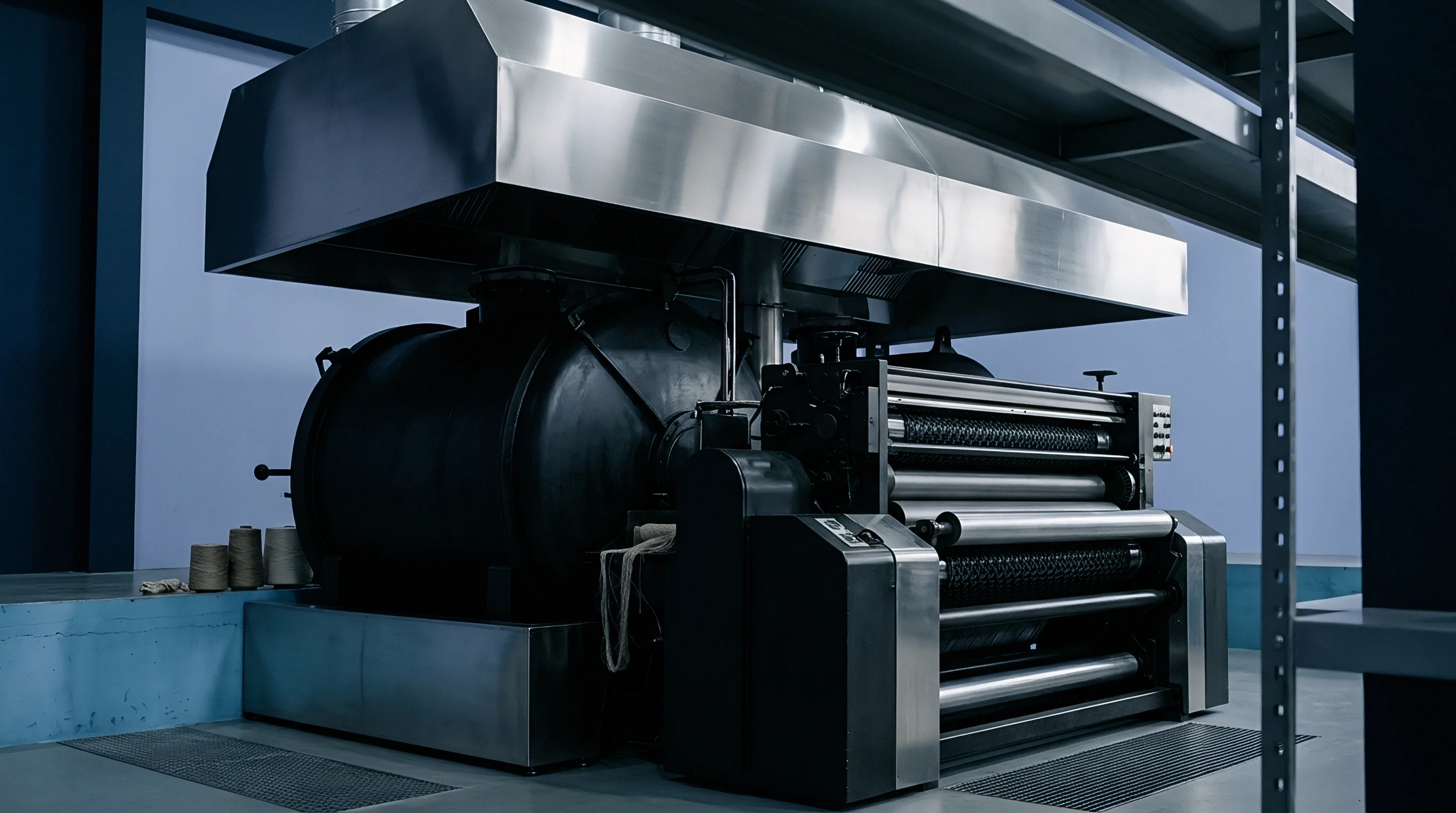
Drafting zones on flax wet-spinning frames rely on specialized roller geometry and precise immersion control to translate hydrodynamic shear into uniform fiber attenuation. Roving passes through a deep stainless steel trough fitted with steam heating tubes and immersion rollers before entering the drafting nip. Top rollers covered in high-durometer synthetic rubber press against fluted bottom steel rollers under heavy spring or pneumatic loading, creating a positive drive point that prevents liquid slippage.
- Fill the stainless steel trough with soft water having a total hardness under two German degrees and establish a continuous fresh water feed.
- Heat the liquid bath to seventy-five degrees Celsius using indirect steam coils to prevent condensation dilution.
- Submerge the incoming flax roving beneath the liquid surface using adjustable ceramic guide bars, setting an immersion path length of three hundred millimeters.
- Adjust the back-to-front drafting roller distance to match the mean length of the technical fiber bundles, typically between thirty-five and forty-five millimeters.
- Apply a nip clamping force of four hundred Newtons per top roller boss to eliminate fiber slip under high hydrodynamic drag conditions.
- Set the total draft ratio between twelve and eighteen depending on the desired yarn lea count and roving weight.

Does Trough Temperature Control Pectin Extraction Rates?
Draft ratios govern fiber slip. Higher liquid temperatures lower fluid viscosity, accelerating the removal of middle lamella pectins and allowing smooth sliding between individual microfibrils. High tension breaks fine fibers.
Operating below sixty degrees Celsius increases liquid drag to levels that snap elementary fibers instead of separating them, producing hairy yarn with low tensile strength.
| Target Yarn Count (Nm / Lea) | Trough Temperature (°C) | Immersion Length (mm) | Draft Ratio | Front Roller Speed (m/min) | Tenacity Target (cN/tex) |
|---|---|---|---|---|---|
| Nm 26 / 15 Lea | 65 | 200 | 10.5 | 48 | 22.5 |
| Nm 44 / 26 Lea | 70 | 250 | 13.2 | 42 | 25.0 |
| Nm 68 / 40 Lea | 75 | 300 | 15.8 | 36 | 28.5 |
| Nm 100 / 60 Lea | 80 | 350 | 18.5 | 28 | 31.0 |
Longer bath immersion times combined with higher temperatures permit higher drafting ratios without increasing end-breakage rates on fine counts.


Defects
Mechanisms of Attenuation Failure and Structural Irregularities
Uneven pectin solubilization directly causes mass variation along the yarn axis. When hydrodynamic shear fails to break down technical fiber aggregates uniformly, large fiber bundles pass intact into the drafting nip alongside fully separated elementary fibers. This differential slip creates localized thick places known as slubs, followed by thin zones where the drafting draft draft concentrated on surrounding loose fibers.
Yarn evenness metrics deteriorate rapidly under these conditions.
Failure to meet the minimum lea strength product specified in ISO 2062 triggers automatic rejection of the spinning lot.
Wet drafting yields fine counts. Uncontrolled bath chemistry causes roller lapping. High pectin concentration in the trough fluid coats the synthetic top rollers, creating a sticky residue that picks up loose fibers from the drafted strand.
These wrapped fibers build up until the strand breaks, forcing the operator to stop the spindle and clean the drafting zone manually.
- Undrafted roving slubs result from insufficient bath temperature failing to melt inter-fiber pectin matrices before the strand reaches the front nip.
- Transverse fiber snapping occurs when high fluid drag forces exceed individual filament tensile strength due to excessive bath viscosity or overly rapid draft acceleration.
- Periodic mass wave defects develop when worn top roller cots slip under high hydrodynamic resistance, altering the local draft ratio at fixed mechanical intervals.
- Pectin skin redeposition creates stiff, brittle yarn segments that fracture during winding and warping operations due to dried carbohydrate crusts on the yarn surface.
Microstructural Analysis of Fractured Filaments
Scanning electron microscopy reveals distinct fracture modes between dry-drafted and wet-drafted flax strands. Dry-drafted fibers show jagged, transverse cell wall fractures indicating forced mechanical separation of intact bundles. Wet-drafted strands exhibit smooth, longitudinal separation surfaces along the middle lamella plane, confirming that chemical solubilization combined with fluid shear separates fibers without damaging the internal cell walls.
What fundamental mechanism triggers sudden end-breakage spikes when trough water conductivity exceeds two thousand microsiemens per centimeter?

Yield

Economic Balance of Water Heating, Additives, and Yarn Value
Fine yarns command higher prices. Translating raw scutched flax line into fine wet-spun yarns requires balancing energy consumption against yarn market premiums. Heating trough water to eighty degrees Celsius consumes significant energy per kilogram of spun yarn.
Operating at lower temperatures saves thermal energy but limits maximum spinnable count to coarse numbers, reducing the gross margin earned per spindle hour.
| Trough Setup (°C) | Thermal Energy Cost ($/kg yarn) | Max Spinnable Count (Nm) | Yarn Market Value ($/kg) | Spindle Yield (kg/shift) | Net Margin ($/spindle/day) |
|---|---|---|---|---|---|
| ambient (20°C) | 0.00 | Nm 18 | 8.50 | 4.2 | 1.12 |
| 60°C Warm | 0.35 | Nm 36 | 14.20 | 2.8 | 2.45 |
| 75°C Hot | 0.62 | Nm 68 | 22.80 | 1.9 | 4.18 |
| 85°C High-Temp | 0.88 | Nm 100 | 38.50 | 1.1 | 5.82 |

Cost-Benefit Mechanics of Chemical Pectin Extraction
Adding chelating agents like ethylenediaminetetraacetic acid or organic acids to the wet-spinning trough increases chemical consumables costs by twelve to eighteen cents per kilogram of yarn. This expenditure pays for itself when spinning fine counts above Nm 68 by reducing end-breakage rates by thirty percent. Lower end-breakage raises machine efficiency, increases total spindle yield, and reduces labor costs required for manual piecing.
Residual calcium ions in hard water suppress pectin solubilization during high-speed wet attenuation.
Standard supply agreements for high-count flax yarns explicitly state that yarn failing to meet the minimum breaking tenacity of twenty-six centinewtons per tex at a coefficient of variation below fourteen percent allows the buyer to apply a fifteen percent price debit against the supplier invoice.

Verification
Laboratory Qualification of Attenuated Yarns
Verification of wet-drafting efficiency requires precise quantitative testing of residual pectin content and yarn structural parameters. Analytical extraction using hot ammonium oxalate solution isolates remaining polygalacturonate compounds from spun yarn samples. Unrefined flax fibers contain six to eight percent pectin by mass.
Well-drafted wet-spun yarn retains between one point five and two point five percent pectin, representing the optimal balance between microfibril freedom and necessary yarn cohesion.
Testing yarn evenness on capacitive mass sensors reveals the exact quality of the drafting operation. Spectrogram analysis identifies mechanical draft waves caused by roller eccentricity alongside material draft waves caused by incomplete pectin solubilization. A broad spectrogram peak centered at a wavelength corresponding to two to three times the staple length confirms that hydrodynamic shear was insufficient to break down technical bundle agglomerates during attenuation.
Tensile testing according to ISO 2062 confirms the structural integrity of the yarn under linear loading. Single-end strength tests performed on conditioned skeins yield force-elongation curves that demonstrate whether individual elementary fibers slide smoothly under tension or fracture prematurely due to localized stress concentrations. High breaking tenacity combined with low elongation at break confirms complete pectin solubilization and uniform alignment of elementary fibers along the yarn axis during the wet drafting process.