Flax Fibre Composition and Elementary Cell Anatomy
Elementary cell wall thickness, microfibrillar angle, and middle lamella pectin dissolution govern drafting limits and yarn counts in flax spinning.
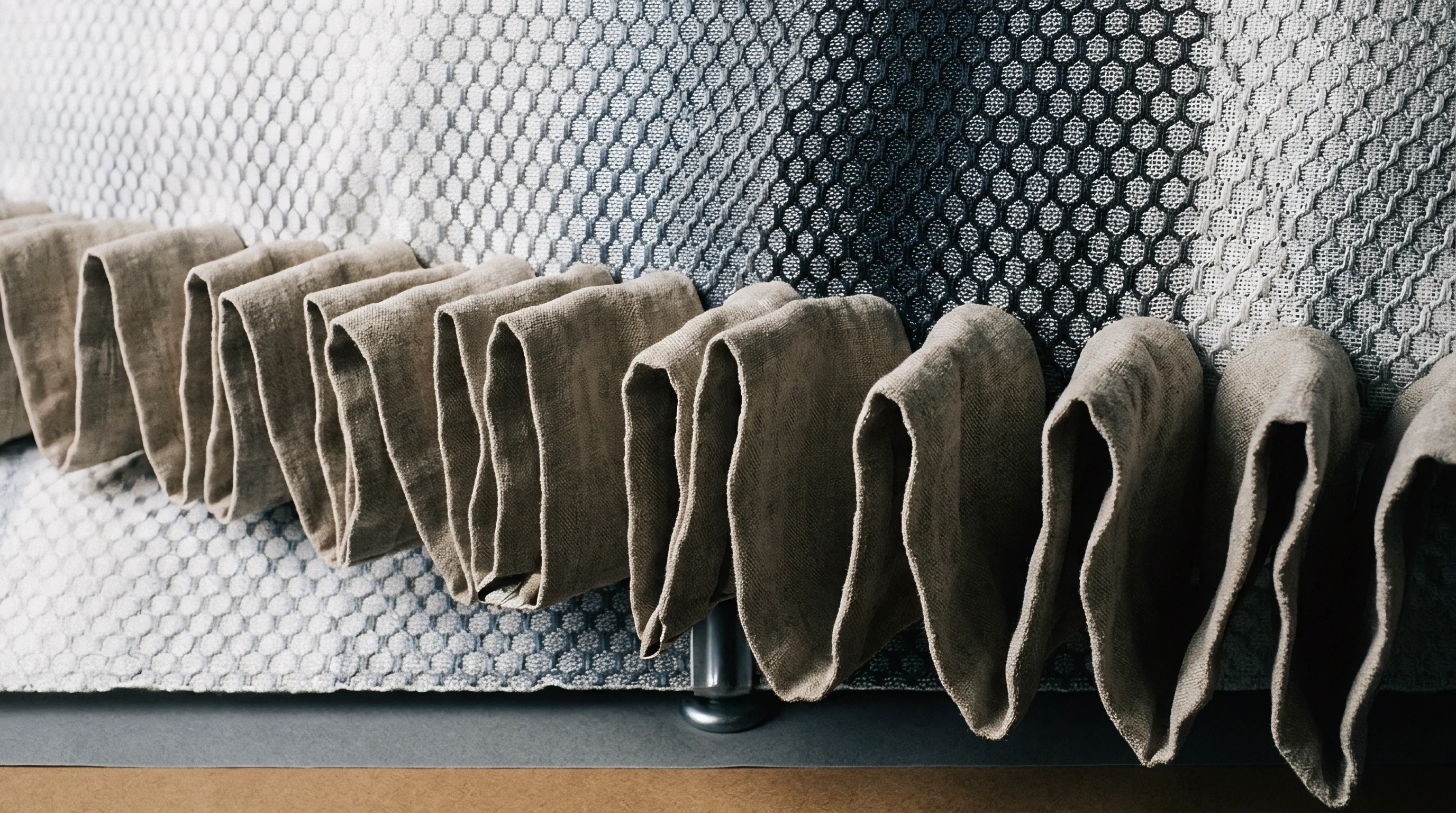

Stem
Flax bast tissue occupies a narrow annular band between the outer epidermis and the inner woody core of Linum usitatissimum. In an unretted stalk three millimetres in diameter, this phloem region holds roughly twenty to fifty technical fibre bundles. Each bundle contains ten to forty individual elementary cells bound by a middle lamella rich in pectin and hemicellulose.
Commercial hackling lines operate on these technical units rather than isolated cells. The biological layout of the stalk thus dictates mechanical yield during decortication and the amount of shive carrying through to breaker cards.
Cross-sectional inspections under polarized light show technical bundles forming a polyhedral ring adjacent to the cortical parenchyma. Adhesion between the cortex and the bundle’s outer perimeter sets the force required to peel the fibrous sleeve from the epidermis. Dew-retting exposes these outer tissues to fungal colonizers ~ predominantly Cladosporium herbarum and Epicoccum nigrum ~ which consume the parenchymal pectin glue while leaving the cellulosic bast wall intact.
Under ambient retting temperatures between 15 and 22 degrees Celsius, fungal colonization requires fourteen to twenty-eight days to lower cortical shear resistance below thirty Newtons per centimetre of stem length.
When field conditions turn excessively dry, fungi fail to propagate, leaving cortical pectin intact so the stalk resists scutching blades. Heavy mechanical beating then fractures the woody core into fine flakes that weld onto unseparated fibre bundles instead of falling through the scutching grid. The resulting scutched tow contains an unacceptably high foreign matter fraction, dropping the commercial grade by three full tiers.
- Cortical skin adherence leaves green, papery epidermal ribbons attached to fibre bundle edges that resist chemical boil-off during roving preparation.
- Shive pin entrapment introduces sharp xylem splinters into the drafting zone, jamming apron flutes and causing immediate sliver breaks.
- Incomplete bundle separation leaves coarse thirty-fibre clusters intact, restricting drafting draw ratios on the gill box to below twelve.
- Pith contamination deposits fragile parenchymatous dust that cakes onto roller cots, driving up yarn count irregularity.
Inspecting raw straw bundles before decortication keeps contaminated stock out of the carding room. ASTM D5103 sets test conditions for foreign matter in vegetable fibers: clean line flax carries a non-fibrous residue limit of 1.50 percent by mass, whereas lower-grade scutched tow often carries shive contamination above 6.00 percent. Under EN 12751 contract specifications, lots are rejected if the mean shive weight fraction across ten representative composite bale samples exceeds 2.25 percent.

Wall
The secondary cell wall of an individual elementary flax fibre accounts for up to ninety percent of its total cross-section. The cell runs ten to forty millimetres long but stays narrow, typically twelve to twenty-four micrometres across. At its center sits the lumen, a narrow capillary channel that usually collapses into an irregular slit as the plant matures and dries out.
Surrounding this lumen is a multilayered cell wall: a thin primary layer followed by concentric secondary layers designated S1, S2, and S3.
The thick S2 layer holds most of the cellulose mass, with highly crystalline microfibrils spiraling at an angle of six to ten degrees relative to the longitudinal axis. This narrow alignment gives flax its high axial tensile strength and low elongation. By contrast, cotton microfibrils wind at twenty to thirty-five degrees, shedding axial stress through torsional uncoiling; flax microfibrils take tensile loads head-on along their covalent backbones.
| Structural Level | Mean Length | Mean Diameter | Wall Thickness | Lumen Width | Microfibrillar Angle |
|---|---|---|---|---|---|
| Elementary Fibre | 28.5 mm | 17.2 µm | 6.8 µm | 1.8 µm | 8.2° |
| Technical Bundle | 650.0 mm | 62.5 µm | Not applicable | Not applicable | Variable |
| Bleached Cell | 27.0 mm | 15.4 µm | 5.9 µm | 1.2 µm | 8.0° |
| Decorticated Tow Unit | 180.0 mm | 88.0 µm | Not applicable | Not applicable | Variable |
Microscopic examination shows transverse markings along the elementary cell, variously called dislocations, slip planes, or knee nodes. Stress from harvesting, roller decortication, and scutching shears the crystalline cellulose lattice within these zones. Hydroxyl bonds break locally, creating amorphous patches that stain intensely under zinc chlor-iodide.
These nodes then act as focal points for mechanical failure and chemical attack.
High shear stresses on the drawing frame exploit these structural flaws. Elementary cells fracture at dislocation zones when draft roller nip pressures exceed 120 decanewtons per centimetre of face width. This breakage converts long line fiber into short floating fibers, creating drafting waves that ruin yarn evenness and spike yarn CV percentage.
The finished fabric suffers from thin spots, frequent loom stops, and uneven shade across piece-dyed lots.
Thick cell walls with narrow microfibrillar angles deliver high axial modulus at the sacrifice of lateral shear endurance.
Birefringence microscopy and cross-polarized optical scanning reveal the integrity of cell wall layers. A high frequency of visible nodes signals over-beaten, bruised stock. When bruised elementary cells undergo bleaching and scouring, alkaline baths rapidly hydrolyze non-cellulosic components inside open slip planes, dropping yarn tenacity by up to thirty-five percent during wet finishing.
Polymer
Cellulose makes up roughly seventy to eighty percent of the dry mass in a clean, dew-retted flax bundle. In virgin bast tissue, its macromolecular chains reach an average degree of polymerization around 8,000 to 10,000, higher than seed hairs like upland cotton. Wide-angle X-ray diffraction shows a crystalline fraction of sixty-five to seventy-five percent, creating a rigid, inextensible backbone inside each elementary cell wall.
Non-cellulosic polysaccharides surround and interpenetrate these microfibrils. Hemicelluloses ~ mainly glucomannans and highly branched xyloglucans ~ account for twelve to fifteen percent of dry fibre weight, while pectins comprise three to five percent in commercial scutched line flax. This pectic fraction consists of smooth homogalacturonan chains linked to branched rhamnogalacturonan regions bearing arabinan and galactan side chains.
Divalent calcium cations form salt bridges between carboxyl groups on adjacent chains, creating a structural gel within the middle lamella.
| Processing State | Cellulose | Hemicellulose | Pectin | Lignin | Wax and Lipids | Moisture Content |
|---|---|---|---|---|---|---|
| Green Unretted | 63.2% | 16.8% | 7.4% | 3.8% | 2.1% | 9.5% |
| Dew Retted Line | 74.1% | 13.2% | 3.1% | 2.6% | 1.4% | 10.2% |
| Water Retted Line | 78.5% | 11.4% | 1.9% | 2.2% | 1.1% | 10.5% |
| Scoured and Bleached | 88.6% | 6.2% | 0.3% | 0.8% | 0.4% | 7.8% |
| Data compiled from wet-chemical gravimetric assays following TAPPI standards T203 for alpha-cellulose and T222 for acid-insoluble lignin. | ||||||
Lignin represents two to four percent of the mass in commercial flax bundles. Unlike jute or kenaf, where lignin concentrations exceed ten to fifteen percent throughout the cell walls, flax concentrates its small amount of lignin mainly in the middle lamella and outer cell corners. This low lignin content keeps flax bundles pliable, allowing them to split into fine strands during hot wet drawing without aggressive delignification.
Lipids, cutin, and surface waxes make up roughly one to two percent of scutched fibre mass. Coating the outer primary wall, these hydrophobic layers regulate moisture absorption and provide lubrication during dry carding. If over-scouring strips these waxes prematurely, dry hackling pins shred the brittle bundles into fly waste.
Wax content is monitored via Soxhlet extraction using petroleum ether.
Natural variation in pectin distribution alters processing performance even when dew-retted lots share identical cellulose purity. Residual calcium-pectate content inside the middle lamella and elevated polygalacturonase resistance lock bundles into coarse divisions that fail to draft down to high metric counts.
Node
Mechanical harvesting and decortication induce stress concentrations that form structural slip planes across the elementary cell wall. Under cross-polarized microscopy, these dislocations appear as transverse X- or V-shaped fissures extending from the outer wall to the lumen. Inside each node, microfibrillar alignment ruptures, shifting chain orientation by up to thirty degrees off the fibre axis and weakening the structure.
Chemical penetrants attack these dislocations rapidly. In alkaline hydrogen peroxide bleaching, the amorphous cellulose inside a node undergoes chain scission far faster than the adjacent crystalline wall. Cellulase enzymes cause the same localized breakdown.
Microscopic cracks propagate outward from the node boundary, leading to brittle trans-fiber fractures under modest tensile loads.
Decortication settings directly dictate node frequency along the fibre. Fluted break rollers set to excessive mesh depth crush the woody shive but introduce fifteen to twenty-five nodes per millimetre of cell length. By comparison, gentle processing through multi-stage turbine rollers with low wrap angles leaves fewer than eight nodes per millimetre ~ a difference clearly reflected in lea dynamometer strength tests.
Fiber sorters evaluate dislocation density when selecting lots for high-speed wet spinning. While individual nodes cannot be seen by eye, bending a dry bundle over a dull edge produces an audible snapping sound in over-processed, node-saturated lots; sound flax flexes quietly.
Fibre bundles that snap crisply under hand flexion yield weak roving on the wet frame.
Fraction
The division of technical bundles into fine spinning fractions determines the ultimate metric count (Nm) achievable on a frame. Dry spinning processes intact technical bundles, relying on friction between raw, unsoftened groups for yarn cohesion; this limits production to counts between Nm 9.5 and Nm 24 (42 to 105 tex). Finer counts, from Nm 39 up to Nm 100 or beyond (10 to 25 tex), require wet spinning.
In wet spinning, water in the trough is kept between fifty and seventy degrees Celsius to soften the pectin and hemicellulose in the middle lamella without dissolving structural cellulose. With drafting roller draft ratios set between ten and twenty, elementary cells slide past one another along their softened interfaces, dividing technical bundles into slender units of two to five cells.
An elementary cell has a minimum linear density set by its cross-sectional area and material density. Based on a cell diameter of seventeen micrometres, a wall area of 180 square micrometres, and a cellulose density of 1.52 grams per cubic centimetre, a single cell has a linear density of about 0.27 tex. A stable yarn cross-section on a commercial ring frame requires thirty-five to forty individual cells to withstand tension peaks and prevent drafting breaks.
Multiplying forty cells by 0.27 tex yields a theoretical limit around 10.8 tex, or roughly Nm 92. Spinning beyond Nm 100 requires long line flax grown in maritime climates like northern France or Belgium, where steady vegetative growth yields cell diameters below fourteen micrometres with minimal secondary wall thickening. Coarser domestic flax with twenty-two micrometre cells cannot produce reliable yarn above Nm 45 without excessive ends-down rates.
- Bale opening technicians sample five percent of the incoming lot, extracting twenty bundle stricks for airflow fineness measurement under ISO 2370.
- The testing room conditions samples at twenty degrees Celsius and sixty-five percent relative humidity for twenty-four hours prior to weighing.
- Technicians comb out entangled short tow on a laboratory hand hackle to isolate the parallel long-line fraction for metric bundle count determination.
- A laboratory roving sample is boiled in water at sixty degrees Celsius for ten minutes to quantify middle lamella thermal swelling.
- The spinning technologist verifies that the calculated metric fibre number exceeds 1200 Nm before approving the lot for wet spinning orders targeting counts finer than Nm 50.
Raw fiber grade directly dictates fabric profitability. Long line flax with optimal cell geometry commands 4.80 to 5.50 euros per kilogram landed at the mill, whereas scutched tow sells for 2.10 to 2.60 euros per kilogram. Attempting to spin an Nm 50 warp yarn from low-grade tow saves on raw material but causes a twelve percent drop in frame efficiency and pushes hackling waste past thirty-eight percent.
Factoring in downtime, operator intervention, and yarn splices, the net cost per square metre of woven fabric rises by 0.42 euros.
Whether chemical retting treatments can selectively dissolve middle lamella pectins without causing cellulose chain scission at elementary cell dislocations remains an open question in industrial practice.