Deriving Hackled Sliver Mass Conversion during Wet Ring Spinning Operations
Hackled sliver mass conversion during wet ring spinning relies on balancing mechanical drafting ratios against aqueous pectin dissolution mass losses.

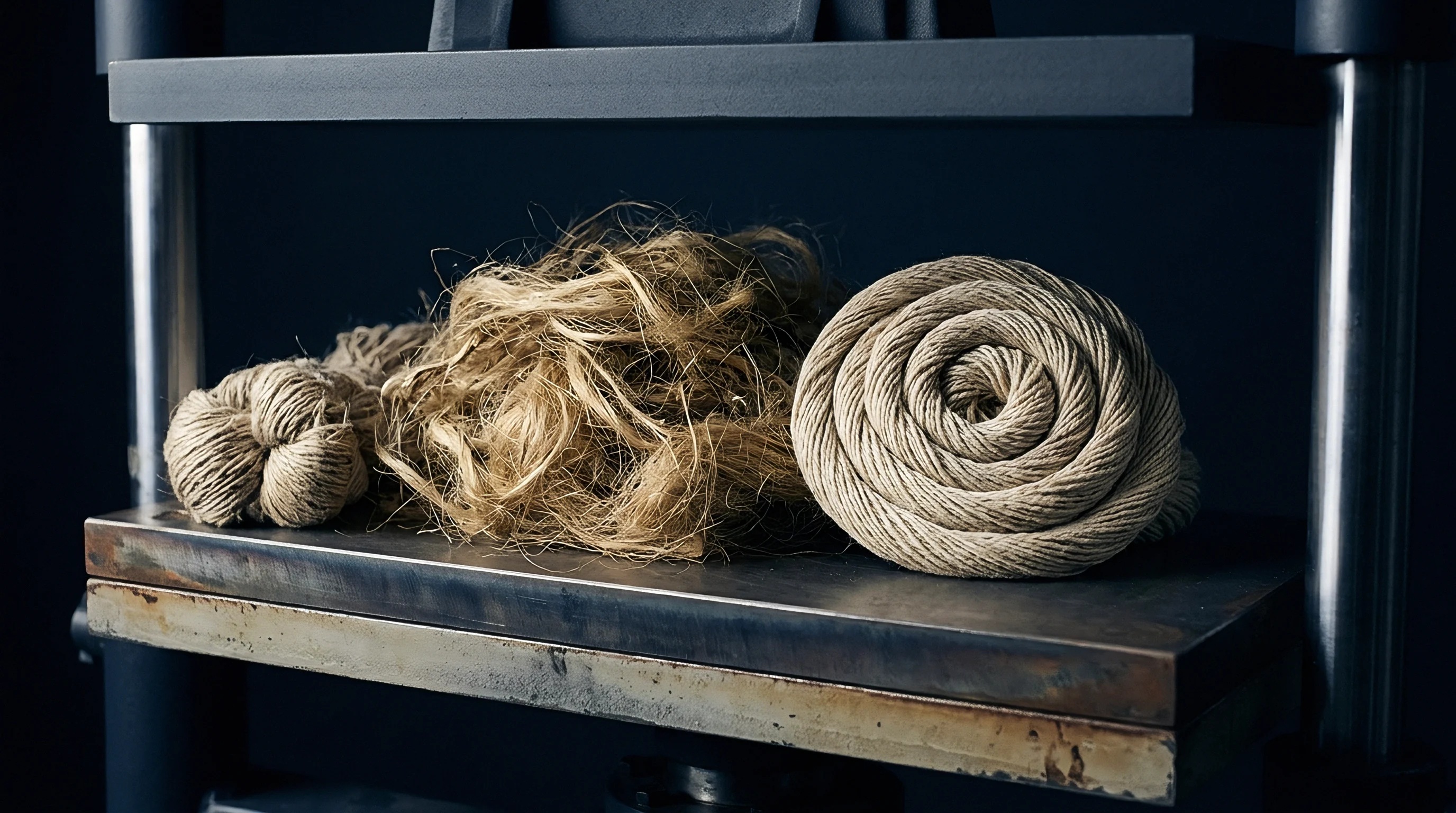
Roving
Hackled long-staple flax enters initial drawing passages as continuous parallel bands. The raw line sliver, ranging from 15 to 25 kilotex (grams per metre), undergoes sequential drafting across pin-gilled drawing frames to align bast fiber bundles and reduce linear density. Mechanical attenuation relies on faller bars equipped with steel pins that control short fibers and prevent uncontrolled drafting waves.
Proper mass control at the roving frame establishes the baseline linear density necessary for consistent wet ring spinning.

Line Sliver Mass Profiles and Drawing Drafts
Initial material linear mass density governs total attenuation factors across pin-gilled machinery. Spinners process hackled line sliver through three or four drawing passages, applying mechanical drafts between 4.5 and 8.0 per passage. Doubling multiple slivers at the back roller averages out short-term mass fluctuations present in hackled flax.
Draft settings dictate strand stability. Controlling sliver linear density within a plus or minus 1.5 percent tolerance window prevents count variation in subsequent roving production.
- Feed conditioned hackled sliver into the back rollers of the first drawing frame.
- Monitor faller bar pin density to maintain fiber orientation during attenuation.
- Set drafting draft ratios between four and eight across passages.
- Insert minimum protective twist to stabilize the roving bobbin package.
Relative humidity inside the drawing room alters fiber flexibility and inter-fiber friction. Operating at 65 percent to 70 percent relative humidity at 20 °C maintains moisture regain at approximately 12 percent, preventing static electricity build-up and fiber lap-ups on drafting rollers. Fiber breakage during gilling generates short fly waste, causing a direct mass loss of 0.8 percent to 1.4 percent of input sliver mass.
Higher twist levels in the drawn strand increase tensile cohesion but impede fluid penetration inside the hot water trough.
Flyer Twist Mechanics and Linear Density Shift
Helical fiber rotation imparted by spinning spindles provides cohesion to drawn strands. The flyer inserts twist measured in turns per metre, calculated using a twist factor relative to the square root of the roving linear density in tex. Roving linear density typically ranges from 600 tex to 1200 tex for wet spinning applications.
Flyer speed limits bobbin build.
| Passage Stage | Input Count (ktex) | Applied Draft | Output Count (tex) | Twist Factor (alpha) | Stage Waste (%) |
|---|---|---|---|---|---|
| First Gilling | 20.0 | 6.2 | 3225 | – | 0.8 |
| Second Gilling | 9.6 (3-doubling) | 6.5 | 1476 | – | 0.5 |
| Third Gilling | 4.4 (3-doubling) | 5.8 | 758 | – | 0.4 |
| Roving Flyer | 2.2 (2-doubling) | 4.4 | 500 | 18.5 | 0.6 |
Twist insertion reduces Roving length slightly due to helical contraction, an effect termed twist take-up. Twist take-up increases effective linear density by 1.2 percent to 2.5 percent over nominal draft calculations. Factoring twist take-up into flyer draft settings maintains precise roving tex targets.
Low twist levels permit smooth draft in the spinning frame while high twist levels cause draft waves and yarn thick places.


Vat
Hot liquid processing softens intercellular pectin structures binding individual flax fibers. In wet ring spinning, the twisted roving passes through a heated water bath immediately before entering the drafting zone. Water temperature and chemical additives lower middle lamella viscosity, permitting ultimate fibers to slide past each other during final elongation.

Aqueous Pectin Extraction and Thermal Softening
Thermal energy in liquid processing reduces shear yield stress of binder compounds. Maintaining trough water temperature between 65 °C and 75 °C yields optimal pectin softening without degrading cellulose crystalline regions. Warm liquid dissolves intercellular pectin.
Water-soluble substances, low-molecular-weight hemicelluloses, and residual retting products leach continuously into the bath.
Pectin extraction reduces the dry solid mass of the fiber strand. Mass loss in the hot water bath varies between 1.5 percent and 3.5 percent of initial dry roving weight, depending directly on retting degree and bath immersion time. Heavy roving increases spinning trough residence.
Over-retted flax exhibits higher solubility and greater mass loss compared to under-retted or green-scutched fiber stock.
| Bath Temp (°C) | Immersion Time (s) | Pectin Loss (%) | Hemicellulose Loss (%) | Total Wet Mass Loss (%) |
|---|---|---|---|---|
| 50 | 3.5 | 0.8 | 0.3 | 1.1 |
| 60 | 3.5 | 1.4 | 0.5 | 1.9 |
| 70 | 3.5 | 2.1 | 0.7 | 2.8 |
| 80 | 3.5 | 2.9 | 1.0 | 3.9 |

Which Bath Factors Accelerate Fiber Bundle Division?
Water temperature and chemical surfactant concentration govern middle lamella dissolution velocity. Adding non-ionic wetting agents at 1.0 to 2.0 grams per litre speeds water penetration into dense roving structures. Alkaline bath modifiers, such as sodium carbonate, accelerate pectin saponification, permitting complete technical fiber breakdown into ultimate fibers measuring 15 to 25 micrometres in diameter.
- Trough Temperature Drift alters pectin dissolution rates, causing uncontrolled yarn count variations across spinning positions.
- Incorrect Reach Distance induces fiber breakage or slippage, leading to elevated thin places and yarn end breaks.
- Roller Lapping Accumulation removes unspun fiber mass from the strand, creating local linear mass deficits.
- Traveller Mass Mismatch generates erratic yarn tension, driving uneven twist distribution along the yarn axis.
Extracted mass reduces strand linear density. Dissolved solids remain in the trough water, accumulating over extended spinning shifts. Trough water replacement schedules prevent re-deposition of dissolved pectins onto yarn surfaces.
Continuous bath overflow maintains consistent extraction kinetics across long production runs.
Aqueous extraction of middle lamella pectins causes continuous linear mass degradation of the roving strand inside the hot water bath.
Spinners frequently claim that mass variance between incoming sliver and delivered yarn stems entirely from harvest-to-harvest retting fluctuations in European flax fields.
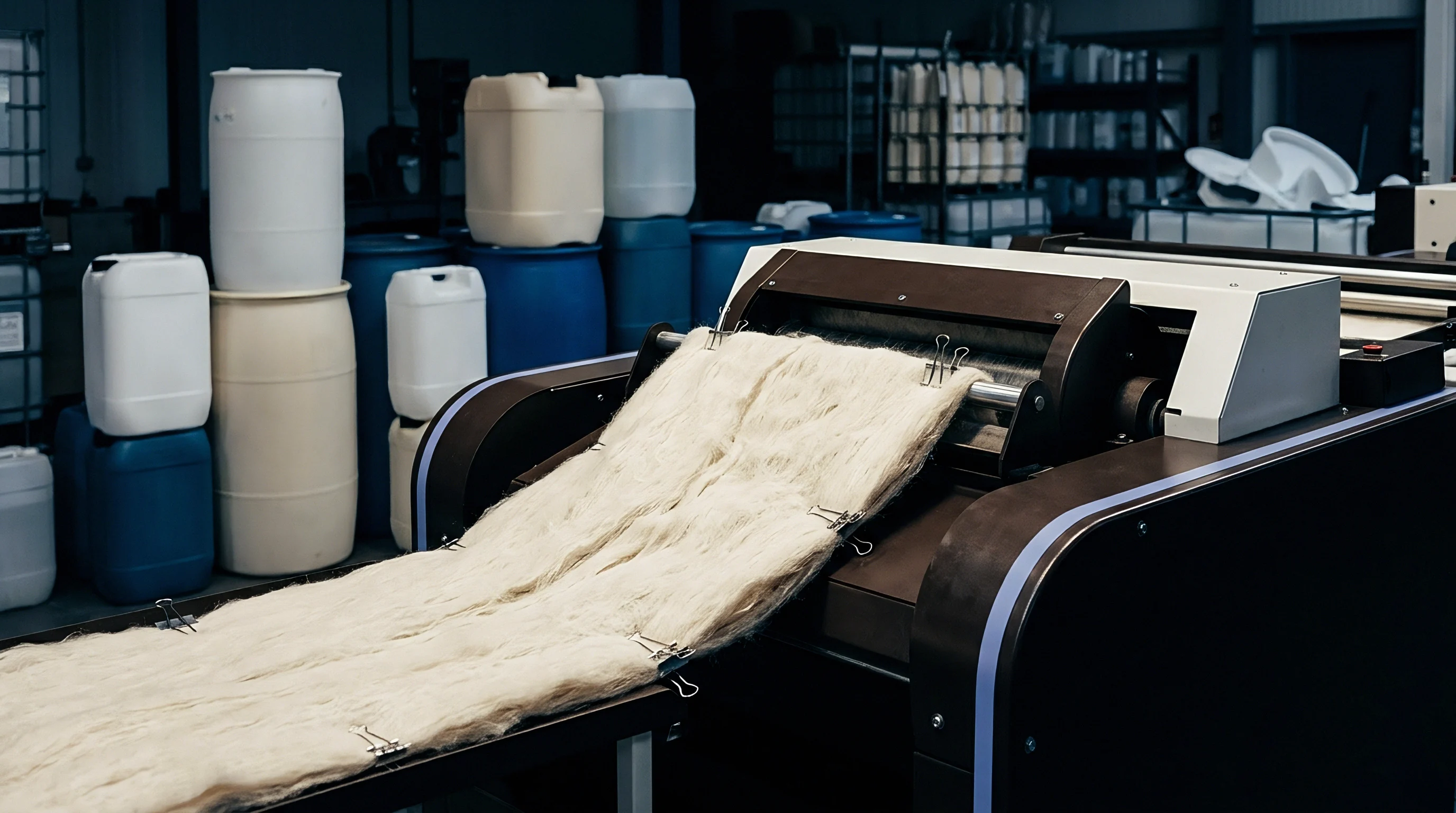

Attenuation
Drafting rollers pull individual strands out of softened fiber bundles. The wet drafting zone consists of a back roller pair running at low surface speed, a reaching zone submerged or wetted, and a high-speed front roller pair. The ratio of front roller speed to back roller speed defines the wet draft ratio, which typically ranges from 10 to 25 in line flax spinning.

Drafting Zone Kinematics and Fiber Sliding
Distance between back and front roller nips sets mechanical reach for strand elongation. Reach settings correspond directly to maximum ultimate fiber lengths, usually set between 40 mm and 55 mm for long-staple line flax. Front roller speed governs production output.
As rollers rotate, individual technical fibers slip over one another along softened pectin interfaces.
Fibre slipping causes local thickness variance. High wet draft ratios increase tension within the drafting zone, squeezing out entrained water and releasing free short fibers into the trough fluid. Fly waste accumulating on front roller scrapers represents a mass loss of 0.5 percent to 1.2 percent of roving weight.
| Conversion Process | Input Mass Basis | Mechanical Output | Extracted/Waste Mass | Cumulative Yield (%) |
|---|---|---|---|---|
| Gilling & Roving | Hackled Sliver (100%) | Roving Strand | 1.8% Fly & Pin Waste | 98.2 |
| Trough Leaching | Roving Strand (98.2%) | Wetted Roving | 2.8% Dissolved Pectin | 95.4 |
| Wet Drafting | Wetted Roving (95.4%) | Drafted Web | 0.9% Trough Fly & Sludge | 94.5 |
| Ring Spinning | Drafted Web (94.5%) | Spun Yarn Package | 0.7% Traveller Fly & Laps | 93.8 |

Deriving Linear Mass Conversion Equations
Calculating finished strand tex incorporates mechanical elongation ratios alongside chemical dissolution mass losses. Mechanical draft alone predicts output tex by dividing roving tex by applied draft. Real yarn linear density deviates systematically from mechanical predictions due to cumulative extraction and waste losses occurring in the wet zone.
The mathematical mass conversion formula accounts for mechanical draft, chemical leaching mass loss factor, and mechanical fly waste coefficient. Let nominal roving linear density be defined as R in tex, mechanical draft ratio as D, chemical pectin leaching loss fraction as L_c, and mechanical spinning waste fraction as L_m. The final dry yarn linear density Y_tex follows the exact relationship:
Y_tex = (R / D) (1 – L_c) (1 – L_m)
A published extraction factor of 2.8 percent mass loss rests on DIN 53811 laboratory extraction of dew-retted Courtrai flax at 70 °C; lower retting intensity drops this extraction yield to 1.4 percent. Spinning fly loss during high-speed wet ring spinning fluctuates between 0.6 percent and 1.9 percent depending on relative humidity; buyers insert a fixed 1.5 percent fly allowance into raw material yield contracts to absorb this variance.
Standard contract terms under ISO 6741 mandate calculating commercial yarn weight using twelve percent moisture regain added to oven-dry mass after scouring.
Similar pectin dissolution mechanisms govern pulp preparation in paper manufacturing, where alkaline extraction strips intercellular binder to isolate pure cellulose fibers. Uncontrolled draft variance destroys count consistency.
- Feed Sliver Linear Density establishes initial mass per unit length entering the drawing system.
- Combined Gilling Draft Factor determines total mechanical reduction achieved prior to roving twist insertion.
- Bath Extraction Fraction quantifies mass removed by hot water pectin solubilization inside the trough.
- Mechanical Waste Allowance accounts for physical fiber loss across drafting rollers and ring travelers.
Whether ultra-high-frequency ultrasonic agitation in the wetting trough can eliminate chemical softening additives while maintaining bundle division remains an open industrial question.

Balance
Reconciling incoming fiber weights against final packaged yarn requires tracking five loss pathways. Mass balance auditing links dry raw material input to commercial yarn output. Fiber mass transitions from dry state to wet state and back to conditioned yarn packages, requiring standardized moisture corrections at every stage.

Mathematical Formulation of Mass Conversion Yield
Quantitative equations connect raw sliver linear density to output yarn count through draft factors. Oven dry measurements establish true baseline. Absolute dry fiber mass passing through the system experiences mass reductions through dust extraction in gilling, flyer fly generation, hot water leaching, trough sludge settling, and bobbin winding waste.
Calculating net mass conversion yield requires establishing the ratio of finished dry yarn mass to initial dry sliver mass. Representing initial dry sliver mass as M_sliver and final dry yarn mass as M_yarn, total conversion yield efficiency Y_mass equals M_yarn divided by M_sliver multiplied by 100. Industrial wet ring spinning operations achieve net dry mass yields between 92.5 percent and 95.0 percent.
Hackled line sliver suffering a three percent wet leaching loss yields ninety-four point two percent dry yarn mass per thousand meters spun.
Moisture Regain and Scouring Loss Adjustments
Standard ambient weight normalization applies official water absorption percentages to oven-dry laboratory measurements. ISO 6741 specifies a standard moisture regain of 12.0 percent for linen yarns. Wet-spun yarn leave ring frames at moisture contents exceeding 20 percent, requiring package drying down to commercial limits.
Cold water slows pectin dissolution kinetics.
Commercial mass calculations adjust invoice weights based on verified moisture content. If delivered yarn carries 14.5 percent moisture, the commercial mass calculation scales back invoice weight to match the 12.0 percent standard. Scouring loss testing via hot aqueous sodium carbonate extraction measures remaining non-cellulosic impurities, verifying total chemical mass loss incurred during spinning processing.
Failing to account for water-soluble mass loss in wet spinning yield equations results in under-costing linen yarn by up to four percent per delivered tonne.


Ledger
Raw fiber purchasing constitutes over sixty percent of finished yarn manufacturing expenditure. Accounting for mass conversion losses during wet ring spinning directly influences yarn unit economics. Unaccounted pectin dissolution and fly losses inflate raw material cost per kilogram of saleable yarn.

Impact of Wet Mass Loss on Yarn Lea Count
Nominal thread count calculations accommodate fiber weight extracted during hot liquid processing. Linen counts use the traditional Lea system (number of 300-yard cuts per pound) or Metric count Nm (thousands of metres per kilogram). Mass loss inside the wetting trough reduces yarn linear density, effectively raising the actual Lea count above nominal mechanical draft settings.
A target count of 40 Lea (Nm 67.7 or 14.8 tex) derived strictly from mechanical draft will shift to 41.2 Lea (Nm 69.8 or 14.3 tex) following a 3.0 percent wet extraction mass loss. Spinners adjust roving count or mechanical draft downward to compensate for extraction loss, ensuring delivered yarn meets target Lea specifications. Yield loss inflates net thread pricing.
| Target Yarn Count (Lea / Nm) | Sliver Mass Required (ktex / 1000m) | Net Mass Yield (%) | Raw Fiber Cost ($/kg) | Extracted Mass Cost ($/kg yarn) | Final Spun Yarn Cost ($/kg) |
|---|---|---|---|---|---|
| 26 Lea / Nm 44 | 22.7 | 94.8 | 8.50 | 0.47 | 14.20 |
| 40 Lea / Nm 68 | 14.8 | 93.5 | 10.20 | 0.71 | 18.90 |
| 60 Lea / Nm 102 | 9.8 | 92.2 | 13.50 | 1.14 | 26.40 |
| 80 Lea / Nm 135 | 7.4 | 91.0 | 17.80 | 1.76 | 38.50 |

Landed Cost Derivation per Spun Metre
Financial calculations compound raw material purchasing prices with net conversion yield coefficients. Fiber price dominates manufacturing costs. Calculating true yarn manufacturing cost per metre requires dividing raw fiber cost by net mass yield efficiency, adding spinning processing expenditure, and normalizing over total package length.
Commercial mass rules govern final settlement.
Including a standardized mass conversion yield clause based on ISO 6741 commercial mass in yarn purchase agreements shifts unmetered trough dissolution losses back to the spinner.