Crystallite Orientation Factor Screening in Raw Scutched Flax
Hermans orientation factor screening via wide-angle diffraction isolates high-tenacity scutched flax lots before hackling, protecting wet-spun yarn yield.

Stem
In the phloem matrix of Linum usitatissimum, raw bast fibre bundles derive their structural reinforcement mainly from crystalline cellulose. Within the secondary cell wall, microfibrils of highly ordered cellulose chains sit embedded in a hemicellulose and pectin matrix. The microfibril angle is formed by the alignment of these chains relative to the long axis of the fibre cell.
Lower angles align applied mechanical loads directly along the cellulose backbone, setting the breaking tenacity and elastic modulus of the scutched strick.

Phloem Fiber Bundle Mechanics and Secondary Walls
Native cellulose chains assemble into elementary fibrils that coalesce into microfibrils within the secondary cell wall, which makes up more than eighty percent of the cross-sectional area of a mature flax fibre. Crystalline domains in native cellulose I-beta exhibit high axial stiffness, with a theoretical elastic modulus approaching 135 gigapascals. How well an individual elementary fibre transfers tensile stress along its length depends on how cleanly these domains align.
When scutching machinery strips the bast ribbon from the woody shive core, mechanical stress acts directly on the cell walls, where any local flaws or disorientations in the microfibrillar matrix pull down the load capacity of the bundle.
Microfibril orientation varies along a scutched flax strick, driven by stem position, plant maturity, growing conditions, and how evenly the crop rets. Dew retting weakens the middle lamellae, but over-retting breaks down intercellular pectins so far that elementary fibres slip out of axial alignment during scutching. Under-retting leaves sticky pectin bridges between fibres, which causes heavy crimping and cell wall dislocations under the turbine beaters.
These local micro-compressions disrupt crystalline alignment, raising the microfibril angle and lowering load capacity in affected spots.
Raw scutched flax fibres exhibit significant microfibrilar alignment variation between the basal, middle, and top regions of the stem.

Microfibril Helix Geometry and Deformation Modes
The helical spiral angle dictates how axial loads convert into tensile shear across the polysaccharide matrix. In raw scutched flax, microfibrils wind around the central lumen in a single-handed Z-spiral. As tensile stress builds during drafting, microfibrils with low orientation angles take direct uniaxial extension, whereas higher-angle microfibrils uncoil and undergo complex shear deformation.
- Kink Band Dislocations create sharp local shifts in spiral angle, cutting local tensile strength by up to forty percent.
- Pectin Phase Softening lets adjacent elementary fibres slide prematurely when ambient moisture exceeds twelve percent, distorting alignment readings.
- Basal Cell Irregularities widen microfibril angles up to eighteen degrees near the root insertion point, lowering total strick modulus.
- Mechanical Beater Crimp introduces artificial sinusoidal waviness into long line stricks, spreading out the observed crystallite orientation distribution.
Quantifying crystallite orientation gives a non-destructive gauge of structural quality before hackling. Standard mechanical tensile tests destroy the sample and produce wide scatter because of irregular bundle cross-sections and clamp slippage, whereas measuring the crystallite orientation factor assesses structural potential at the molecular level.


Beam
Wide-angle X-ray diffraction measures the azimuthal scattering intensity from the 200 equatorial crystallographic plane of native cellulose I-beta. Direct measurement records transmission patterns as monochromatic X-rays pass through a parallelized bundle of raw scutched fibres, forming discrete reflection arcs on the detector plane. The full width at half maximum of the 200 azimuthal intensity profile maps directly to the mean microfibril angle and the Hermans crystallite orientation factor.

Azimuthal Profile Integration and Hermans Equation
Diffraction rings from parallel elementary fibrils vary in intensity along the equatorial arc. Calculating the crystallite orientation factor requires integrating the azimuthal intensity profile I(phi) across the selected reflection peak, deriving the average cosine squared of the orientation angle phi against the azimuthal angle.
The Hermans crystallite orientation factor, designated Fc, follows the standard relationship where Fc equals one-half times the quantity three times the average cosine squared of phi minus one. A factor of unity indicates perfect alignment along the fibre axis, while zero represents isotropic disorder. High-grade scutched line flax typically falls between 0.88 and 0.94, corresponding to mean microfibril angles of six to ten degrees.
Transmission wide-angle diffraction of conditioned raw scutched flax at twenty degrees Celsius and sixty-five percent relative humidity yields a Hermans orientation factor uncertainty below 0.015.

Diffraction Bench Setup and Sample Conditioning
Accurate scattering measurements require mounting parallel stricks across a fixed open window. Before mounting, raw scutched flax stricks are combed manually with a fine hand hackle to clear out crossing fibers, neps, and residual shives. The bundle is then tensioned under a steady load of 0.05 centinewtons per tex to remove slack without stretching the secondary cell wall.
- Extract a ten-gram representative sample strick from the mid-span of the raw scutched flax lot.
- Comb the strick through a pins-per-inch hand comb twenty times to align the elementary fibers.
- Condition the combed bundle at twenty degrees Celsius and sixty-five percent relative humidity for twenty-four hours per ISO 139.
- Clamp the bundle into a custom aluminum frame under 0.05 centinewtons per tex tensile pretension.
- Mount the frame in the X-ray goniometer stage with the fibre axis perpendicular to the beam.
- Expose the sample to copper K-alpha radiation at forty kilovolts and forty milliamperes for one hundred twenty seconds.
- Extract the azimuthal intensity profile across the 200 reflection peak near twenty-two point six degrees two-theta.
- Fit the profile with a Gaussian function to determine full width at half maximum and calculate the Hermans factor.
| Method | Measurement Target | Spot Size | Sample Time | Fc Standard Deviation |
|---|---|---|---|---|
| Wide-Angle X-ray Diffraction | Bulk Crystalline Lattice (200 Plane) | 1.0 mm Diameter | 120 Seconds | 0.008 |
| Polarized Raman Spectroscopy | C-O-C Ring / C-O Stretch Modes | 2.0 μm Spot | 15 Seconds | 0.022 |
| Polarized FTIR-ATR | C-H / O-H Stretching Vibration | 100 μm Spot | 45 Seconds | 0.031 |
| X-ray Microtomography | 3D Microfibril Spiral Tracking | 0.5 μm Resolution | 1800 Seconds | 0.005 |
Spectroscopic methods like polarized Raman offer faster spot testing by measuring the depolarization ratio of the 1098 wavenumber cellulose backbone band. This provides micro-scale spatial resolution across single elementary fibres within a technical bundle. Polarized Fourier-transform infrared spectroscopy instead measures dichroic ratios across the 1160 wavenumber band.
Commercial contracts under ISO 2370 often append an explicit orientation factor tolerance of plus or minus two degrees microfibril angle to adjust pricing on long line scutched flax.


Scale
Tensile breaking tenacity in flax yarn connects directly to internal molecular alignment. When raw scutched flax enters the hackling room, mechanical pins comb out short fibers, cross-fibers, and un-retted outer cortex tissue. Long line flax with a high crystallite orientation factor withstands pin impacts with minimal internal fibre snapping, yielding longer, continuous hackled sliver while generating less tow waste.

Could Microfibril Angle Screening Predict Hackling Yield?
Axial stiffness determines how well technical bundles endure the aggressive mechanical combing of hackling pins. Fibres with low microfibril angles transmit energy along the primary cellulose chains without undergoing transverse shear failure. When microfibril angles exceed twelve degrees, the shear forces imposed by the pins trigger widespread longitudinal splitting and cross-axial rupture.
The broken long line fibre falls off into short tow, pulling down line yield and shifting material into lower-value tow streams.
Lower microfibril angles yield proportional increases in dry hackled line recovery and wet-spun tenacity limits.
Screening raw scutched lots for crystallite orientation factor allows spinners to forecast hackling yield before production begins. Lots with Hermans orientation factors above 0.91 routinely deliver hackling yields over sixty-four percent of raw mass. By contrast, lots below 0.85 produce yields under fifty-two percent on identical machine settings, filling tow bins with fractured fibre segments.

Tenacity Calculations and Spinnable Limits
The mathematical link between microfibril angle and ultimate bundle breaking tenacity relies on the orientation distribution parameter. Mechanical tenacity, expressed in centinewtons per tex, correlates with the square of the Hermans orientation factor multiplied by the intrinsic single-crystal strength of cellulose I-beta.
Evaluating the economic impact of orientation screening shows clear differences across a typical mill batch of twenty metric tonnes for wet-spun apparel yarns. Grade A scutched line flax priced at 4.20 Euros per kilogram carries a measured Hermans factor of 0.92 and a predicted microfibril angle of 7.2 degrees. Grade B line flax costs 3.50 Euros per kilogram with a Hermans factor of 0.84 and a predicted microfibril angle of 13.1 degrees.
- High-Orientation Grade A Stock yields 65 percent long line sliver after hackling, producing 13,000 kilograms of sliver capable of spinning to yarn counts up to Nm 80 at 52 centinewtons per tex tenacity.
- Low-Orientation Grade B Stock yields 50 percent long line sliver after hackling, producing 10,000 kilograms of sliver restricted to yarn counts up to Nm 39 at 31 centinewtons per tex tenacity.
- Hackling Tow Generation Rate rises from 30 percent in Grade A stock to 44 percent in Grade B stock, shifting high-value line fibre into lower-value tow priced at 1.80 Euros per kilogram.
- Effective Sliver Landed Cost calculates to 5.76 Euros per kilogram for Grade A long-line sliver versus 6.04 Euros per kilogram for Grade B sliver after accounting for tow value offsets.
| Grade Description | Mean Microfibril Angle (°) | Hermans Factor (Fc) | Bundle Tenacity (cN/tex) | Max Spinnable Count (Nm) | Hackling Yield (%) |
|---|---|---|---|---|---|
| Dew-Retted Prime Line | 6.8 | 0.93 | 58.5 | Nm 90 | 67.2 |
| Dew-Retted Standard Line | 8.5 | 0.90 | 49.2 | Nm 60 | 63.5 |
| Dew-Retted Coarse Line | 11.2 | 0.86 | 38.0 | Nm 40 | 55.1 |
| Water-Retted High Tenacity | 6.1 | 0.94 | 62.1 | Nm 110 | 70.4 |
| Under-Retted Scutched Tow | 14.5 | 0.79 | 24.5 | Nm 26 | 41.0 |
Spinning trials demonstrate that long line sliver with an orientation factor of 0.92 sustains wet-spinning drawing drafts up to forty-five without excessive end breaks. The same frame running sliver with an orientation factor of 0.84 suffers end-breakage rates above twenty-two breaks per thousand spindle hours at high draft ratios. Processing raw flax with undetected molecular disorientation leads to frequent drafting breaks, forcing mills to downgrade yarn counts from Nm 60 down to Nm 30.


Dock
Receiving raw scutched flax at the spinning mill requires rapid triage to separate high-tenacity line flax from inferior lots. Traditional hand-grading relies on subjective tactile checks of smoothness, body, and color, which miss internal molecular disorientation from poor retting or stem damage during scutching. Installing desktop wide-angle diffraction or polarized Raman spectroscopy at the receiving dock establishes an objective quantitative intake boundary.

Intake Sampling Rules for Raw Bales
Core extraction samplers pull representative stricks from ten percent of incoming containers. Workers sample from the outer, middle, and core zones of selected 200-kilogram bales to capture internal lot variance, checking extracted stricks for moisture content with high-frequency dielectric probes before mounting them in the screening bench.
| Batch Size (Bales) | Sample Bales Drawn | Stricks Per Bale | Screening Method | Acceptance Fc Limit |
|---|---|---|---|---|
| 1 to 20 | 3 Bales | 5 Stricks | Benchtop WAXD | Fc ≥ 0.89 |
| 21 to 50 | 6 Bales | 5 Stricks | Benchtop WAXD | Fc ≥ 0.89 |
| 51 to 100 | 10 Bales | 8 Stricks | Polarized Raman | Fc ≥ 0.88 |
| 101 to 250 | 15 Bales | 10 Stricks | Polarized Raman | Fc ≥ 0.88 |
Spectroscopic Screening at Receiving
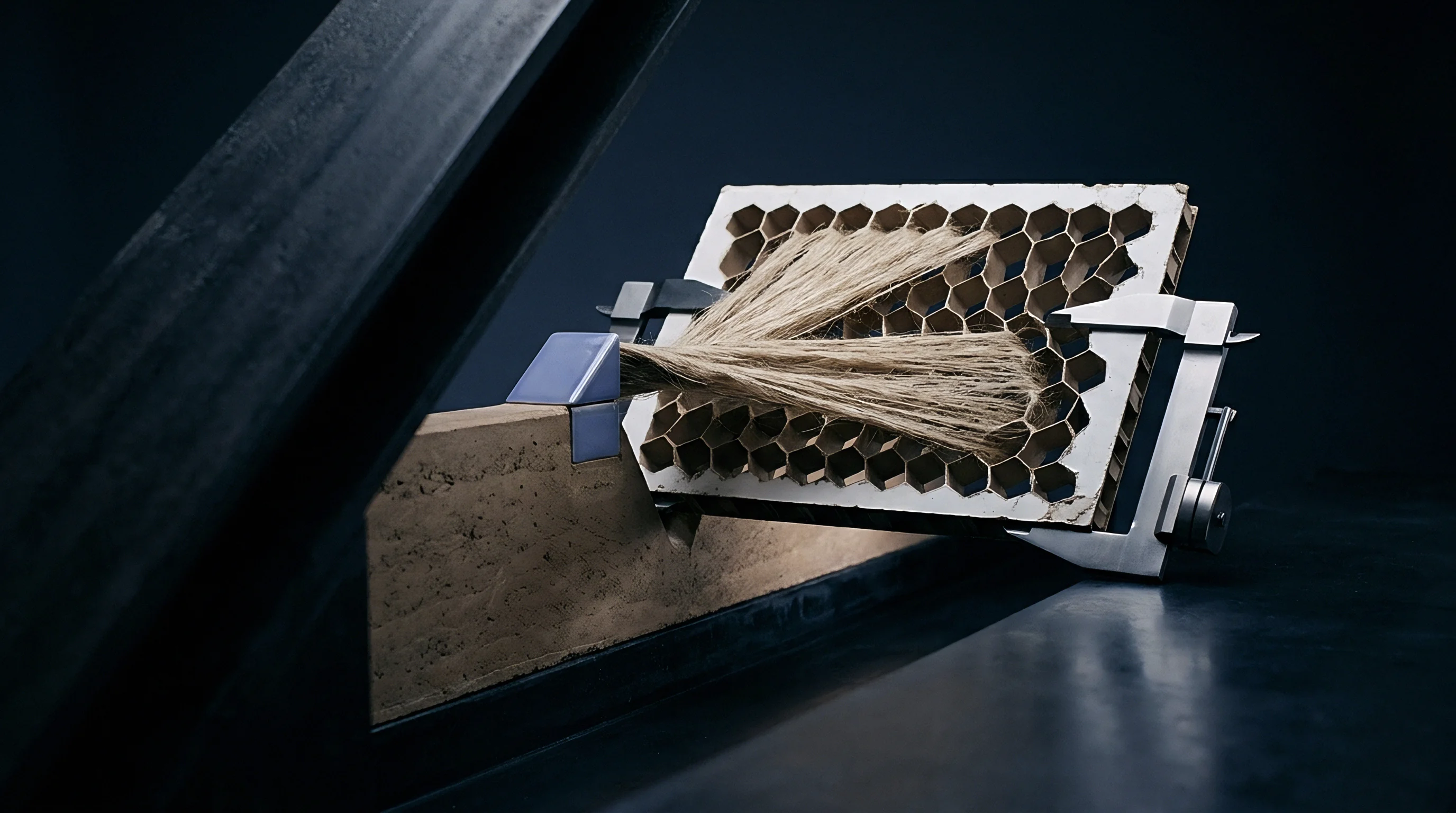
Portable analytical tools use backscatter geometry to capture orientation markers within sixty seconds. Rapid dockside screening verifies whether an incoming lot meets the structural specifications in the purchase agreement before bales are unstrapped and fed into the opening line.
Intake specifications enforcing ISO 6741 conditioning protocols require incoming scutched flax lots to maintain a minimum Hermans crystallite orientation factor of 0.89 to avoid automatic commercial re-grading.
- Certificate of Analysis Validation detailing average Hermans crystallite orientation factor, microfibril angle distribution curves, and diffraction testing conditions.
- Traceable Lot Core Records mapping individual 200-kilogram bale serial numbers to specific field origin, retting method, and scutching turbine lines.
- Spectroscopic Dichroic Index raw data files verifying full-width half-maximum values across five sample stricks per core.
- Moisture Equivalence Statement confirming sample conditioning occurred within the allowed relative humidity window between sixty and sixty-eight percent.
Integrating crystallite screening into receiving workflows prevents low-tenacity flax from entering high-count wet-spinning lines. Mills using dockside testing assign incoming batches to production routes based on measured orientation factors, routing high-Fc lots directly to wet-spun apparel lines while shifting lower-Fc lots to dry-spun coarse weaving yarns. Whether handheld polarized Raman tools can achieve enough signal clarity through thick epidermal remnants to replace benchtop diffraction during dockside intake remains an open question.


Craft
Commercial valuation models for raw scutched flax integrate physical metrics alongside moisture and shive content. While sourcing contracts historically relied on length, color, and hand, incorporating Hermans orientation factor metrics replaces subjective grading with reproducible physical boundaries. Purchasing teams now write explicit orientation factor thresholds directly into technical specifications to anchor pricing tiers.

Contract Adjustments and Quality Premiums
European trade terms for line flax set structured price schedules based on verified physical parameters, with base pricing assuming a Hermans orientation factor of 0.90. When laboratory diffraction shows orientation factors above 0.92, suppliers receive a premium of two point five percent per 0.01 Fc increment above baseline. If tests show an orientation factor below 0.87, buyers apply an automatic price penalty of four percent per 0.01 Fc drop or exercise full lot rejection.

Arbitration Protocols for Disputed Lots
Disputed test results between buyer and seller go to accredited referee laboratories. Standard arbitration protocols require double-blind wide-angle X-ray diffraction on ten freshly conditioned strick samples from sealed reference cores. The referee laboratory’s measurements determine final payments and allocate testing costs to the losing party, recognizing that higher Hermans orientation factors in raw scutched stricks translate directly into better hackling efficiency and cleaner sliver drafting.