Calculating Wet Spun Linen Yarn Conversion Ratios
Wet spun linen conversion ratios calculate finished yarn mass by deducting hackling comb waste, roving loss, and hot water trough leaching from scutched flax input.

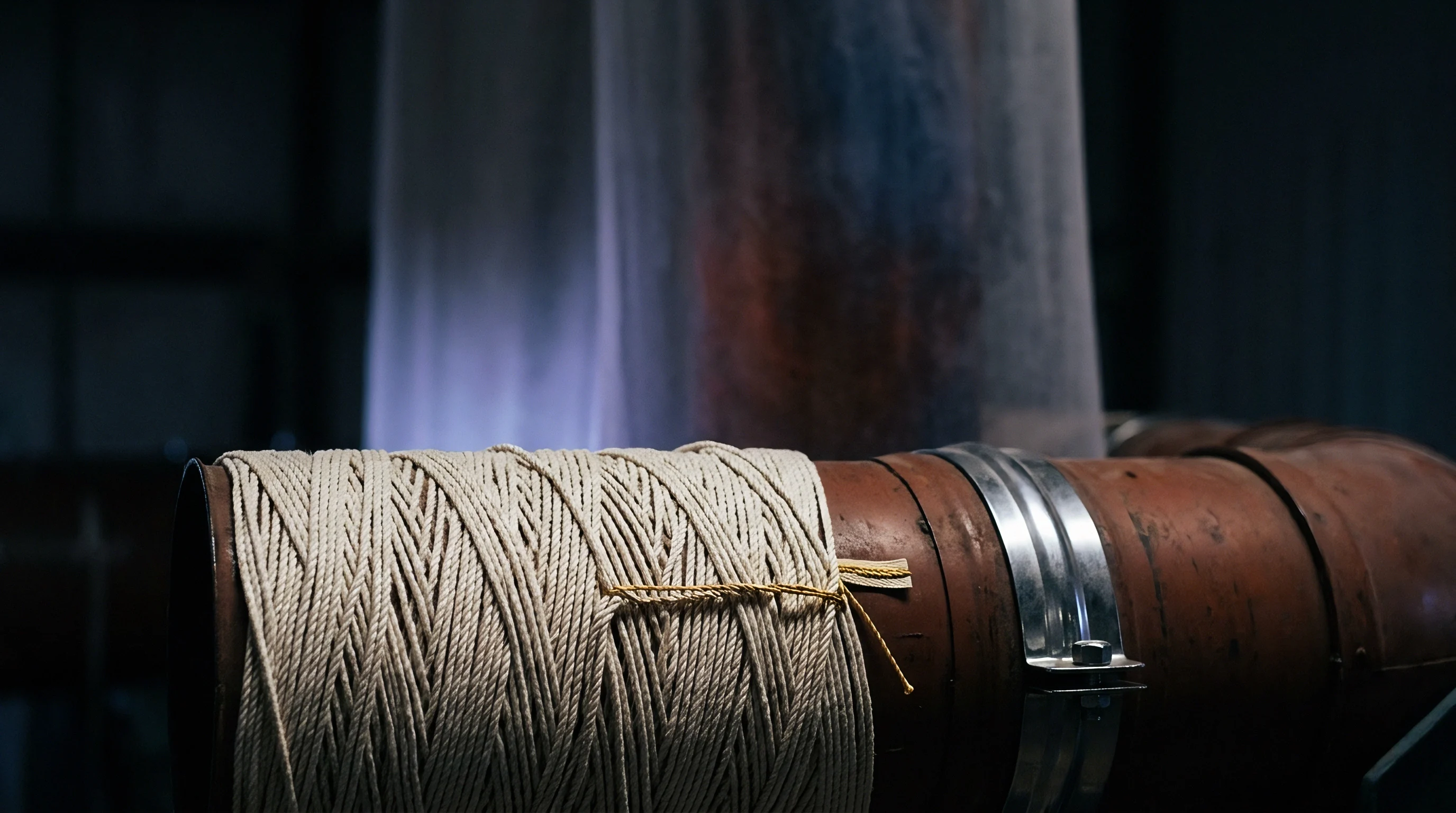
Trough
Water temperature inside the immersion tank directly influences pectin solubility during yarn attenuation. Wet spinning passes flax roving through a heated bath before drafting, dissolving binding substances that hold elementary fibers inside technical fiber bundles. This chemical extraction removes non-cellulosic compounds, reducing total mass while enabling fine yarn counts impossible in dry processing systems.
The immersion fluid extracts water-soluble hemicelluloses, pectins, residual waxes, and inorganic salts. Pectin breaks down rapidly. The resulting weight loss directly shifts the yarn count conversion ratio, requiring precise tracking of mass loss between the raw roving input and the dried, wound package.
Dew-retted bundle structures retain higher concentrations of calcium pectates than water-retted equivalents. As roving moves through the spinning bath at speeds between 12 and 22 meters per minute, bath temperature and residence time determine the total mass extracted. Operating the bath at 65 degrees Celsius extracts between 3.2 percent and 4.8 percent of the incoming dry roving mass.
Higher bath temperatures accelerate pectin hydrolysis, increasing extraction rates up to 6.2 percent at 85 degrees Celsius while degrading fiber tenacity. Temperature alters dissolution rates. Controlling fluid turnover and bath temperature stabilizes mass extraction levels across spinning lots.

Thermal Dissolution Dynamics in Wet Spinning
Process fluid chemistry in the spinning tank creates a continuous extraction zone. Water-soluble content varies based on retting history and fiber origin. Scutched flax from European dew-retting operations contains approximately 4.5 percent water-soluble matter by mass, whereas enzyme-retted stock exhibits lower soluble fractions due to targeted enzymatic digestion during preliminary processing.
The bath fluid requires continuous filtration and fresh water replenishment to prevent dissolved pectin buildup, which increases bath viscosity and alters drafting resistance at the spinning rollers.
| Bath Temperature (°C) | Dwell Time (s) | Soluble Mass Loss (%) | Roving Count (Nm) | Spun Yarn Count (Nm) | Net Mechanical Draft Ratio |
|---|---|---|---|---|---|
| 50 | 4.2 | 2.10 | 3.2 | 26.0 | 7.95 |
| 60 | 4.2 | 3.45 | 3.2 | 26.4 | 8.02 |
| 70 | 4.2 | 4.60 | 3.2 | 26.7 | 8.08 |
| 80 | 4.2 | 5.85 | 3.2 | 27.1 | 8.16 |
| Notes: Data compiled under ISO 2060 testing conditions using Grade 4 European dew-retted line flax roving at 12.0% standard moisture regain. | |||||
Chemical Extraction Rates across Retting Types
Dissolved mass losses directly alter the physical relationship between roving mass fed into the machine and final yarn mass collected on bobbin cops. A mill feeding a 3.2 Nm roving into a wet spinning frame at 70 degrees Celsius experiences an effective length-to-mass change driven by combined mechanical attenuation and chemical extraction. Ignoring bath mass loss leads to systematic errors in yarn count prediction, resulting in delivered yarn that runs finer than nominal calculations suggest.
Mill managers frequently attribute unexpected mass deficits to non-cellulosic gum variance in raw scutched lots rather than excessive bath temperatures.


Loss
Mechanical comb pins divide raw scutched bundles into continuous parallel sliver while extracting short entanglement masses. Scutched line flax fed into the hackling machine undergoes progressive combing across fine-pin beds, separating long line fibers from short tow fibers and residual shive particles. Hackling strips weak fibers.
Retting history dictates yield. The proportion of hackled line sliver obtained relative to raw scutched flax input forms the initial recovery metric in yarn manufacturing arithmetic. Typical hackling yield ranges from 55 percent to 68 percent line sliver, with comb tow taking up 28 percent to 38 percent and unrecoverable dust or shive waste taking the remainder.
- Bundle Splitting Resistance Coarse flax bundles resist mechanical division, causing excessive fiber breakage at the hackling pins and shifting mass yield from line sliver into lower-value comb tow.
- Shive Retention Mechanical Scraping Unretted woody bark fragments cling to fiber bundles, demanding aggressive comb pin penetration that generates extra short-fiber waste.
- Pin Jamming Fiber Shear Accumulated fiber laps on hackling combs create localized tension spikes, shearing long-staple strands into irregular tow fractions.
- Roving Frame Roller Slip Differential speed between front and back drafting rollers causes localized fiber gathering, generating unspinnable roving waste during speed frame stops.
Fiber length distribution determines how much long-staple material survives hackling without descending into tow categories. Long line flax with average staple lengths exceeding 700 millimeters yields high-grade hackled sliver suitable for fine yarn counts above Nm 50. Shorter scutched stock under 500 millimeters suffers high comb-waste percentages, reducing net line yield.
Hackling yield sets the cost foundation for the entire yarn batch because line sliver commands a substantial market premium over comb tow.
Hackling 100 kilograms of Grade 4 dew-retted scutched flax yields 61.5 kilograms of hackled line sliver at standard 12 percent moisture regain under ISO 6741 conditions.

Staple Length Breakdown and Hackling Yield
Drawing and doubling operations following hackling refine sliver weight uniformity without significant fiber mass loss. Mass loss in drawing frames remains low, typically between 0.8 percent and 1.5 percent, caused by fly waste and suction removal of loose short fibers. The primary yield reduction occurs during hackling and wet spinning.
Tracking exact mass losses at each stage prevents cumulative errors in final yarn production planning.

Roving Frame Mass Reduction Factors
Drafting rollers attenuate hackled sliver through successive passes to achieve target bundle weight per unit length. The roving process inserts light protective twist, producing a cohesive roving strand wound onto wooden bobbins. Mechanical friction during drafting releases short fiber fly into room air, creating a minor weight loss.
This mechanical loss must be factored alongside chemical trough leaching to calculate exact overall conversion efficiency.
Failing to account for hackling tow ratios skews yarn mass predictions and leaves mill budgets unhedged against raw fiber price surges.
Regain

How Does Moisture Regain Alter Delivered Yarn Mass?
Standard laboratory ovens measure absolute dry weight by heating raw specimens to 105 degrees Celsius until mass equilibrium stabilizes. Dry mass determines valuation. Regain shifts billed mass.
Flax is a highly hygroscopic bast fiber, absorbing atmospheric moisture up to balance levels defined by surrounding relative humidity and ambient temperature. Commercial yarn transactions convert bone-dry mass into official commercial mass using standardized regain allowances established by international standards. ISO 6741 defines the official moisture regain allowance for flax yarns at 12.0 percent.
ISO 6741 mandates an official allowance of 12.0 percent for flax yarns, causing a 3.2 percent invoice penalty when incoming shipments are weighed below target moisture equilibrium.
Commercial mass calculations prevent discrepancies caused by ambient humidity changes during storage and maritime transport. Evaluating a yarn lot weighed immediately after spinning shows higher water content than identical material stored in an arid environment. Applying ISO 6741 formulas establishes a uniform invoice mass regardless of ambient conditions at point of delivery.
Disregarding moisture regain adjustments produces artificial mass variations that corrupt conversion calculations.
Laboratory Mass Reconciliation Standards
Certified testing routines apply fixed percentage multipliers to dry measurements to derive billable commodity weights under ISO 6741. Calculating commercial mass requires drying test samples to constant oven-dry weight, then applying the designated regain factor. If raw fiber is purchased at one moisture level and sold as yarn at another, an artificial mass gain or loss appears on financial ledgers unless corrected to dry mass bases.
| Physical Condition | Measured Scale Mass (kg) | Measured Moisture Content (%) | Oven-Dry Base Mass (kg) | Official Regain Allowance (%) | Commercial Mass (kg) |
|---|---|---|---|---|---|
| Fresh Spun (Damp) | 1000.0 | 15.5 | 845.0 | 12.0 | 946.4 |
| Conditioned Store | 960.0 | 12.0 | 844.8 | 12.0 | 946.2 |
| Desiccated Ship Container | 915.0 | 7.5 | 846.4 | 12.0 | 947.9 |
Moisture equilibrium governs weight. Commercial mass balance verification requires taking sample cores from sealed yarn boxes prior to laboratory testing. Weighing samples before and after oven drying reveals actual moisture regain at the scale.
Converting invoice weights to oven-dry mass isolates actual fiber content from absorbed water mass, establishing precise material balances across spinning operations.
ISO 6741 Section 4 establishes standard regain at 12.0 percent, shifting billable shipment weights by up to three percent when ambient mill humidity drops.


Arithmetic
Input fiber mass undergoes four distinct reductions before winding onto final spinner packages. Calculating the net conversion ratio requires chaining mass retention factors from scutching through hackling, roving, wet-trough extraction, and bobbin winding. Each stage removes a measurable percentage of initial fiber weight.
The total conversion factor represents the fraction of raw scutched line mass converted into finished wet-spun yarn.

Sequential Mass Yield Formula Derivation
Defining conversion factors mathematically establishes an exact framework for material balance control. Let initial scutched flax mass be represented by input mass M_input. The total yarn recovery formula factors individual mass retention rates across sequential operations:
M_yarn = M_input Y_hack Y_rov (1 – L_trough) (1 – L_wind) ((1 + R_yarn / 100) / (1 + R_flax / 100))
Where Y_hack represents hackling line sliver yield (decimal), Y_rov represents roving stage mass retention (decimal), L_trough represents trough extraction mass loss fraction (decimal), L_wind represents winding waste fraction (decimal), R_yarn represents yarn official commercial regain percentage (12.0%), and R_flax represents raw fiber commercial regain percentage (12.0%).

Worked Mass Balance Calculation for Line Yarn
Standard mill inputs assume a starting baseline of 1000 kilograms of raw scutched line material. Assume a Grade 4 dew-retted lot processed into Nm 26 wet-spun yarn under standard mill conditions:
- Weigh raw scutched flax lot to confirm baseline input mass of 1000.0 kilograms at standard 12.0 percent commercial moisture regain.
- Deduct hackling comb waste based on a measured line sliver yield of 62.0 percent, leaving 620.0 kilograms of hackled line sliver and producing 345.0 kilograms of comb tow and 35.0 kilograms of unrecoverable dust waste.
- Apply roving mass reduction factor of 98.2 percent retention (1.8 percent mechanical fly waste), leaving 608.84 kilograms of roving delivered to spinning frames.
- Calculate trough dissolution deduction based on a 70 degree Celsius bath operating temperature resulting in a 4.20 percent soluble mass loss, yielding 583.27 kilograms of dried spun yarn on cops.
- Deduct 1.20 percent for winding, clearing, and splicing mass loss, yielding 576.27 kilograms of net finished wet-spun yarn packages.
Calculating yarn delivery from raw fiber mass requires deducting cumulative mechanical waste before applying chemical leaching factors in wet processing.
Net yield drives profit. The overall net mass conversion ratio for this worked baseline equals 576.27 kilograms divided by 1000.0 kilograms, resulting in a net conversion ratio of 0.5763 (or 57.63 percent). The remaining 42.37 percent of initial mass consists of comb tow (34.50 percent), hackling dust (3.50 percent), roving waste (1.12 percent), trough extractives (2.56 percent), and winding scrap (0.69 percent).
Yarn Count Systems Conversion Mechanics
Direct and indirect numerical systems express linear density through inverse mathematical relationships. Wet-spun linen yarn counts are reported in Metric Count (Nm), Lea or English Linen Count (NeL), or Tex. Metric Count indicates the number of 1000-meter hanks per kilogram.
Lea indicates the number of 300-yard hanks per pound. Tex indicates mass in grams per 1000 meters of yarn.
Converting between systems relies on fixed conversion constants derived from length and mass definitions:
Nm = NeL 1.6534
NeL = Nm 0.6048
Tex = 1000 / Nm
Tex = 1653.4 / NeL
Twist contracts yarn length. Inserting spinning twist contracts drafted roving strands, increasing linear mass density per unit length relative to straight fiber strands. Twist contraction factor alpha_m ranges between 1.015 and 1.035 in wet-spun flax yarns.
Mechanical draft settings on spinning frames must compensate for twist contraction to hit target final yarn counts exactingly. A draft calculation ignoring twist contraction produces yarn that runs heavier than intended.
The degree to which low-temperature enzyme pre-treatments can preserve fiber mass while softening pectin matrices remains an open analytical question for spinning technologists.


Costing
Comb tow sales return partial revenue credits against initial scutching expenditure. Hackling comb tow generated during line fiber processing remains a valuable secondary material, suitable for coarse dry-spun yarns, non-woven substrates, or paper pulp blends. Factoring comb tow resale values into conversion arithmetic reduces effective fiber raw material expenditure charged against line yarn production.

Raw Fiber Cost Allocation per Finished Kilogram
Coarser counts yield more. Fine yarn increases waste. Landed yarn manufacturing cost per kilogram incorporates fiber purchase price, net conversion ratio, spinning conversion fee, and byproduct waste credits.
Net raw material cost allocation uses the formula:
Net Fiber Cost ($/kg yarn) = (P_raw – (Y_tow P_tow)) / CR_line
Where P_raw represents scutched line flax price (/kg), Ytow represents comb tow yield fraction (0.345 in worked example), Ptow represents market tow price (/kg), and CR_line represents net line yarn conversion ratio (0.5763 in worked example).
| Target Count (Nm) | Scutched Fiber Price ($/kg) | Hackling Line Yield (%) | Net Conversion Ratio (%) | Net Fiber Allocation ($/kg) | Spinning Processing Fee ($/kg) | Finished Yarn Landed Cost ($/kg) |
|---|---|---|---|---|---|---|
| Nm 14 (Coarse) | 4.20 | 66.0 | 61.8 | 5.42 | 3.10 | 8.52 |
| Nm 26 (Medium) | 5.50 | 62.0 | 57.6 | 7.81 | 4.50 | 12.31 |
| Nm 39 (Fine) | 7.20 | 58.0 | 53.4 | 11.42 | 6.80 | 18.22 |
| Nm 60 (Superfine) | 9.80 | 52.0 | 47.2 | 18.05 | 11.20 | 29.25 |
Tow credits offset losses. Spinning fine yarn counts requires premium long-staple scutched flax, increasing input material cost per kilogram while yielding lower net line ratios due to aggressive comb pin extraction settings. Processing surcharges elevate finished yarn pricing on fine counts due to lower frame production speeds in meters per minute.
Lower conversion ratios on fine count yarn frames reflect extended drafting passes and higher trough leaching rates.

Fabric Conversion Factors and Loom Yields
Woven fabric construction translates linear yarn mass into area weight per square meter based on warp end density and reed width settings. Converting yarn costs into woven fabric cost per linear meter requires adding warp preparation waste (typically 2.0 percent to 3.5 percent) and loom fringe waste (typically 1.5 percent to 2.5 percent). Calculating total material inputs for a fabric order involves multiplying net fabric mass by combined yarn and weaving conversion factors.
- Raw Mass Verification Weigh raw incoming bales upon arrival and test moisture content to establish exact oven-dry baseline mass before issuing production lots to hackling.
- Tow Scraping Credit Accounting Track comb tow weight generation by grade lot to credit hackling departments accurately against raw material inputs.
- Trough Temperature Tolerance Limits Calibrate wet spinning bath temperature controllers within plus or minus 1.5 degrees Celsius to stabilize dissolution mass loss rates across shifts.
- Commercial Regain Reconciliation Reconcile outgoing yarn package scale weights against ISO 6741 commercial mass formulas before issuing final commercial sales invoices.
Rule of thumb: Coarse yarns preserve raw fiber investments while fine counts demand high-grade scutched line input to absorb cumulative processing losses.