Predicting Bundle Cohesion and Drafting Limits from Esterification
Pectin esterification testing predicts flax bundle cohesion and wet-spinning drafting limits, establishing exact yarn count boundaries before mill processing.


Stem
Flax bast fibres reside in the cortex of the plant stalk, embedded within a complex pectic matrix. This matrix acts as the primary adhesive binding individual elementary fibres into technical fibre bundles. Homogalacturonan, the dominant pectin polysaccharide in the middle lamella, consists of linear chains of alpha-(1-4)-linked D-galacturonic acid residues.
The degree to which these galacturonic acid residues carry methyl ester groups at the C-6 carboxyl position determines the chemical personality of the bundle interface. Natural retting processes, whether executed in dew fields, water tanks, or enzyme reactors, progressively remove these methyl esters alongside hemicellulosic polysaccharides. The residual chemical structure of this middle lamella governs how effectively technical bundles split into elementary units during mechanical hackling and drawing.
Bundle cohesion relies directly on the interplay between methyl-esterified carboxyl groups and free carboxyl groups capable of forming ionic cross-links. Unesterified galacturonic acid residues bear negative charges at typical processing pH levels. These charges interact with divalent cations, primarily calcium ions (Ca²⁺), forming stable junction zones often described as egg-box structures.
When the degree of esterification is high, fewer unesterified carboxyl groups exist to form calcium bridge networks. The middle lamella remains more flexible, yielding weaker inter-elementary bundle adhesion. Conversely, low esterification levels create dense calcium-mediated cross-link networks that resist mechanical shearing.
Scutched line flax entering the spinning mill carries an esterification profile that records its exact retting history.
Residual galacturonic ester groups restrict sliver attenuation during drafting by locking elementary bundle cohesion.
Dew-retted flax from Western Europe generally exhibits lower esterification degrees than water-retted or rapidly processed green flax. Field retting relies on natural fungal colonization, where pectin methylesterases cleave methyl esters before polygalacturonases depolymerize the pectin backbone. Variations in field moisture and atmospheric temperature cause wide swings in enzyme activity across harvest lots.
A lot harvested after a dry retting window retains high methoxyl content, leaving large, cohesive technical bundles that resist division. A lot exposed to prolonged rainfall suffers severe demethylation and structural degradation. Pectin governs inter-bundle friction.
Assessing raw fibre cohesion without quantifying pectin chemistry leaves the spinning mill vulnerable to unpredicted drafting force spikes.
Suppliers frequently attribute high stick-slip variation in green flax lots to seasonal harvest moisture rather than incomplete enzymatic demethylation of the middle lamella.

Carboxyl
Quantitative determination of methylated galacturonic acid groups relies on Fourier-transform infrared spectroscopy. Analytical protocols evaluate the ratio of peak absorbances at 1740 cm⁻¹ and 1600 cm⁻¹. The 1740 cm⁻¹ band corresponds to esterified C=O carbonyl stretching vibrations, while the 1600 cm⁻¹ band reflects ionized carboxylate group (COO⁻) asymmetric stretching.
Chemical titration following saponification provides secondary verification, establishing the molar percentage of esterified carboxyls relative to total galacturonic acid content. High-grade scutched line flax suitable for fine wet spinning typically exhibits a degree of esterification between 45 percent and 65 percent. Values exceeding 70 percent indicate green, under-retted material, whereas values under 35 percent signal over-retting and severe cellulose degradation.
| Degree of Esterification (%) | Calcium Content (mg/g) | Bundle Friction (µ) | Cohesion Force (N/ktex) | Drafting Behaviour |
|---|---|---|---|---|
| 30 to 40 | 4.2 to 5.5 | 0.48 to 0.55 | 2.4 to 3.1 | High resistance, severe sliver stick-slip |
| 45 to 55 | 2.8 to 3.9 | 0.36 to 0.44 | 1.5 to 2.1 | Optimal attenuation, stable drawing zone |
| 60 to 70 | 1.5 to 2.6 | 0.28 to 0.34 | 0.9 to 1.3 | Rapid bundle breakdown, false drafting risk |
| 75 to 85 | 0.6 to 1.3 | 0.20 to 0.26 | 0.4 to 0.7 | Poor bundle integrity, high sliver break rate |
Calcium ions stabilize middle lamellae. The spatial concentration of these divalent cations dictates whether carboxyl groups build rigid networks or remain isolated. Washing flax slivers with chelating agents such as ethylenediaminetetraacetic acid removes bound calcium, instantly lowering bundle cohesion force even when the degree of esterification remains unchanged.
Industrial drawing, however, operates on un-chelated dry slivers. Inter-fibre friction coefficients measured via bundle pulling tests show a direct linear correlation with unesterified carboxyl density. Higher density increases inter-elementary shear resistance, requiring elevated drafting roller nip pressures to prevent uncontrolled bundle slipping.
Dew-retted flax with an esterification degree above 62 percent exhibits a bundle friction coefficient of 0.38 at standard ambient conditions of 20 degrees Celsius and 65 percent relative humidity.
Improperly managed esterification levels disrupt mechanical processing across every drawing passage. The following failure modes emerge when draw frame drafting parameters do not match incoming pectin chemistry:
- Drafting zone clogging occurs when high calcium cross-linking prevents inter-bundle shearing, causing fibre accumulation at the front roller nip.
- Thick slub generation arises from uneven bundle slipping where high-cohesion clusters pass through untransformed into the drafted sliver.
- Sliver tension breakage happens when drafting force exceeds the tensile strength of the incoming undrafted strand during high-speed delivery.
- Roller lapping cycles increase when sticky pectin residues transfer from low-esterification fibres onto upper rubber cot surfaces under ambient humidity spikes.
Miscalibrating esterification measurements against raw cohesion forces leads to selecting unsuitable draw-frame draft ratios, producing persistent yarn count variation that invalidates fabric weight tolerances at the loom.

Slip
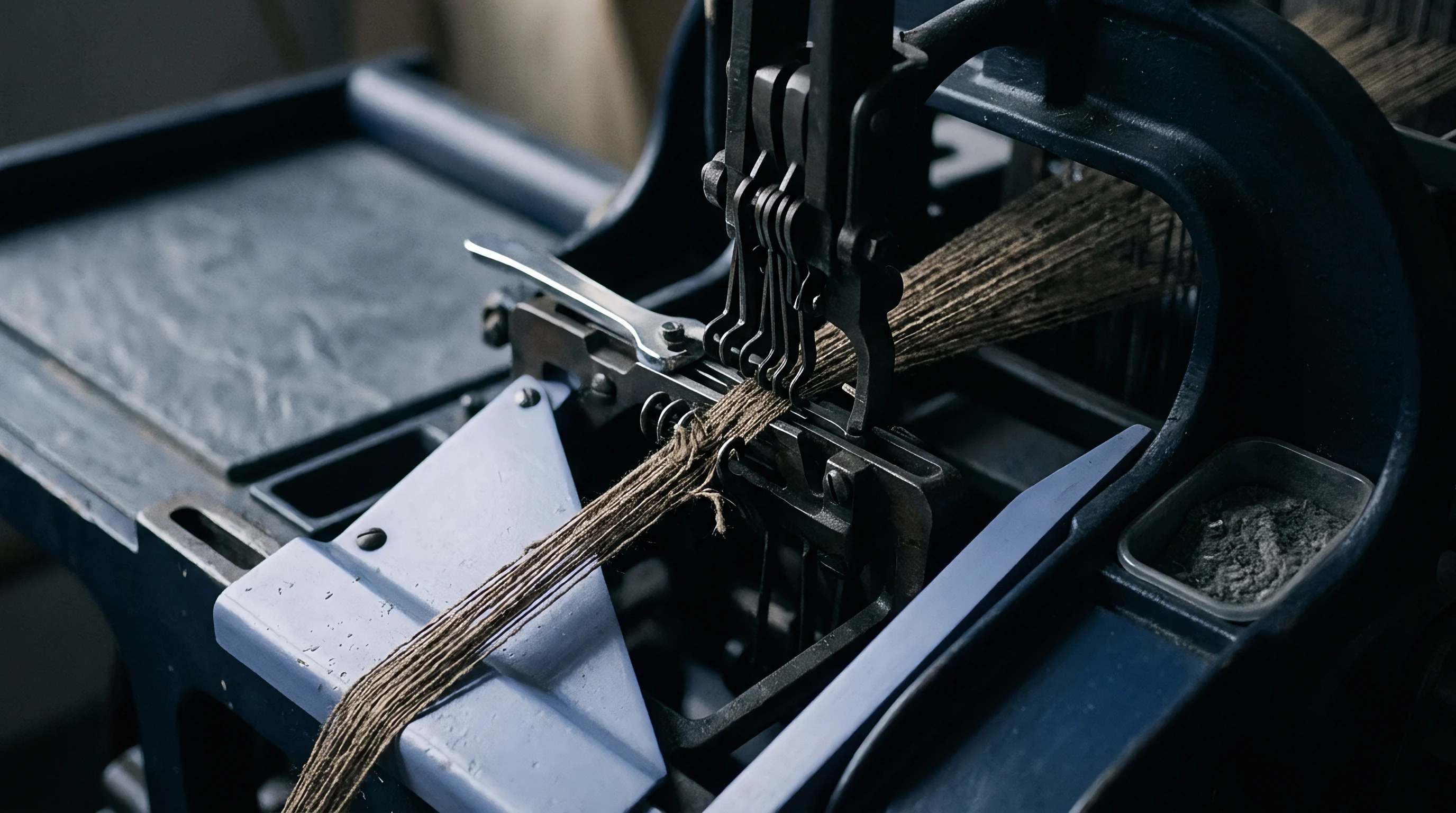
Inter-fibre bundle cohesion dictates the force required to pull elementary strands past each other during mechanical attenuation. Drafting zones on pin drafters and speed frames rely on a delicate balance between clamping pressure and inter-bundle friction. When a sliver enters the drafting zone between the back rollers and the front delivery rollers, back-draft tension pulls on the technical bundles.
If bundle cohesion is too high, the drafting force spikes beyond the mechanical hold of the faller pins. The sliver surges forward in chunks rather than attenuating smoothly. This phenomenon generates stick-slip oscillation, recorded as periodic force peaks during continuous draft testing.
High esterification speeds bundle drafting. Methoxyl groups sterically hinder the close alignment of galacturonan chains, weakening hydrogen bonding and preventing calcium bridge formation. As a result, technical bundles slip past one another at lower absolute force thresholds.
Pin drafting machines can run at elevated draft ratios, ranging from 8x to 12x, without inducing drafting waves or roller slip. However, if esterification is excessively high, inter-bundle cohesion drops below the threshold required to hold the sliver together under delivery tension. The sliver drafting zone collapses, causing spontaneous end breaks and mill downtime.
Higher esterification degrees preserve inter-elementary pectin bridges while lowering hot water dissolution rates inside the wet spinning trough.
Stick-slip dynamics convert directly into mass variations across the drafted product. Open-loop draw frames cannot compensate for high-frequency force fluctuations caused by irregular pectin demethylation. High-resolution capacitive mass testing reveals distinct wavelength periodicities corresponding to faller pin pitch when cohesion forces exceed 2.2 Newtons per kilotex.
Lowering the breaker draft ratio from 1.4 to 1.15 dampens these oscillations, but reduces overall production throughput. The technician balances roller nip pressure, faller pin density, and zone draft against the measured cohesion profile of the lot.
When inter-fibre bundle friction rises above drawing roller clamping pressure, reduction of breaker draft ratios prevents sliver choking and eliminates thick-place yarn defects.
Tension
Hot water conditioning in the wet-spinning trough alters the structural rigidity of middle lamella pectins before roving enters the drafting zone. Water temperatures between 55 degrees Celsius and 75 degrees Celsius plasticize the pectin matrix, hydrating residual polysaccharides and breaking temperature-sensitive hydrogen bonds. The degree of esterification determines how rapidly pectin dissolves under these hydrothermal conditions.
Highly esterified pectins dissolve faster in hot water, reducing bundle cohesion inside the trough. Low-esterification pectins, locked by insoluble calcium pectate complexes, resist hot water softening, preserving bundle stiffness into the front drafting zone.
| Trough Temperature (°C) | Dwell Time (s) | Pectin Dissolution Rate (%) | Peak Drafting Resistance (N) | Maximum Spinnable Count (Nm) |
|---|---|---|---|---|
| 50 | 3.0 | 8.2 | 4.1 | Nm 26 |
| 60 | 3.8 | 14.5 | 2.8 | Nm 42 |
| 70 | 4.5 | 22.1 | 1.6 | Nm 68 |
| 80 | 5.2 | 31.4 | 0.9 | Nm 85 (slub risk) |
Hot water softens pectin networks. As roving travels through the submerged trough, water penetrates the porous fibre core. Unesterified carboxyl groups retain bound calcium ions, maintaining structural bridges that hold elementary fibres together inside technical bundles.
Highly esterified segments lose structural integrity quickly. Excessive solubilization causes technical bundles to split completely into elementary fibres before reaching the front roller nip. Uncontrolled splitting creates free fibre ends, leading to heavy spinning trough debris accumulation, high yarn hairiness, and frequent end breaks under high spindle speeds.
ISO 2370 compliance failure during fineness grading triggers automatic batch re-testing under buyer risk allocation clauses.
Mill technologists execute a systematic qualification sequence to determine the maximum draft limit of incoming roving batches:
- Sample five 50-gram fibre bundles from distinct locations within the incoming scutched bale.
- Measure total galacturonic acid methyl ester content using Fourier-transform infrared spectroscopy at 1740 cm⁻¹ absorbance peaks.
- Condition roving strands at 65 percent relative humidity and 20 degrees Celsius for 24 hours prior to trough testing.
- Pass roving through the wet-spinning trough at 65 degrees Celsius with a retention dwell time of exactly 4.2 seconds.
- Record peak drafting resistance force across the front drafting roller zone using a load sensor calibrated to ISO 2062 specifications.
Incorporating ISO 6741 conditioning mass corrections alongside maximum drafting force thresholds into raw fibre supply contracts shifts financial liability for un-draftable high-esterification lots back to the scutching mill.

Count
Fibre bundle fineness and inter-elementary cohesion directly set the structural limit of spinnable yarn linear density. The metric count (Nm), representing yarn length in metres per gram of weight, depends on the number of elementary fibres present in the yarn cross-section. Fine linen yarns, such as Nm 60 or Nm 80, demand that technical bundles split down to bundles containing only 2 to 4 elementary fibres.
If incomplete retting leaves a low degree of esterification, calcium cross-links prevent this deep division. The minimum cross-sectional area of the bundle remains large, capping the maximum achievable yarn count at Nm 30 or lower.
Scutched line yields finer counts. The initial hackling yield measures the percentage of long-staple fibre recovered after mechanical combing. High bundle cohesion reduces hackling waste by preventing premature fibre breakage, but leaves coarse bundles that limit wet-spinning attenuation.
Conversely, low cohesion yields fine elementary bundles at the expense of generating higher tow percentages during hackling. The economist evaluates the trade-off between hackling yield loss and the market price premium achieved by spinning finer metric counts.
| Flax Grade | Degree of Esterification (%) | Hackling Yield (%) | Draft Limit (Ratio) | Yarn Tenacity (cN/tex) | Uster Evenness (CV %) |
|---|---|---|---|---|---|
| Prime Dew-Retted Line | 52 to 58 | 68.5 | 18.5x | 28.4 | 12.2 |
| Water-Retted Line | 44 to 49 | 72.1 | 14.0x | 31.2 | 14.8 |
| Enzyme-Treated Tow | 64 to 71 | 54.2 | 22.0x | 21.8 | 18.5 |
| Green Unretted Tow | 78 to 84 | 48.0 | 8.5x | 16.5 | 24.1 |
| Data acquired under ISO 2062 tensile testing conditions using 250 mm gauge length at 200 mm/min traction speed. | |||||
Achieving fine counts with low mass variability requires tight adherence to fibre specification targets across the drawing line. Standard procurement contracts specify structural and chemical limits for line flax lots intended for high-count wet spinning:
- Fineness distribution target specifies a mean metric fibre number exceeding 1800 Nm under ISO 2370 test protocols. Single-bundle deviations must remain under 12 percent across the entire lot.
- Bundle cohesion limit maintains steady slip dynamics between 1.2 and 1.8 Newtons per kilotex during third-passage draw frame attenuation.
- Tenacity threshold value demands a minimum dry bundle breaking force of 45 centinewtons per tex when evaluated on a 100-millimetre gauge length.
- Trough solubilization rate dictates that pectin loss during wet spinning remains between 14 and 18 percent by weight to preserve yarn structure.
Whether enzymatic retting can be controlled tightly enough on an industrial scale to yield consistent esterification profiles across multi-tonne bales without increasing chemical treatment costs remains unproven across commercial processing lines.
Margin
Economic efficiency across long-staple flax processing relies on minimizing hackling waste and optimizing spinning frame speed. Fibre purchasing contracts reflect both raw mass costs and projected spinning yield. A raw flax lot purchased at 4.20 Euros per kilogram with a 65 percent hackling yield produces long-staple line fibre at an effective raw material cost of 6.46 Euros per kilogram, excluding processing energy and labour.
If low esterification forces a reduction in spinning frame draft from 18x to 12x, machine productivity drops by 33 percent, increasing fixed overhead allocation per kilogram of finished yarn.
Consider a practical cost calculation for weaving-grade Nm 40 wet-spun yarn. Assume a mill purchases a 20-tonne lot of dew-retted scutched line flax. If esterification sits at the optimal 55 percent level, hackling waste stays at 32 percent, roving draft operates at 16x, and wet-spinning end breakage rates remain under 25 breaks per 1000 spindle hours.
The resulting yarn cost calculates to 14.80 Euros per kilogram, yielding finished 150 cm wide linen fabric at 4.15 Euros per linear metre. If esterification drops to 38 percent due to over-retting, hackling waste increases to 41 percent, draft ratio drops to 11x, and end breakage spikes to 68 breaks per 1000 spindle hours. The landed yarn cost ascends to 18.90 Euros per kilogram, driving finished fabric costs to 5.30 Euros per linear metre.
Slubs impair weaving efficiency.
Commercial buyers managing long-staple linen contracts verify batch-level esterification certificates prior to opening credit lines, protecting mill margin against yarn rewinding costs and weaving efficiency drops.