Predicting Non Linear Viscoelastic Crimp Recovery during Continuous Wet Finishing Processes
Predicting wet warp crimp recovery through nonlinear viscoelastic models allows accurate stenter overfeed adjustments to meet finished width and shrinkage specs.
Nip
On continuous open-width bleaching ranges, greige cloth endures steady axial pull while squeeze rolls strip saturated liquor between processing compartments. Water plasticizes cellulosic polymers within seconds of submersion. As this tensile load draws out the wet warp during transport, the crimped sinusoidal geometry established on the loom distorts heavily: warp yarns flatten along the machine direction, driving weft yarns into exaggerated out-of-plane undulations via mechanical crimp interchange.
Swelling pressures expand yarn diameters outward by thirty percent, packing the yarn intersection points tightly together. When the cloth passes between extraction rollers, the nips clamp these displaced intersections, locking temporary longitudinal stretch into the running web.
Applying tensile stress to water-swollen flax or cotton yarns triggers rapid chain slippage through non-crystalline cellulose domains. Initial elastic extension gives way to time-dependent viscoelastic creep. On continuous washing and desizing ranges running at one hundred twenty metres per minute, cloth segments face irregular dwell times between longitudinal pulls and transverse squeezes.
Nip rolls exert linear pressures between thirty and seventy kilonewtons per metre, keeping yarn bundles from relaxing toward minimum-energy configurations during extraction. The structure relaxes only when line tension falls below the yarn’s internal restorative force.
Controlling this transition means balancing drive motor speeds across consecutive processing boxes, typically with load cells and dancing rollers holding warp tension inside narrow limits. Unchecked axial pull strips crimp from the warp entirely, shifting all curvature into the weft and collapsing fabric width. As the web leaves the final extraction unit, stored viscoelastic strain stays locked inside the flattened yarn nodes.
Predicting how much of that lost warp crimp can be recovered is what determines whether the cloth meets finished width, square metre weight, and residual washing shrinkage targets.
Yarn curvature set under boiling tension locks the warp path until mechanical energy breaks the secondary bonding.
Drive synchronization faults cause immediate dimensional distortion through continuous wash boxes, where machine geometry dictates whether fabric enters the extraction nip slack or under heavy longitudinal strain.
- Entry tension calibration limits warp elongation before immersion wetting, preventing irreversible plastic yarn extension prior to chemical saturation.
- Submerged guide roll alignment stops edges curling in open-width boxes; out-of-parallel rolls produce asymmetric crimp interchange between the left, centre, and right of the running sheet.
- Intermediate nip drive regulation matches roll surface speed directly to web velocity, curbing face abrasion and shear strain.
- Compensator roll displacement monitoring tracks small shifts in line resistance to trim motor speeds between adjacent wet compartments.
Finished width loss across the line is frequently attributed to incoming greige variability rather than downstream tension profiles.
Creep
Sustained mechanical load produces time-dependent extension in wet natural fibers moving through finishing chemistry. Cellulosic textiles behave in an intensely nonlinear viscoelastic manner under plant tension. Dry bast fibers exhibit a steep initial modulus with virtually no immediate stretch, but aqueous baths sever inter-chain hydrogen bonds, depressing the yield point and speeding up both primary and secondary deformation.
Under five centinewtons per tex of warp tension, wet flax yarns pull out continuously over time, storing unrecoverable plastic strain alongside delayed elastic stretch.
Calculating warp crimp recovery requires separating instantaneous elastic spring-back from delayed viscoelastic recovery and permanent plastic set. Classical Maxwell or Kelvin-Voigt linear analogues fail under fluctuating line tensions in saturated cellulose. Workable nonlinear models replace fixed spring and dashpot constants with stress- and moisture-dependent viscosity functions, using modified Eyring activation energy relationships to describe molecular flow in the amorphous matrix and link strain rate directly to plasticization and applied load.
Where Does Crimp Interchange Shift under Tension?
At rest, intersecting warp and weft yarns settle into Peirce geometric equilibria, but continuous line tension overrules static geometry. Axial pull on the warp drags crimp height down from an initial greige eight percent to less than two percent. That displacement forces orthogonal weft picks to loop over taut warp ends, driving weft crimp from seven percent up to fifteen percent and narrowing fabric width long before goods reach the dryers.
Once tension drops in intermediate dwell troughs or scrays, viscoelastic decay proceeds logarithmically as warp yarns contract under the bending strain energy stored at yarn knuckles. Radial swelling assists by pushing contact points apart, though the recovery rate decays rapidly over dwell time according to the yarn’s internal relaxation spectrum.
Saturating pure linen at ninety degrees Celsius cuts the relaxation time spectrum from twelve hours to four minutes under five centinewtons per tex.
Nonlinear Recovery Rates in Wet Cellulosic Bundles
Hydrothermal conditions shift the viscoelastic retardation spectrum of wet bast fibers across several orders of magnitude. Raising bath temperature from twenty to eighty degrees Celsius speeds chain mobility enough to convert sluggish delayed recovery into an immediate response. However, if web tension stays high while rinse baths cool, the drawn-out yarn structure sets semi-permanently, blocking spontaneous crimp recovery down the line.
| Bath Temperature (Celsius) | Warp Tension (cN/tex) | Instantaneous Elastic Recovery (%) | Viscoelastic Relaxation Time (s) | Plastic Deformation Ratio (%) | Finished Warp Crimp (%) |
|---|---|---|---|---|---|
| 20 | 3.0 | 42.5 | 340 | 18.2 | 4.8 |
| 40 | 3.0 | 48.1 | 185 | 15.4 | 5.4 |
| 60 | 3.0 | 55.6 | 62 | 12.1 | 6.2 |
| 80 | 3.0 | 63.2 | 14 | 8.7 | 7.1 |
| 95 | 3.0 | 68.9 | 4 | 6.2 | 7.8 |
| 80 | 6.5 | 41.2 | 22 | 24.6 | 4.1 |
Differential transport equations incorporate these empirical parameters to model continuous open-width travel. Finite-element runs across individual yarn cross-sections show inter-fiber friction to be the chief barrier to complete crimp recovery; adding lubricants to desizing baths lowers internal shear resistance and permits higher crimp return within shorter dwell periods. Where warm yarns relax readily, cold, wet bundles carry their drawn geometry through downstream operations.
Bath
Aqueous baths alter cellulosic polymer mechanics by rapidly hydrating hydroxyl sites along glucan chains. Caustic scouring and mercerization drive lattice shifts from cellulose I to cellulose II, untwisting fibers and rounding their cross-sections. If yarns are held at fixed length, these swelling forces generate substantial axial contraction stresses; continuous open-width mercerizers exploit this by running under high warp tension during caustic contact to build luster and tensile strength.
Counter-current washing stages then dilute residual caustic under controlled holding tension. As the bath drops below eight percent sodium hydroxide, the swollen matrix stiffens abruptly. High longitudinal line pull during this transition sets the fabric into an extended, low-crimp condition that resists mechanical relaxation later on.
Stable finishing sequences tune line speed and nip squeeze pressures to match these shifting viscoelastic thresholds across each bath.
Water molecules break inter-chain hydrogen bonds in amorphous cellulose zones before the squeeze roll ever touches the selvedge.
Thermal Plasticization in Caustic Mercerizing Runs
Higher bath temperatures speed chemical penetration into dense linen yarns while lowering liquor viscosity at extraction nips, helping relax internal stresses carried over from ring spinning and winding. In peroxide bleaching compartments running above ninety-five degrees Celsius, fiber bundles yield plastically under far lower line tensions than in cold wash tanks.
Operating continuous ranges outside physical tolerances leads to clear mechanical failures:
- Excessive washer drive lead stretches warp yarns past yield, permanently depressing finished warp crimp and narrowing the delivered fabric.
- Asymmetric squeeze nip loading creates an uneven cross-web stress profile, producing bow and skew in the finished pick line.
- Inadequate dwell time in slack relaxation troughs cuts short viscoelastic strain recovery, leaving residual shrinkage to appear during commercial laundering.
- Abrupt thermal quenching during rinse cycles locks non-equilibrium molecular states, arresting crimp interchange before geometric equilibrium is reached.
Which Viscoelastic Model Captures Hydrothermal Relaxation?
Multi-element Maxwell-Weichert representations approximate stress relaxation under steady strain reasonably well, but fail under dynamic open-width tension cycles. Schapery nonlinear integral formulations handle both stress-dependent kernel shifts and moisture variations through successive wash compartments, using thermodynamic scaling factors in the compliance function to shift the material time base with local regain and bath temperature.
Coupling Schapery constitutive equations with Peirce geometry predicts finished pick counts within three percent of production values by tracking how much stored bending moment survives nip passage at yarn interlacing points. Calibration requires laboratory creep curves across single yarns at multiple moisture levels and chemical concentrations. Tying purchase agreements to ISO 6330 laundering benchmarks places financial responsibility for out-of-spec shrinkage squarely on the finisher rather than the garment cutter.
Hysteresis
Cyclic loading across driven guide rolls and squeeze presses dissipates noticeable mechanical energy in wet fabrics. As warp tension rises, the loading curve trends stiff and upwardly concave while crimp flattens against lateral yarn resistance. Unloading traces an entirely lower path with marked residual deformation; the enclosed hysteresis loop reflects filament-on-filament friction paired with viscoelastic rearrangement inside the cell wall.
Internal friction creates a mechanical dead-band where crimp interchange stops without outside kinetic energy. In rope washers, bath turbulence and mechanical beating overcome this barrier to allow quick crimp recovery. Open-width washers offer no such agitation, relying only on gentle fluid flow and roll curvature; as a result, open-width ranges deliver far less spontaneous warp crimp recovery than rope ranges running the same greige style.

Deformation Energy in Bending Nodes
Bending moments at yarn intersections dictate how much elastic energy remains to restore crimp once fabric clears high-tension zones. As warp ends bend over weft picks, outer fibers run under axial tension while inner fibers sit in compression, with moisture shifting the neutral bending axis inward. When line tension eases, this stored moment forces yarns back toward an undulating path; however, if the web relaxes viscoelastically while clamped flat in a nip, the restoring moment decays exponentially, leaving permanent length behind.

Drying Dynamics across Stenter Frames
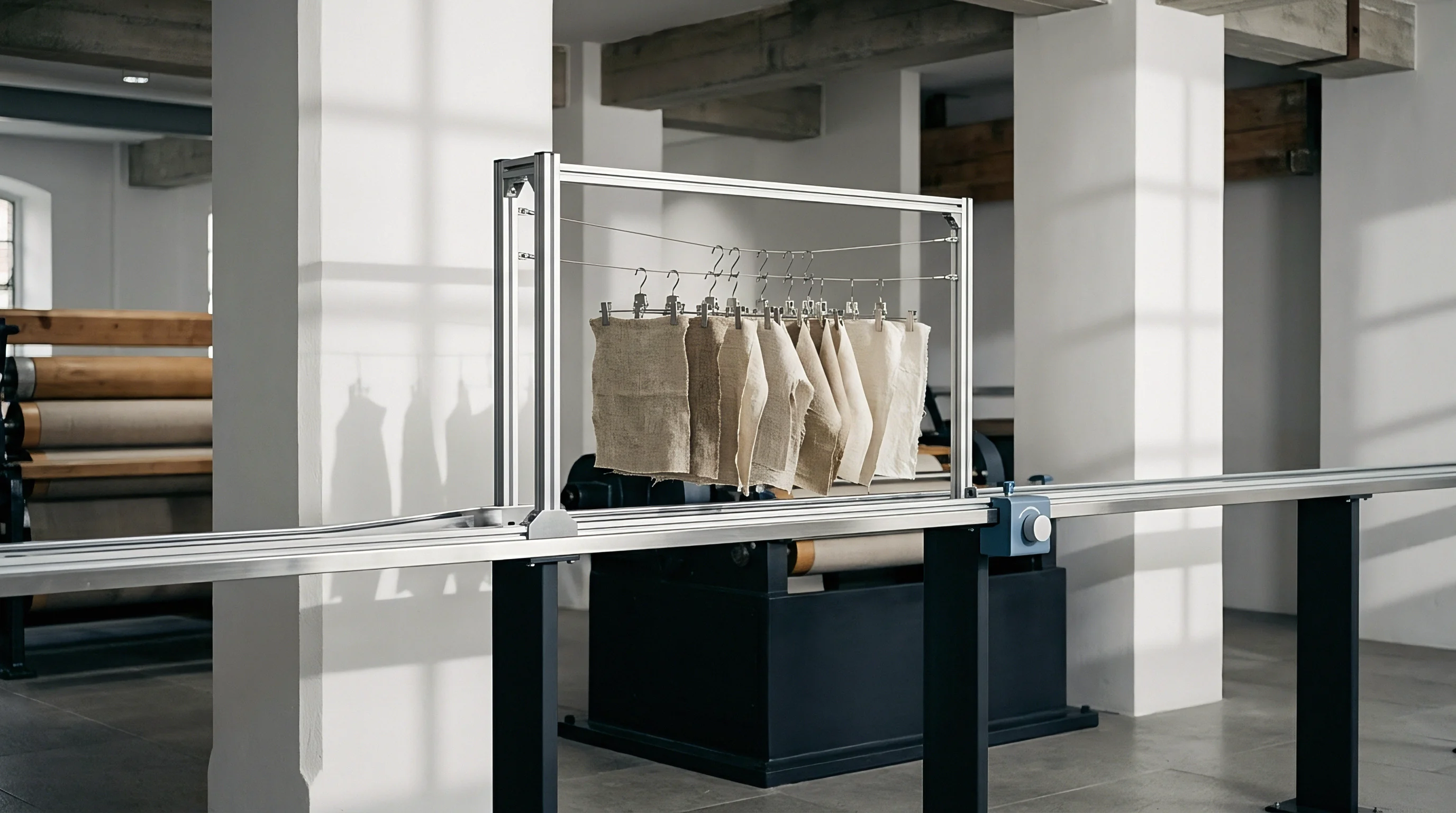
Stenter drying fixes the permanent crimp balance. Below fiber saturation, re-forming hydrogen bonds freeze the existing yarn geometry. Overfeed drives feed fabric onto the stenter pins or clips with deliberate lengthwise slack, letting air nozzles vibrate the sheet so compressed weft yarns can expand outward while warp yarns draw back, regaining crimp before drying locks the structure.
| Processing Line Stage | Running Warp Tension (N/m) | Measured Warp Crimp (%) | Predicted Warp Crimp (%) | Finished Cloth Width (cm) | Model Error Deviation (%) |
|---|---|---|---|---|---|
| Greige Loom State | 0 | 8.4 | 8.4 | 158.0 | 0.0 |
| Scouring Compartment 1 | 280 | 3.1 | 3.3 | 147.2 | +6.4 |
| Caustic Wash Box 3 | 320 | 2.4 | 2.5 | 145.5 | +4.1 |
| Intermediate Neutralizer | 180 | 4.6 | 4.4 | 149.8 | -4.3 |
| Drying Cylinder Entry | 240 | 3.8 | 3.9 | 148.0 | +2.6 |
| Stenter Delivery (12% Overfeed) | 40 | 8.9 | 8.7 | 152.4 | -2.2 |
| Testing conducted on pure linen 185 GSM plain weave with nominal 14.5 lea warp and 14.5 lea weft across open-width processing line. | |||||
Developing reliable predictive control over continuous lines requires gathering several baseline parameters during qualification runs:
- Greige geometric auditing measures baseline warp and weft crimp percentages alongside yarn linear densities before wet chemical processing begins.
- Hydrothermal relaxation testing measures single-yarn viscoelastic creep compliance across target bath temperatures and chemical baths in the laboratory.
- Continuous tension mapping logs load-cell feedback across every driven motor section of the range.
- Stenter overfeed optimization determines line speed differentials required to reach equilibrium crimp targets.
How strain energy divides between crystalline slip and inter-fiber friction during high-speed washing remains undocumented across commercial linen blends.
Ledger
Textile finishing margins hinge on predicting finished yield from incoming greige yardage. When warp crimp recovery misses by even two percentage points, goods deliver long but narrow, leaving the finishing mill to absorb the cost when garment cutters reject sub-width piece goods with non-conformance chargebacks. Conversely, over-recovering warp crimp creates short yardage, triggering immediate volume deficits against purchase orders.
Weave room planning depends on these finishing figures. At a specified eight percent greige warp crimp, weaving one thousand finished metres requires one thousand eighty metres of warp yarn on the beam. If line pull draws that warp down so finished crimp measures only four percent, the mill extracts one thousand forty metres from the beam, but the fabric loses square-metre weight, dropping out of its contract weight class and failing four-point inspection.
Specifying residual shrinkage limits under ISO 5077 penalizes the mill when warp crimp recovery falls short of target width.
Loom Booking Capacities and Take up Calculations
Planners turn crimp recovery estimates into loom hours and shed schedules. If finished warp crimp must hit nine percent to pass wash stability tests, the weave room must insert more picks to balance the construction. Higher pick density means more machine cycles per linear metre, reducing shed output and driving up conversion cost: adding even four picks per centimetre on an air-jet loom running eight hundred picks per minute adds noticeable run time across a twenty-thousand-metre production order.
| Warp Crimp Outcome | On-Loom Pick Sett (picks/cm) | Loom Speed (picks/min) | Loom Hours per 10,000 m | Greige Width Needed (cm) | Finished Weaving Cost (USD/m) |
|---|---|---|---|---|---|
| Low Recovery (4.0%) | 18.5 | 820 | 376.0 | 154 | 1.42 |
| Nominal Recovery (6.5%) | 19.5 | 820 | 396.3 | 158 | 1.51 |
| High Recovery (9.0%) | 21.0 | 820 | 426.8 | 164 | 1.64 |
| Compensated High Sett (10.5%) | 22.5 | 800 | 468.8 | 168 | 1.82 |
Commercial Settlement Terms for Width Contraction
Fabric contracts set strict cuttable width limits alongside residual wash shrinkage under ISO 5077, forcing sourcing teams to balance yarn budgets against finishing exposure. When continuous washing pulls out warp crimp without sufficient downstream overfeed, laundering inevitably takes it back, pushing warp shrinkage past ten percent. Sourcing teams prevent marker shortfalls by writing mandatory wet-relaxation overfeeds into master contracts; failing to account for wet crimp contraction routinely causes cutting plants to reject entire dye lots.