Standard Sizing Film Viscoelastic Test Methods for Rapier Loom Warps
Forced-oscillation film testing establishes elastic storage and viscous damping thresholds that prevent warp filament clinging during rapier loom insertion.
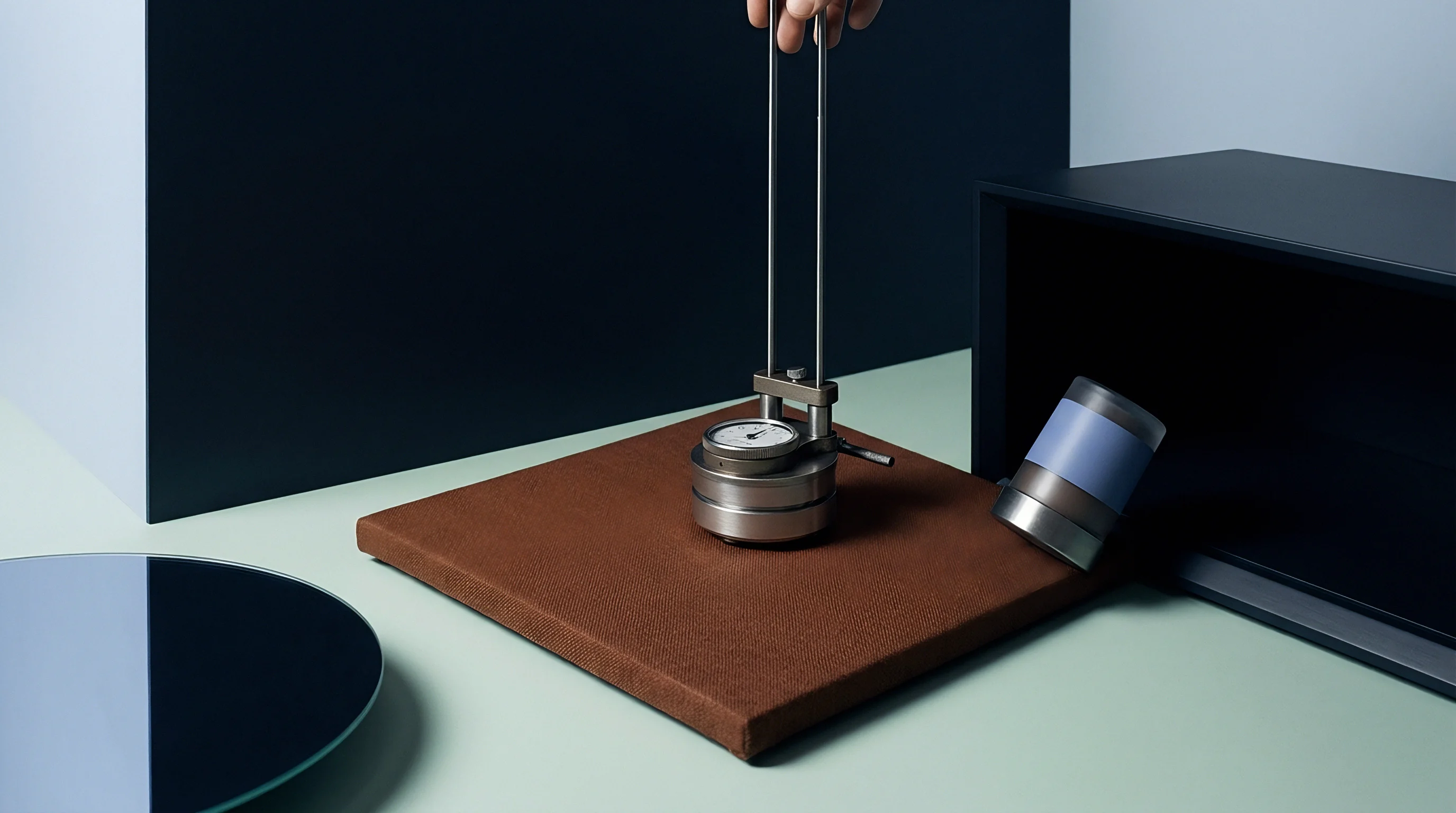

Specimen
Cast polymer membranes yield repeatable tensile figures only when thickness across the gauge span stays strictly uniform. Technicians prepare the liquor under atmospheric reflux or in pressurized vessels to reach full dispersion before degassing, since entrained bubbles leave voids that serve as crack initiation sites under load. The hot solution is drawn across level polytetrafluoroethylene plates or mirror-polished stainless tables using micrometer-adjusted doctor blades.
Setting the blade gate height requires an offset for liquor solids, accounting for volumetric shrinkage as the solvent evaporates.
Because rapid solvent loss leaves pinholes behind, drying rates govern chain packing; casting requires an ambient room at twenty-one degrees Celsius with laminar flow below 0.2 metres per second. If the surface dries too fast, skinning seals residual moisture into the core, creating internal porosity and density gradients. Once consolidated, the film peels from the substrate without stretching and transfers directly to an environmental room at twenty-three degrees Celsius and fifty percent relative humidity under ISO 139 protocols.
Gauge marks applied to cut strips use water-insoluble optical ink rather than scribing tools, preventing perimeter stress concentrations.
ASTM D882 mandates conditioning cast films at twenty-three degrees Celsius and fifty percent relative humidity for forty-eight hours to eliminate unrelaxed thermal stresses.
Technicians verify strip thickness across five equidistant points along the fifty-millimetre gauge length with a dead-weight digital micrometer exerting 0.50 kilopascals of contact pressure. Any specimen showing thickness variations over five percent between points is discarded. Width tolerances demand similar care: double-bladed guillotine cutters with hardened tungsten steel edges produce parallel sides without notches or shear tearing.
Specimen geometries follow either fifteen-millimetre straight strips or ISO 527-3 Type 5 dogbones, chosen according to whether grip slippage or gauge failure controls the run.
- Edge burrs and perimeter micro-fissures cause premature tensile failure before uniform plastic deformation occurs along the gauge length.
- Internal air voids induce severe local stress concentrations that distort both elastic extension and ultimate yield measurements.
- Thickness gradient deviations exceed five percent across the active span, producing asymmetrical stress profiles that void elongation recordings.
- Residual casting tension alters baseline molecular orientation, falsely elevating apparent stiffness while depressing actual strain capacity.
Drying uniformity sets the morphology. Uneven moisture equilibrium skews tensile values because the hydrophilic groups in starches, carboxymethylated cellulose, and polyacrylates absorb ambient water quickly, depressing the glass transition temperature. In blends of polyvinyl alcohol, modified starch, and acrylic binders, temperature swings during drying trigger phase separation.
If the solvent evaporates too quickly, acrylic fractions migrate toward the air interface while denser starch settles, leaving an anisotropic cross-section that invalidates uniaxial tensile data.
| Parameter | Specification Limit | Governing Standard | Operational Impact |
|---|---|---|---|
| Casting Thickness | 0.080 to 0.120 mm | ISO 527-3 | Controls stress distribution uniformity |
| Thickness Tolerance | ±5 percent maximum | ASTM D882 | Eliminates localized necking artifacts |
| Conditioning Temperature | 23.0 ± 1.0 °C | ISO 139 | Stabilizes polymer chain mobility |
| Conditioning Humidity | 50.0 ± 2.0 % RH | ISO 139 | Fixes moisture plasticization baseline |
| Gauge Span Length | 50.0 ± 0.5 mm | ASTM D882 | Defines uniform deformation zone |
| Specimen Width | 15.0 ± 0.1 mm | ISO 527-3 | Prevents perimeter notch tearing |
Inspection protocols enforce these dimensions, rejecting sizing batches whenever cast membranes display irregular birefringence patterns under cross-polarization.

Modulus
Storage stiffness measures the elastic recovery available per cycle during shedding. With rapier looms cycling ends through heald eyes and reed dents at rates over six hundred picks per minute, the protective size sheath endures simultaneous tension, flexure, and surface abrasion. Dynamic mechanical testing splits this response into in-phase elastic storage (E-prime) and out-of-phase viscous loss (E-double-prime).
Unmodified starch fractures under dynamic shock, while films lacking adequate storage modulus yield plastically under shedding tension, producing slack ends, poor shed geometry, and gripper mis-picks.
While stored elastic energy restores yarn geometry after deflection, the loss response tracks mechanical energy converted to heat through macromolecular friction. As rapiers enter the shed, clamp contact and yarn-on-yarn rubbing generate heat across the outer size sheath. Sizing with sufficient viscous loss dampens this kinetic input through segmental motion, keeping impact shocks from reaching the fibre core.
Blending polyvinyl alcohol with modified starches balances elasticity with damping, while acrylic terpolymers supply the lateral flexibility needed to resist cracking under heald frame motion.
Formulations maintaining a loss factor between 0.18 and 0.26 at forty hertz suppress both yarn fuzzing and filament stickiness during insertion.
Because viscous flow absorbs insertion shocks, the ratio of loss to storage ~ expressed as tan delta or the loss factor ~ governs damping efficiency. High tan delta values indicate excessive viscous character: the film turns tacky, promoting yarn clinging, poor separation, and transfer jams in the rapier guides. At the opposite extreme, low loss factors mark brittle coatings that pulverize into dust under reed beat-up.
Weaving operations track these damping ratios to match sizing rheology against machine speeds.

Which Loss Factor Prevents Shedding Cling?
Damping ratios govern shedding cleanliness in dense warp set-ups. Heavy flax or compact cotton warps running at six hundred picks per minute require a loss factor between 0.18 and 0.26 at thirty degrees Celsius and forty hertz. Drop below 0.18, and shedding dust spikes as brittle film flakes off at the drop wires and heald eyes.
Climb past 0.26, and friction along the raceboard softens the polymer into a gummy residue that bonds adjacent warp ends, triggering warp-stop motions.
| Sizing Chemistry System | Storage Modulus (MPa) | Loss Modulus (MPa) | Tan Delta (Loss Factor) | Observed Shed Defect Mode |
|---|---|---|---|---|
| Unmodified Native Potato Starch | 2800 to 3400 | 140 to 190 | 0.05 to 0.07 | Severe drop-wire shedding dust |
| Hydroxyethyl Corn Starch | 1800 to 2200 | 190 to 260 | 0.10 to 0.13 | Brittleness, filament hairiness |
| PVA Fully Hydrolyzed (99%) | 1400 to 1800 | 210 to 290 | 0.15 to 0.17 | Moderate shedding flakes |
| PVA Partially Hydrolyzed (88%) | 900 to 1300 | 200 to 300 | 0.21 to 0.25 | Clean shed, minimal warp stops |
| Polyacrylate / Starch Blend (30/70) | 1100 to 1500 | 230 to 330 | 0.20 to 0.24 | Stable shed line, zero cling |
| High Acrylic Soft Polymer (100%) | 350 to 550 | 160 to 260 | 0.45 to 0.52 | Severe yarn cling, rapier jams |
Drop-wire shedding dust is frequently blamed on low shed relative humidity, though deficient film dissipation produces identical brittle fracture along the yarn line.
Sweep
Forced-oscillation testing maps mechanical transitions across varying frequency and thermal ranges. Strips twenty millimetres wide mount in tension grips within an environmental chamber. A sinusoidal displacement overlays cyclic strain onto a static pre-load, keeping the strip taut during reverse oscillation.
Because rapier motions span a broad spectrum of strain rates, single-frequency tests miss operational defects; sweeps from 0.1 to 100 hertz show whether polymer chains can relax at intervals matching high-speed shed changes.
As excitation frequency rises, macromolecular chains lack time to rearrange, driving storage stiffness up while suppressing viscous dissipation. Between twenty and eighty hertz ~ typical for rapier insertion ~ films that test as ductile at quasi-static rates can behave like glassy solids. Temperature sweeps from minus ten to plus eighty degrees Celsius at fixed frequencies locate the glass transition temperature.
Formulations running below their transition shatter under reed impact, whereas those operating well above it soften and abrade against steel heald eyes.
Rapier insertion accelerations impose deformation rates exceeding fifty cycles per second on warp yarn surface coatings.
Laboratories follow a standard sweep protocol to eliminate thermal lag and clamp slippage:
- The operator mounts the film strip into tension clamps with ten Newton-centimetres of torque to avoid edge pinching while preventing sample pullout under peak cyclic loads.
- The chamber stabilizes at thirty degrees Celsius and fifty percent relative humidity for fifteen minutes before initiating any mechanical excitation.
- The instrument applies a static tensile pre-strain of 0.2 percent to keep the thin film straight and prevent buckling during downward oscillatory segments.
- A preliminary strain sweep from 0.01 percent to 1.5 percent strain identifies the linear viscoelastic region, selecting 0.1 percent strain for subsequent operational tests.
- The spectrometer records storage, loss, and tan delta responses across a logarithmic frequency ramp from 0.1 to 100 hertz at ten points per decade.
- The thermal chamber ramps temperature at two degrees Celsius per minute while holding oscillation at ten hertz to detect exact glass transition coordinates.
In starch and polyvinyl alcohol films, water acts as an active plasticizer by interrupting hydrogen bonds between chains. A four percent dip in weaving shed humidity can push the film’s glass transition temperature up by as much as twelve degrees Celsius. A recipe balanced for sixty-five percent relative humidity will embrittle and micro-fracture if the shed drops below fifty percent.
Humidity-controlled oscillation sweeps identify these boundary shifts before sized beams reach the loom.

Does Frequency Sweeping Predict Loom Beat Up?
Dynamic data collected above fifty hertz correlates closely with warp survival during reed impact. At beat-up, the reed strikes the cloth fell within four to eight milliseconds, producing transient strain rates comparable to high-frequency harmonic loads. Films with steady storage curves and no sharp inflection between fifty and eighty hertz remain intact without shedding from the yarn core.
These sweeps establish whether a blend retains enough damping under impact, or if dynamic strain pushes the sizing past its brittle threshold.
Whether linear oscillation models fully capture the multiaxial shock waves generated when drop wires fall during sudden slackening cycles remains an open question.

Creep
Prolonged tension causes progressive unrecoverable strain across sized warp sheets. With heald frames holding ends apart in the upper and lower sheds, warp yarns sit under peak tensile load through every dwell period. Size films must tolerate this continuous stress without excessive creep compliance.
Standard creep testing applies a square-wave tensile load to a cast strip, holding the force from ten to six hundred seconds while recording instantaneous elastic stretch alongside time-dependent viscous drift.
Viscoelastic creep progresses through three stages: initial elastic extension, secondary viscous flow at a declining rate, and tertiary flow ending in rupture. Sizing applied to rapier warps must stay out of secondary creep during shed dwell. If the polymer yields plastically while held open, the ends cannot recover their working length once the frames level out.
When unrecovered strain creates slack ends, they sag directly into the rapier path, fouling gripper heads and causing loom stops, fabric floats, and reed damage.
Rapid elastic recovery of the sizing matrix maintains distinct shed separation without yarn entanglement.
Cyclic recovery testing tracks the ratio between elastic spring-back and permanent set under pulsed loads. Instruments cycle specimens through twenty stages of ten megapascals applied for 0.5 seconds followed by 0.5 seconds of rest, approximating loom dynamics at six hundred picks per minute. Complete elastic recovery keeps sheet tension uniform across the reed width and prevents warp lane distortion.
- Instantaneous elastic recovery ratio exceeds eighty-five percent within fifty milliseconds following tensile stress release to maintain shed levelness.
- Accumulated viscous plastic creep remains below 1.8 percent total elongation after five hundred consecutive loading cycles.
- Secondary creep strain rate stabilizes below 0.002 percent per second under continuous five-megapascal tensile loads.
- Creep compliance under load maintains values lower than 0.25 square gigapascals to prevent shed sagging during prolonged loom stops.
Excessive plastic deformation disrupts loom tension controls. Size formulations containing too much plasticizer experience accelerated viscous relaxation, losing mechanical lock on the underlying fibres. As the size sheath creeps, core fibres slip past one another and permanently elongate the bundle.
Formulations that balance modulus with recovery ensure that yarns snap back to dimension the instant the shed closes.
| Film Blend Composition | Instant Elastic Strain (%) | Creep Strain at 60 s (%) | Elastic Recovery at 10 s (%) | Permanent Plastic Set (%) |
|---|---|---|---|---|
| Native Potato Starch (100%) | 0.35 | 0.48 | 92.0 | 0.08 |
| Oxidized Tapioca Starch (100%) | 0.42 | 0.65 | 88.5 | 0.14 |
| PVA Fully Hydrolyzed (100%) | 0.85 | 1.15 | 86.0 | 0.28 |
| PVA / Carboxymethyl Starch (50/50) | 0.68 | 0.92 | 89.0 | 0.19 |
| PVA / Acrylic Copolymer (80/20) | 0.95 | 1.40 | 82.0 | 0.42 |
| High Plasticizer Starch Blend | 1.60 | 3.80 | 54.0 | 2.10 |
Film resilience dictates warp integrity across cyclic shed operations.

Rupture
Tensile failure defines the outer threshold of warp survival during mechanical misalignments. Pulling cast strips to destruction on a universal testing frame yields three core metrics: yield strength, elongation at break, and work of rupture ~ the total strain energy absorbed before parting. Films with high tensile strength but low elongation snap cleanly if a gripper clips an off-line end.
Conversely, membranes that stretch extensively at low yield stress deform without shielding the fibres from abrasive wear. Sizing requires both moderate tensile resistance and adequate extension.
Because continuous friction strips fragile coatings, the work of rupture ~ the integral of the stress-strain curve to failure ~ serves as the primary predictor of wear and impact resistance. Films registering under twelve megajoules per cubic metre fail rapidly in the reed dents. As rapier guides and insertion elements pass through the yarn sheet at speed, low-energy films flake off, leaving unprotected core fibres to snag, cling, and break.
Sizing evaluation connects mechanical rupture metrics directly to operating performance. Consider a weave room operating across a 220-centimetre reed width on medium-weight plain cloth at 550 picks per minute, carrying 5,200 ends of Ne 30/1 combed cotton. Baseline efficiency runs at eighty-eight percent after factoring in planned beam out and package changes, making unscheduled warp breaks the main driver of lost loom time.
If degraded sizing causes work of rupture to fall from eighteen to nine megajoules per cubic metre, warp stops rise from 0.8 to 3.4 per 100,000 picks. Repairing a single break takes roughly 1.5 minutes to find the end in the harness, draw it through the drop wire and reed, and engage the loom. Across twenty-four hours, that difference amounts to 27.2 extra stops per machine, losing 40.8 minutes of active weaving and pulling loom efficiency down from eighty-eight percent to eighty-five point five percent.
In an eighty-loom weave room, a 2.5 percent efficiency drop cuts greige production by roughly 2,900 linear metres daily. Fixed overhead ~ power, climate control, depreciation, and labor ~ remains identical whether the looms run or sit idle. Films that fail tensile and toughness standards directly consume weaving margins through cumulative stop time and downgraded cloth.